Get in Touch with Pangeng

Nitrogen Booster Compressor
Nitrogen Booster Compressor Solutions — Custom High-Pressure N2 Systems
From membrane nitrogen to pipeline-ready pressures — engineered booster compressor solutions built for oil recovery, chemical processing and industrial gas supply. Pangeng delivers screw-piston hybrid boosters with flow capacity of 200–1,200 Nm³/h and discharge pressures reaching 50 MPa.
Get Instant Quote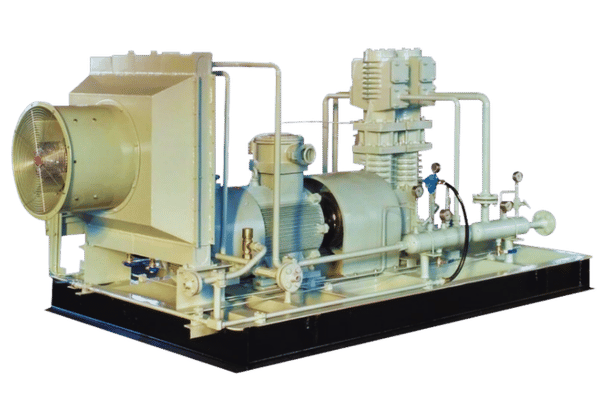
Why Nitrogen Boosting Matters — Challenges in High-Pressure N2 Supply
Membrane and PSA nitrogen generators can provide the requisite pressure at low outlet pressures, typically 0.5-1.0 MPa. The processes that consume nitrogen, however, may require pressures far in excess of that: injection of oil well stimulation at 25 MPa, pressurization for pipeline injection at 35 MPa, leak testing at 50 MPa. It is at this pressure step-up, between generator and process, where your booster compressor lives.
Ongoing Challenges
No booster, no matter how well matched to your nitrogen demands, presents four ongoing challenges.
01
First, cost – once you reach 200 Nm of daily usage, single-use cylinders, rental contracts and tri-weekly delivery separate your bottom line from your logins.
02
Second, oversizing a nitrogen generator coupled with an underperforming or mismatched booster can introduce flow inertia that triggers downstream flow interruptions.
03
Third, ensuring purgeability of nitrogen during compression requires custom oil and gas sealing systems; a generic compressor design invites contamination through lubricants and oxygen atoms.
04
Fourth, delivering consistent high-pressure nitrogen in remote industrial locations or petrochemical plants depends upon uninterrupted performance at all hours.
Pangeng Solutions
Pangeng nitrogen booster compressor solutions address all four of these pain points head-on. A twin screw first stage with two parallel rotors provides smooth flow and energy efficiency.
High-speed reciprocating piston stages, with each stroke synchronizing with the rotor rotors’ rotation, deliver each incremental rise in discharge pressure accurately to 50 MPa and beyond.
OEM electronic-mechanical dual- protection control is standard equipment on every unit with automated safety threshold adjustment parameters for efficient operation.
Engineering Note
The twin screw piston hybrid synergizes two compressor architectures – allowing maximized volumetric efficiency at the inlet point with reliably delivered pressure at the outlet stage. Screw-rotor compressors operate efficiently at high volumetric throughput but their single stage system cannot safely reach high pressure rises. The reciprocating piston stages make up for that deficiency but are unsuitable for handling the high inlet flows. The tandem combination is the engineering solution to minimizing the volume-to-pressure equation – and that is the experience upon which Pangeng machine designs are built – 3,4, or 5 piston stages depending on target pressure.
Screw-Piston Hybrid vs. Traditional Nitrogen Compressors — Performance Comparison
Selecting the appropriate type of nitrogen compressor architecture has a direct impact on your operating costs, maintenance requirements, and system robustness. We regularly receive inquiries from engineering groups considering various options, so here is our side-by-side comparison based upon the three main architectures used for nitrogen boosting service.
| Parameter | Screw-Piston Hybrid (Pangeng) | Pure Reciprocating Piston | Diaphragm Compressor |
|---|---|---|---|
| Max Discharge Pressure | 50 MPa (7,250 psi) | 35–45 MPa (5,000–6,500 psi) | 100+ MPa (14,500+ psi) |
| Flow Rate Range | 200–1,200 Nm³/h | 50–500 Nm³/h | 5–100 Nm³/h |
| Inlet Volume Handling | High (screw stage) | Moderate | Low |
| Vibration Level | Low (screw dampens pulsation) | Moderate to high | Low |
| Gas Purity Maintained | Up to 99.99% | Up to 99.9% (oil-lubricated) | Up to 99.9999% |
| Wearing Parts Interval | 4,000–8,000 hours | 2,000–4,000 hours | 8,000–12,000 hours |
| Footprint (1,000 Nm³/h system) | ~5,500 × 2,500 × 2,500 mm | ~7,000 × 3,000 × 3,000 mm | Not applicable at this flow |
| Best Suited For | Medium-to-high flow, 25–50 MPa | Low-to-medium flow, up to 35 MPa | Ultra-high purity, low flow |
The screw-piston hybrid fills this niche — efficiently boosting high quantities of nitrogen (> 25 MPa) without an unreasonable maintenance interval. While a straight piston machine handles lower flowrates, as soon as your process needs 600+ Nm³/h at 35 MPa or greater, the sheer numbers of cylinders and vibration are unhospitable to your installation. Diaphragm compressors, while offering superior purity, are not suitable for the throughput demanded by an oil field injection plant or chemical manufacturing plant.
From a TCO (total cost of ownership) point of view, the hybrid also reduces maintenance labor through longer interval periods of wearing parts. For example, our MZD series operates at between 4,000 to 8,000 hours between piston ring and valve plate replacements, whereas typical P/A designs operate at 2,000 to 4,000 hour intervals while handling the same pressures. In addition, the twin-screw first stage benefits the piston stages by providing inherently more stable and even flow of gases, resulting in less load cycling for components downstream.
Industry Applications — Oil Recovery, Chemical Processing & Beyond
Pangeng nitrogen booster compressors are used in every part of the world, throughout the oilfield, chemicals plants, pipeline contractors, energy producers. Every our system is shaped by our engineer team according to the gas condition, pressure and working environment of your process.
Oil & Gas — Enhanced Oil Recovery
Nitrogen Injection for Reservoir Pressure Maintenance
In the process of enhanced Oil Recovery (EOR) source stream pressure is controlled by injection of N2, to depleted reservoirs where it increases the formation pressure and shifts the remaining crude oil; operating conditions are 600-1,200 Nm3/h at 25-35 MPa. Membrane nitrogen generators are supplied which produces ‘on site’ N2 from the ambient air, which is then passed into the MZD series booster for compression up to injection pressure thus removing the nuisance of liquid N2 tanker supplies to remote service points.
Application reference: API RP 45 – Recommended Practice for Analysis of Oilfield Waters

Chemical Processing — Inert Gas Blanketing
Reactor & Storage Vessel Nitrogen Purging
Chemical installation using 8-30 MPa high-pressure nitrogen to blankering reactors, storage vessels, or creating inert environments to eliminate oxidation or explosion hazards. Flows range from 200 to 900 Nm3/h. Fill pressures are generally 8-30 MPa. Volumes from 12-3000 kL and purge cycle durations will determine the systems flow requirements for which the ZW/DW monoseries boosters are ideal in providing an oil free lubrication package when pure process gases are to be handled. This is fitted with digital pressure control and dual phase pressure safety interlocks- because in the chemical industry a gas compressor breakdown can have more than just a financial impact.

Energy — Pipeline & Equipment Testing
High-Pressure Leak Detection & Pipeline Commissioning
Before order-ing the necessary pressure vessels, process equipment, and installed pipeline, operators test nitrogen pressure and purity at 1.5X design operating pressure. When sizing and specifying a booster for this purpose, the sales team can look to the N2 pressure booster providing high pressure nitrogen supply – typical operating window 300-600 Nm/h at 35-50 MPA. Compressors like the MZD-900/500 five-stage attain 50MPA in tests for the most severe vessel code approvals per ASME PCC2 standards. Air cooling eliminates at-site water supply for this application.

Field Insight
We see a typical mistake in oilfield nitrogen injection projects: specifying the booster based on system steady state flow only, without regard for well shut-in pressure buildup. When an injection well sticks shut, back-pressure spikes well above ordinary set point by 15-20%. Every Pangeng MZD includes a rated discharge buffer vessel and self-activating unloader to cover these surges. This specification is standard – not an option.
Additional applications include laser beam cutting assist gas supply (high purity N2 at 1.5-3.0 MPa), food packaging atmosphere generation, pharmaceutical manufacturing inert atmospheres, or electronics industry solder reflow oven blanketing. In each case, we select the right booster size to suit your parameters as opposed to offering a fixed catalog machine.
Nitrogen Gas Compressor: Engineering Standards and Certifications
Every Pangeng nitrogen booster compressor is built and tested to meet recognised international pressure vessel standards. Our Bengbu, Anhui Province plant includes dedicated machining and assembly areas established upon decades of gas compressor production experience.
CE Marking
Pressure Equipment Directive 2014/68/EU
ISO 9001
Quality Management System
ASME
Pressure Vessel Code Compliance
API Standards
Oil & Gas Equipment Specifications
GB/T Standards
Chinese National Standards Compliance
A Procurement Guide for High-Pressure Nitrogen Compressors
In order to generate an accurate quotation for a nitrogen booster compressor, your process specific parameters need to be considered. The following factors shape the final cost, and the information we require to make it.
Price-Determining Factors
Factor
Impact on Price
What to Specify
Flow Rate
Primary cost driver — larger frames and motors
Required Nm³/h at standard conditions
Discharge Pressure
Higher pressure = more compression stages = higher cost
Target MPa (or psi/bar)
Inlet Pressure
Higher inlet reduces stages needed
Your N2 generator outlet pressure
Drive Type
Diesel adds ~15–25% vs. electric motor
Grid power availability at site
Lubrication
Oil-free designs carry a premium
Required N2 purity level
Mounting & Packaging
Skid-mounted or containerized adds packaging cost
Installation type: permanent / mobile / offshore
Certifications
CE, ASME, or specific country certifications
Destination country and applicable codes
Typical Lead Times
Standard models (MZD-200 through MZD-600): 8-12 weeks from order receipt. Heavy duty, high volume/high pressure designs (MZD-900/500, MZD-1200/500): 12-16 weeks, due to special cylinder machining and longer testing time. Fully custom booster: 16-20 weeks. Ex-works Bengbu, China; delivery costs and customs clearance extra.
After-Sales Support
Custom remote support for initial commissioning and operational troubleshooting. Spare parts for standard units – piston rings, sealing rings, valve plates, packing kits – are shipped in 3-5 work day, ready-to-use condition. For long-term maintenance planning, recommended spare parts sets corresponding to your operation conditions and running hours are recommended, available to order from stock. Operator and technical personnel on-site training and commissioning support available.
Procurement Tip
In quoting your system, please include your process flow diagram (PFD) – available to send us – it offers our engineers the picture they need to construct a cost-effective technological solution rather than quoting the highest available power dimension. Include climatic condition and installation altitude, if relevant. Please state your ATEX or other explosion proof classifications. These influence your motor ratings, enclosure selection and total price.
Nitrogen Booster Compressor Sizing & Calculation Tools
Model Selector
Input your required suction pressure, discharge pressure, and flow rate to instantly identify the optimal nitrogen booster model for your system.
Compression Stages Calculator
Calculate the ideal number of compression stages, determine compression ratios, and estimate discharge temperatures based on your gas parameters.
Frequently Asked Questions
A nitrogen booster compressor is fed low pressure nitrogen either from a membrane/PSA generator (generally 0.6 to 1.0 MPa) and then compresses it to the required discharge pressure by means of several compression stages. In Pangeng systems a screw-piston combination is employed: the characteristic of a screw compressor, that it can simultaneously take high volume ‘feeds’ and generate high pressure at the discharge, makes it ideal for the first (screw) stage. The final high-pressure compression is then done by a series of reciprocating piston stages (three for 25 MPa, four for 35 MPa and five for 50 MPa systems). Each of the stages between the high compressor and the high-pressure piston compressors has a gas cooling and moisture separation system fitted in order to keep the air/gases in good quality and also the compressor running efficiently.
Nitrogen compressor – Gas tight seals to prevent oxygen from getting in, purity maintained at 99.999%. Materials, lubricants and even valve designs are different to standard air service. For the simple reason, air compressors are not designed to allow oxygen and trace elements (moisture even) in, (they don’t care about purity). You wouldn’t put air into a chemical blanketing, food pack or laser cutter. N2 only.
It is a function of flow rate, discharge pressure, number of stages, and drive type. Email us your process parameters for a project-specific quotation.
Start with three numbers: Nm/hr of the nitrogen required, inlet pressure of your nitrogen source (i.e. pressure at booster inlet), and desired discharge pressure. From there consider contamination requirements – most industrial producers use oil-lubed piston rings, but if you need ultra-clean Pureair nitrogen those are limited to spark ignited turboexpanders (BHV, FTB lines). Temperatures outside the 45 C ambient operating limits may require larger coolers; we normally air-cool to 45 C, and base the size of the cooler on the average highest ambient temperature of the application. Power source considerations include electric motor for permanent applications, and..viscous diesel engine for remote oil fields, mobile laboratories, or flexible mobile testing programs. Installation type (skid-mounted, foundation-mounted, or vehicle-mounted) corresponds to detail in the frame structure, as well as vibration isolation needs. Refer to the Decision Matrix in the specifications section of our website to narrow your search, and reach out to engineering for the final recommendation. For exotic applications – variable inlet pressures, non-continuous duty cycles, trace components in the feed streams..we use our own needs assessment and design from scratch.
Yes. Gas-tight piston rod packing, non-contaminating PTFE-based rings, and labyrinth crankcase seals maintain cleanliness of the gas path. Oil-free versions of the ZW/DW stand-alone series are available.
Routine maintenance consists of regular changing of piston rings, packing seals and valve plates – every 4,000 to 8,000 operating hours (depending on discharge pressure and gas quality). Oil changes are every 2,000 hours as per standard lubricated model practice. During every operating hour between major overhauls, the discharge temperature, inter-stage pressure and oil quality are monitored on a daily basis. The wearing parts list/whole kit of spare parts list, which we provide, allows you to schedule maintenance to fit in with your production needs, rather than at a time when your apparatus breaks down or fails to operate. We also provide remote diagnostic support for problem solving prior to escalation.
A nitrogen booster pump (or gas booster) is a pneumatically-driven, single-acting negative-pressure machine that uses compressed air to boost the pressure of nitrogen. These devices are appropriate for small flow, discontinuous activities – topping off gas cylinders, charging accumulators, pressure testing small vessels. A booster compressor is an engine- or motor-driven multi-stage machine suitable for continuous industrial use at higher flows. If you need to supply a process with a sustained flow of nitrogen greater than 100 Nm/h – oil recovery injection, chemical plant supply, pipeline testing – a booster compressor will usually be the most cost-effective solution on a cubic-meter basis.
Trending now
![Low Pressure Hydrogen Compressor Applications [Guide]](https://pgcompress.com/wp-content/uploads/2026/09/low-pressure-hydrogen-compressor-applications-blog-featured-150x150.png)