Get in Touch with Pangeng


Quick Specs: Rotary Screw Air Compressors
| Compression Type | Twin-screw positive displacement |
| Typical Pressure Range | 100–150 psi (7–10 bar) |
| Capacity Range | 5–500+ hp / 20–2,500+ cfm |
| Duty Cycle | 100% continuous |
| Noise Level (Enclosed) | 65–75 dBA |
| Oil Change Interval | 4,000–8,000 hours |
| E×pected Airend Lifespan | 80,000–100,000+ hours before rebuild |
A rotary screw air compressor employs intermeshing helical rotors to compress air uninterrupted – no pistons, no valves opening and shutting on cycle, no de-facto cooling-off time required between runs. That mechanical simplicity yields 100% duty cycle operation, lower noise floors, and maintenance intervals measured in thousands of hours not hundreds.
This primer covers the engineering behind rotary screw compressors, why they outperform reciprocating (piston) options, differences between oil-injected and oil-free designs, a no-nonsense sizing method you can use before you call OEM for quotes, maintenance intervals based on OEM data, and the real cost of wheeling a compressed air system. If you are researching rotary screw air compressor solutions for an industrial process, the info here will enable you to ask better questions and avoid costly purchasing mistakes.
How Rotary Screw Air Compressors Work

A rotary screw compressor traps ambient air between two intermeshing helical rotors – a male rotor (generally four lobes) and a female rotor (generally six flutes) – within a sealed chamber. As the rotors turn, the trapped volume diminishes progressively from the intake end to the discharge end, compressing the air. The entire compression cycle occurs in a single continuous revolution, and that is why screw compressors deliver pulsation-free flow at a stead discharge pressure.
In an oil-injected (oil flooded) rotary screw compressor, lubricant is added directly into the compression chamber. That oil performs three roles: it seals the inclusion spaces between the rotors and housing, consumes the heat of compression, and lubricates the rotor interface surfaces. The compressed air-oil mixture is then sent through an oil separator element that reduces lubricant carryover to near 3 ppm before the air enters the downstream system. A refrigerated air dryer or desiccant dryer handles downstream air treatment, extracting remaining moisture to deliver quality compressed air.
📐 Engineering Note
Single-stage rotary screw compressors produce compression ratios of 7:1 to 10:1, creating discharge pressures of 100-150 psi from atmospheric inlet. Internal operating temperatures in oil-flooded units range from 140-160F (60-71C) – more than a hundred degrees below the 300-400°F seen in reciprocating compressors. That temperature differential affords a notable reduction in thermal stress on seals, bearings, and lubricant chemistry. Per the U.S. Department of Energy, compressors manufactured after January 2025 shall meet revised energy conservation standards under 10 CFR 431.345.
Rotary Screw vs Piston Compressor: Which One Fits Your Application?

Choosing between a rotary screw air compressor and a reciprocating (piston) compressor depends on duty cycle needs, noise restrictions, and operating cost considerations. Piston compressors are cheaper initially, but that benefit diminishes quickly if your plant operates compressed air over a handful of hours daily.
| Parameter | Rotary Screw | Reciprocating (Piston) |
|---|---|---|
| Duty Cycle | 100% continuous | 60–70% (requires cool-down) |
| Noise Level | 65–75 dBA | 80–90 dBA (OSHA hearing protection threshold: 85 dBA) |
| Airend Lifespan | 80,000–100,000 hours | 10,000–20,000 hours before rebuild |
| Output Efficiency | 4–5 cfm per hp at 100 psi | 3–4 cfm per hp at 100 psi |
| Operating Temperature | 140–160°F | 300–400°F |
| Oil Carryover | ~3 ppm (oil-injected) | 10+ ppm (worsens with wear) |
| Best For | Continuous industrial use, 8+ hr/day | Intermittent use, small workshops |
✔ Advantages of Rotary Screw
- 100% duty cycle — no mandatory downtime
- 4–10× longer airend service life
- 20–25% higher cfm output per hp
- Low vibration — minimal foundation requirements
- Quieter operation below OSHA hearing protection threshold
⚠ Limitations of Rotary Screw
- Higher initial purchase price than equivalent piston models
- Oil-injected units require separator elements and oil management
- Inefficient operation at very low loads without variable speed drive
- Needs minimum operating temperature (~170F) to vaporize condensate – short-cycling strains the airend
Industry forum engineers routinely report one novice mistake in piston-to-screw conversions: believing the screw compressor can short-cycle like a piston unit. rotary screw compressors need to attain operating temperature (above 170-205F) for at least one hour each run to vaporize internal water. Frequent short cycles at cool temps induce rust build-up, lubricant fouling, and premature airend fatigue – a wear mode most piston compressor users never see.
💡 Key Takeaway
If your plant uses compressed air for greater than 6 hr/day, rotary screw compressor will almost definitely provide lower cost/ cfm equivalent overall cost than piston models, despite the higher purchase price.
Oil-Injected vs Oil-Free Rotary Screw Compressors

You can make the distinction of oil-injected or oil-free screw compressors that other factors that decide to what different applications and to air quality requirements a system can be applied. For most general industrial applications the use of oil-injected (oil-flooded) models is preferable as the injected lubricant offers the following benefits: better sealing, better cooling, longer life for the airend (air compressor). The running of oil-free compressors will have no oil in the compression chamber at a premium cost, and with different service considerations.
| Parameter | Oil-Injected | Oil-Free |
|---|---|---|
| Oil Carryover | ~3 ppm (with separator); <0.01 mg/m³ with inline filtration (ISO 8573-1 Class 1) | 0 ppm inherent (ISO 8573-1 Class 0 capable) |
| Air Quality Class | Class 1–2 (with proper filtration) | Class 0 (certified oil-free) |
| Purchase Cost | Lower (baseline) | 30–50% premium over oil-injected equivalent |
| Maintenance Complexity | Separator element + oil changes every 4,000–8,000 hrs | Rotor coating inspection; coating wear increases leakage over time |
| Typical Applications | General manufacturing, construction sites, automotive, metalworking | Food/beverage, pharma, electronics, medical air per ISO 8573-1:2010 |
The purity classes of compressed for particulate, water and oil content are laid out in the ISO 8573-1:2010 standard. For instance in the 1Class 0 air is specified in that even more stringent than Class 1 oil contamination levels—this is provided by oil-free compression to a) Industrial applications that require zero oil trace is not using upper Class 0 air, an oil-injected compressor provides the same air quality at lower capital and operational costs.
⚠️ Important
Oil-free screw compressors use dedicated rotor plates coating (generally PTFE, or similar based) to make it seal internal clearances sans lubricant. Fields engineers on Eng-Tips noted that the coating would erode over time leading to added internal leakage and rising discharge temperatures. However this was only remarked upon after thermally checking periodically.
How to Size a Rotary Screw Air Compressor for Your Facility

An under sized installation starves pneumatic tools with pressure drops; an oversize ones wastes capital and pushes the compressor into unnecessarily inefficient operation under part load. An easy sizing method is to determine your real-world “foom” after deduction, and then to work backwards to the horsepower you’d need.
Sizing Method: 4 Steps
- Find out all pneumatic tools and processes used- For each tool, find cfm and operating pressure (PSI). Manufacturers provide this information on the equipment name plate or spec sheets.
- Calculate simultaneous demand – not all the machinery in use at once. Use a factor of utilization in the range of 0.6-0.8 for generic factory applications so that the peak cfm can be calculated.
- Add 25-30% headroom—for future expansion, compressor degradation, and peak demand bumps over the average calculation.
- Convert cubic feet per minute (cfm) to horsepower – refer to the reference table provided below. A rotary screw compressor breathes in roughly 4 to 5 cfm per hp at 100 psi; at 125 psi, it is more about 3.5-4 cfm per hp.
| Compressor HP | Approx. CFM at 100 PSI | Approx. CFM at 125 PSI |
|---|---|---|
| 5 hp | 20–25 cfm | 16–20 cfm |
| 7.5 hp | 30–38 cfm | 24–30 cfm |
| 10 hp | 40–50 cfm | 32–40 cfm |
| 20 hp | 80–100 cfm | 64–80 cfm |
| 30 hp | 120–150 cfm | 96–120 cfm |
| 50 hp | 200–250 cfm | 160–200 cfm |
If the airflow requirement varies during a shift, which is typical in batch operations, construction, or body shops, then a variable speed rotary screw air compressor will coordinate the motor speed with the actual requirement. fixed speed compressors inflates and deflates to cycle pressure, discarding energy during part-load operation. variable speed drive (VSD) compressors vary the rotor speed at all times, providing only the cfm demanded by the system.
💡 Pro Tip
Oversizing a fixed speed rotary screw compressor costs more in the long run than undersizing one. An oversized unit short-cycles between load and unload, never reaching proper operating temperature. This accelerates oil degradation, increases moisture accumulation, and shortens airend life — all while wasting electricity on unloaded motor idling.
Maintenance, Oil, and Service Life
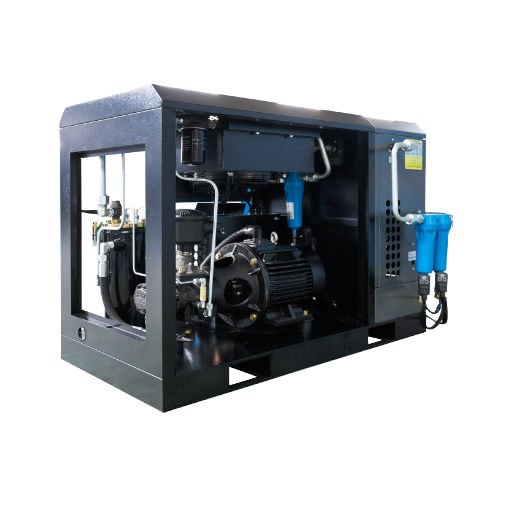
Rotary screw compressor maintenance: rotary screw compressor maintenance is set at defined intervals based on operating hours, not calendar days. These intervals below have been assembled from multiple OEM manuals. Your application specifics such as ambient conditions, oil type, and duty profile however may alter your manufacturer’s recommended service intervals. Verify all listed intervals with your OEM documentation.
| Task | Interval | Notes |
|---|---|---|
| Condensate drain check | Daily | Automatic drains still need periodic manual verification |
| Oil level / condition check | Weekly | Check sight glass; milky oil indicates moisture contamination |
| Oil analysis / sampling | Every 1,000–2,000 hours | Quarterly minimum; catches degradation before damage occurs |
| Air intake filter replacement | Every 2,000–4,000 hours | Dusty environments: inspect every 500 hours |
| Oil filter replacement | Every 2,000–4,000 hours | Replace simultaneously with oil change when possible |
| Separator element replacement | Every 2,000–4,000 hours | Skipping increases differential pressure and energy cost |
| Full oil change | Every 4,000–8,000 hours | Premium synthetic lubricants may extend to 8,000–10,000 hours |
Rotary screw compressor oil (also called compressor lubricant or coolant) forms the medium through which the airend is sealed, cooled, and lubricated in an oil-flooded system. The OEMs typically ship their machines with a mineral based oil and then offer a synthetict solution that extends drain intervals and provides better overall thermal stability. Different OEMs use different oils, and different applications require different additives packages and viscosities. Do not mix oil types or brands without an oil flush or you risk chemical incompatibility that could increase wear and reduce efficiency.
⚠️ Common Maintenance Mistake
One of the most neglected maintenance items, practitioners report, is the oil separator element. If the separator becomes clogged, the pressure differential across it becomes greater – forcing the compressor to work harder and increasing energy consumption 5-10%. A great many operators change their oil on a mandated schedule without considering their separator – and the energy inefficiency involved when compared to the cost of replacing the separator element is enormous.
Total Cost of Ownership and Energy Efficiency

The purchase price of a rotary screw air compressor is but a small fraction, 10-15%, of the true cost of ownership over the average 10 year life. According to the U.S. DOE ENERGY STAR program, the expenditure of electricity makes up 76% of the life cycle costs of a air compressor, leaving the lion’s share of depreciation, installation, maintenance, and overhead costs (19%). The remaining 10-15% includes maintenance.
76%
Electricity (Energy Star)
10–15%
Maintenance & Parts
10–15%
Equipment Purchase
That cost structure, in turn, makes energy efficiencies a top priority – 5-7 times more so than negotiating the perfect purchase price. Using all available data, compressed air systems in the US are responsible for a huge 10% of all industrial electricity – totaling 8.8 TWh annually. Individual facilities may see many times that – possibly 30% or more of the total electricity used in the facility.
VSD variable speed drive compressors cut down on wasted energy by adjusting motor speed rather than on-off cycling in response to real time air demand. Between about 30-80% of capacity, VSD can deliver in the range of 25-35% energy savings versus load/unload fixed speed based facilities. In contrast, VSD is not always best: as every installer and designer of the rotary screw has found, there exists an optimal tip/rotor speed region for each rotor design. Running very slow or very fast outside that envelope can decrease isentropic efficiency – in practice, a facility where demand is predictable and steady at near full capacity, a fixed speed of adequate size could actually be more energy-efficient than a VSD unit.
📐 Engineering Note
Looking back, the industry history often overlooked: in the 1970s-80s rotary screw compressors were averaging 425 cfm per 100 hp, but double-acting reciprocating machines were producing 500+ cfm per 100 hp. Improvements in rotor profile design and precision machining have reversed that image – today a single-stage screw compressors can reach 530 cfm per 100 hp, and a two stage approach reaches as high as 600 cfm per 100 hp. When purchasing second hand equipment and analyzing former efficiencies, be sure to rely on actual efficiencies, not assumed efficiencies for screw compressors equal to or better than other technologies.
Thinking of evaluating compressed air systems for a greenfield or brownfield project? Check out PanGeng’s rotary screw compressor units with built in air dryer and variable speed options to directly impact the Total Cost of Ownership
Frequently Asked Questions
Q: Is a rotary screw air compressor good for a home shop?
View Answer
It really depends on your air demand. For the casual amateur who is only using a single impact wrench or spray gun intermittently, a small piston compressor might be just fine. It is also more budget friendly. An air demand sufficient for a hobby shop is often 5-10 cfm and a piston compressor will be a far better budget choice. As soon as you need to run two or more pneumatic power tools simultaneously, or require a dedicated continuous steady air flow for a sandblaster, plasma cutter, or CNC operation, then a rotary screw compressor is likely justified. The small 5 hp rotary screw units that use the tank mount configuration output between 20 and 25 cfm at 100 psig, and will be enough to feed most serious amateur workshop setups. The bigger price can be amortized through the less noise generated, the less frequent maintenance needs, and the stable pressure delivery.
Q: What are the disadvantages of rotary screw air compressors?
View Answer
The main negatives are the far higher initial outlay (possibly as much as 2-3x the cost of a similar piston compressor), the need for oil management in oil-injected versions (separator element replacement, oil change requirements, carryover issues), and being prone to short-cycling. piston compressors are tolerant of frequent start-stop cycling, while rotary screw compressors seem to require long periods of operation in order to reach the correct operating temperature (and eliminate dampness). For applications where the demands on the compressor are very sporadic, then a lot of time might be spent running the compressor unused in order to keep its airflow moisture free. oil-free models are also available, with a further 30-50% premium on the initial purchase, but these need regular monitoring of the state of the rotor coating.
Q: How long do rotary screw air compressors last?
View Answer
A properly maintained rotary screw compressor airend should last in the range of 80,000 to 100,000 hours before requiring a major overhaul. In practical terms, at 8 hours per day over 250 work days a year, that’s 40-50 years of usage before the machine itself might be considered end of life. At this point, many compressors are either upgraded for greater efficiency, or discarded completely because of new requirements or limitations. The wear components are bearings, seals, and separator element. Following OEM maintenance protocols extends the life span.
Q: Are rotary screw air compressors quieter than piston models?
View Answer
Yes – by a huge amount. Enclosed rotary screw compressors run at 65-75 dBA (equivalent to normal conversational noise). piston compressors still generate 80-90 dBA, because that is above the OSHA 85 dBA threshold that requires hearing protection in workplaces. The lower noise emissions are because of the constant movement of the screw elements, versus the muscle pounds, of the reciprocating action, and fewer vibrating valve components. For a facility where people are working next to the compressor, the justifying reason for the more expensive more quiet compressor can be the fact they can carry on working without hearing protection.
Q: What is the difference between a rotary screw and a helical compressor?
View Answer
In terms of how the machine looks and operates, there is no difference. A rotary screw compressor is also a helical compressor so the terminology is interchangeable. The term ‘helical’ describes the spiral progression of the rotors within the machine, while the ‘rotary screw’ term relates to the mechanism using the compression element for capture. Both terms can be seen in machine descriptions and in manufacturer’s datasheets to describe precisely the same thing. Some companies even separate the wording with one describing the progress of the rotors; while the other describes the mechanism.
Q: How often should rotary screw compressor oil be changed?
View Answer
A standard mineral based compressor oil needs changing every 4,000 hours. The upscale synthetic lubricants compressor oil is good for up to 8,000 hours of operation, if the compressor operates at normal temperatures with not too much contamination around. Sampling the oil in a laboratory every 1,000 hours will give a good early indication as to whether the oil is degrading. Look out for a rising acid number, particulate and moisture count. The ambient environment will also play a part in changing the oil more often, so a dusty or humid environment can alter oil change intervals. Consult your manufacturer’s specifications.
Ready to choose the right rotary screw air compressor for your business?
About This Analysis
PanGeng offers a complete line of gas compression systems including twin-screw and screw-piston tandem machines with capacities of 200 to 1,200 Nm³/h at pressures up to 50 MPa. Some of the technical data used here for reference is taken from U.S. Department of Energy materials, ISO specifications, and OEM service maintenance manuals rather than confidential PanGeng testing. Because some values are test machine/model/environment dependent, we specify them as such instead of extrapolating them to estimates.
References & Sources
- Commercial and Industrial Air Compressors — U.S. Department of Energy
- Determine the Cost of Compressed Air for Your Plant — ENERGY STAR / U.S. EPA
- ISO 8573-1:2010 — Compressed Air Purity Classes — International Organization for Standardization
- Energy Conservation Standards for Compressors — Test Procedure NOPR — U.S. Department of Energy
- Isentropic Efficiency of Rotary Screw Air Compressors — Compressed Air Best Practices Magazine
![Low Pressure Hydrogen Compressor Applications [Guide]](https://pgcompress.com/wp-content/uploads/2026/09/low-pressure-hydrogen-compressor-applications-blog-featured-150x150.png)