Get in Touch with Pangeng

GAS AIR COMPRESSOR
Gas Air Compressor — Industrial Gas-Powered Air Compressor Solutions
Reciprocating gas air compressor designs for oilfield, drilling platform, mine and off-grid applications where electric power is not available. 200 to 12,000 Nm/h capacity, designed to API 618 and ASME standards.
Request a Quote
200–12,000
Nm³/h Capacity Range
25–50 MPa
Max Discharge Pressure
3–5 Stage
Multi-Stage Compression
API 618
Industry Standard
15+ Years
Manufacturing Experience
0%
Grid Dependency
When Your Job Site Needs Air Power Without Grid Access
A gas air compressor directly converts fuel energy to compressed air – and does so without any reliance on electrical infrastructure. When electric compressors hooked into the grid simply will not cut it, gas power takes over.
100% Grid Independence
For round-the-clock oilfield operations 50 miles from the nearest substation, on 3km deep drilling rigs, or across applications spanning dozens of square kilometers at a time, electric compressors hooked into the grid will simply not cut it. Gas engine driven solutions deliver power precisely where it’s needed.
Multi-Fuel Versatility
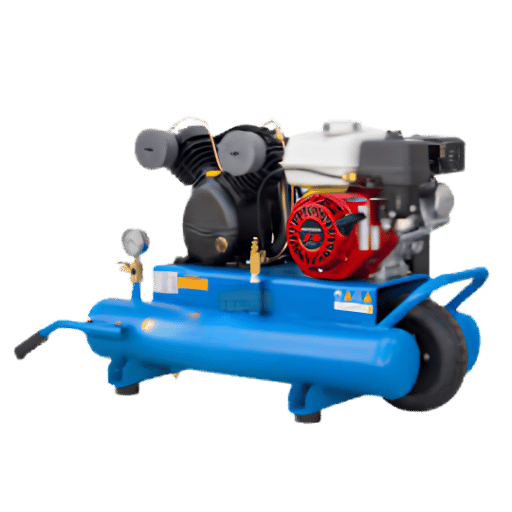
PanGeng gas air compressors operate on dual-crank reciprocating, multi-stage compression, using easy-to-run gasoline, diesel, or natural gas fuel. Upstream oilfield applications can run directly on the very gas you produce on-site, minimizing logistics and slashing fuel costs to practically zero.
Industrial-Scale Capacity
Compare that to a battery of electric compressors topping out at 20-30 CFM and requiring massive generators: a single PanGeng gas engine delivers 200-12,000 Nm/h at pressures up to 7,250 psig. This slashes maintenance headcount, prevents power-outage downtime, and easily scales up to 500 HP for heavy-duty pneumatic mining tools.
Engineering Note — Reciprocating Compression Efficiency
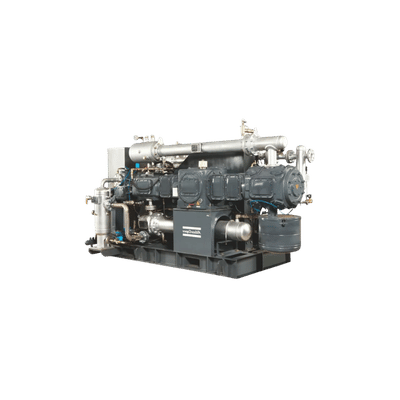
Reciprocating (piston) gas compressor efficiencies peak at 70-90% isentropic – far superior centrifugal stage efficiencies at pressure ratio 3.5:1 and below. PanGeng units feature forged steel crankshafts, precision machined cylinders and pressure-balanced piston rings to sustain 85+% volumetric efficiency across the operating pressure range. Certified to IEC 62-4 specifications and CAGI Performance Verification trials.
The operational freedom and responsiveness you deliver with a gas air compressor is not a waste of capability, it is the factor between getting the job done instead of waiting out premature infrastructure installation.
PanGeng Gas Air Compressor Series — Models and Selection Guide
Our two product lines of gas air compressor systems encompass a full range of industrial requirements: medium to high pressure portable air compressors as well as continuous-duty elevated pressure systems for 24/7 downhole oil, gas and mineral platforms. All use advanced reciprocating piston design, water-cooled hot sides, and automatic pressure adjustment to meet your real needs.
Medium-High Pressure Air Compressor Series
| Model | Flow Rate (Nm³/h) | Discharge Pressure (MPa) | Stages | Cooling | Best Application |
|---|---|---|---|---|---|
| LGF-JP-10/100 | 600 | 10 | 3 | Water | Pipeline pressure testing |
| LGF-JP-15/80 | 900 | 8 | 3 | Water | Mining ventilation |
| LGF-JP-13/150 | 780 | 15 | 4 | Water | Oil field injection |
| LGF-JP-20/100 | 1,200 | 10 | 3 | Water | Large-scale construction |
| LGF-JP-31/100 | 1,860 | 10 | 3 | Water | Industrial plant air |
Drilling Air Compressor Series
| Model | Flow Rate (Nm³/h) | Pressure (MPa) | Configuration | Stages | Footprint (mm) |
|---|---|---|---|---|---|
| JP-3/1.7-200-45.2 | 180 | 1.7 | Dual-crank / Single | 4 | 1200×900×2500 |
| JP-5/1.7-300-88.2 | 300 | 1.7 | Dual-crank / Single | 4 | CLA48×60(2500) |
| JP-8/1.7-200-88.2 | 480 | 1.7 | Dual-crank / Single | 4 | CLA48×60(2500) |
| JP-13/1.7-300-145.6 | 780 | 1.7 | Dual-crank / Dual | 4 | 2400×2500×2500 |
| JP-14/2.1/1.7-300-145.6 | 840 | 2.1 | Dual-crank / Dual | 5 | 2400×2500×2500 |
Selection Advisory
Choose a compressor that matches your real operating needs, instead of your worst-case possible. Oversize by 25%, and all you are doing is reducing your effective fuel economy by that amount. Undersize and thermal trips will cut your production on the spot. Give the operating environment (elevation, temperature, simultaneous tool air demand) to our engineers and we will do the rest. Request a custom compressor sizing study from PanGeng.
Every PanGeng gas air compressor leaves our shop as a complete package, inline controls, safety components, hot gas-clean engine, intercooler, separator, and complete wiring and installation guide, Accessories and service support schematics enclosed. No measuring, no field building prior to using.
Gas vs Electric vs Diesel Air Compressor — Performance and Cost Comparison
Gas, electric, diesel compressors, what do you choose? Cost of energy/ fuel comprises 70-91% of a compressor’s lifetime cost as per Atlas Copco and Energy Star estimates. How much you pay upfront (the purchase price – something that procurement loves to fixate on) is 12-20% of your total 40+ year service life costs.
| Factor | Gas Air Compressor | Electric Air Compressor | Diesel Air Compressor |
|---|---|---|---|
| Grid Dependency | 0% — Fully Independent | 100% — Requires utility power | 0% — Fully independent |
| Typical HP Range | 5–500 HP | 1–500+ HP | 10–1,000+ HP |
| Energy Cost (% of TCO) | Variable — near zero when running on process gas | 76% (Energy Star) | 70–80% |
| Engine Lifespan | ~5,000 hours | 40,000+ hours (motor) | ~10,000 hours |
| Fuel Efficiency | Baseline | 3–4× better per energy unit | 25–30% better than gas per gallon |
| Maintenance Cost (% of TCO) | 8–12% | 5–8% | 10–15% |
| Cold Weather Start | Requires warming protocol | Instant start | Glow plug delay, reliable to -30°C |
| Portability | Skid/trailer mount standard | Requires power cable run | Skid/trailer mount standard |
| Noise Level (typical) | 75–95 dBA | 60–80 dBA | 80–100 dBA |
| Emissions | Moderate — cleaner than diesel | Zero on-site | Highest on-site emissions |
| Best For | Remote sites, oil fields, drilling, construction without grid | Fixed facilities with reliable power | Heavy-duty mobile, continuous high-HP |
For grid-connected plants running more than 8,000 hours/y, electric compressor costs per kWh are unrivalled. But what if your site draws no utility power? In remote artificial-lift oilfield gas gathering, mining, construction, and emergency response use cases, the gas air compressor category stands alone. PanGeng gas-powered units also conserve facility heaters and heat exchangers by channeling waste heat from the cooling jacket and hot exhaust back into the process – an efficiency benefit no electric system can match.
Ready to review lifecycle cost?
Contact us for a site-specific TCO quoteField-Proven Performance — Customer Results and Industry Applications
We design our gas air compressors for operation in severe climates on all six inhabitable continents – from the 50C land of pavement in Sharjah to Siberian field locations below -35C. Each field deployment underscores our experience testing in hot and cold environments: back-to-back two-stage dual-crank water-cooled compressors provide rated performance where single-stage portable assemblies can not.
Oil and Gas — Nitrogen Injection Systems
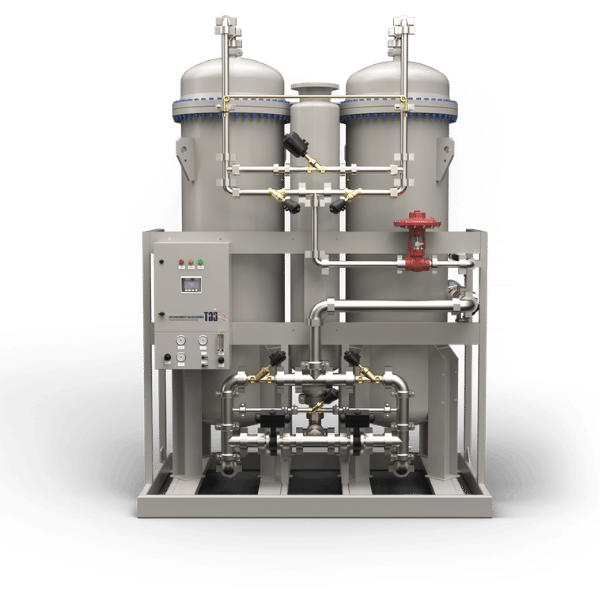
Our Nitrogen membrane injection systems combine PanGeng gas air compressors with self-contained nitrogen makers to deliver enhanced oil recovery. Our compressor systems drive membrane separators producing 95-99.5% nitrogen at injection pressure from 25 to 50MPa. A 4-stage system can produce 600-1200 Nm3/h of continuous nitrogen to sustain reservoir pressure – reducing operator expenses of nitrogen trucking by 3-5X/regular cubic meter in remote basins.

Drilling Operations — Underbalanced Drilling Air Supply
Mobile air-drilling compressor packages install on a common truck chassis for rapid deployment between well sites. The JP-series feeds pressurized air into the drill string for cuttings lift, well control, and foam drilling requirements. Redundant dual units provide n+1 reliability: if one compressor trips on downhole demands, the other maintains wellbore pressures – preventing costly well control incidents common to single-compressor packages.
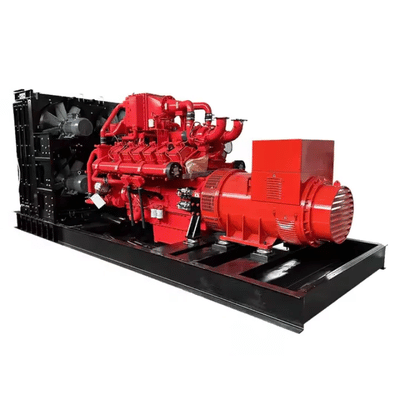
Coal Bed Methane and Shale Gas Recovery
Our CBM producing stations rely upon PanGeng reciprocating compressors to compress production gases from 0.1-0.3 MPa to pipeline delivery pressures of 1.0-2.5 MPa. Our CBM compression schemes tolerate high inverter condensing impurities including sulfur, carbon monoxide, and water saturation where standard compressor systems see rapidly deteriorated component life. PanGeng deploys 316L stainless valve plates and Teflon alloy pistons rings for sour and moisture laden compression tasks.
Similar operating environment?
Get a site-specific quote
Certifications and Engineering Standards
API 618
Reciprocating Compressors for Petroleum, Chemical & Gas
ASME Sec. VIII
Pressure Vessel Code, Division 1
ISO 9001:2015
Quality Management System
CE Marking
European Conformity
Ex-Proof
Explosion-Proof Rating for Hazardous Zones
ISO 1217
Compressor Performance Testing
Every PanGeng gas air compressor pressure vessel is certified to ASME Section VIII Division 1—which is the Ministerial Regulation requirements for a commercial compressed air system. Re-ciprocating compressor packages fed for petroleum and chemical service are constructed in accordance with API 618, which establishes equipment lubrication systems, controls, instrumentation, intercoolers, aftercoolers, and pulsation suppression devices. API 618 also establishes an API 618 maximum discharge temperature of 150C / 300F. API 618 also specifies driver trip speed limits of 110% for reciprocating engines, and 105% for gas turbine drivers.
Third-party pre-shipment inspection by SGS or Bureau Veritas may be obtained upon request. We welcome factory audit visits—our Bengbu facilities operate on an open-door policy for qualified buyers undertaking a supplier qualification to their own internal procurement standards.
Procurement Guide — Pricing Factors, Lead Time, and After-Sales Support
Industrial gas air compressor pricing is determined by five primary variables. Knowing these before you for your RFQ your cost estimates are within budget and your review does not uncover unacceptable cost overruns.
Pricing Factor Framework
What Drives Your Compressor Cost
1. Capacity and Pressure Class
Desired flow rate (Nm/h)—discharge pressure (MPa): determines cylinder bore, number of compression stages and frame size—every element of increased pressure or capacity also increases the weight of materials and the accuracy of machining required.
2. Gas Composition
Raw sour gas, or if transit is wet or contains high-CO streams, requires alloyed corrosion resistant valve plates, piston rings, and cylinder liners (316L, Monel, Inconel)—15-40% increase in material costs over standard air service.
3. Driver Choice
Gas engine, diesel engine, or electric motor—each with different capital outlays, different installation costs. Using process gas to run a gas engine driver eliminates the costs of fuel procurement.
4. Package Scope
Bare compressor, or complete skid package equipped with engine or compressor, coolers, separator, controls, safety valves etc. Complete packages cost less on installation on site, although they cost more at the factory gate.
5. Certification requirements
API 618, ASME U-stamp, ATEX and IECEx explosion proof ratings, third-party inspection—each increases the engineering and associated documentation costs. Provide your project specifications to avoid change orders inflating the factory-gate price.
Lead Time and Delivery
Standard packages are shipped within the normal reciprocating compressor production lead-time. Specially engineered packages for non-standard pressure or special gases requires longer engineering and purchasing lead-time. Tell PanGeng about your project schedule to receive a firm delivery commitment.
After-Sales and Spare Parts
PanGeng manufactures and maintains inventory of spare parts for all current models, and traces back maintenance parts inventories for units manufactured in the last 15 years. Piston rings, valve plates, gaskets, filter elements ship in 48 hours from receipt of confirmed order. Remote support via video sharing We Chat/ WhatsApp accounts makes it possible for factory engineers to troubleshoot issues directly with your on-site maintenance personnel, 24 hours a day, instead of waiting 24-48 hours for service.
Procurement Advisory
Ask for a concrete quotation with the composition analysis of your specific gas; operating ambient conditions, temp. range, and altitude; project schedule and flow rate and pressure let our engineering team give you an accurate quotation on first response, avoiding the 2 to 4 week revision cycle that drive your project behind schedule.
Gas Air Compressor Professional Tools
Provide professional data support for your gas compressor projects. Use the calculators and selection guides below to accurately evaluate equipment specifications, calculate long-term ownership costs, and choose the industrial solution that best matches your operating conditions.
Compressor Sizing Calculator
A professional compressor sizing calculator to help you quickly determine the most suitable equipment displacement and power specifications based on your actual flow and pressure requirements.
Access CalculatorTCO Comparison Calculator
Total Cost of Ownership (TCO) comparison tool. Intuitively displays the differences in initial investment, long-term energy consumption, and maintenance costs to facilitate lean purchasing decisions.
Compare TCOApplication Selection Guide
Comprehensive application selection guide. Provides professional technical specifications and selection reference schemes tailored for different gas media and industrial application scenarios.
Read GuideReady to Discuss Your Gas Air Compressor Requirements?
Provide your capacity requirements and conditions. Our engineers will reply in 24 hours with a technical recommendation and budget quotation.
Request a QuoteFrequently Asked Questions — Gas Air Compressor
Gas air compressors are the power source of choice for remote and off-grid locations where electric power is not available – oil fields, mines, job sites, emergency response. Electric units cost less in total lifecycle costs per unit of compressed air from facilities connected to the grid running 8,000+ hours a year. For sites without grid access, gas comes in that category. Your charging factor is site power first, total cost of ownership second.
Chemical, oil and gas sector only-API 618 (reciprocating compressors), ASME Section VIII Division 1 (pressure vessels), and Fugoafs Besieodas (quality management) are your go/no-go -performance requirements. CAGI’s independent performance verification gives you head-to-head efficiency data for apples-to-apples brand comparison. Add explosion-proof (ATEX/IECEx) ratings if your installation is in a classified hazardous zone, and CE (European conformity) markings if you plan export into Europe.
Inside each gas engine crankcase, the crankshaft is connected to a series of pistons housed in top-quality machined cylinders, with a precise piston stroke sealed on top by an intake valve and on bottom by a discharge valve, compressing the intake air through direct discharge into a receiver tank, or a piping loop. Connecting 3-5 compression stages with intercooling chambers between each one in multi-stage design keeps thermodynamic compression efficiency at 0.8-50 MPa while keeping discharge temperatures under 150C per API 618. Reciprocating compression’s inherent mechanical simplicity-impervious to surge lines, dynamic impeller seals and impellers, and control systems-requires wrench-and-torque maintenance instead of vibration analysts and laser-guide systems. That matters when your forward-acting compressor is on a drilling platform 200 km from the nearest authorized on-site service center.
Industry data universally confirms that energy and fuel costs composed 70-91% of a compressor’s total lifecycle costs, with highest initial purchase costs at 12-20% and maintenance activities at 8-12%. That translates to a 20,000 of compressor’s lifecycle operational costs being energy costs, with the compressor also spending 50-80% of its lifecycle financial outlay on electricity, natural gas, or DME as determined by site conditions. In this case, right-sizing a compressor to actual rather than maximum intermittent demand typically slashes lifecycle operational costs by 45% – leak detection programs and upgrades to IR detectors, and repair programs reclaim another 20-30% of energy and costs.
Yes. In upstream oil and gas producers-in fact, gas compressor units frequently run on processed wellhead supplies, so saving operation and maintenance dollars on fuel The gas quality can be improved to meet specifications-pressurized, dehydrated, and within BTU range for your engine rating. We sell entire processing system of fuel gas conditioning.
Estimate total FAD draw of every pneumatic tool and process running concurrently including margin for losses and future utilization, then check that FAD specification with the compressor’s rated FAD at your working pressure. For high altitude applications (above 1500m), apply a 3% of FAD decrease per 300m altitude gain.
Quality depends on the manufacturer- just as it does on any country of origin. PanGeng compressors are manufactured to API 618 and ASME standards, tested in accordance with ISO 1217 protocols, and offered with 3rd-party pre-shipment inspection through SGS or Bureau Veritas. Many Western companies purchase components or entire compressor units from Chinese factories. What matters in choosing a compressor is not where it is manufactured, but if it adheres to your applicable industry standards-and that if the company provides certification that can be verified through transparent test reporting, and responsive after-sale services.
Routine gas compressor maintenance includes: engine oil and filter changes (every 250-500 hours of operation), inspection of air intake filter elements (daily in dusty environments), inspection of valve plates (every 2,000-4,000 hours), replacement of piston rings (every 8,000-12,000 hours), and cooling system flushing (annually). PanGeng offers prepackaged maintenance kits for each scheduled service, complete with all gaskets, orings, and consumables. Maintaining oil filter and other routine services ensures 95% availability and avoids cascading damage so costly that a 200 dollar filter change turns into a $15,000 cylinder re-bore.
Trending now
![Low Pressure Hydrogen Compressor Applications [Guide]](https://pgcompress.com/wp-content/uploads/2026/09/low-pressure-hydrogen-compressor-applications-blog-featured-150x150.png)