Get in Touch with Pangeng

Contact Form Demo
ISO 9001 & CE Certified

Hydrogen Booster Compressor

Hydrogen Booster Compressor — Custom H2 Gas Compression Solutions

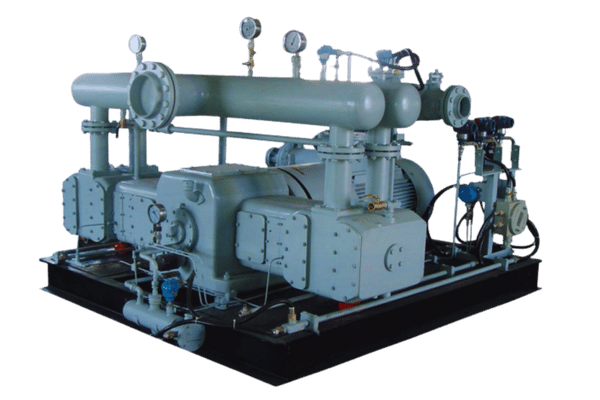
Custom designed reciprocating H2 Compressors 20- 12000 Nm/h up to 22 Mpa. Specifically designed to serve various applications such as: refinery recycle hydrogen, pre-compression for hydrogen fuel stations, chemical hydrogenation and storage of energy throughout the hydrogen value chain.

Get Technical Specs
Industrial Hydrogen Booster Compressor

28 Models

Standard Configurations

20–12,000 Nm³/h

Volume Flow Range

Up to 22 MPa

Max Discharge Pressure

Custom Engineering

Application-Specific Design

Multi-Stage

Compression Architecture

Global Delivery

Worldwide Shipping & Support

Why Hydrogen Compression Demands Purpose-Built Boosters

Your hydrogen compression system has to deal with a gas that aggressively attacks its containment materials, seeps through microscopic leaks unlocatable by normal seals, and ignites in an air flammability range of 4-75%. Consumer-grade industrial gas compressors haven’t succeeded in hydrogen service because they weren’t built for these circumstances. A hydrogen booster compressor—a high pressure reciprocating compressor designed to compress hydrogen gas from a low inlet pressure to a high discharge pressure—pre-empts all of these blowing conditions before they can occur.

The First Challenge

The first, and largest, is (ironically) hydrogen embrittlement: atomic H2 migrates through the wall of a metal grain or apartment under pressure, cycling temperature and pressure, and nucleating microcracks that (with persistence) lead to ultimate failure. Steel garments that have to ole to show lengthy record of no problems in N2 or NG gloves turn seal-hard within a few months under H2 hands.

The Second Challenge

Second is molecular leakage–with a (kinetic) molecule diameter of just 2.89 (and 3.00) angstroms, H2 can sneak through clearances that retain methane and higher molecular weight gases.

The Third Challenge

Third is contamination—many of the downstream H2 applications-LHV fuel cell cars to catalytic H2 blowing reactors to chemical-grade processing will always require oil-free or ultra-zero-oil compression.

The Fourth Challenge

Fourth, (to the extent that one can pressurize) a 20 to 22 MPa discharge from an inlet that can be as low as 0.02 MPa (electrolysis pressures sometimes are found below 0.10 MPa) requires multi-stage compression with millers of degrees of intercooling-a scientific art form that is same(s) to the accomplishment.

This is achieved using reciprocating piston technology proven over 11+ years in multiple applications, using hydrogen rated all-welded construction materials, specifically 316 stainless steels with a minimum of 10% Nickel, each mill certificate traceable back to the original heat number. The double mechanical-electronic compressor protection system measures discharge temperature and pressure, oil flow and vibration in real time and trip out (shut down) in milliseconds should the compressor operate outside pre-selected limits. The compressor is all air cooled with no requirement for cooling water infrastructure and is therefore quick, simple and cost effective to install and maintain onsite.

All wear parts (piston rings, packing sets, inlet- and valve plates) are compatible across the product family so replacement items are available within 5-10 business days ex-stock worldwide.

Technical Deep-Dive: Hydrogen Embrittlement Prevention

Hydrogen embrittlement is observed when monatomic hydrogen diffuses through the metal lattice and re-combines at grain boundaries, forming “a build-up of internal pressure and causing the grain boundaries to crack intergranularly”. This becomes a concern at above 200C, and at increased partial pressures of H 2. in the compressor cylinders and valve components, this leads to brittle fracture during normal pressure cycling.

Pangeng’s preventive approach: all parts that contain pressure takeoff made from 316L stainless steel (UNS S31603). Confirmed %Ni greater than 10%, balls and seat ring half-HRC < 22. After machining, passivate all critical parts in solution at 1040-1080C then normalize quench to prevent carbide precipitate formation from further complicating traps made in time of manufacturing.

Check all surfaces for positive material identification (PMI) using a hand-held X-ray fluorescence device before installation. Referenced procedure against ASME BPVC Section VIII, Division 1 specification for hydrogen.

Pangeng Hydrogen Booster Compressors For Sale: Models & Selection Guide

Our three product families deliver different solutions for different segments of the hydrogen value chain. When your application is new hydrogen compression for refinery makeup gas or recycle hydrogen boosting for hydrocracking loops—or high-pressure gas compression for fuel station dispensing at 700 bar—we can start from a standard platform—and then design every parameter to fit your process.

New Hydrogen Compressors ZW Series

New Hydrogen Compressors (ZW Series)

ZW series: new hydrogen from steam methane reformers, pressure swing adsorption units, or electrolysis. Our ZW-series compressors are designed to take in hydrogen at relatively moderate inlet pressures and boost it to process-feed conditions. Typical volume flows are 350 to 740 Nm/h, and the package is designed to be space-saving and modular.

Variations in design are available to suit new hydrogen generation from these sources for use in chemical plants, or other processes calling for mid-tier hydrogen volume flow rates.

Recycle Hydrogen Compressors DW Series

Recycle Hydrogen Compressors (DW Series)

ZT series: new or recycle hydrogen for downstream processing. Core components of refinery hydroprocessing units (hydrotreaters, hydrocrackers, isomerization reactors) rely on a continual flow of recycle hydrogen to maintain catalyst activity and ensure adequate conversion rates. Our ZT series is the durable solution to the persistent demand of refinery 24/7 operation: typical flow rates are 700 to 12,000 Nm/h, and inlet pressures are as low as 0.02 MPa (for low-pressure flash gas removal), with discharge pressures reaching 10.0 MPa.

High Pressure Hydrogen Compressors Custom Platform

High Pressure Hydrogen Compressors (Custom Platform)

High-pressure gas compression to dispensing stations at 350 or 700 bar, energy storage compression for tube trailers at 200 bar or greater, and pipeline transport require a high-pressure platform capable of reaching up to 22 MPa. Permutations of compression stage count, cooling duty, and safety apparatus can be incorporated to meet your exact needs. Plug-and-play design reduces installation time on site to a matter of days.

Compressor Specifications

Series Application Flow Rate (Nm³/h) Inlet Pressure (MPa) Discharge Pressure (MPa) Stages
ZW-0.6/(0.6–1.0)–3.5 New H2 Feed 350–740 0.6–1.0 3.0–3.5 2
DW-0.8/0.02–1.2 Low-P Recycle H2 700–2,500 0.02–0.5 1.2–3.0 2–3
DW-3.0/1.0–5.0 Medium-P Recycle H2 1,500–6,000 1.0–2.5 3.0–5.0 2
DW-6.0/2.0–10.0 High-P Recycle H2 3,000–12,000 2.0–4.0 5.0–10.0 2–3
Custom HP Platform Fuel Station / Storage 20–1,000 0.5–4.0 10.0–22.0 3–5

Decision Matrix by Application

Which hydrogen compressor should I choose? An initial step should be to identify the process conditions where our solution should focus. The chart below provides a visualization of four key sectors of application mapped to recommended series, typical operating points, and selection symbols.

Application Sector Recommended Series Typical Pressure (MPa) Typical Flow (Nm³/h) Key Selection Criteria
Refinery Hydroprocessing DW Series 1.2–10.0 700–12,000 24/7 reliability, API 618 compliance, long service intervals
Hydrogen Refueling Stations Custom HP 35.0–45.0 (350 bar) / 70.0–90.0 (700 bar cascade) 20–500 ISO 14687 purity, small footprint, ATEX zone classification
Chemical Processing ZW / DW Series 3.0–5.0 350–6,000 Oil-free options, gas purity, process integration
Energy Storage & Transport Custom HP 20.0–22.0 50–1,000 Tube trailer filling, post-electrolysis compression, modular skids

Hydrogen Booster Compressor vs Alternative Compression Technologies

How to select a compression technology for your hydrogen process requires parallel comparison of compression technologies against several criteria: pressure capability, volume throughput, system simplification and trading for purity, maintenance intensity, and total cost of ownership. The table below compares parameters for four existing technology types, and consolidates specification experience from existing refinery, chemical, and clean energy projects.

Reciprocating piston compression-compression technology employed by all Pangeng hydrogen boosteras- offers the widest breadth of operating range: inlet pressures from 0.02 MPa to 22 MPa of discharge pressure, flow rates from 20 to 12,000 Nm/h. For applications that might involve small-flow electrolysis or subsequent compression processes, membranes precisely zero impurities emerge as a distinct technology option. At the high end, centrifugal compression technology performs best at flow rates greater than 1,000 Nm/h but, of course, supports only a limited compression ratio.

Parameter Pangeng Reciprocating Booster Centrifugal Diaphragm Electrochemical
Pressure Range (MPa) 0.02–22 0.5–100 0.1–1000 0.1–100
Flow Rate (Nm³/h) 20–12,000 1,000–100,000+ 1–500 0.5–50
Gas Purity Impact Oil-free / oil-lubricated options Oil-free (dynamic seals) Zero contamination Oil-free (electrochemical)
Compression Ratio per Stage 2:1–4:1 1.2:1–2:1 3:1–10:1 N/A (continuous)
Maintenance Interval (hrs) 4,000–12,000 16,000–24,000 2,000–6,000 8,000–20,000
Customization Flexibility Full (stages, materials, skid) Limited Moderate Limited
Footprint (relative) Medium Large Small Small
Capital Cost (relative) $$ $$$ $$$$ $$$$$

In the majority of industrial hydrogen uses where there is a need for significant throughput and high discharge pressure, reciprocating piston technology provides the optimal solution in terms of performance, dependability, and total ownership cost. If your application is outside of the reciprocating envelope-an application requiring either very high flows less than 12,000 Nm/hr or very low flows less than 20 Nm/hr with very high purity requirements-pring is happy to consider other technologies.

25–40%

TCO Perspective

Equipment is 25-40% of overall lifecycle cost, with energy usage, wear parts and scheduled maintenance making up the rest. Pangeng’s modular built along with standardized wear parts then helps to reduce any long term ownership costs through minimizing special skills required at service intervals and minimum required of proprietary parts.

Applications for High-Pressure Hydrogen Compressors

We design hydrogen booster compressors to meet exact process conditions-not a generic duty point. Here are 5 actual application cases in which our compressor solutions provided value for money. We show what the process parameters are for our engineering department to perform technical proposals for the compressor solution.

Refinery Hydrocracking & Hydrotreating

Refinery hydroprocessing utilizes both recycled hydrogen (that of the separator at the reactor at a lower pressure) as well as makeup fresh hydrogen. Our DW-series recycle H2 compressors re-compress separator gas from about 1.5-3.0 MPa back to the reactor inlet pressures (ca 5.0-10.0 MPa) to preserve the high partial pressure of H2 for catalyst activity. ZW-series fresh H2 compressors provide the makeup H2 at from ca. 3.0 to about 3.5 MPa from the hydrogen plant.

Though not so popular we normally engineer both units for dual purpose they run on the same machine architecture, same control loops, and keep the maintenance schedules in sync.

Refinery Hydrocracking Compressor Process
  • Recycle flow: 2,000–12,000 Nm³/h
  • Inlet: 1.5–3.0 MPa
  • Discharge: 5.0–10.0 MPa
  • 24/7 operation
  • API 618 compliant

Hydrogen Refueling Stations

Refuelling of a hydrogen fuel cell vehicle involves compression of hydrogen from the electrolyzer or pipeline supply pressure (around 0.5-3.0 MPa) up to cascade storage pressure, i.e. 45 MPa (for 350-bar dispensers) or 90 MPa (for 700-bar dispensers). Our high-pressure platform compresses H2 in 4-5 stages with intercooling after each stage, while for 700-bar stations we have integrated downstream pre-cooling to -40C to comply with fill protocols specified by SAE J2601. Skid-mounted packages are supplied complete with PLC controls, safety interlocks, gas detection equipment and other facilities for quick-field installation.

This is what makes our high-pressure system the ideal equipment solution for hydrogen refueling stations.

Hydrogen Refueling Station High Pressure Compressor
  • Inlet: 0.5–3.0 MPa
  • Discharge: 45–90 MPa
  • Flow: 20–500 Nm³/h
  • Pre-cooling: –40°C (700 bar)
  • ISO 14687 purity

Chemical Processing — Hydrogenation Feed

Fine chemical, pharmaceutical and edible oil processing often use hydrogenation reactions for processing, demanding hydrogen at exact pressures and purity specifications. These compressors deliver processed hydrogen at conditions suitable for feeding to reactors (approx 3.0-5.0 MPa) from PSA or electrolyser sources. Oil free piston arrangements avoid carry over of lubricants to catalytic processes.

Variable speed drives or suction valve unloading allow turndown to 50% of flow without recycling for effective matching of hydrogen supply to batch or continuous reactor demand curves.

Chemical Processing Hydrogenation Feed
  • Flow: 350–3,000 Nm³/h
  • Inlet: 0.6–2.0 MPa
  • Discharge: 3.0–5.0 MPa
  • Oil-free available
  • Batch/continuous modes

Energy Storage — Post-Electrolysis Compression

Upon generation green hydrogen, made by alkaline or PEM electrolysers, is at a relatively low pressure-typically 0.1-3.0 MPa. It must be compressed for storage in tube trailers at 200 bar (20 MPa) or more for transportation to end use facilities. Pangeng compressors provide the real-time, cost-effective compression from low to high pressures in 3-4 efficient compression stages with air cooled intercoolers.

We can offer modular, skid mounted packages installed adjacent to solar or wind farms, with additional units to parallel as hydrogen production capacity increases.

Energy Storage Post-Electrolysis Compressor
  • Flow: 50–1,000 Nm³/h
  • Inlet: 0.1–3.0 MPa
  • Discharge: 20.0–22.0 MPa
  • Air-cooled
  • Modular skid

Pipeline & Tube Trailer Transport

Moving hydrogen from generation location to the end user requires increasing pressure for pipeline injection or tube trailer loading. Pipeline booster stations raise the hydrogen pressure from 2.0-4.0 MPa to 6.0-10.0 MPa overcoming transmission frictions losses over 50-200+ km. Tube trailer filling compressors must steadily support a broad pressure range as trailer banks fill from residual 0.5 MPa to full 20-22 MPa. Our hydraulic-actuated capacity control delivers a steady throughput over this changing backpressure curve ensuring complete fills within desired cycle times. These compression systems form essential infrastructure of the growing hydrogen economy linking renewable green hydrogen generation on sun and wind powered sites to our industries.

Pipeline & Tube Trailer Transport Compressor
  • Pipeline boost: 2.0–10.0 MPa
  • Trailer fill: 0.5–22.0 MPa
  • Flow: 200–5,000 Nm³/h
  • Variable backpressure operation
  • Unmanned station capable

  Certifications & Compliance for H2 Compressor

Every Pangeng hydrogen booster compressor is designed and built to adhere to a certified quality system, with pressure retaining components constructed to date ASTM, API, or ASME code. We understand project engineers require paperwork compliance-not just verbal assurances. Below is an overview of the quality standards governing our hydrogen compressor manufacturing, testing, and sourcing.

  • ISO 9001

    Quality Management System

  • ASME BPVC VIII

    Pressure Vessel Design & Fabrication

  • API 618

    Reciprocating Compressor Design

  • ISO 14687

    Hydrogen Fuel Purity Standard

  • ATEX / IECEx Equiv.

    Explosion Protection Certification

  • CE Marking

    European Market Conformity

Procurement Guide for Custom Hydrogen Compressor: Pricing, Lead Time & After-Sales

Buyer Advisory: Key Pricing Factors
Cost of a hydrogen compressor is a function of several balancing technical parameters. The main cost considerations are:
Flow capacity Higher Nm/h demands larger cylinders, more powerful motors, and cooler fluids.
Discharge pressure Higher pressures require additional stage compression or thicker walls.
Gas specifications Oil-free requirements require upgraded packing strings and impregnated titanium coatings.
Explosion proof ATEX Zone 1 versus Zone 2 enclosures impact motor selection and instrumentation.
Package Factory integrated skids carry a premium; bare foundation-mounted designs are less but demanding more on-site integration.
Material grade Duplex or Inconel adds marker content, tooling, and machining costs.
If you require a written breakdown of how your investment is distributed in each part of your compressor, we deliver as much detail as you require, with no surprises or hidden surcharges.
7-Step Ordering Process
Step 1 Requirements Submission
Step 2 Technical Proposal
Step 3 Quotation & Review
Step 4 Contract & Deposit
Step 5 Manufacturing & QC
Step 6 FAT Witnessing
Step 7 Shipping & Commissioning
Ongoing Support
Once your process parameters are received, your Pangeng engineer will provide a detailed technical proposal within 5 days, complete with a process flow diagram and utility demand table. Manufacturing lead time is 8-16 weeks. Factory acceptance testing with customer witnessing occurs before shipment.
After-Sales Support

Trucking is only part of your story with Pangeng. In addition to our delivery assurance: live remote troubleshooting & operator consultation via video conferencing, attendance at compressor start-up on your site by our service technicians (available around the world), standard low-wear parts availabilities from our Bengbu, Anhui warehousing that dispatch within 5-10 working days normally, and annual maintenance scope agreements with defined time of response. We keep the tech file of every compressor we supplied you for spare parts arrangement and service intervention refer to your built optimization.


Hydrogen Booster Compressor Tools

Engineering calculators and selection guides designed for high-pressure hydrogen applications.

Model Selector

Identify the optimal booster compressor model based on intake pressure, discharge requirements, and flow rate.

Access Tool

Stage Calculator

Calculate compression ratios, discharge temperatures, and optimize multi-stage configurations.

Access Tool

TCO Estimator

Evaluate the Total Cost of Ownership including CAPEX, OPEX, and projected maintenance cycles.

Access Tool

Hydrogen Booster Compressor FAQ

1. What is a hydrogen booster compressor and how does it work?

A hydrogen booster compressor is a reciprocating piston machine designed to increase the pressure of hydrogen gas from its inlet value to the higher appropriately higher internal or external process pressure. Hydrogen compressor activity consists of taking a fixed volume of H2 gas in a closed cylinder, then reducing the volume to raise the pressure. 2-, 3- or 4-phase compression, often with intercooling has increasingly been used in H2 compressor arrangement for efficiency from a work cycle with intake pressures as low as 0.02 MPa to 22 MPa outlet pressure, due to the fact that H2 molecule is as small as 2.89 angstrom requiring the specialist parts such as seals, 316SS wetted parts, closer machining tolerances.
Inlet pressures from 0.02 MPa to 4.0 MPa, discharge up to 22 MPa. ZW-series: 3.0–3.5 MPa. DW-series: 1.2–10.0 MPa. Stage count (2-5) matches your pressure ratio.
Four main types: reciprocating piston (0.02-22 MPa, 20-12,000 Nm³/h), diaphragm (highest purity, 1-500 Nm³/h), centrifugal (above 1,000 Nm³/h, limited ratio per stage), and electrochemical (emerging, below 50 Nm³/h). Reciprocating remains the workhorse for industrial hydrogen where both high pressure and throughput matter.
There are 4 technical distinctions between hydrogen and ordinary air compressor: material: those used for hydrogen are more than 10% Ni 316SS stannous metal Alloys, standard steel in common air compressor, two key factors we consider; sealing: H2 molecules 2.89A is very small so the very close clearances and green PTFE packing materials are needed; safety: hydrogen has a wider explosive range (4-75%) than that of air, so need ATEX/EocEx approved electric hardware and constantly keep the H2 spread out gas detection inside the system; many use oil free structure.
Selection ranges are defined based on five most common parameters: the required volume flow rate at standard conditions in Nm/h, inlet pressure supplied from your hydrogen network (electrolyser, PSA, pipeline, reactors separator etc), discharge pressure required for your process, gas purity requirement (in particular in case of hydrogen as fuel gas in fuel cells – ISO 14687), working environment – indoors/outdoors, ambient temperature range, working altitude, hazardous environment classification. Supply these parameters to our engineers and we will recommend the optimum model, compression stage number, cooling design, steel grade within 5 working days.
Hydrogen introduces four technical challenges to compressor design. Embrittlement: hydrogen atoms enter carbon steels and oxide grain boundaries causing extensive cracking, solved using 316 stainless steel and heat treatment. Molecular leakage: at 2.89 angstrom diameter, hydrogen leaks through gaps between meterism parts , solved using precision-machined clearances sealed with PTFE based packing. Low density: hydrogen’s gravity at STP 0.0899 kg/m means larger swept volumes are required per unit mass compressed. Large wide-flammability range: 4-75%, explosion-proof electrical supply and continuous gas monitor needed in compressor suite.
Price of industrial hydrogen compressors depends on flow rates, discharge pressure, gas purity need, explosion safety requirement and an optional skid mount or frame installation. Purchase price represents 25-40% of the total lifecycle cost – 60-75% are energy consumption, maintenance, and wear part cost. Only request quotation referencing your process particulars in order to obtain a credible piece of representation. We always deliver clearly itemized quotations and detailed technical proposals within 5 working days.
Yes. Pangeng manufactures every hydrogen booster to suit your exact process parameters. We have custom options for: flow (20-12,000 Nm/hr), inlet and discharge pressures, number of compression stages, intercooler design (air cooled is standard, water cooled optional), steel quality (copper, duplex, Inconel standard for harsh service), integrated plug-and-play package, programmable logic controller (PLC) integration, hazardous environment certification. Our modular design philosophy enables us to adapt standard models to bespoke applications without the need for complete custom engineering lead times.
A well-certified hydrogen compressor should meet: ISO 9001 and ISO 14001 (quality and environmental management system), ASME BPVC Section VIII (design and manufacturing of pressure equipment), API 618 (reciprocating machine standard), II-VI INES (hydrogen fuel standards), CE flag (EU CE certification), region specific certifications such as ATEX or IECEx for areas with explosive atmospheric dangers. For manufacturers in China: GB/T 150 standards for pressure vessel constructions and TSG technical code for safety are too utilized standard. Confirm all relevant documentation before signing your purchase order.
Maintnenance requirement for hydrogen compressor is to have piston rings and packings checked every 4,000-8,000 hours of operation, valves inspected every 8,000-12,000 hours, oil sample analyzed and changed as per recommendations, intercoolers cleaned and tested periodically, vibration analysis done for every term scheduled services and foundation adjustments checked after foundation repairs. Pangeng stocks standard wear parts on demand and guarantees ship with 5-10 working days in addition to option yearly maintenance packages to eliminate delay caused in project planning.