Get in Touch with Pangeng


How to Choose an Underhood Air Compressor for Your Service Truck Fleet
An underhood air compressor is a rotary-screw air-supply unit installed inside the engine compartment of a service truck or commercial van, drawing power directly from the truck’s engine through a belt, direct, or hydraulic drive. It eliminates a tow-behind trailer and a deck-mounted unit, freeing roughly 80 cubic feet of cargo space and reducing GVW by up to 1,900 lb compared with portable engine-driven alternatives. For fleets running 1/2″–1″ impact wrenches, light jackhammers, and tire-inflation duties from a single mobile platform, this compressor type has displaced reciprocating tow-behind machines as the default service-truck choice over the past decade.
This buyer’s guide walks through the decision: how to size CFM correctly, when belt drive beats direct drive, what 5-year total cost of ownership actually looks like, what standards procurement teams should verify, and the buyer mistakes that show up repeatedly in fleet-operator forums. The product line sits at Pangeng’s underhood compressor catalog — this article focuses on the choice logic, not the spec sheet.
Quick Specs at a Glance
| CFM Range | 40 – 150 CFM (typical service-truck units) |
| Pressure | 150 – 175 PSI maximum |
| Duty Cycle | 100% (continuous, rotary-screw architecture) |
| Unit Weight | 150 – 280 lb (engine-bay mounted) |
| Cargo Space Saved | Up to 80 cu ft vs deck-mount; 100% trailer-free |
| GVW Reduction | Up to 1,900 lb vs tow-behind |
| Drive Types | Belt / Direct / Hydraulic |
| Install Time | 4 – 8 hours (trained tech with kit) |
What Is an Underhood Air Compressor (and Why Fleets Are Switching)?
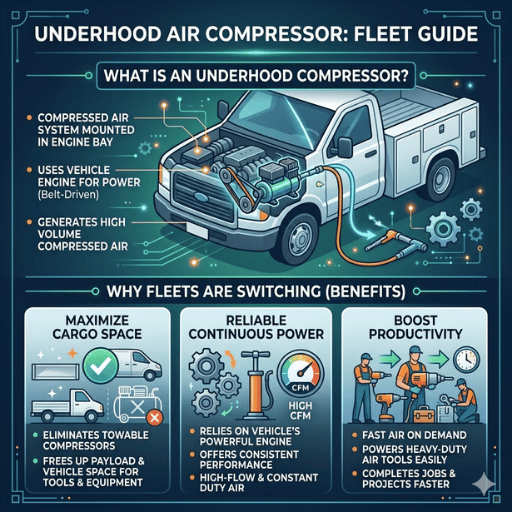
A service-truck underhood unit is a sealed rotary-screw compressor pack mounted in the engine bay, driven off the engine via a belt pulley, a direct splined coupling, or the truck’s hydraulic system. Two helical rotors trap and compress incoming air; oil injection seals rotor clearances and removes heat in a single integrated cycle, which is why these compressors run at a 100% duty cycle without overheating — a significant contrast with reciprocating piston designs, which industry data places at roughly 20 – 30% of the duty-cycle capability of a comparable rotary screw.
Three pressures pushed the underhood category into mainstream service-fleet adoption. First, every pound on the truck deck eats payload — and tow-behind units add 2,400 lb of trailered weight plus another 200 – 800 lb for deck-mounted PTO alternatives. Second, separate engines on tow-behind compressors mean a second oil-change schedule, second emissions package, and second fuel tank. Third, dispatching with a trailer adds maneuvering time on every job site, especially in tight urban work zones. VMAC commercialized the underhood category in the late 1990s; today the format spans light vans through Class 4 – 7 medium-duty chassis from multiple manufacturers.
The “engine-bay heat” objection that surfaces in forum threads is real, but engineering data and field reports converge: enclosed rotary-screw architectures with oil cooling and high-temperature gaskets operate within the full ambient temperature range of a working engine bay. Operators in extreme-heat regions report years of trouble-free runtime — a Western-Australia user on the JeepWrangler forum has run an underhood ARB unit for nearly two years in summer conditions exceeding 110°F without issues.
Underhood vs Tow-Behind vs Deck-Mount: Which Type Fits Your Fleet?
Service-truck buyers face three mainstream options that solve the same problem with different cost, weight, and CFM profiles. Choosing correctly depends on peak air demand, payload sensitivity, and how much job-site maneuvering each truck does per week.
| Metric | Underhood | Tow-Behind | Deck-Mount PTO |
|---|---|---|---|
| CFM Range | 40 – 150 | 100 – 375 | 50 – 200 |
| Weight On Vehicle | 150 – 300 lb | 2,400+ lb (towed) | 400 – 800 lb |
| Initial Cost | $4,000 – $8,000 | $27,000 – $34,000 | $8,000 – $15,000 |
| Annual Maintenance | $200 – $400 | $1,500 – $2,500 | $500 – $1,000 |
| Duty Cycle | 100% | 100% | 100% |
| Noise Level | 60 – 70 dB | 75 – 85 dB | 70 – 80 dB |
| Bed Space Used | 0 cu ft | 0 (towed) | 15 – 25 cu ft |
| Separate Engine | No | Yes | No (PTO) |
There’s a heuristic I use to summarize this comparison cleanly — call it the 60/40 Rule: roughly six in ten fleet buyers oversize CFM (paying for 150 CFM when 70 covers their actual tool inventory), and four in ten under-budget for duty-cycle reality (specifying a deck-mount or reciprocating unit and discovering the rated CFM only holds for short bursts). This rule isn’t a published industry statistic — it’s a pattern that emerges from procurement-call data and from how buyers describe their previous compressor in switch-over conversations. Fixing both errors at once usually points to a 70 CFM underhood unit, which is why models in that class consistently sell as the most popular service-truck pick across manufacturer lineups.
Tow-behind machines still win when sustained demand exceeds about 150 CFM — large sandblasting operations, multi-operator jackhammer work, and heavy pipeline-purging duty cycles. Below that threshold, underhood economics dominate within roughly two years of use, primarily because the second engine on a tow-behind generates its own maintenance and fuel curve.
How to Choose the Right CFM for Your Service Truck
CFM sizing is the single decision most often gotten wrong. Math is straightforward; discipline is in correctly accounting for simultaneous tool use and duty factor.
What size underhood air compressor do I need for my service truck?
Start with the highest-demand tool in the truck’s kit and add a 20 – 30% buffer for pressure recovery between cycles. A single technician running a 1/2″ impact wrench (typically 9 – 42 CFM under load, per industry tool-consumption guides) plus occasional blow-gun use stays comfortably within 40 CFM. Two technicians sharing the truck — or one technician running a 3/4″ impact alongside a die grinder — pushes you to 70 CFM. Continuous jackhammer or sandblast workflows require 110 – 150 CFM.
📐 Engineering Note — CFM Sizing Formula
CFMrequired = Σ (tool_cfm × duty_factor) × 1.25 buffer.
Worked example: 3/4″ impact at 12 CFM (40% duty) + blow gun at 5 CFM (20% duty) + occasional die grinder at 8 CFM (15% duty) = (12×0.4) + (5×0.2) + (8×0.15) = 4.8 + 1.0 + 1.2 = 7.0 CFM continuous demand × 1.25 = 8.75 CFM required for that single technician. A 40 CFM unit handles this job with significant margin and supports peak-demand spikes for the impact wrench.
| Air Tool | CFM Demand | Recommended Unit Class |
|---|---|---|
| Tire inflation, blow guns, light air ratchets | 3 – 15 CFM | 40 CFM unit |
| 1/2″ – 3/4″ impact wrenches, die grinders | 9 – 42 CFM | 40 – 70 CFM unit |
| 1″ impact wrenches, vertical grinders, light chipping hammers | 15 – 70 CFM | 70 CFM unit |
| 60 – 90 lb jackhammers, sandblasters, post pounders | 70 – 120 CFM | 110 – 150 CFM unit |
A 10 – 30 gallon air receiver tank smooths peak demand for tools that draw heavily for short bursts (impact wrenches, jackhammers) — the tank covers the spike while the rotary-screw unit refills. Without the tank, you’ll experience pressure dips on hard-hitting tools even when the rated CFM nominally covers the demand.
Decision logic cleans up to a small tree: tools demand under 30 CFM and one technician → light underhood (PG-UH40 class works here); 30 – 80 CFM with one or two simultaneous techs → standard underhood (PG-UH70 sits at the volume sweet spot, which is why fleets buy more 70 CFM units than the 40s and 150s combined); 80 – 150 CFM with jackhammer or sandblast workflows → heavy-duty underhood or PTO deck-mount; over 150 CFM continuous → tow-behind diesel.
Drive Type Decision: Belt vs Direct vs Hydraulic
Drive selection follows engine bay layout and CFM target more than personal preference. Each architecture has a clean operating window, and matching the truck to the drive type up front avoids most installation rework.
Belt Drive
✔ Mounts to existing accessory pulleys — broadest engine-bay compatibility
✔ Lowest install complexity
✔ Best price point
⚠ Belt tension inspection required at service intervals
⚠ Belt slippage risk above ~70 CFM continuous, especially under hood with high under-bonnet temperatures
Direct Drive
✔ Eliminates intermediate belt — no slippage
✔ Handles continuous high-CFM duty
✔ Lower service-interval count
⚠ Requires factory-spec accessory drive coupling
⚠ Vehicle-specific mounting kit per chassis platform
Hydraulic Drive
✔ Decouples compressor RPM from engine RPM
✔ Used when no accessory PTO is available
✔ Common on Class 4 – 7 chassis
⚠ Highest install complexity (pump + lines)
⚠ Highest price tier
In practice: belt drive is the default below 70 CFM and on light-duty pickups and vans; direct drive owns the 70 – 150 CFM band on platforms with a factory accessory-drive option; hydraulic drive is the answer when the chassis has no accessory PTO available, particularly on heavier Class 4 – 7 trucks. Forum threads from diesel-truck operators flag vibration as a real concern — rotary-screw architectures handle this better than reciprocating piston designs because there’s no piston pulsation to amplify, but proper isolation mounting still matters. Specify the kit by chassis make, model, year, and engine to get the right pulley-or-coupling option from the start.
5-Year Total Cost of Ownership Compared
Procurement decisions live and die on TCO, not sticker price. Five years is the right horizon for service-truck compressors because that timeframe captures one full maintenance cycle for the alternatives — particularly the engine-driven tow-behind, where year 3 – 4 typically brings the first emissions service and a major hose-and-belt refresh.
| Cost Category (5-Year) | Underhood | Tow-Behind | Deck-Mount PTO |
|---|---|---|---|
| Equipment Purchase | $4,000 – $8,000 | $27,000 – $34,000 | $8,000 – $15,000 |
| Maintenance | $1,000 – $2,000 | $7,500 – $12,500 | $2,500 – $5,000 |
| Fuel / Operating | $0 incremental | $3,000 – $5,000 | $500 – $1,500 |
| Trailer Reg / Insurance | $0 | $1,500 – $3,000 | $0 |
| Installation | $800 – $1,500 | $0 | $1,000 – $2,500 |
| 5-Year Total | $5,800 – $11,500 | $39,000 – $54,500 | $12,000 – $24,000 |
$23K – $30K
Initial-cost gap, underhood vs tow-behind, per truck
$30K – $45K
5-year TCO gap, per truck
Savings compound across a fleet: a contractor running 10 underhood-equipped service trucks instead of 10 tow-behinds operates $300K – $450K under the alternative over five years. Industry trade journal Utility Fleet Professional notes that life-cycle cost differentials between truck-mounted compressor types reach the hundreds of thousands over a 10-year fleet horizon.
Maintenance is what drives the gap. Underhood units run on synthetic rotary-screw oil with 500 – 1,000 hour change intervals (1.5 – 3.2 quarts per change), spin-on filter replacement on the same schedule, and belt inspection on belt-drive variants. There’s no second engine to oil, no second emissions package, no separate fuel system. Annual maintenance on a tow-behind regularly runs 4 – 6× higher because every engine-driven cost duplicates.
Common Mistakes Fleet Buyers Make (and How to Avoid Them)
Five recurring buyer mistakes show up in service-truck operator forums and fleet-procurement post-mortems. Each one is preventable with a half-hour of pre-purchase diligence.
- ①
Undersizing CFM by buying the cheapest model. Construction-fleet operators on Reddit’s r/Construction describe undersized underhood units that “didn’t hold up very well and didn’t provide enough air” once their crews moved beyond tire inflation into impact-wrench duty. Run the CFM math against your actual tool inventory, then add a 25% buffer. - ②
Confusing rated CFM with continuous CFM on reciprocating alternatives. Reciprocating piston compressors typically operate at 20 – 30% of the duty cycle of a rotary screw — the rated CFM holds for short bursts, then thermal cycling forces a cool-down. For service-truck duty, rotary-screw architecture is the default for a reason. - ③
Ignoring drive-type-to-chassis fit. Operators on the Service Trucks Anonymous community have reported PTO-mount compressors shaking loose on the highway when bracketry was undersized for the chassis. Specify the mounting kit against your truck’s exact make, model, year, and engine — not “close enough.” - ④
Skipping the heavy-duty air filter on dusty job sites. Engine-bay placement exposes the intake to road grime; one Reddit user reported their bay-mounted unit “would get absolutely filthy” on rough-job-site work. Spec a pre-cyclonic or two-stage filter from day one if your trucks see gravel pads, demolition sites, or unpaved access roads. - ⑤
Buying without an air receiver tank. A 10 – 30 gallon receiver tank costs a few hundred dollars and absorbs peak demand from impact wrenches and jackhammers, smoothing the pressure curve for the rotary-screw unit. Without it, you’ll experience pressure dips on tools the unit nominally covers.
Is an underhood air compressor worth it?
For service-truck workflows under 150 CFM, yes — and the answer is largely independent of brand. The category economics work because eliminating the second engine (on tow-behinds) or the deck footprint (on PTO mounts) compounds across maintenance, fuel, registration, and dispatch time. The honest exception is the high-CFM continuous-demand profile (sustained 150+ CFM, multi-operator sandblasting or jackhammer crews) — that’s still tow-behind territory. For everything else, the 5-year math favors underhood by $30K – $45K per truck, which is hard to argue with at fleet scale.
Standards, Certifications & What to Verify Before Purchase
Procurement teams need paperwork to approve fleet integration. Five standards define the floor for a credible underhood compressor — request documentation against each one before the purchase order goes out.
- ✔
ISO 1217:2009 — Displacement Compressor Acceptance Tests. The internationally recognized performance-rating standard for displacement compressors, including rotary screws. ISO 1217 specifies how volumetric flow rate and power consumption are measured. CAGI’s Performance Verification Program uses ISO 1217 (with simplified test codes added as appendices) as its testing reference for rotary compressors in the 5 – 200 HP range. - ✔
ISO 9001:2015 — Quality Management. Manufacturing-quality system certification. Confirms the producer operates documented inspection gates from raw-material receipt through final pressure testing. - ✔
ASME Boiler & Pressure Vessel Code, Section VIII Division 1. Required for all air-receiver tanks and pressure-vessel components in the system. Procurement should verify the tank stamping and request the data report. - ✔
CAGI B19.1-2011 — Compressor Safety Standard. Covers guarding, controls, pressure relief, and electrical requirements for OEM-integrated compressors. Particularly relevant for service-truck installations where the unit sits in close proximity to operators during use. - ✔
CE Mark. European Conformity declaration covering health, safety, and environmental requirements. Even for U.S. fleets, CE Mark serves as a recognized indicator of safe design discipline at the manufacturer.
When the supplier returns your RFQ, ask for: ISO 1217 acceptance test report (per-unit or per-batch), ASME data report for the receiver tank, materials traceability documentation, dimensional inspection records, and the CAGI Data Sheet listing the published performance numbers. A supplier that publishes certified test reports per ISO 1217 simplifies the procurement-team review and reduces the “trust us” gap.
Industry Outlook: What’s Changing in Mobile Compressed Air (2025 – 2026)
Two structural shifts are reshaping how fleets plan compressor refresh cycles. Both are real, but neither moves on the timeline that EV-pessimist or EV-optimist forecasts suggest.
Medium- and heavy-duty truck electrification is accelerating, but slower than headline figures imply. The IEA Global EV Outlook 2025 reports e-MD/HD truck sales grew nearly 80% year-over-year in 2024, exceeding 90,000 units globally. For service trucks specifically — Class 4 through Class 7, where most underhood compressors live — the timeline stretches further. Ford’s late-2025 decision to discontinue the F-150 Lightning BEV pickup and replace it with an Extended-Range EV is a useful signal: belt-driven accessories will persist on hybrid and range-extender chassis longer than pure-BEV scenarios assumed. If you’re planning a 2026 – 2028 refresh, belt-drive and direct-drive units remain the safe pick.
Telematics integration is becoming a procurement differentiator. Fleet managers are starting to ask compressor suppliers about run-hour logging, oil-change-interval tracking, and remote diagnostics — the same data flow they already get from truck OEMs. Expect this to be a standard checklist item by 2027. Today, it’s still a “nice to have” that sets newer products apart.
Standards continue to consolidate around ISO 1217. The U.S. Department of Energy’s compressor test procedures explicitly reference ISO 1217:2009(E) as the appropriate industry standard for displacement-compressor performance evaluation. Expect efficiency-disclosure pressure to rise on procurement teams over the next two budget cycles, particularly for state and municipal fleets. CAGI Data Sheets will become the default decision document — a manufacturer that publishes them is making your procurement easier.
FAQ
Q: Are underhood air compressors safe in extreme temperatures?
View Answer
Yes. Enclosed rotary-screw architectures are oil-cooled and tested for full engine-bay temperature range. Operators in the U.S. desert Southwest, Canadian arctic zones, and tropical climates report consistent operation with no thermal derating. Use synthetic rotary-screw oil rated for cold starts (sub-zero) and high-temp service (engine bay frequently exceeds 200°F under load). High-temp gaskets and corrosion-resistant materials are standard on credible units.
Q: How long does an underhood compressor installation take?
View Answer
A trained technician with a chassis-specific mounting kit installs a standard underhood unit in 4 – 8 hours. First-time self-installers should plan a full day with a torque wrench, multi-meter, and the kit’s hose-routing diagrams handy. Belt-drive on common platforms (Ford Super Duty, Ram 3500) goes fastest; direct-drive on a less-common chassis can take 8 – 12 hours when the kit requires a custom bracket adaptation.
Q: Can underhood compressors run jackhammers and impact wrenches?
View Answer
A 70 CFM unit covers 1/2″ and 3/4″ impact wrenches plus simultaneous secondary-tool use comfortably — including dual-technician trucks where two operators share air at once. For 60 – 90 lb pneumatic jackhammers, sandblasting equipment, and 1″ impact drives, the 110 – 150 CFM class is the right pick. Pair either with a 10 – 30 gallon air receiver tank to absorb peak draw and stabilize working pressure.
Q: What maintenance does an underhood compressor require?
View Answer
Synthetic rotary-screw oil change every 500 – 1,000 hours (1.5 – 3.2 quarts depending on CFM rating), spin-on filter replacement on the same interval, and belt-tension inspection on belt-drive units. Annual parts and labor budget runs $200 – $400. There is no second engine to service, no piston rebuild, no separate emissions package. Replace the air-filter element every 1 – 2 years on dusty service profiles.
Q: What trucks are compatible with underhood compressors?
View Answer
Mid-size cargo vans (Ford Transit, Mercedes Sprinter, Ram ProMaster) handle 40 CFM units. Full-size pickups in the F-350+, RAM 3500, and GMC 3500HD class fit 70 CFM units comfortably. Class 4 – 7 medium-duty chassis (International, Freightliner, Hino, Ford F-450 through F-750) accept 110 – 150 CFM heavy-duty installations. Confirm fitment by chassis make, model, year, and engine — both gas and diesel options exist for most platforms.
Q: Will an underhood compressor void my truck’s manufacturer warranty?
View Answer
No, not by virtue of installation alone. The U.S. Magnuson-Moss Warranty Act prevents vehicle manufacturers from voiding a warranty solely because an aftermarket part was installed; the manufacturer must demonstrate that the part directly caused the failure. Retain installation documentation, torque records, and any modifications to OEM systems — that paperwork makes warranty claims straightforward in the rare case of a dispute.
About This Buyer’s Guide
This underhood air compressor selection guide was assembled by Pangeng’s applications engineering team — Anhui PanGeng Gas Compressor Co., Ltd. specializes in customized rotary-screw compressor design and manufacturing for oilfield, chemical, and energy fleets, with in-house ISO 1217 acceptance testing and ASME B&PV-conformant pressure-vessel production. The CFM math, drive-type criteria, and TCO ranges in this article reflect data from our service-truck product line (PG-UH40 / PG-UH70 / PG-UH150) cross-referenced against industry standards published by ISO, CAGI, and the U.S. Department of Energy.
References & Sources
- ISO 1217:2009 — Displacement compressors — Acceptance tests — International Organization for Standardization
- CAGI Air Compressor Performance Verification Program — Compressed Air & Gas Institute
- Packaged Compressor Efficiency Ratings (Factsheet 8) — Compressed Air Challenge
- Energy Conservation Program: Test Procedures for Compressors — U.S. Department of Energy
- Trends in Heavy-Duty Electric Vehicles, Global EV Outlook 2025 — International Energy Agency
- Consumer Warranty Information Enforcement (Magnuson-Moss Warranty Act) — Specialty Equipment Market Association
- Spec’ing the Right Truck-Mounted Air Compressor for the Job — Utility Fleet Professional
Related Articles
- Pangeng Underhood Air Compressor Series — Models & Selection Guide — Full PG-UH40 / PG-UH70 / PG-UH150 specs and pricing
- CFM Sizing Calculator — Match underhood compressor CFM to your pneumatic tool kit
- 5-Year Total Cost of Ownership Calculator — Run TCO numbers for your fleet specifically
- Truck Compatibility Checker — Confirm fitment by make, model, and engine
![Low Pressure Hydrogen Compressor Applications [Guide]](https://pgcompress.com/wp-content/uploads/2026/09/low-pressure-hydrogen-compressor-applications-blog-featured-150x150.png)