Get in Touch with Pangeng


An electric air compressor is a motor-driven machine that compresses atmospheric air into usable power — and an industrial one is a different animal from the portable unit that inflates a tire. An industrial electric air compressor is a continuous-duty, motor-driven machine — usually a rotary screw or two-stage piston design — that supplies air to an entire factory, feeding tools, machines, and process equipment running at the same time at constant pressure. This Buyer’s Guide outlines how to select an industrial air compressor by focusing on what really matters in equipment selection: compressor type, CFM/pressure sizing, electrical supply, the life-cycle energy cost implications, and due diligence when selecting a supplier.
Quick Specs, Industrial Electric Air Compressor
| Power range | 5–600 HP (4–450 kW); PanGeng LGF.VF line 1.3–100 m³/min air delivery |
| Standard pressure | 100–175 psi (7–12 bar); high-pressure variants to 50 MPa |
| Flow (capacity) | 13–3,000 CFM (0.36–84.9 m³/min) |
| Drive | Electric motor (or CUMMINS diesel for off-grid) |
| Duty cycle | 100% continuous (rotary screw); 30–70% (piston) |
| Electrical supply | Single-phase ≤5 HP; three-phase 208–480 V for ≥7.5 HP |
What Makes an Air Compressor “Industrial” — and Why Most Run on Electric Drive
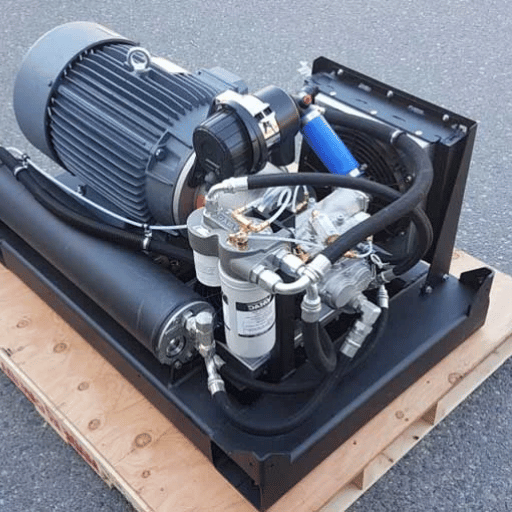
An industrial air compressor distinguishes itself on three concurrent counts: continuous-duty capability, 3-phase electrical supply, and the air flow and pressure rating to support several devices operating concurrently. A 60-gallon hardware-store unit isn’t industrial, it’s a single-phase, intermittent machine that overheats under sustained load. Electric drive dominates the plant floor because the air end run indoors, near a reliable three-phase grid, where an electric motor is quieter, emission-free, and cheaper to run than a comparable diesel or natural-gas unit.
💡 The Industrial-Class Qualifier
What classifies a unit as “industrial”? Meet all three qualifications below and then the unit you “buy” actually will “run”: 1. A publicized and published “continuous duty” rating rather than a published “duty cycle” percent. 2. It runs on 3-phase power, not single phase. 3. It’s appropriately sized for you to run multiple tools or devices at the same time or to power multiple functions simultaneously. If your equipment falls short in any aspect, you actually bought a “heavy duty shop compressor, not a production piece of equipment.”
The first and usually biggest misunderstanding of an industrial purchase is #1. It must run “100% duty – approximately 75% loaded and 25% unload,” as described by a manufacturing engineer; meaning the equipment must simply run. There’s nothing more critical on the plant floor and so central to 70%+ of processes that the United States Department of Energy notes that a machine that make compressed air is indispensable and will return a cost of ownership decade long ROI.
Electric vs Engine Drive: When Electric Wins
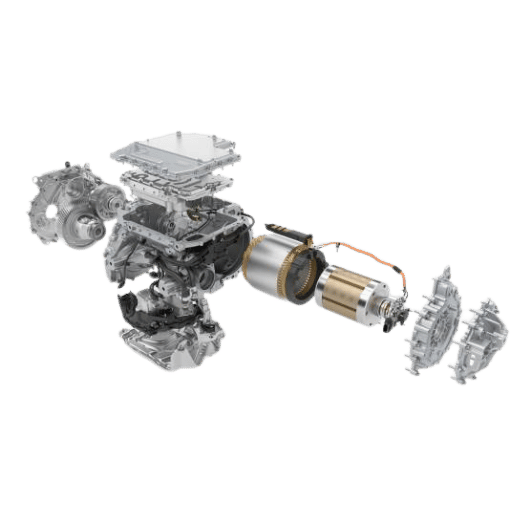
Choose electric drive whenever you have a stable three-phase supply and the compressor lives indoors. Electric is more energy-efficient, runs quieter, produces no exhaust, and carries lower maintenance than an engine. Picture two sites: a fabrication shop on a 480 V feed running its compressor 16 hours a day pays far less per year on electricity than on diesel fuel, and it skips the exhaust ventilation a combustion unit would force indoors. A pipeline-compression crew 40 km from the nearest grid tie-in has the opposite problem — no power to tap — so a CUMMINS-diesel unit is the only practical drive. The deciding variables are grid access, indoor-versus-outdoor siting, and annual run-hours; above roughly 2,000 grid-connected run-hours a year, electric almost always wins on total cost.
This section is the decision rule only. For the full head-to-head on fuel cost, mobility, and emissions, see our companion guide on the diesel vs electric air compressor trade-off, or browse the diesel air compressor range. PanGeng builds the LGF.VF air line in both electric and CUMMINS-diesel configurations on the same air end, so the drive choice never forces a compromise on the compression hardware itself.
Rotary Screw vs Reciprocating (Piston): Matching Type to Duty
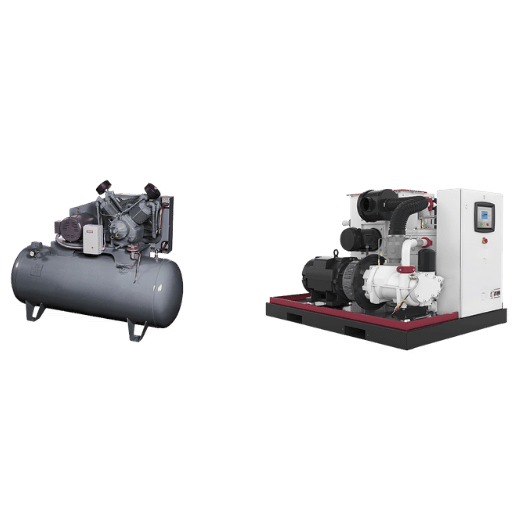
Your first major dilemma is the compressor type: the rotary screw air compressor pushes air with meshing rotors, while the piston type reciprocates and pumps in spurts. The general rule is performance based: a rotary screw is for air needed round-the-clock, where a piston type shines under very high pressure or on-off usage.
The 9-Type Compressor-to-Duty Matrix
| Compressor type / configuration | Duty cycle | Best CFM band | Typical pressure | Best fit |
|---|---|---|---|---|
| Rotary screw — oil-flooded, fixed-speed | 100% continuous | 30–3,000 CFM | 100–175 psi | Steady plant air, multi-shift production |
| Rotary screw — oil-flooded, VSD | 100% continuous | 30–3,000 CFM | 100–175 psi | Variable demand across the shift/day |
| Rotary screw — oil-free | 100% continuous | 30–2,000 CFM | 100–150 psi | Food, pharma, electronics (Class 0 air) |
| Two-stage reciprocating (piston) | 30–70% | 10–150 CFM | 145–175 psi | Intermittent shop use, higher pressure |
| Single-stage reciprocating (piston) | 25–50% | 5–30 CFM | ≤125 psi | Light, occasional manual-tool use |
| Rotary vane | 100% continuous | 10–200 CFM | 100–145 psi | Compact constant-duty packages |
| Scroll | 100% continuous | 2–30 CFM | 100–145 psi | Small oil-free, lab/medical air |
| Centrifugal (dynamic) | 100% continuous | 1,000+ CFM | 100–150 psi | Very large, oil-free plant demand |
| Screw-piston hybrid (high-pressure) | 100% continuous | 45–3,500 CFM | 8–50 MPa | Drilling, blasting, high-pressure process |
Duty-cycle and CFM bands compiled from DOE/CAGI reference data and field practice; values vary by model. High-pressure hybrid band reflects the PanGeng LGF.VF platform.
Which is better: a reciprocating (piston) or rotary screw air compressor?
For most industrial operations, a rotary screw air compressor is the better choice: it runs a 100% duty cycle, delivers more CFM per HP, runs cleaner and quieter, and lasts 60,000-80,000 hours before overhaul. A piston compressor is cheaper up front and tolerates dirty environments, but it only runs a 30-70% duty cycle, so it makes air for part of the time.
So use a rotary screw for continuous air delivery and a piston for blow-off or intermittent hand-tool work. If demand fluctuates but never drop to zero while the machine runs, a variable speed drive lets a rotary screw follow it.
Lubrication is the second axis. Oil-flooded rotary screw compressors survive harsher conditions and cost less; an oil-free compressor delivers ISO 8573-1 Class 0 (class zero) oil-free air where no contamination is tolerated — breweries, food processing, pharmaceutical, and electronics plants. Compare the full ranges on our rotary screw air compressor and reciprocating air compressor pages, or read the deeper rotary screw guide. PanGeng’s LGF.VF design pairs a rotary-screw first stage with reciprocating high-pressure stages, reaching 8–15 MPa where a single technology can’t.
Air treatment is the quiet third decision. Even the best rotary screw compressors send out air that still needs conditioning: an aftercooler (a heat-exchange cooler) cools the hot discharge, and air dryers strip the moisture that corrodes tools and ruins a low pressure process line. Match the wider range of air compressors to the right type of air compressor for the job — a two stage air compressor for higher pressure, or a vacuum pump where you need suction rather than pressure.
Sizing an Electric Air Compressor: CFM, Pressure, and Horsepower
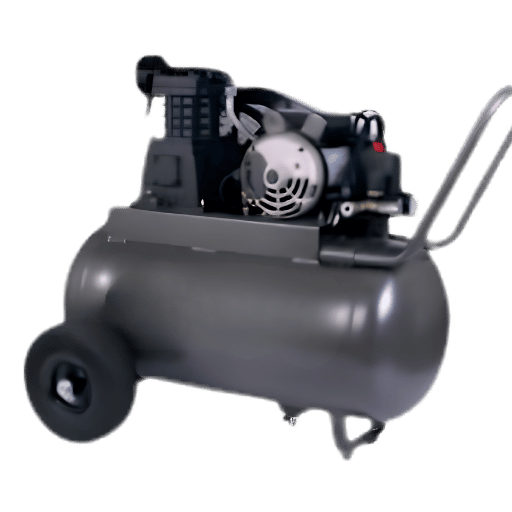
Sizing rests on three linked numbers: airflow in cubic feet per minute (CFM), pressure in psi, and motor power in horsepower (HP). Get the order right and the HP falls out almost automatically.
The 3-Step Compressor Sizing Method
- Adjust pressure first. For example most pneumatic tools and process require 90 to 100 psi at the point of use. Don’t over do “just in case” – each two psi increase is approximately one percent energy increase.
- Add up your CFM demand – the sum of CFM requirements for all equipment running concurrently at that pressure, and then add another 30% to account for future needs, leakage and duty cycle.
- Just read off the HP on your table and know that the generally efficient industrial rotary is around 4-5 CFM per HP at 100 psi so divide the CFM you want to deliver by that number to make it close.
How do I size an air compressor?
Size it to your peak concurrent demand plus a margin — never to a single tool’s rating. Add up the CFM of every tool that may run at once at your working pressure, add about 30% headroom, then match that “CFM at 100 psi” figure to a compressor’s rated output.
An oversized compressor just wastes electricity. If demand is spiky, a receiver tank covers the bursts so you can size for the average instead of the peak.
📐 Engineering Note — Worked Sizing Example
Maximum: Two die grinders (12 CFM each), one plasma cutter (7 CFM), one impact wrench (4 CFM) and blow-off (5 CFM) equals 28 CFM concurrent, operating at 90 psi. Add 30% headroom (36 CFM @ 100 psi). At ~4 CFM/HP this equates to 10 HP, a 10-15 HP rotary screw with a receiver tank in the 80 gallon to 120 gallon range works. One common error is adding up the CFM of every tool that you ever owned – you can get as high as 30+ HP thatway – which leaves you with years of wasted electricity.
Run your own numbers with our CFM sizing calculator, then sanity-check the result against the full electric air compressor range.
Energy and Total Cost of Ownership: Why Purchase Price Is Only ~20%
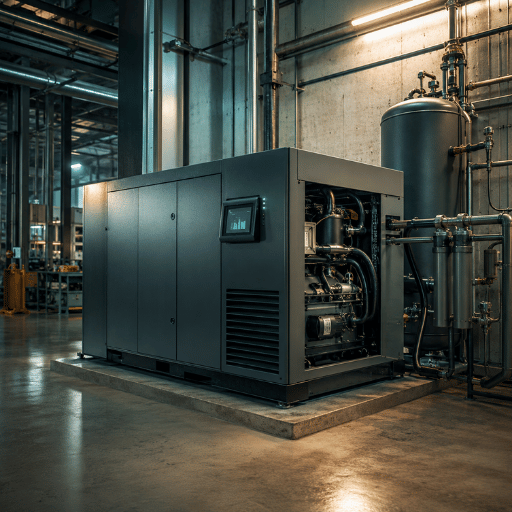
Purchase price is just the beginning of the air compressor operating expense. Total cost of ownership over 7-10 years comprises approximately 80-91% energy and maintenance, compared to 20% for the machine itself- a ratio derived from the PanGeng cost-of-ownership model and the industry average. Independently derived statistics are even more stark: studies of industrial compressed-air use confirm the systems consume roughly 10% of all industrial electricity consumed but less than 10-15% of the energy input is converted to usable work. (U.S. DOE / OSTI research)
📐 Engineering Note — Worked TCO Example
One typical 50 HP (37 kW) rotary screw operating 6,000 hours/year at $0.12/kWh consumes about 37 kW × 6,000 h × $0.12 ≈ $26,600 in electricity annually. This equates to around $266,000 over ten years, significantly out-costing the equipment purchase. A often-cited U.S. DOE standard suggests that producing compressed air can cost as much as 18-30 cents per 1,000 cubic feet. (DOE cost of compressed air) A 10% efficiency gain through improved operating conditions (such as higher pressure or the use of a VSD) saves approximately $2,660 year, after year.
Do I need a variable speed drive (VSD) air compressor?
You need a VSD if your air demand varies across the shift, day, or season. A variable speed drive ramps the motor up and down to match real-time demand instead of running flat out, and field studies of compressed air systems show that can cut energy use by 20-35%. (CAGI VSD case study)
If your load is genuinely flat 24/7, a fixed-speed machine is fine and cheaper. It’s the fluctuation that allow VSD efficiency savings to grow.
💡 The Specific-Energy Yardstick (kW per m³/min)
When comparing bids, don’t get distracted by the sticker price; instead, ask each vendor to provide actual energy consumption-kW per 100 CFM (or kW/m³)-at your typical operating pressure. Even a small 0.5 differential in specific energy for a 75 kW unit will exceed the cost difference between machine quotes within the first two years. This number truly indicates the true cost over a decade.
“Buyers fixate on the quote and the horsepower. We ask them for one number instead, specific energy at their working pressure. Once they see kW per cubic metre against ten years of run hours, the cheapest machine on the page is almost never the cheapest machine to own.”
PanGeng applications engineering team, Bengbu
Model the full picture, energy and maintenance, with our total cost of ownership calculator before you sign anything.
Power and Electrical Requirements: Single-Phase vs Three-Phase

An industrial electric air compressor won’t turn on unless you’ve the right electrical supply – one of the most common causes of install delays. Under 5 HP, a single-phase 230 V supply might suffice; but from 7.5 HP up, you effectively need a three-phase power supply, normally anywhere from 208–480 V here in North America. CAGI reference data notes large motors also draw heavy inrush current at start, so a soft starter or VSD protects both the motor and the rest of your plant.
- Confirm three phase – either 208/230/460/480 V, when your motor is 7.5 HP or higher.
- Check that the breaker and the wire size match up with the full-load amps required by your motor, not its Horsepower rating.
- In the case of motors over roughly 20 HP, select either a soft starter or VSD so you can limit the inrush.
- Ensure that your controller or starter selection are specified for your power supply voltage and frequency (whether 50 or 60 Hz).
⚠️ Important
Don’t take for granted that you can just hook any available three-phase drop to run it. The amount of fault current, frequency, and voltage all matter. Before your supply is shipped, inform your supplier as to what incoming voltage and phase you’ll have, as electrical hook-up is the #1 cause of install delays.
Application Match: Plant Air, Fabrication, Laser/Plasma Assist, and Beyond

Each of the main industrial applications influences motor requirements; whether its pressure, air quality, or flow rate they each pull the motor specs in different directions. Select a standard starter spec based on primary use application; then fine tune. The most common selection mistake here is under-specifying air quality: run a Class 0 process — a paint booth, a food line, or electronics assembly — on ordinary oil-flooded air, and oil carryover contaminates the product and scraps whole batches. ISO 8573-1 defines the purity classes that prevent that failure, so match the air-quality column below to your process before you size anything.
| Application | Recommended type | Pressure / flow band | Air quality |
|---|---|---|---|
| General plant air | Oil-flooded rotary screw | 100–125 psi, sized to demand | Standard, filtered |
| Sandblasting | High-flow rotary screw | 100–150 psi, high CFM | Dried, standard |
| Plasma / laser assist | Rotary screw + dryer | 120–175 psi, clean dry air | Low dewpoint, oil-removed |
| Automotive paint / finishing | Oil-free or oil-flooded + filtration | 100–125 psi | Class 0 oil-free preferred |
| Food / pharma / electronics | Oil-free rotary screw | 100–145 psi | ISO 8573-1 Class 0 |
Beyond standard plant air, the LGF.VF platform also covers heavy-duty mobile work, drilling and blasting, at 1.3–100 m³/min, fixed, skid-mounted, or vehicle-mounted. For pressures beyond standard plant air, a dedicated air booster compressor or the centrifugal air compressor range handles the extremes. Across industries and applications — from a contractor’s mobile rig to a stationary plant-air system — the goal is the right air compressor for your application: a dependable supply of compressed air sized to the work. Match the compressed air equipment to your real compressed air needs, not the brochure peak, and air power flows where it is needed without wasted energy.
What’s Changing in 2026: IE4 Motors, VSD, and Smart Monitoring
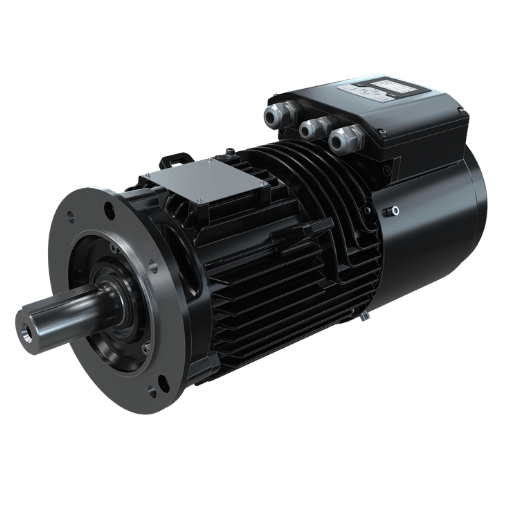
The most important 2026 shift for buyers is not a bigger market — it is tightening regulation, and it changes what you should specify today. Motor-efficiency rules keep climbing, and that reshapes how you choose both the drive and the controls on your next compressor.
The standards continue to rise: IE1-IE4 ratings are defined in IEC 60034-30-1 (latest 2025 edition), and the US Department of Energy mandates that by 2027 large electric motors meet the top IE4 efficiency class (an analysis by motor manufacturer ABB indicates a 200 HP unit must be roughly 96% efficient to reach IE4). IEC efficiency classes DOE motor standards
Perhaps the biggest shift however; regulators are turning from a single component evaluation, to the overall package efficiency. This means that purchasing a lower efficiency, single speed unit now will soon turn into an expensive, under-valued asset that has limited sell ability. Consider a plant that installs a fixed-speed IE3 machine in 2026: when it later expands or tries to resell that asset, the unit may no longer meet the tightened efficiency floor — stranding capital and forcing an early, unbudgeted replacement. An IE4 motor runs roughly 1–3 percentage points more efficient than the older IE2 baseline it replaces, which on a 75 kW compressor running continuously can waste or save several thousand kWh a year. What this means is, specifying an IE4 unit with variable speed and predictive technology will protect the total cost of ownership while supporting your efficiency initiatives – patent activity suggests variable speed efficiency is the trend moving forward. USPTO US6216474B1 A stationary plant compressor with a touch-screen controller and IoT monitoring can flag a fault before it becomes downtime, and the same telemetry turns small efficiency drifts into measurable energy savings and stronger energy efficiency. Global air compressor industry market share – expected to grow approx. 4.5 – 5 % per year. The regulatory standards should however be your main criteria when selecting an air compressor solution.
Buying Checklist: Vetting an Industrial Electric Air Compressor Supplier

Once the specification is in hand, the supplier can still either give you a decade of operation, or a decade of heartburn. A compressor designed and built to last only earns its keep if the supplier stands behind it — rugged hardware, real compressor experts to call, and service technicians who cut downtime instead of adding it. Reliability is a supplier property as much as a spec-sheet line. Get these on paper instead of through sales patter:
- Factory Acceptance Test – The supplier must submit a 100% FAT report using a ISO 9001 quality system with each machine.
- Published specific energy – kW/ m/min at your pressure required. Not in horsepower!
- warranty coverage – air-end warranty for multiple years; check the limits.
- MOQ and lead time – have this guaranteed by email (PanGeng averages 6-10 weeks for standard designs and 12-16 for custom designs; a 1-unit MOQ applies.)
- Spares and support -availability of all wear-parts (rings, filters, separators, and valves), and speed of technical support.
- Certification standards – ISO 9001, CE, ASME, and compliance standards specific to your intended application (ISO 8573-1 standard, API 618 for higher pressure, and so on).
- Target MTBF (mean time between failure) – know your equipment’s projected operational life (PanGeng exceeds 50,000 hours.)
Can we assist with finding a machine to cover your unique CFM, pressure, and operational conditions?
Frequently Asked Questions
Q: Which air compressor is best for industrial use?
View Answer
For most industrial use, an oil-flooded rotary screw air compressor is the best general choice. It runs at a 100% duty cycle for continuous, multi-shift demand, delivers more CFM per horsepower than a piston unit, runs quieter and cleaner, and carries a lower lifetime energy cost. Choose an oil-free rotary screw where air purity matters — food, pharmaceutical, or electronics — and reserve a two-stage piston for intermittent or high-pressure work where continuous duty is not required.
Q: How much does an industrial electric air compressor cost?
View Answer
Purchase price varies widely with HP, type, and air treatment, but it is only about 20% of the real cost. Over 7–10 years, energy and maintenance make up roughly 80–91% of total cost of ownership, so a machine that costs more up front but runs more efficiently is usually cheaper to own. Request a quote tied to your CFM and pressure rather than a list price (figures as of 2026).
Q: Can an electric air compressor run continuously all day?
View Answer
A rotary screw industrial unit can — it is rated for a 100% duty cycle and designed for continuous operation, typically loaded about 75% of the time and unloaded the rest when sized correctly. A piston compressor cannot; its 30–70% duty cycle forces it to rest. For all-day demand, choose rotary screw.
Q: Single-phase or three-phase: which do I need for an industrial electric air compressor?
View Answer
It depends on motor size. Below about 5 HP a single-phase 230 V supply can drive it; at 7.5 HP and above — the range most plants need — it effectively requires three-phase power, usually 208–480 V. Confirm your incoming voltage and phase with the supplier before ordering.
View Answer
Only when your process cannot tolerate any oil carryover — food, pharmaceutical, electronics, or paint lines needing ISO 8573-1 Class 0 air. For general plant air, an oil-flooded compressor with good filtration is more durable, simpler, and cheaper to own.
Q: How do I calculate the CFM I need?
View Answer
Add up the CFM rating of every tool and process that runs at the same time at your working pressure, then add about 30% headroom for leaks and growth. That total is your required “CFM at 100 psi.” For example, 28 CFM of concurrent tools plus 30% gives ≈36 CFM, which points to a 10–15 HP rotary screw. A receiver tank lets you size for average demand rather than brief peaks.
Q: Rotary screw or piston, which lasts longer?
View Answer
A well-maintained rotary screw lasts 60,000–80,000 hours before a rebuild and is built to run continuously; a piston unit is simpler and cheaper but wears faster under heavy, sustained duty. For continuous industrial use, the rotary screw clearly lasts longer.
References & Sources
- Compressed Air SystemsU.S. Department of Energy
- Determine the Cost of Compressed Air for Your PlantU.S. Department of Energy
- Energy, Economic and Environmental Analysis of Compressed Air Systems (Kapp, 2023)U.S. DOE OSTI
- Uniform Methods Project, Ch. 22: Compressed Air Evaluation ProtocolNREL
- Electric Motors, IE Efficiency Classes (IEC 60034-30-1)International Electrotechnical Commission
- Energy Conservation Standards for Electric Motors (2023)U.S. Federal Register
- Variable Speed Drive Case StudyCompressed Air and Gas Institute (CAGI)
Why We Wrote This Guide
PanGeng has engineered electric and diesel-driven air compressors for industrial plants across 50+ countries since 2009. The sizing method, specific-energy yardstick, and TCO figures in this guide come from our LGF.VF production data and Factory Acceptance Test records, cross-checked against U.S. DOE and CAGI sources, not from a sales sheet. Reviewed by the PanGeng Compressor technical team.
Related Articles
- Top Industrial Air Compressor Manufacturers — the wider supplier landscape
- Industrial Air Compressors — the full PanGeng range
![Low Pressure Hydrogen Compressor Applications [Guide]](https://pgcompress.com/wp-content/uploads/2026/09/low-pressure-hydrogen-compressor-applications-blog-featured-150x150.png)