Get in Touch with Pangeng

High-Pressure Nitrogen Compressor Selection: 12 Proposal Checks Before Purchase

Contents
show
Buyer-side technical review
High pressure nitrogen compressor selection is the buyer-side process of normalizing and challenging supplier proposals after preliminary sizing, and it should not end with the arrival of three quotations because nitrogen’s service boundary, competing nitrogen compressor solutions, and high-pressure cylinders still need a like-for-like review. This is when the real work starts: ensuring that all offers are based on the same design, verifying the assumptions behind the arrangement of the various stages, identifying contamination and leakage boundaries, and reaching consensus on what the factory test should demonstrate.
This guide begins after an initial request for quotation (RFQ) has been issued and the after-sales scope is ready for comparison. Still uncertain about the flow rates, inlet pressure, delivery pressure, purity requirements, duty cycle, storage, any energy storage interface, or the evidence behind an energy-efficient claim? First, use the nitrogen compressor sizing guide. The purpose here is different: turn unlike supplier proposals into an auditable go, clarify, or stop decision.
The short version: Do not compare price, installed power, or stage count until each vendor has signed off on the same process cases, reference conditions, package limits, site data, and acceptance method. A cheaper package built around easier assumptions is not a cheaper solution.
Start After Sizing: What This Selection Guide Owns
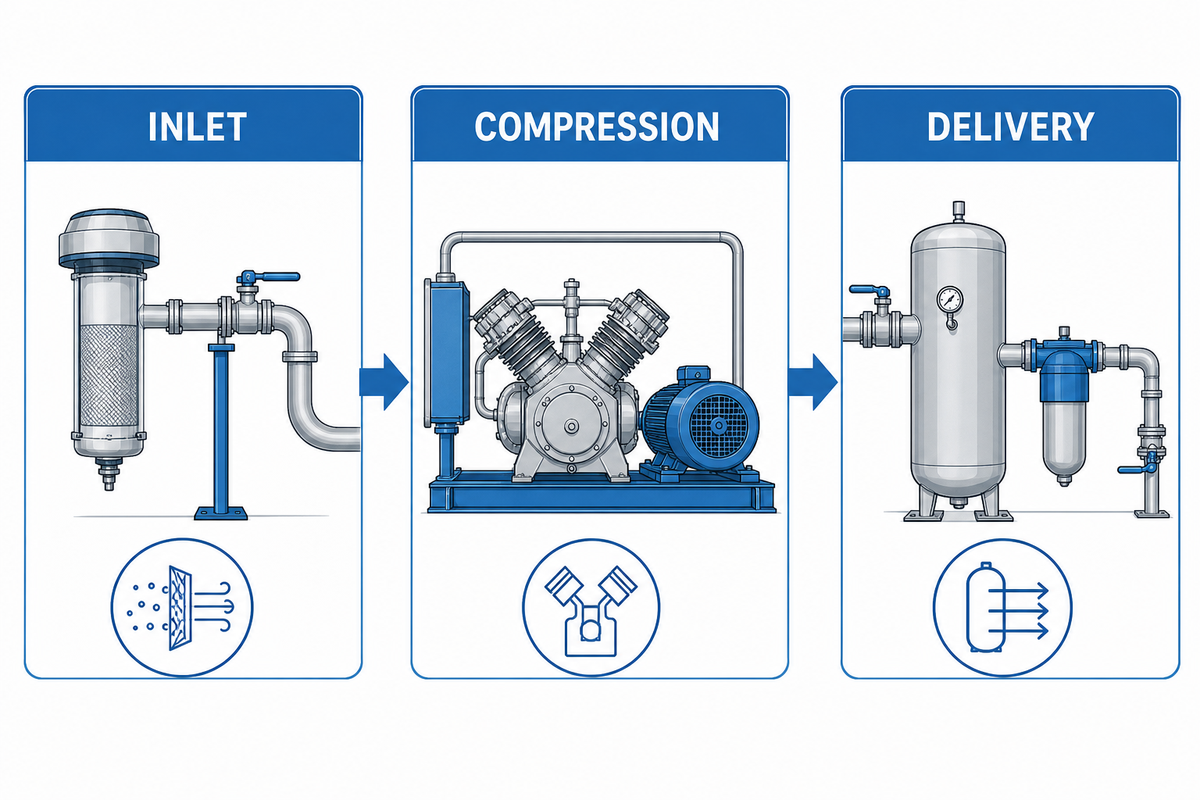
PanGeng has other resources with basic specifications for nitrogen compressor, differences between boosters and compressor applications, and widest industrial nitrogen compressor options. Covering those topics again in this resource would make the cluster less useful and create ambiguity on which page to answer specific searches.
This page covers the post-RFQ review. You should have a technical proposal, as well as related project information, to challenge it. The output is not a favorite brand or type of compressor for your application. The outcome is a list of assumptions, questions (with owners), exceptions (that are ruled out), and purchase order requirements that are testable.
GO
The proposal uses the agreed basis, supports critical claims with calculations or records, and defines acceptance evidence.
CLARIFY
An open point is bounded, has an owner and due date, and does not invalidate the selected architecture.
STOP
The supplier will not define a safety boundary, guarantee basis, package exclusion, or method for proving performance.
Normalize Every Proposal to One Common Design Basis
Values given in terms of capacity (Nm³/h, Sm³/h, SCFM, etc.) or actual inlet volume must be clarified by the reference conditions (temperature and absolute pressure), moisture basis and location of measurement. The same is true for pressure. “250 bar discharge” does not give sufficient information.
Create a Common Design Basis Sheet and make all bidders complete the same rows. The Ariel calculation guidance shows compressor predictions are dependent on what bidder declares as suction conditions, discharge conditions, gas properties and operating cases, as opposed to product label alone.
| Comparison row | What must be fixed | Evidence to request | Stop signal |
|---|---|---|---|
| Gas | Nitrogen composition, purity, dew point, trace contaminants, molecular data used | Design composition and allowable range | “Pure nitrogen” with no specification |
| Flow | Net delivery, reference conditions, dry/wet basis, normal and peak demand | Conversion basis and guarantee point | Different reference conditions hidden in footnotes |
| Suction | Minimum, normal, maximum pressure and temperature at the package boundary | Case table including upstream losses | Only nominal inlet pressure is evaluated |
| Discharge | Required delivery pressure, measurement point, downstream losses | Pressure profile to the user boundary | Compressor flange pressure is presented as user pressure |
| Duty | Annual hours, continuous or intermittent operation, peaks, starts and turndown | Operating profile and control narrative | One full-load point represents the entire year |
| Package | Motor, coolers, separators, controls, filters, receiver, piping and instruments | Scope list and battery-limit drawing | Critical auxiliaries sit in “by others” |
Add four management columns: discrepancy, responsible party, due date, and disposition. Discrepancy: The origin of the inconsistency. Responsible Party: The person or organization that owns the discrepancy. Due Date: The date by which the discrepancy must be resolved. Disposition: The action to be taken with respect to the discrepancy. While subtle, this change transforms a data sheet into a decision making tool. It prohibits procurement from assuming unanswered questions are no-cost changes.
| Review category | Boundary to normalize | Question for the proposal |
|---|---|---|
| Industrial gas source | Delivered liquid, cylinder, pipeline, membrane, or on-site PSA nitrogen | Which source conditions define the gas supply at the compressor inlet? |
| Gas compressor duty | Net nitrogen delivery rather than displacement | Is the quoted flow available at the agreed outlet boundary? |
| Air compressor interface | Feed-air package when nitrogen is generated on site | Is feed-air consumption inside or outside the vendor scope? |
| Purity class | High-purity nitrogen gas composition and dew point | Where and how is quality verified? |
| Pressure basis | Absolute and gauge values at named locations | Do all vendors use the same suction and delivery points? |
| Demand profile | Normal, peak, low-load, and recovery operation | Which cases are guaranteed, derated, or prohibited? |
| Storage tank | Usable pressure band and control interaction | Is receiver behavior included in the control narrative? |
| Pipeline boundary | Downstream losses, valves, filters, and regulators | Does compressor discharge equal required point-of-use pressure? |
| Industrial applications | Process-specific cleanliness, continuity, and safety needs | Which application requirements are purchase-order obligations? |
| Safety classification | Inert and non-flammable gas, pressure energy, and oxygen displacement | Who owns venting, relief, ventilation, and site risk assessment? |
Audit Pressure Basis, Staging, and Discharge Temperature
In high-pressure service, pressure is measured in psia, psig, barg, and bara, while the air separation source, high humidity, and extreme temperatures remain separate site-design inputs. A special effort must be made to capture these conditions and locations of measurement. Separate normal operating pressure from maximum. Related values are not synonyms.
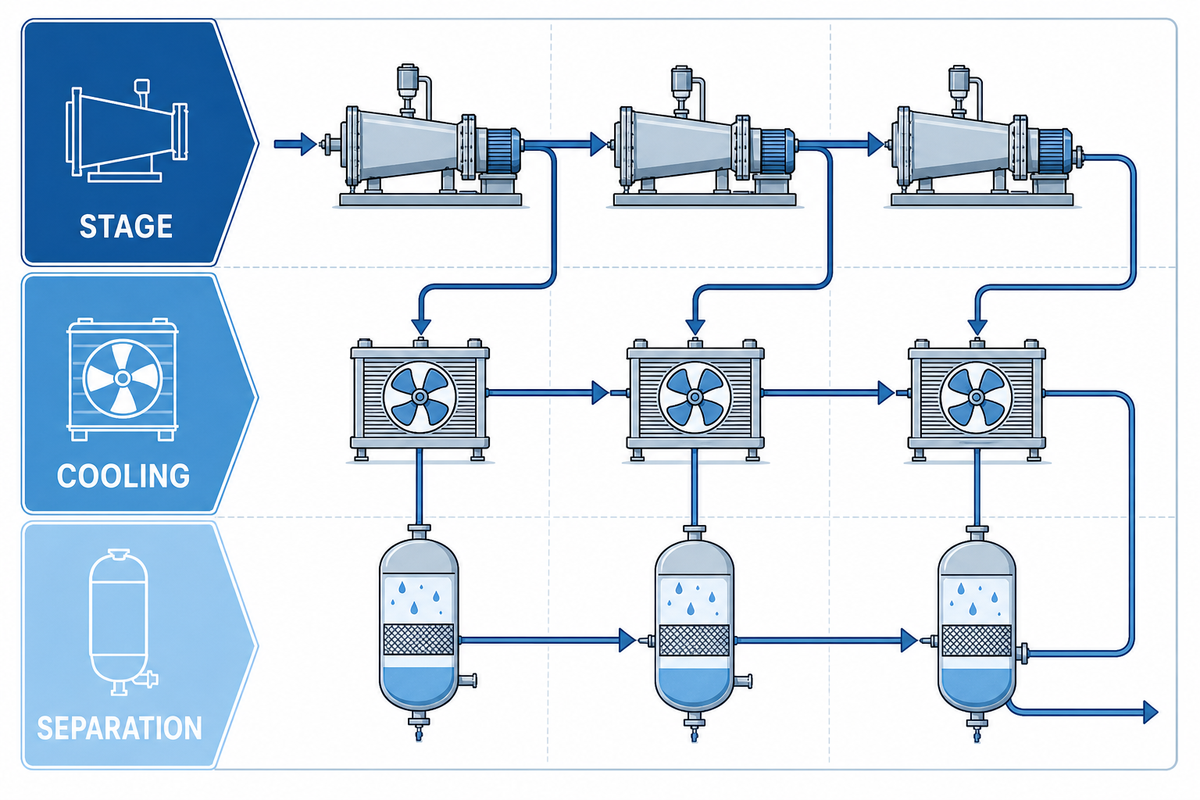
For the minimum, normal and maximum cases, ask for a stage table. Each case must show the suction pressure and temperature of the stage and the discharge pressure and temperature. Intercooler outlet temperature, conditions of the cooling medium, separator duty and absorbed power must also be included. Specify the tolerances. Check the calculation limits against the supplier’s engineering basis (the Ariel Application Manual for a reciprocating compressor frame, for example).
Do not buy a stage count. More stages are not automatically safer or more efficient, and fewer stages are not automatically simpler or cheaper. Stage arrangement is a result of pressure ratio, gas properties, temperature limits, cooling, machine architecture, operating envelope, and vendor design limits.
In the absence of stage data, it cannot be assumed that high off-design temperatures, a high temperature risk as pressure rises, missing pressure testing evidence, an assumed inlet pressure that the site cannot support, and a cooling duty that exceeds the available utility are resolved within the design.
Verify the Contamination Boundary Behind an Oil-Free Claim
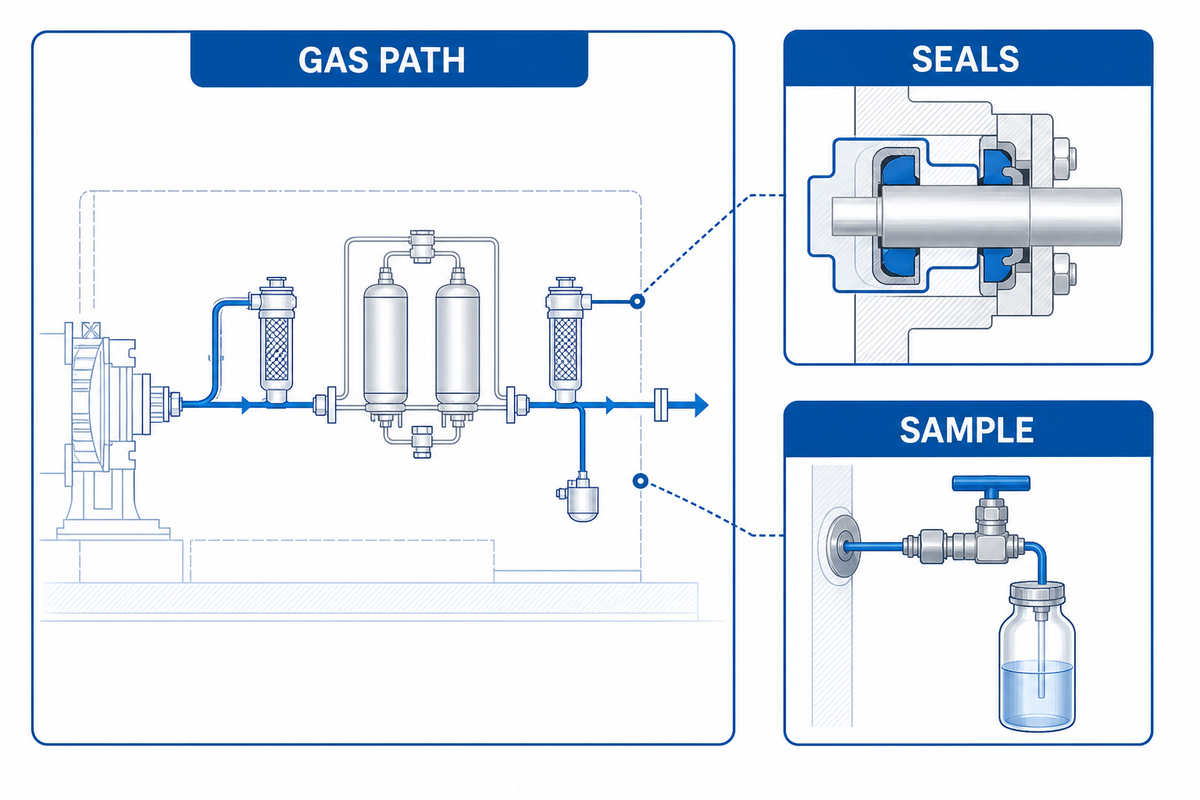
The term “oil-free” needs a noun, a boundary, and a measurement method. It may describe an unlubricated cylinder, a compressor chamber with no process side oil injection, a boundary around gas-contact components, or a specified gas sample. These are not interchangeable statements.
Create a “Boundary Map of Gas-Contact and Contamination”. Trace cylinder, compressor chambers and diaphragms, piston rings and membranes, packing, distance pieces, crankcase separation, purge and buffer gases, coolers, separators, drains, receivers, filters, valves, and piping downstream. Consider potential directional leakage during startup, shutdown, normal and abnormal wear, and maintenance.
Ask the supplier to complete this sentence: “The guaranteed cleanliness applies at ___, under ___ operating cases, measured by ___ method with a detection limit of ___, provided that the following buyer-supplied equipment and maintenance conditions are met: ___.”
The answer should also identify the inert gas-contact materials and the gas purity, dew point, contaminant limits, and purity levels for which they were selected. Should a technology-level comparison be necessary, use the oil-free versus oil-lubricated nitrogen compressor guide. Here, the question is whether the proposal’s boundary can be verified.
Check Leakage, Venting, Relief, and Nitrogen Safety
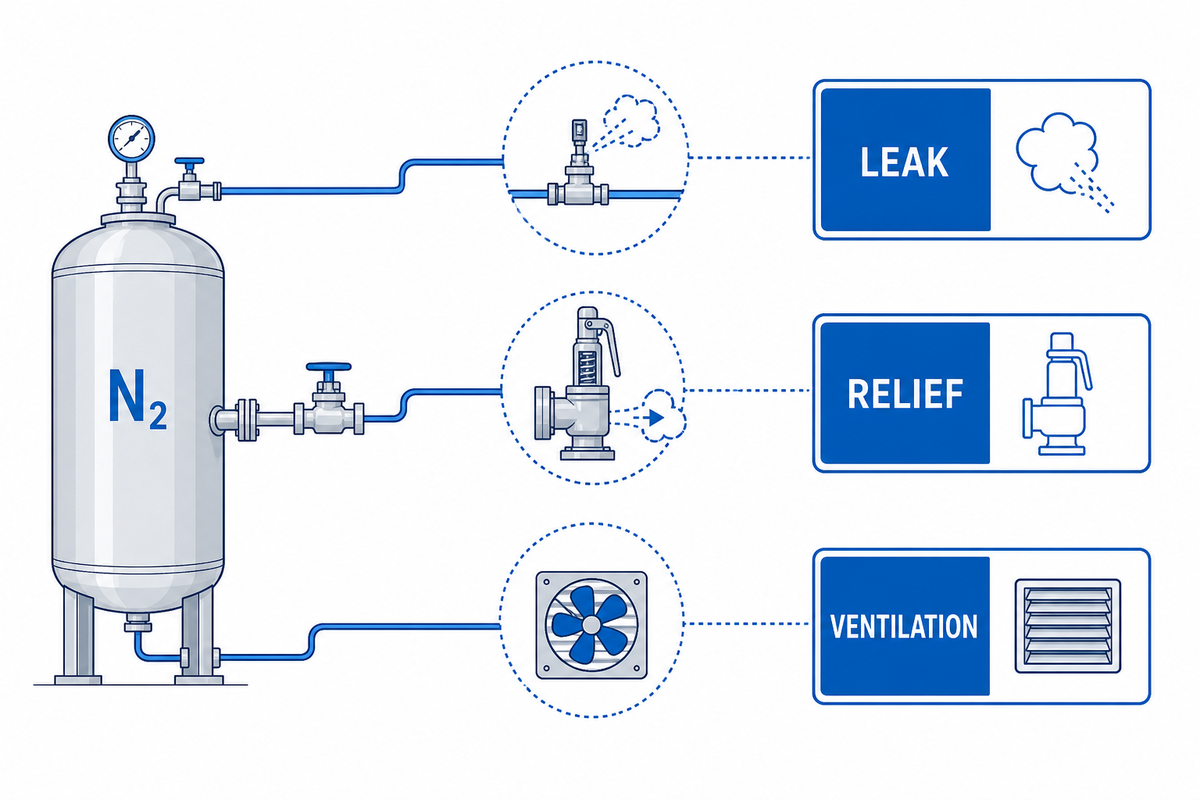
Facilities use nitrogen because it is inert and nonflammable, but nitrogen storage and nitrogen consumption still affect the system boundary, while inertness does not remove pressure hazards or the possibility of oxygen displacement. For confined-space rules, OSHA uses less than 19.5% oxygen as the definition of an oxygen-deficient atmosphere. That number is a regulatory definition for the cited context, not a substitute for a project-specific ventilation and hazard assessment. See OSHA 29 CFR 1910.146.
Identify all normal and abnormal releases: packing leak, purge discharge, distance piece vent, relief valve discharge, blowdown, separator drains, maintenance depress, analyzer vents and receiver vents. Assign expected composition, pressure, frequency, destination, monitoring, isolation and the design engineer for each.
The wide range of applications creates varied product quality requirements, so the site owner and qualified engineers determine applicable pressure vessel rules, relief system design, ventilation, oxygen monitoring, hazardous area classification, fire and gas system interfaces, and local jurisdictional requirements. A compressor supplier can provide package data, but should not silently become the owner of undefined site risks.
Test Controls, Turndown, and Off-Design Operation
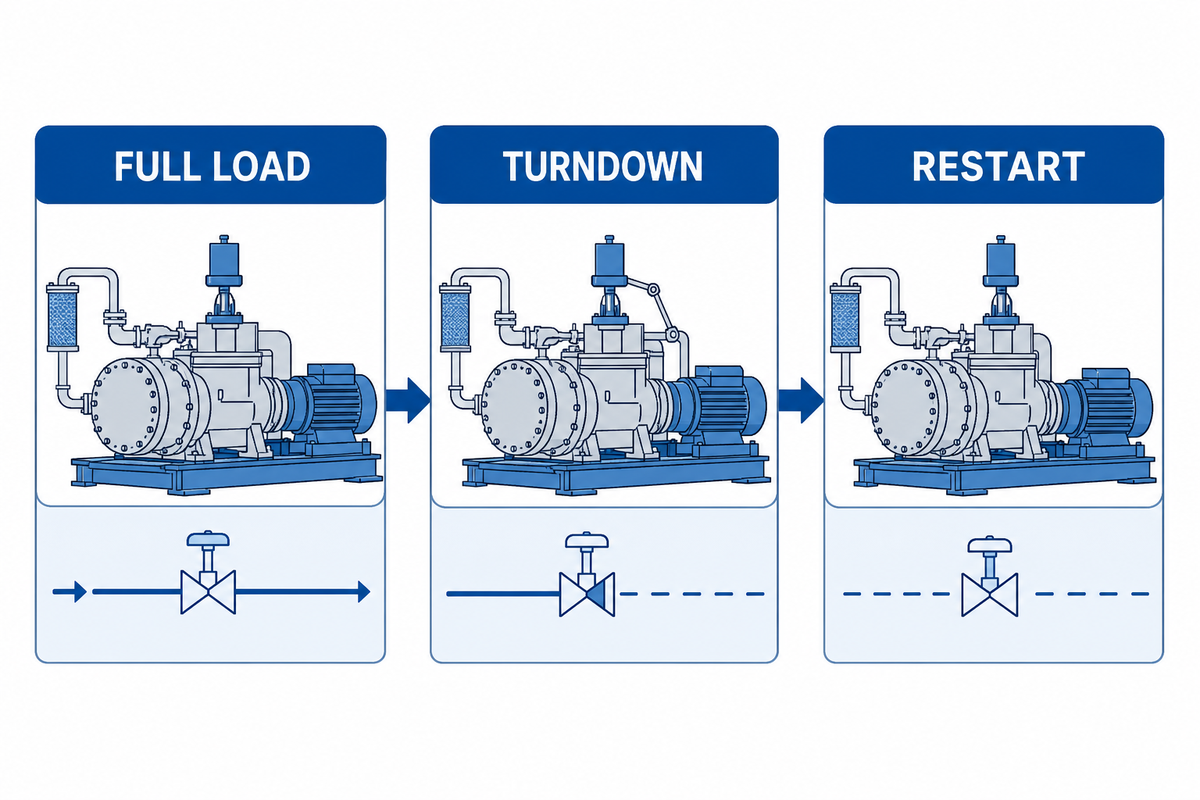
Little is said by a full-load guarantee about what happens during peak or low demand. What happens to dry nitrogen delivery during a drop in the inlet pressure from on-site nitrogen generation or PSA nitrogen generators? What if there is a high ambient temperature? What happens if there is a loss of cooling? Ask for a control narrative.
Use the operating-profile discipline in the U.S. Department of Energy’s compressed-air system evaluation guidance to document load points, controls, and measured behavior rather than relying on a nameplate case.
Capacity control
Define speed control, unload, recycle, bypass, stop/start logic, receiver interaction, minimum stable operation, and forbidden zones.
Permissives and trips
List start permissives, alarm delays, shutdown setpoints, restart rules, emergency-stop behavior, and reset authority.
Data ownership
Agree tags, units, sampling rate, trend storage, remote access, time synchronization, event logs, backups, and cybersecurity responsibility.
For each off-design case, ask 3 questions. Is it guaranteed? Is it allowed with derating? Or, does it result in a controlled shutdown? A supplier who answers these questions clearly is easier to compare than one with a broader, undefined “operating range.”
Close Controls, Utilities, and Site Interfaces Before Award
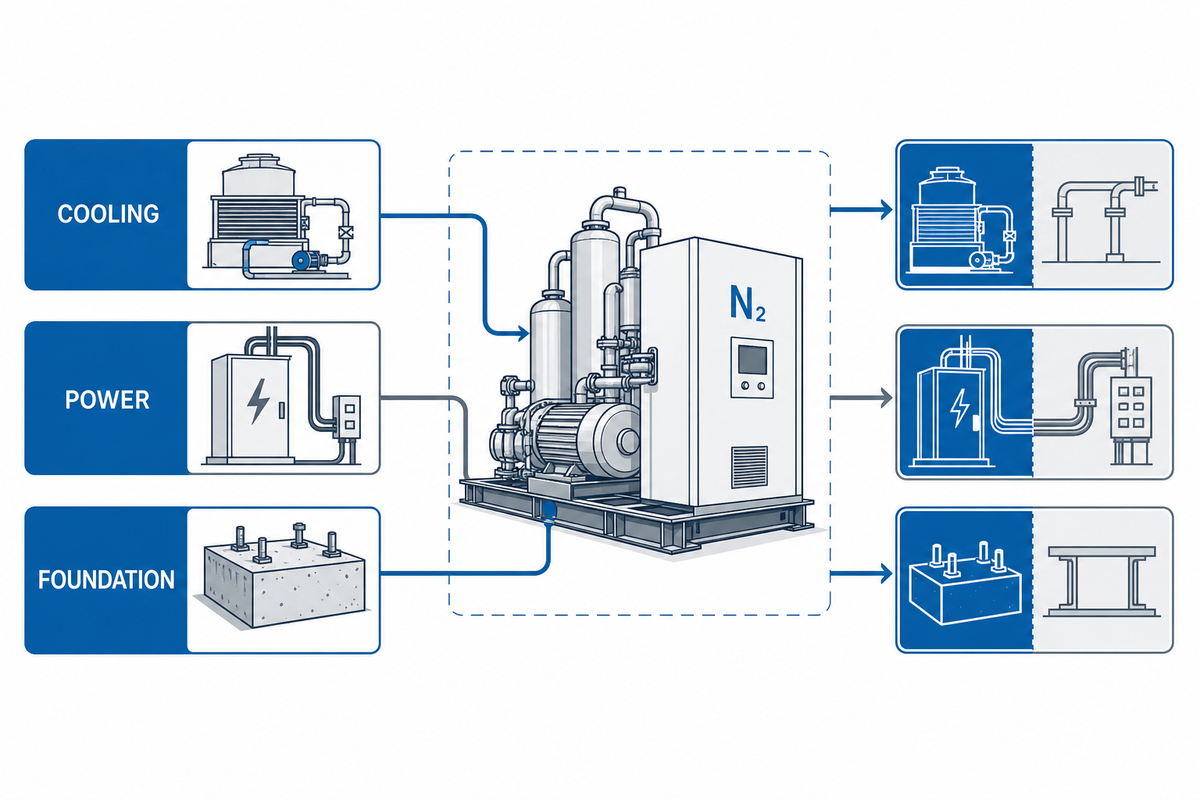
Several change orders can result when interfaces are left unassigned. Scope exclusion is reasonable when the interface is visible and technically defined, priced elsewhere, and assigned to an owner.
The Ariel Application Manual illustrates why compressor-package decisions must be tied to defined application conditions and system boundaries.
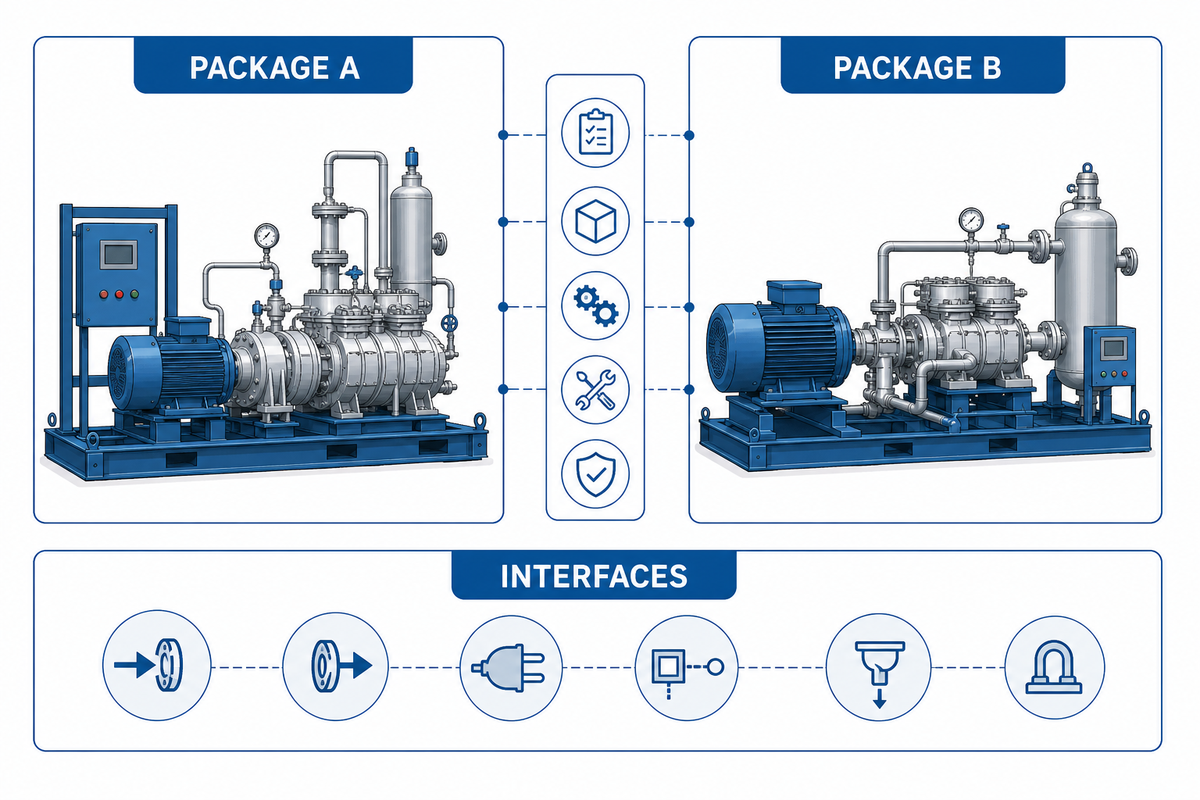
An Interface Closure Matrix can be used to show alignment of scope for the following: Electrical supply, Voltage & Frequency, Short Circuit, Motor Starting, Cooling Water & Temperatures, Ambient Temperature, Drains, Ventilation, Foundation, Lifting & Maintenance Clearances, Piping Loads, HACZ, Insulation & Heat Tracing, Noise Boundary, PLC/DCS, F&G Signals, Erection & Commissioning, Performance Testing Utilities.
Practical rule: Every interface row needs a value or document, an owner, a due date, an acceptance criterion, and a consequence if it remains open. “To be confirmed” is not a closed interface.
Integrated packages can reduce the number of interfaces; however, integration doesn’t remove the need to define boundaries. A skid which contains generation, compression, storage, controls and receivers, for example, still has electrical, cooling, and ventilation interfaces whose owners must be assigned.
Make the FAT Prove the Proposal, Not Just That the Package Runs
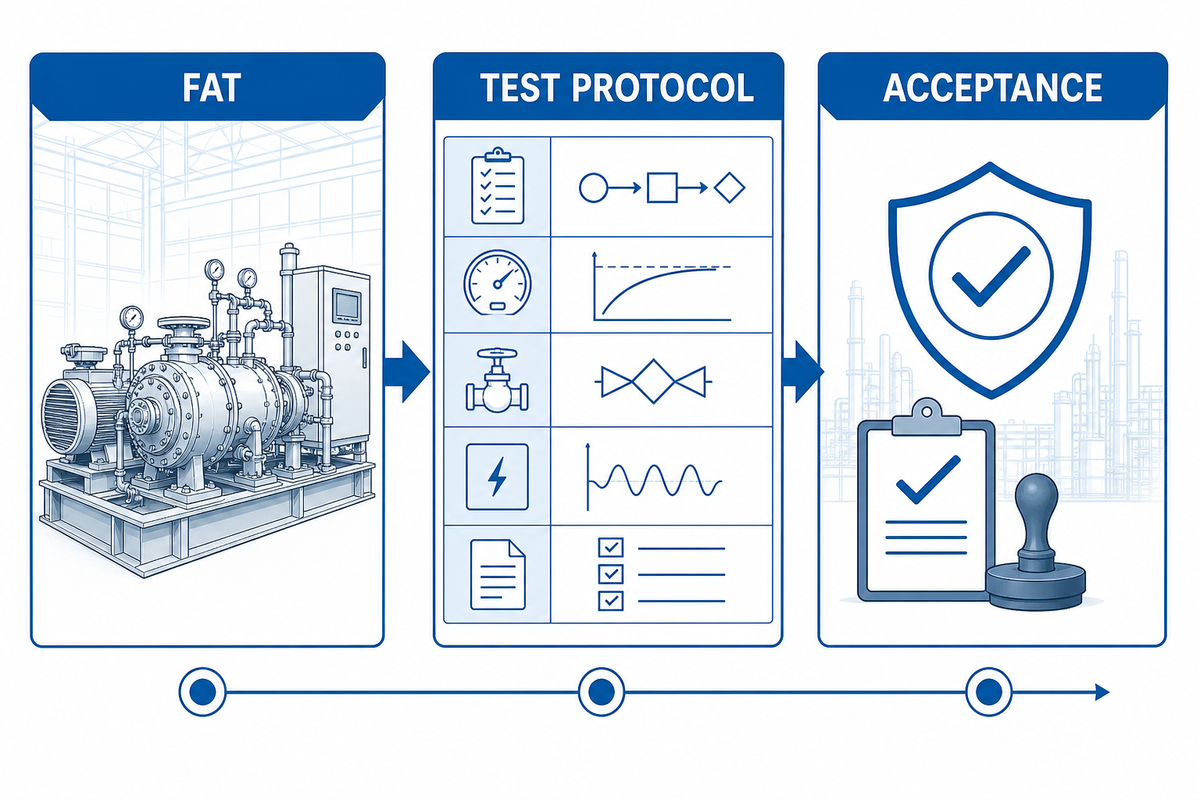
The answers in a factory acceptance test protocol should be sufficient to define test conditions, instruments, tolerances, and deviation handling. Approve the test protocol with the equipment manufacturer, including relevant ancillary equipment, before the manufacturing process is complete and while design and instrumentation changes are still feasible.
Use the same documented application conditions described in the Ariel Application Manual when defining what the factory test can prove and what must carry over to site acceptance.
The FAT Evidence Pack should cover the test medium, inlet conditions, load points, correction method, calibrated instruments, tolerances, stabilization period, witness points, retest rules, and deviation process. It should also cover construction and tag checks, control rotation, alarms, trips, emergency stop, leak testing, vibration, stage temperatures, cooler behavior, and agreed performance points.
| FAT question | Required record | If full site conditions cannot be reproduced |
|---|---|---|
| Was the promised configuration built? | Approved drawings, bill of materials, nameplates, instrument list, punch list | Record every substitution and its approval |
| Do controls protect and operate the package? | Cause-and-effect test, alarm/trip record, control trends | Identify simulations and repeat site-dependent loops at SAT |
| Does performance match the guarantee? | Raw readings, calibration data, correction method, calculation sheet, tolerances | Agree the test gas and correction method before FAT |
| Are open items controlled? | Deviation register with owner, date, disposition and retest need | Carry unresolved site items into a signed SAT plan |
A no-load run may confirm rotation and basic control behavior, but it cannot be considered a performance guarantee. Conversely, a factory cannot reproduce all site conditions. The honest approach is to separate factory acceptance tested evidence from site acceptance testing.
Compare Lifecycle Cost and Vendor Risk on the Same Boundary
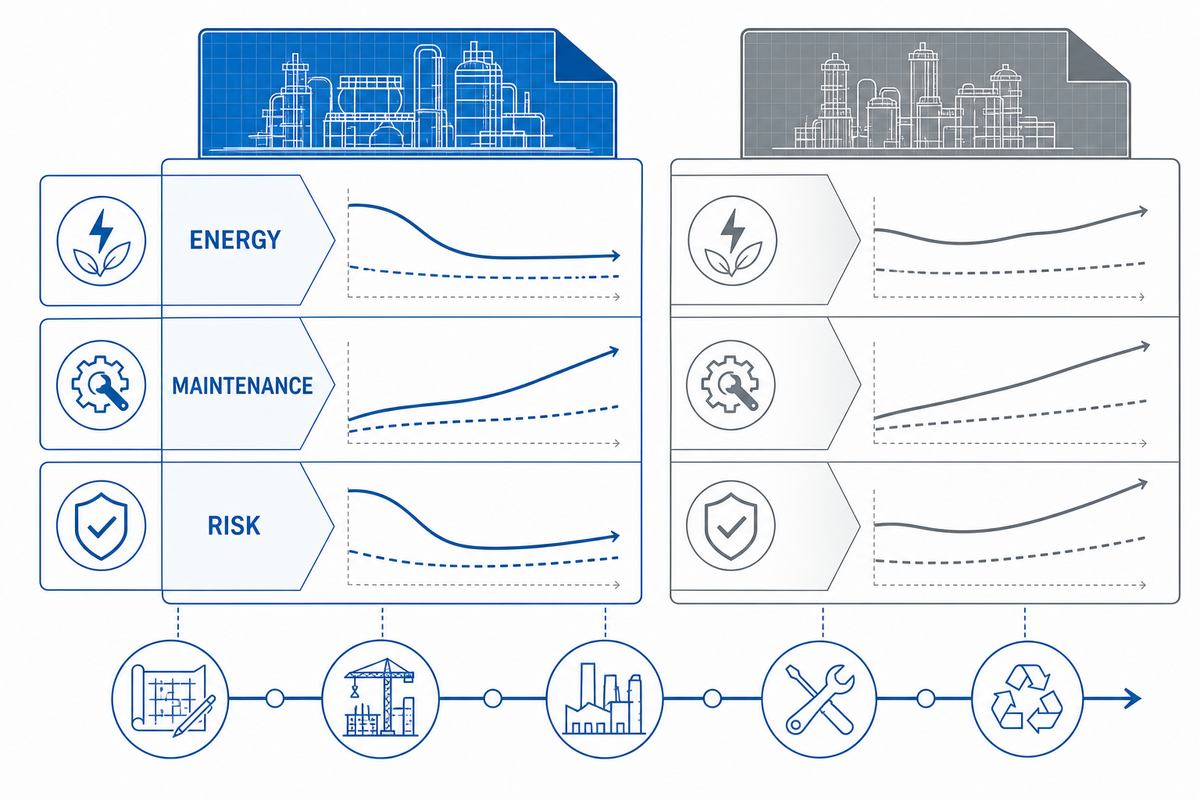
When evaluating the cost of a purchase, many assumptions beyond purchase price are considered, including operating costs, operational costs tied specifically to continuous supply, buyer-supplied tariffs, operating hours, cooling and maintenance costs, consumables and spare parts, overhauls, consequences of downtime, financing costs, and the paid-for duty profile.
The U.S. Department of Energy’s compressed-air system evaluation guidance is useful in setting the general frame of measuring power and operating behavior. Nitrogen service still requires its own nitrogen supply boundary, a definition of the nitrogen stored on site, a supplier guarantee, and an agreed basis for cost per unit.
| Scorecard area | Normalize | Risk question |
|---|---|---|
| Capital scope | Base package, auxiliaries, options, freight, installation, commissioning | What required item is excluded? |
| Utilities | Power at the same cases, cooling, purge gas, instrument air, ventilation | Are package-only and total-site loads mixed? |
| Maintenance | Routine tasks, consumables, major overhaul scope, labor, special tools | Are intervals guarantees, recommendations, or estimates? |
| Spares and service | Two-year spares, critical rotables, local stock, technician travel, response terms | What happens when the stated service path is unavailable? |
| Evidence | Calculations, references, drawings, FAT/SAT records, manuals, certificates | Is a low price supported by less evidence? |
Always maintain an evidence confidence column next to cost. Information not provided is uncertainty, not zero. Procurement can always apply its own risk allowance or stop condition, but should not let missing evidence or incomplete assurance make an offer look efficient.
The final go-or-stop review should also retain the measurement and operating-profile discipline described in the Department of Energy’s system evaluation guidance.
Decision Framework: 12 Go, Clarify, or Stop Checks
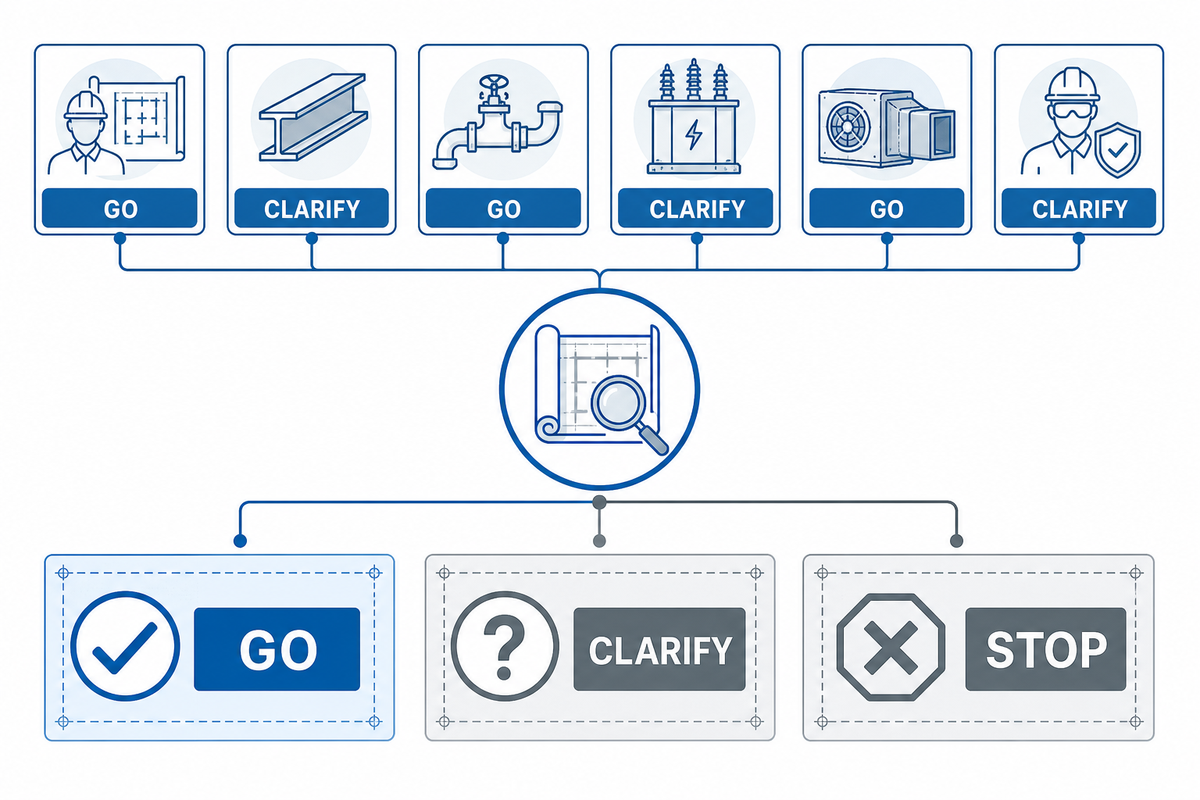
- Common design basis signed: Referential conditions, operating cases, site data, and package limitations agree.
- Flow guarantee aligned: Net delivery, tolerance, reference basis, and measurement point are all defined.
- Pressure boundary aligned: Suction and delivery points, losses, operating, design, alarm, trip and relief values are all specified.
- Stage table supplied: Minimum, normal and maximum cases show pressure, temperature, cooling and power.
- Contamination boundary mapped: The scope and test method for the oil-free or cleanliness claim is defined.
- Release paths assigned: Leaks, vents, drains, purges, blowdowns, and reliefs have owners.
- Control narrative accepted: Full, low, and upset loads, trips, restarts, remote control are defined.
- Interfaces closed: Utilities, installation, hazardous areas, piping, DCS, access, and maintenance have owners.
- Code responsibility agreed: Supplier and buyer responsibilities for the project scope and the applicable codes are defined.
- FAT and SAT agreed: Conditions and instruments, tolerances, deviations, retests, and carryovers are specified.
- Lifecycle boundary normalized: Energy and cooling, and maintenance, spares, and service contract exclusions are scoped the same.
- Commercial risk accepted: Warranty, schedule, documentation and evidence gaps, response obligations are scoped.
Stop the award when a proposal depends on incompatible process assumptions, leaves a critical pressure or vent boundary undefined, refuses to state the basis of a guarantee, or offers no credible way to prove the purchased performance.
For safety-related stop conditions, treat the applicable local rules as a project input; OSHA’s confined-space standard is one jurisdictional example for oxygen-deficiency assessment, not a universal design code.
Frequently Asked Questions
What information is needed to select a high-pressure nitrogen compressor?
Begin with nitrogen composition, purity, and dew point; required net flow with reference conditions; minimum, normal, and maximum suction conditions; delivery pressure at a defined battery limit; duty cycle and turndown; ambient conditions; utilities; area classification; package scope; and acceptance criteria. If those inputs are still uncertain, return to the sizing worksheet before treating supplier quotations as comparable.
Does higher discharge pressure always require more compressor stages?
Not by a universal rule. Stage count depends on overall pressure ratio, suction conditions, gas properties, allowable temperatures, cooling approach, compressor architecture, efficiency, operating cases, and vendor design limits. Ask for a stage-by-stage pressure and temperature table at the guaranteed cases rather than selecting a machine by stage count alone.
How can I verify whether a nitrogen compressor is truly oil-free?
Define what “oil-free” means, where cleanliness is measured, the test method and detection limit, and which cases are covered. Then map cylinders, packing, distance pieces, crankcase, purge gas, coolers, separators, drains, receivers, and downstream filters. A non-lubricated cylinder is useful design information, but it does not by itself prove the delivered nitrogen specification.
What should be included in a nitrogen compressor FAT?
Agree the test medium, inlet conditions, load points, correction method, calibrated instruments, tolerances, stabilization time, and retest rules before testing. The FAT should create evidence for construction, controls, alarms, trips, leak checks, vibration, temperatures, and agreed performance. Record every substitution and carry site-dependent items into a defined SAT plan.
How should two compressor quotations be compared?
Put both quotations on one design basis and package boundary. Normalize exclusions, utilities, power, cooling, consumables, maintenance, overhaul scope, spares, commissioning, documentation, FAT, warranty, and service response. Keep a separate evidence-confidence and unresolved-risk column. A lower number is not a better bid when it depends on easier inlet conditions or omits required scope.
Turn the checklist into a reviewable specification
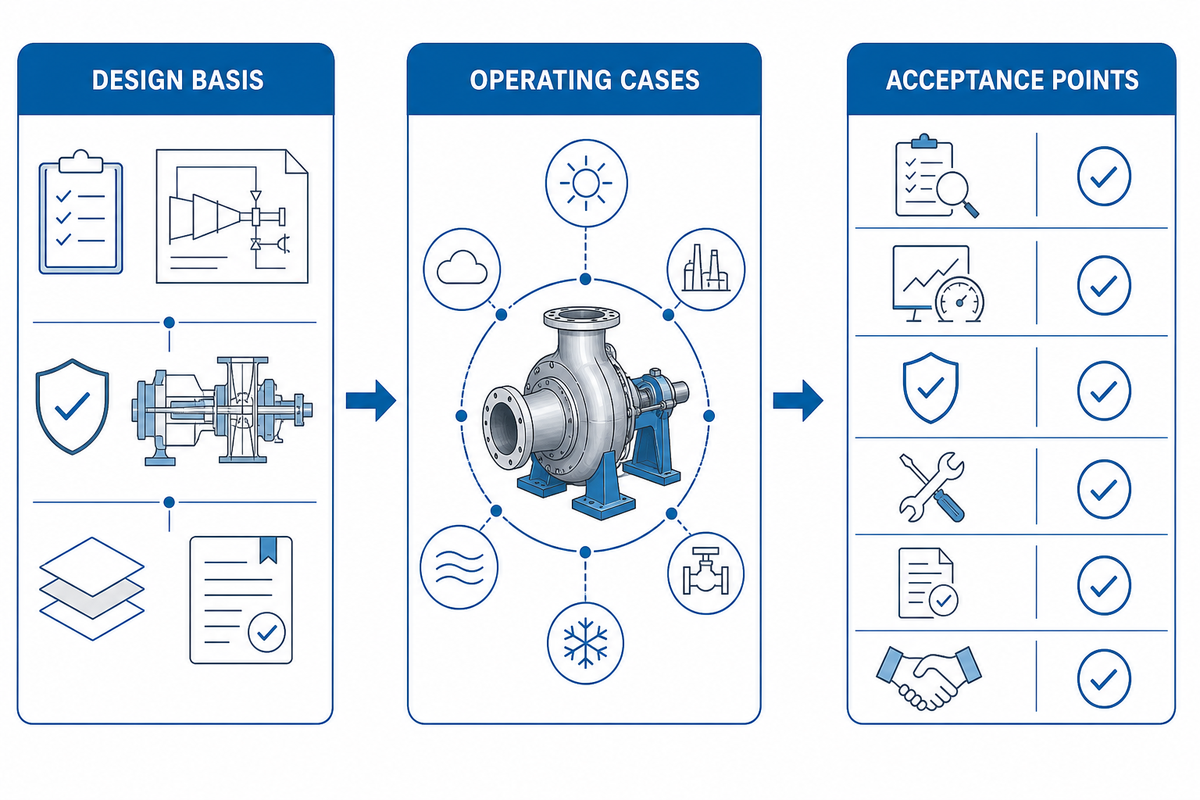
Send PanGeng your design-basis sheet, operating cases, site interfaces, and proposed acceptance points. The engineering discussion can then focus on the package that fits the duty instead of a catalog label.
References & Sources
- Ariel Application Manual
- U.S. Department of Energy compressed-air system evaluation guidance
- OSHA 29 CFR 1910.146
- EIGA Doc 194/24
- API Standard 618 information
Engineering Note: This article is a procurement and proposal review framework. The final design of the compressor pressure protective systems, ventilation, hazardous area classification, Codes, and Acceptance requirements need to be determined by duly qualified personnel for the actual project and jurisdiction.
// SYS-DOC: WHY I WRITE THIS
[01] About PanGeng
PanGeng is an industrial gas compressor manufacturer based in Bengbu, Anhui, China. Since 2009, we have focused on the design, R&D, production, and manufacturing of customized gas compressor systems for oilfield, chemical, energy, hydrogen, nitrogen, biogas, and industrial air applications.
[02] Our Expertise
We write compressor guides based on real manufacturing and engineering experience, including hydrogen compressors, nitrogen compressors, booster compressors, medium and high-pressure air compressors, oilfield nitrogen injection systems, biogas compressors, and OEM/ODM custom compressor solutions.
Our engineering team supports customers from application analysis and compressor selection to production, factory testing, commissioning, spare parts, and after-sales service.
[03] Why You Can Trust This Content
The technical information in our articles is based on PanGeng’s in-house compressor design and manufacturing experience, current product capabilities, and project support for industrial clients in global markets. Our goal is to help buyers understand compressor types, pressure ranges, gas requirements, customization options, and long-term operating costs before making a purchasing decision.
CONTACT PROFILE
AUTHORITATIVE SOURCE
NAME
PanGeng Engineering Team
BRAND
PanGeng
COUNTRY
China
MODEL
B2B / OEM & ODM
EMAIL
pg20090705@163.com
PHONE
0552-4958225
WEBSITE
pgcompress.com