Get in Touch with Pangeng

How to Size, Site, and Commission a Gas-Powered Air Compressor

Contents
show
A Gas Air Compressor is a compressed-air package driven by a gasoline engine for industrial and jobsite service-air work. Planning starts with the air your work must receive—not horsepower, tank size, or maximum pressure. This guide shows how to document demand, screen the operating site, estimate storage, verify startup, and hand useful evidence to a supplier without duplicating a product catalogue.
Updated August 2026 Informational planning guide for industrial and jobsite service air
TL;DR
First prove delivered CFM at working PSI, operating overlap, environment, and distribution loss. Then apply an exposure veto, select a drive type, verify the package under load, and keep the commissioning record.
Quick Specs: The Inputs to Collect Before You Compare
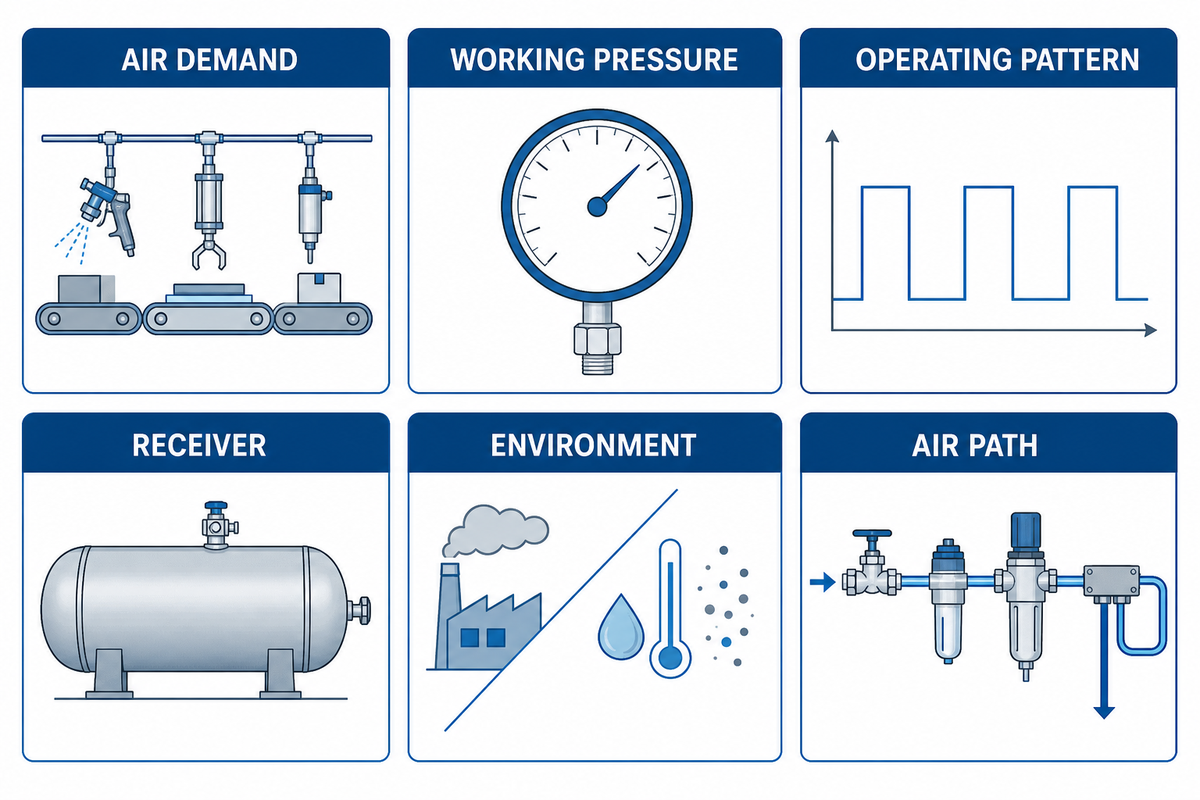
| Input | Record it as | Why it changes the decision |
|---|---|---|
| Air demand | Delivered CFM or SCFM for each simultaneous user | Separates sustained production from a short receiver-assisted event |
| Working pressure | PSI at the point of use, plus allowable drop | A maximum-pressure label does not show delivered flow at the tool |
| Operating pattern | Seconds or minutes per event, events per hour, overlap, shift length | Defines peak, average, recovery, and heat-load conditions |
| Receiver | Gallons or ft³, upper/lower pressure band, recovery rule | Storage can bridge a finite deficit but cannot create continuous output |
| Environment | Temperature °F/°C, altitude ft/m, humidity, dust, rain | Changes cooling, intake conditions, derating review, and protection |
| Air path | Hose/pipe length and diameter, filters, dryer, fittings | Shows where pressure and air quality may be lost |
What a Gas Air Compressor Is, and What It Is Not
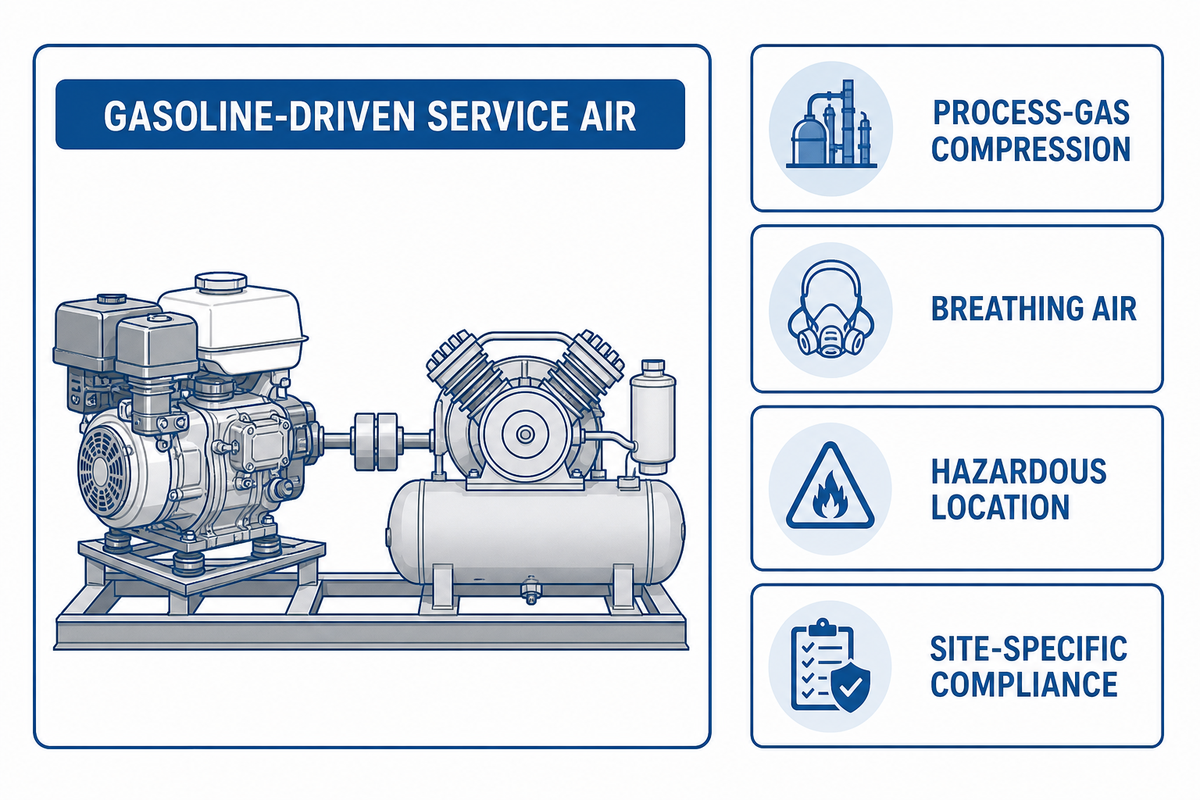
In this guide a gas air compressor is a compressed-air package whose air end is driven by a gasoline engine. “Gas” names the fuel for the prime mover; it doesn’t mean the machine is compressing natural gas, hydrogen, refrigerant, or process gas.
This guide owns
- Industrial and jobsite service air
- Demand, pressure, storage, and distribution
- Outdoor engine-drive boundaries
- Startup, records, and diagnostics
Separate engineering scope
- Natural-gas or process-gas compression
- Medical or supplied breathing air
- Hazardous-location equipment selection
- Site-specific legal compliance
The package may use a reciprocating or rotary air end, one or more compression stages, a receiver, controls, treatment, and an outlet system. Learn the broader industrial air compressor categories first if the drive method hasn’t yet been selected.
| Cluster | Drive | Air end | Useful question | Limitation |
|---|---|---|---|---|
| 1 | Gasoline | Single-stage reciprocating | Does flow at working PSI cover the duty? | Stage count alone does not prove capacity |
| 2 | Gasoline | Two-stage reciprocating | What pressure and duty justify the architecture? | Not automatically more efficient for every load |
| 3 | Gasoline | Rotary screw | Is the operating profile sustained enough? | Package controls and cooling still govern fit |
| 4 | Diesel | Reciprocating | Does the fuel and service ecosystem fit? | Independent power does not remove exhaust risk |
| 5 | Diesel | Rotary screw | Is continuous mobile air the actual need? | Do not transfer diesel ratings to gasoline units |
| 6 | Electric | Reciprocating | Can available voltage and phase support it? | No engine exhaust, but electrical limits remain |
| 7 | Electric | Rotary screw | Does the facility need steady plant air? | A fixed-system study is still required |
| 8 | Hydraulic | Reciprocating or rotary | Can the host hydraulic circuit support it? | Host heat and flow become system boundaries |
| 9 | Various | Process-gas compressor | Which gas, code, seal, and process duty? | Outside this service-air guide |
Translate Catalogue Labels Into Evidence
Search listings group gas-driven air compressors by labels such as 8-gallon, 8 gallon, 30-gallon, 30 gal, 175 PSI, 5.5 HP, 6.5HP, 13HP, 13 HP, and 14 HP. Those phrases describe an advertised selection of gas air compressors; they don’t prove delivered flow, duty, portability, durability, or reliability.
A Honda engine, Honda GX390, Honda GX390 OHV engine, GX160, HP Honda, HP gas, Kohler, ROLAIR, or Mi-T-M Corporation reference identifies an advertised brand or component. Verify the exact document and engine family rather than assuming that a similar label belongs to the offered package.
Wheelbarrow, wheelbarrow air compressor, gallon portable, lightweight, rugged, durable, heavy-duty, portable air, service trucks, construction sites, remote worksites, roof work, and on-the-go use are form-factor or application signals. Confirm loaded handling, clearances, weather protection, and the real movement route instead of treating the adjectives as test results.
Application lists may mention powering pneumatic tools, pneumatic tools, nailers, impact wrenches, paint sprayers, or tire service. Architecture phrases such as rotary screw air, cast iron, twin cylinder, drives a piston, pressure gauge, drain valve, lever, and pressurized air still require a configuration drawing, operating point, and verified limitation.
ISO 1217 covers acceptance testing for displacement compressors, while current U.S. EPA pages separately organize emission rules for small equipment engines. Those sources help define evidence categories; neither certifies an unnamed package. See the ISO 1217 catalogue entry and EPA small-equipment rules.
Build a Working-Air Duty Profile for the Gasoline Package
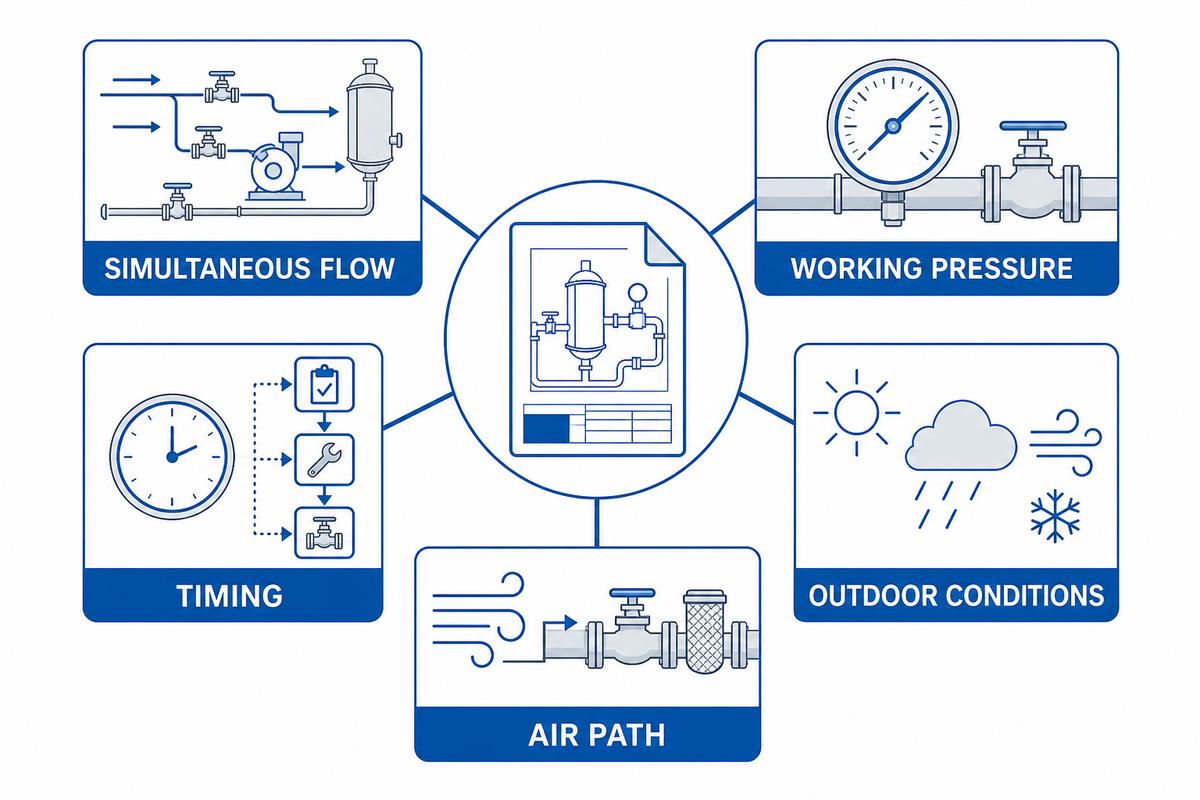
The 5-Input Working-Air Duty Profile
Working-Air Duty Profile: a five-input handoff covering simultaneous flow, working pressure, timing, outdoor conditions, and the air path. It gives the supplier a bounded operating case without turning this guide into a general compressed-air system design manual.
- List every air user — record delivered CFM or SCFM and required PSI from the tool or process documentation.
- Identify overlap — mark which users run together and for how many seconds or minutes.
- Separate peak from sustained demand — show the deficit a receiver may bridge and the production the compressor must sustain.
- Record operating conditions — include temperature, altitude, humidity, dust, shift length, and expected mobility.
- Map the air path — include hose or pipe length, diameter, fittings, filters, dryers, and point-of-use pressure.
Use the profile to expose the engine-driven questions that a general plant-air comparison cannot answer: can the package carry the stated load at the site altitude and temperature, reject heat outdoors, keep exhaust away from people and intakes, and repeat the required start-load-stop cycle? CAGI’s sizing brief and the DOE sourcebook provide the broader storage and system context.
Once those five inputs are documented, the project is ready for application-specific package discussion. The commercial gas air compressor page owns model configuration and quotation; this guide owns the evidence that should reach that page.
Check the Gasoline Engine-to-Air-End Interfaces
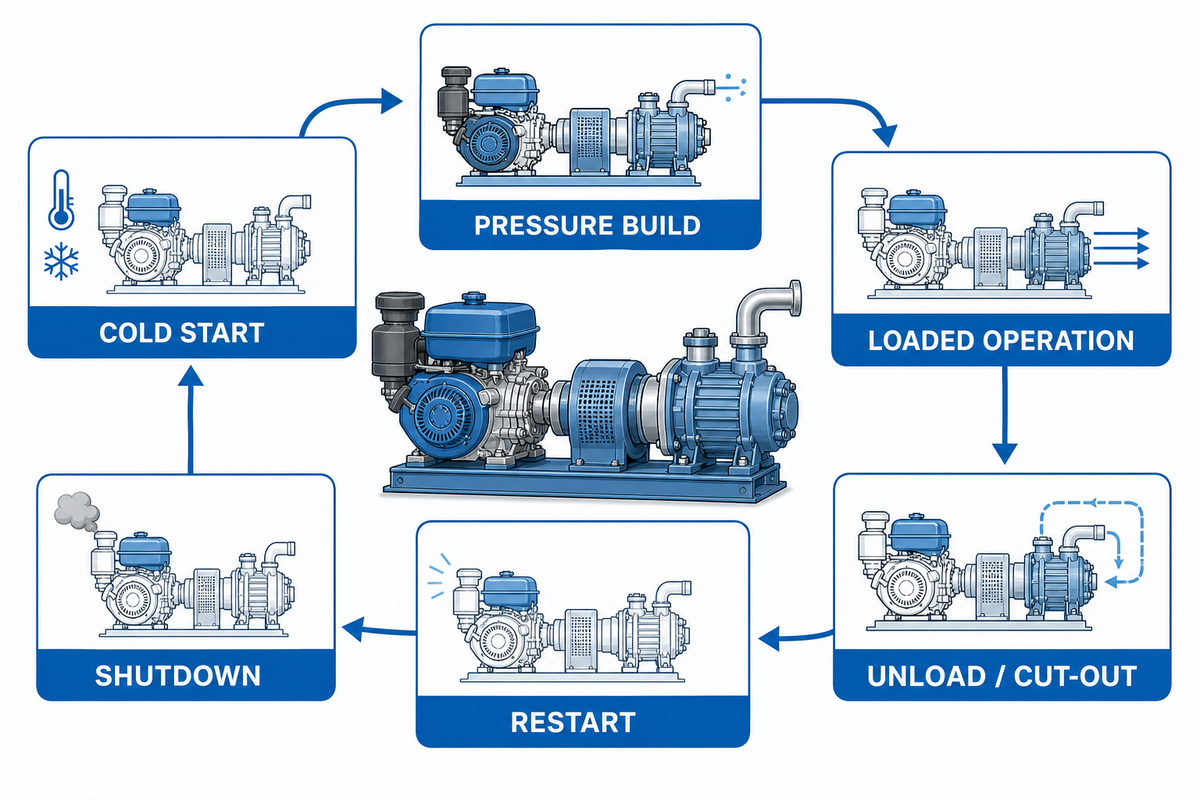
The engine and air end must behave as one package through cold start, pressure build, loaded operation, unload or cut-out, restart, and shutdown. Compare delivered CFM at working PSI under the stated test conditions; engine horsepower, tank gallons, and maximum PSI alone do not show that the engine, drive, controls, and air end will carry the duty.
Package rule
A receiver can bridge a short air deficit, but it cannot correct an engine that cannot hold the required loaded operating state.
Ask how the exact package controls starting load, engine speed, unload or cut-out behavior, cooling, and hot restart. Record the installed belt, coupling, clutch, or direct-drive arrangement instead of transferring assumptions from another model. The piston air-end architecture context helps identify the air-end family after the engine-driven duty is clear.
Downstream storage, treatment, condensate, and distribution still matter, but their full design belongs to the broader compressed-air system study. For this gasoline-package decision, preserve only the pressure and air-quality losses needed to state what must arrive at the use point.
Give the Supplier One Bounded Working-Air Duty Profile
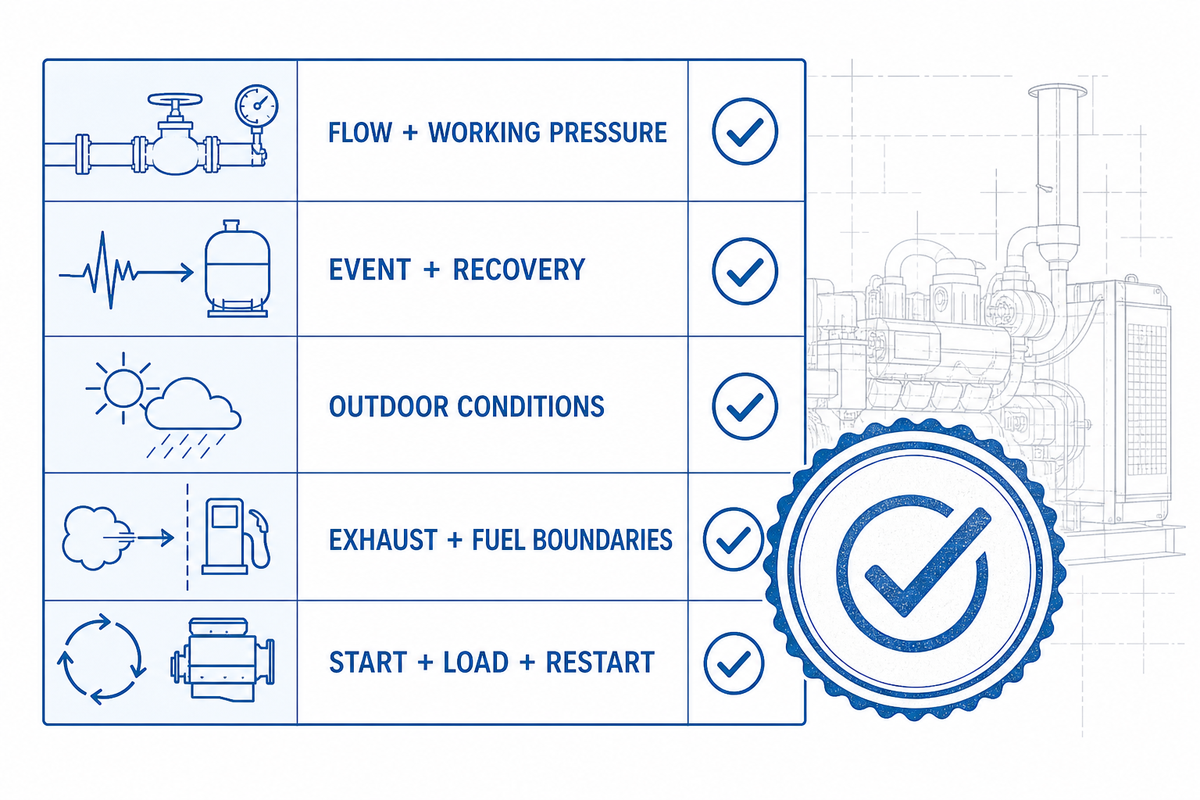
State simultaneous delivered flow at working pressure, event duration, repetition, outdoor conditions, and the pressure required at the tool. Tank gallons, engine horsepower, and maximum PSI remain labels until the supplier maps them to that bounded case.
What belongs in the gasoline-package handoff?
If two users require 10 CFM and 8 CFM at 100 PSI during the same 30-second event, record 18 CFM at 100 PSI before distribution loss. Do not turn that single event into a receiver or package recommendation; also state how often it repeats, the recovery window, altitude, ambient temperature, and whether a hot restart is expected.
Supplier duty record
- Delivered flow and working pressure at the point of use
- Event duration, overlap, repetition, and shift pattern
- Outdoor temperature, altitude, dust, rain protection, and cooling clearance
- Exhaust route, occupied zones, air intakes, fuel storage, and refueling access
- Cold-start, loaded-run, unload, hot-restart, and shutdown expectations
The supplier must verify delivered performance, engine and air-end compatibility, cooling, recovery, and approved duty against the exact package documents. A receiver may support a short event, but sustained output and repeated recovery still require an adequate compressor package.
Use the gas air compressor sizing calculator only as an estimate, then validate the result against manufacturer performance data and the applicable acceptance-test basis. ISO 1217 addresses compressor acceptance testing; it does not turn an online estimate into certified performance.
Use Three Vetoes Before Comparing Gasoline With Electric Drive
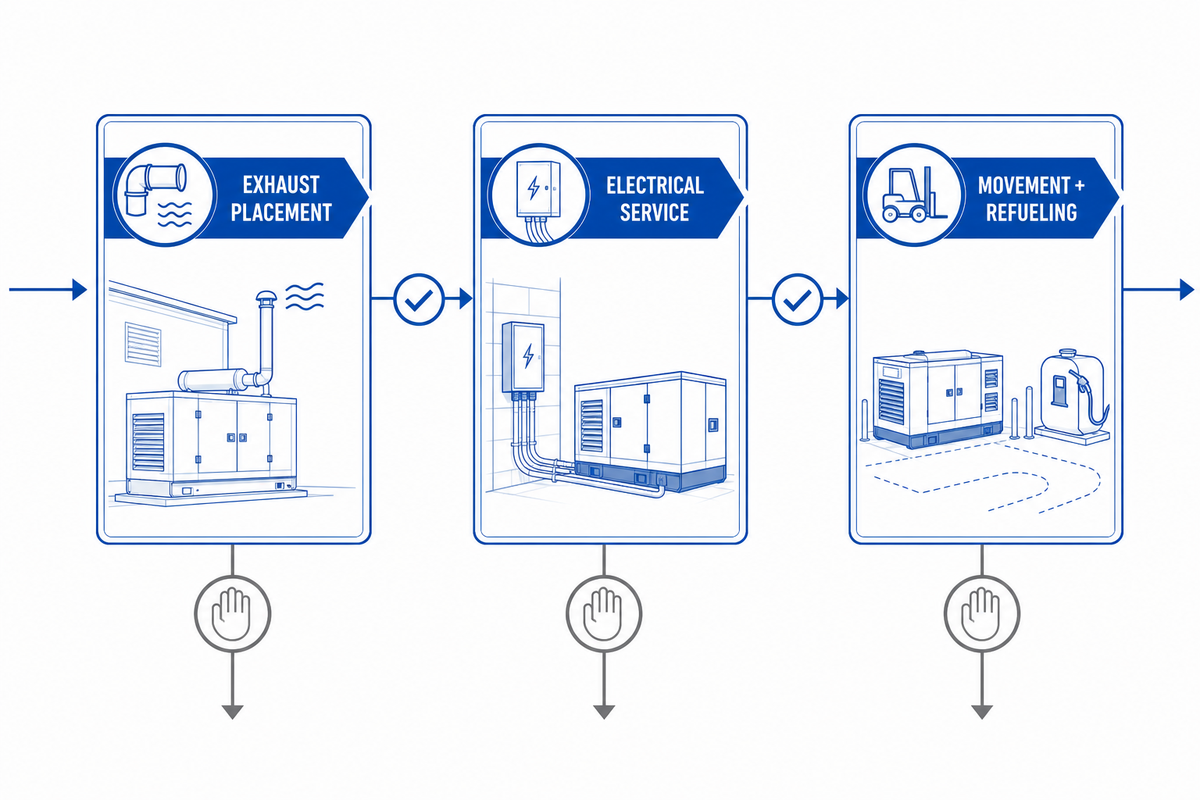
This guide does not own a full gasoline-versus-electric comparison. It asks three threshold questions for the same documented duty: can the engine operate outdoors without exhaust migration, can the site provide suitable electrical service, and can the package be moved and refueled without creating an unresolved exposure or fire-control problem?
| Condition | Gasoline candidate | Electric candidate | Verify | Limitation |
|---|---|---|---|---|
| Enclosure | Only with compliant outdoor engine placement | Avoids engine exhaust at the compressor | Actual air and power layout | Electric equipment has other hazards |
| Grid power | Useful where suitable service is absent | Useful where voltage, phase, and capacity exist | Starting and running demand | Presence of an outlet proves little |
| Mobility | Independent of a long power cable | Practical within a planned supply area | Loaded transport and setup | Portable does not mean safe everywhere |
| Runtime | Fuel and cooling plan required | Supply and motor duty required | Loaded duty profile | No universal runtime winner |
| Noise | Engine plus air-end exposure | No engine combustion noise | Worker exposure measurement | Sound ratings are condition-dependent |
| Fuel handling | Storage and refueling controls required | No gasoline at the compressor | Site fire and spill controls | Electricity is not risk-free |
| Weather | Outdoor protection still required | Electrical enclosure suitability required | Rain, heat, dust, and cold | Outdoor does not mean unprotected |
| Service skills | Engine and compressor skills | Electrical and compressor skills | Local parts and qualified support | Architecture changes maintenance |
| Alternative fuel | Compare gasoline only after veto | Compare fixed power where feasible | Fuel availability and destination rules | A third path may fit better |
For fixed sites with adequate service, review industrial electric air compressors. Where independent power is necessary but gasoline is not the right fuel path, compare diesel air compressor packages under the same exposure and duty evidence.
For U.S. general-industry workplaces covered by 29 CFR 1910.95, OSHA uses an 85 dBA eight-hour time-weighted average as the hearing-conservation action level and requires monitoring when exposure may reach it. This is a worker-exposure criterion, not a sound-power specification for a compressor. See 29 CFR 1910.95.
Use the Engine-Exhaust Siting Veto Before You Run the Engine
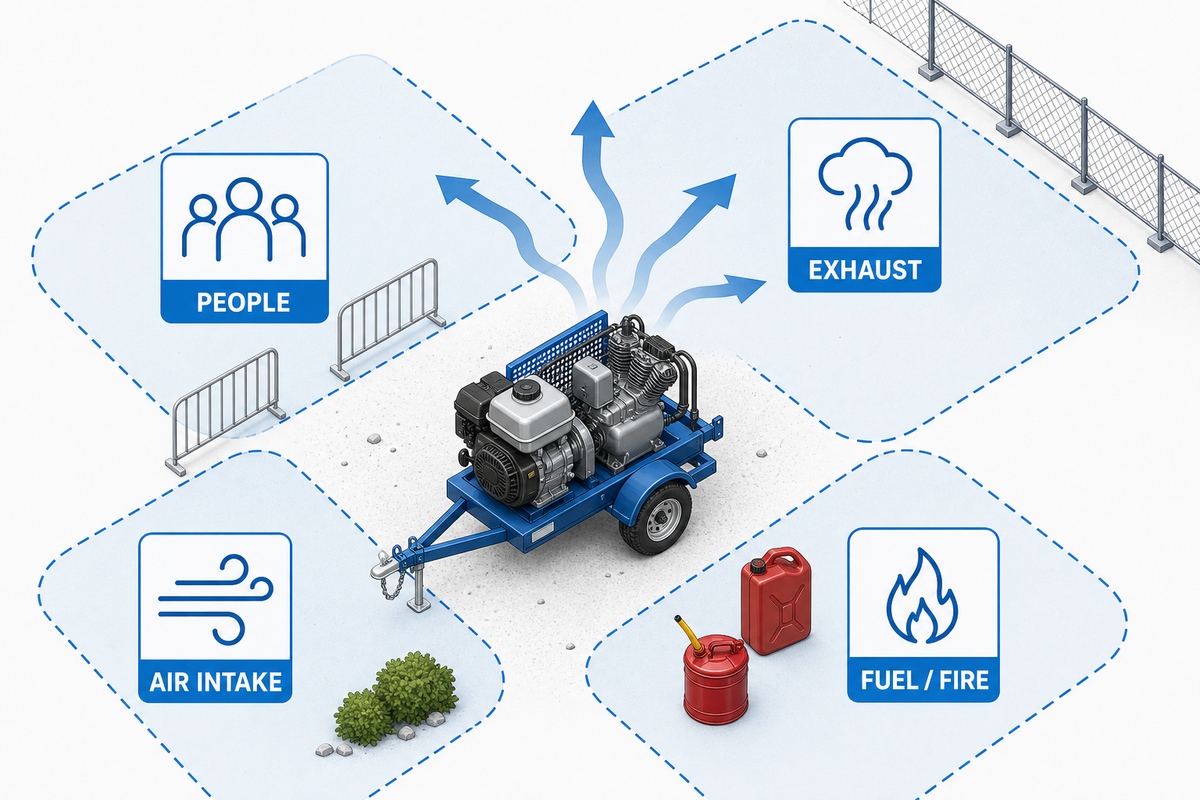
Engine-Exhaust Siting Veto: a pre-start screening routine for people, exhaust migration, compressor intake, and fire and fuel exposure around an engine-driven air package.
“Place gasoline powered engines outside and at least 20 feet from any building openings.” — NIOSH, Carbon Monoxide Hazards at Work
Treat that 20 ft statement as current NIOSH occupational-health guidance, not a universal legal setback for every site. Keep the unit outdoors; assess doors, windows, garages, air intakes, vehicles, wind, occupied zones, exhaust direction, manufacturer instructions, and local requirements. An open door or fan does not make indoor gasoline-engine operation acceptable.
1. People
Identify workers, occupants, confined or semi-enclosed areas, and emergency response.
2. Exhaust
Trace carbon-monoxide migration to openings, intakes, work zones, and vehicles.
3. Intake
Keep compressor and engine intake air away from exhaust, dust, heat, and restrictions.
4. Fuel/fire
Control shutdown, cooling, refueling, storage, ignition sources, and spills.
ISO 18623-1:2026 is a current compressor-safety scope check for in-scope compressor units above 50 kPa, including units fitted in or used with motor vehicles. Its official page also states exclusions and says it is not applicable to units manufactured before publication, so do not imply retroactive certification. Verify the ISO 18623-1:2026 scope.
Breathing-air exclusion: this article covers ordinary service air. Air supplied to atmosphere-supplying respirators is a separate high-stakes application; U.S. OSHA rules address Grade D breathing air, carbon-monoxide limits, compressor siting, filtration, tagging, and monitoring. See 29 CFR 1910.134(i).
Commission the Engine-Driven Package Around Heat, Exhaust, and Restarts
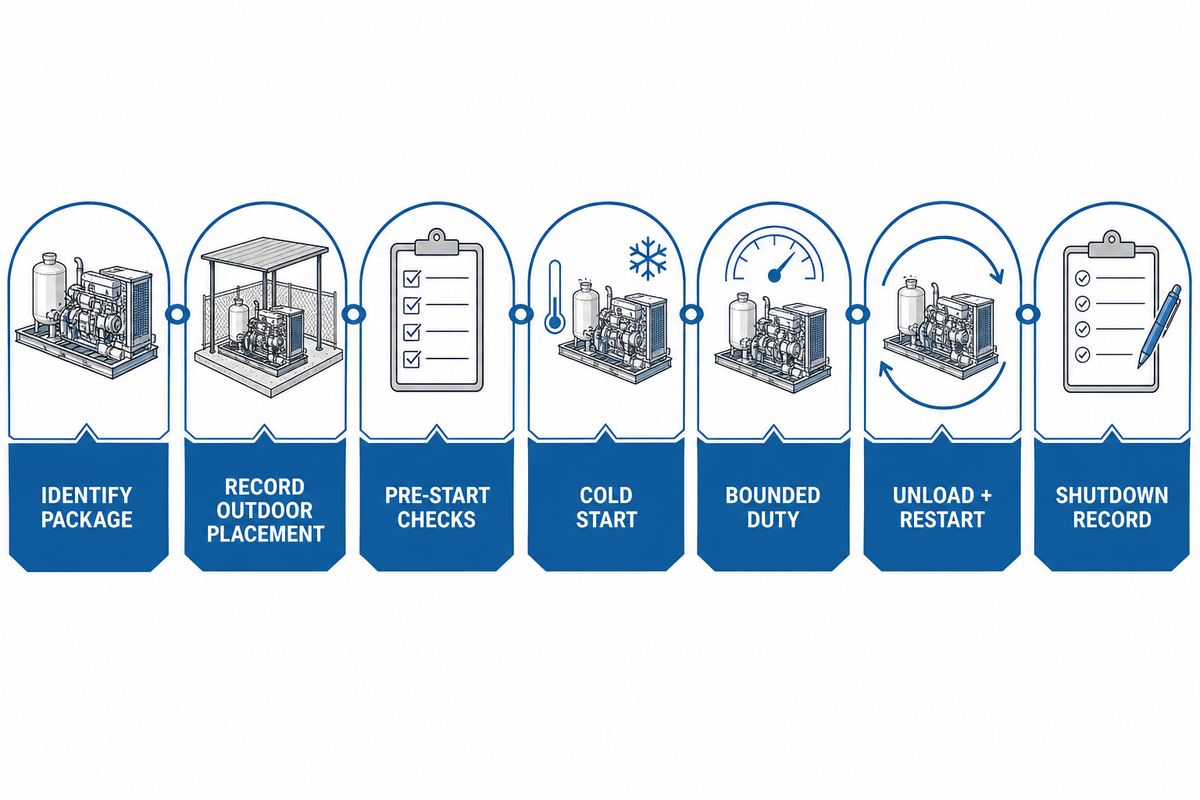
A successful cold start is not acceptance. Once the siting veto is cleared, commissioning should show how the exact engine-driven package behaves through pressure build, representative load, heat soak, unload, hot restart, and shutdown without losing the outdoor and fuel-control boundaries.
- Identify the package: engine family and model, air end, drive arrangement, receiver, controls, serials, manuals, and document revisions.
- Record outdoor placement: openings and intakes, exhaust direction, wind, weather protection, level, access, and fuel controls.
- Complete the manual’s pre-start checks: fuel, oil and other fluids, filters, guards, fasteners, hoses, valves, drains, and control state.
- Observe the cold start: starting sequence, unloader or load state, abnormal sound, vibration, leakage, speed, and warm-up behavior.
- Apply the bounded duty: record pressure at the use point, engine behavior, load duration, recovery, cooling-air path, and temperature observations.
- Observe unload and restart: preserve receiver pressure, control state, cool-down or heat-soak condition, restart behavior, and any deviation from the manual.
- Close the engine record: shutdown, cooling before refueling, instruments, conditions, corrective actions, signers, and retest status.
Example Field Record, Observations, Not Acceptance Limits
A field sheet should distinguish a measured value from a target, alarm, and published rating. The hypothetical record below demonstrates the level of context that makes a later comparison possible; none of its numbers should be copied as a limit for another package.
Any cool-down or repeat-window entries are observations for comparison, not prescribed times.
| Observation | Illustrative entry | Context to preserve |
|---|---|---|
| Outdoor condition | 82°F, 65% relative humidity | Shade, wind, weather, measurement time |
| Elevation and setup | 366 m, 2° surface | Source of elevation and level check |
| Cold start | 3,600 RPM in the stated control state | Fuel, choke or control position, instrument, tolerance |
| Loaded event | 100 PSI at the tool for 30 sec | Receiver start pressure, users, engine behavior |
| Heat observation | 5 min recovery after a 20 min load block | Cooling path, alarms, instrument or observation basis |
| Hot restart | Restart after the recorded unload state | Receiver pressure, unloader state, elapsed time |
| Fuel and shutdown | No leak observed; cooling state recorded | Inspection method and refueling boundary |
| Review trigger | Repeat after 250 hours or a material change | Use the actual manual interval, not this example |
A useful record states uncertainty: was engine speed measured or displayed, was temperature instrumented or only observed, and were the load and restart states repeatable? Compare like outdoor conditions and control states before declaring deterioration; temperature, altitude, fuel condition, cooling restriction, residual air-end load, and user overlap can change the result.
OSHA 1910.169 addresses gauges, safety valves, drains, and inspections for air receivers within its stated U.S. scope, but the section says it is not intended to apply to compressed-air machinery and equipment used on transportation vehicles. Preserve that limit when reviewing truck-mounted packages. Read 29 CFR 1910.169.
ISO 1217 can define a compressor acceptance-test basis, but this field record has a narrower job: connect published air performance to the engine-driven configuration and actual outdoor start-load-restart conditions. Mark whether each value comes from a test report, calibrated field instrument, control display, nameplate, manual, or observation.
Separate Engine Hard Starts and Heat Problems From Air-End Load
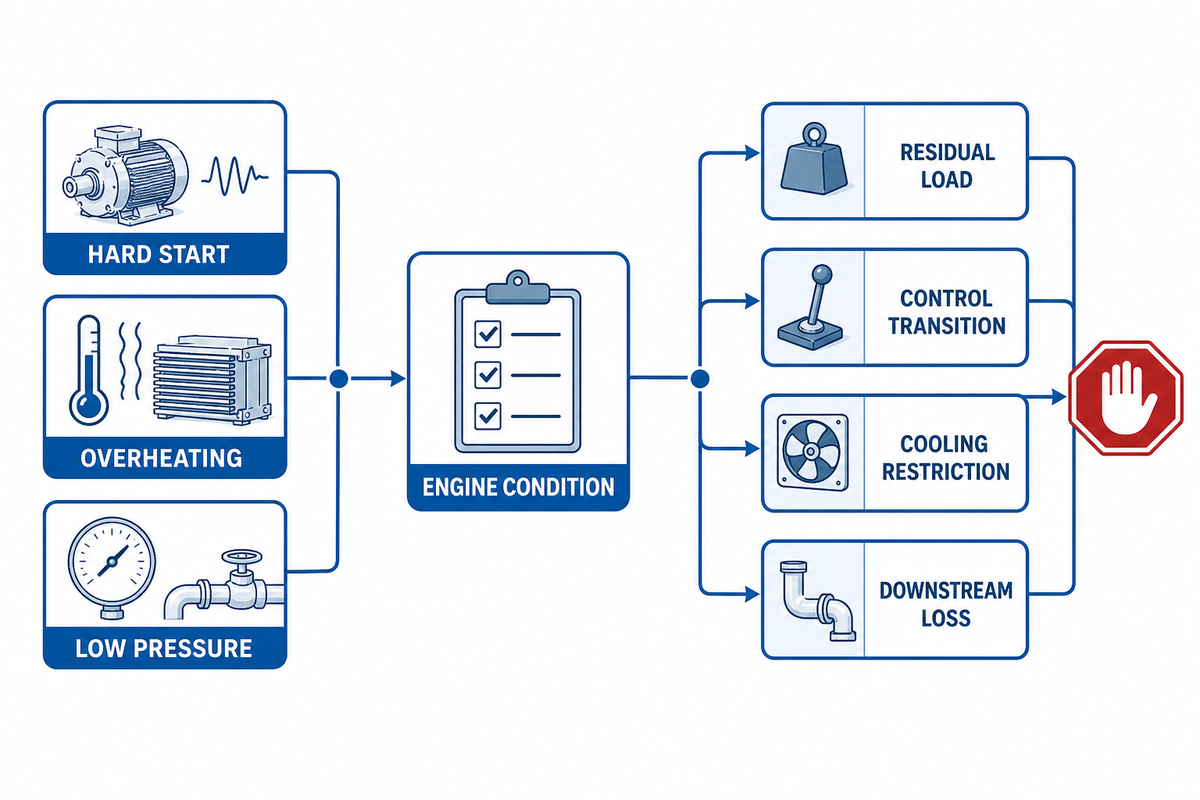
Use the commissioning sequence to identify whether the symptom begins before pressure build, only under load, after heat soak, or during restart. Do not jump from “hard start,” “stall,” or “overheating” to a replacement part; the first task is to separate engine condition, residual compressor load, control transition, cooling restriction, and the stated duty.
| Symptom | First evidence | Engine-package split | Stop condition |
|---|---|---|---|
| Slow pressure build or stall under load | Engine speed basis, receiver start pressure, unloader state, and load timeline | Engine output vs residual air-end load vs control transition | Unstable controls, severe leakage, abnormal resistance, or manual warning |
| Overheating | Ambient, intake, cooling path, load duration, oil and other fluids, temperature trend | Engine cooling vs compressor cooling vs excessive duty or restriction | Alarm, smoke, fire risk, lubrication warning, or manual limit |
| Hard start or failed hot restart | Cold or heat-soak state, receiver pressure, unloader state, fuel and ignition checks | Engine starting vs residual compressor load vs control transition | Kickback, fuel leak, abnormal resistance, or repeated failed starts |
For low pressure, compare and retain receiver and point-of-use readings to determine whether the engine and air end fail to produce or the loss occurs downstream. ISO 11011 and ENERGY STAR compressed-air guidance cover the broader supply, transmission, and demand assessment; this guide does not duplicate that system diagnosis.
Stop and use qualified service whenever the manual requires it or the evidence indicates combustion, pressure-vessel, electrical, control, fire, or severe mechanical risk. This diagnostic framework is for organizing evidence; it is not permission to bypass guards, safety devices, or lockout procedures.
Build a Gasoline-Engine Service Handoff
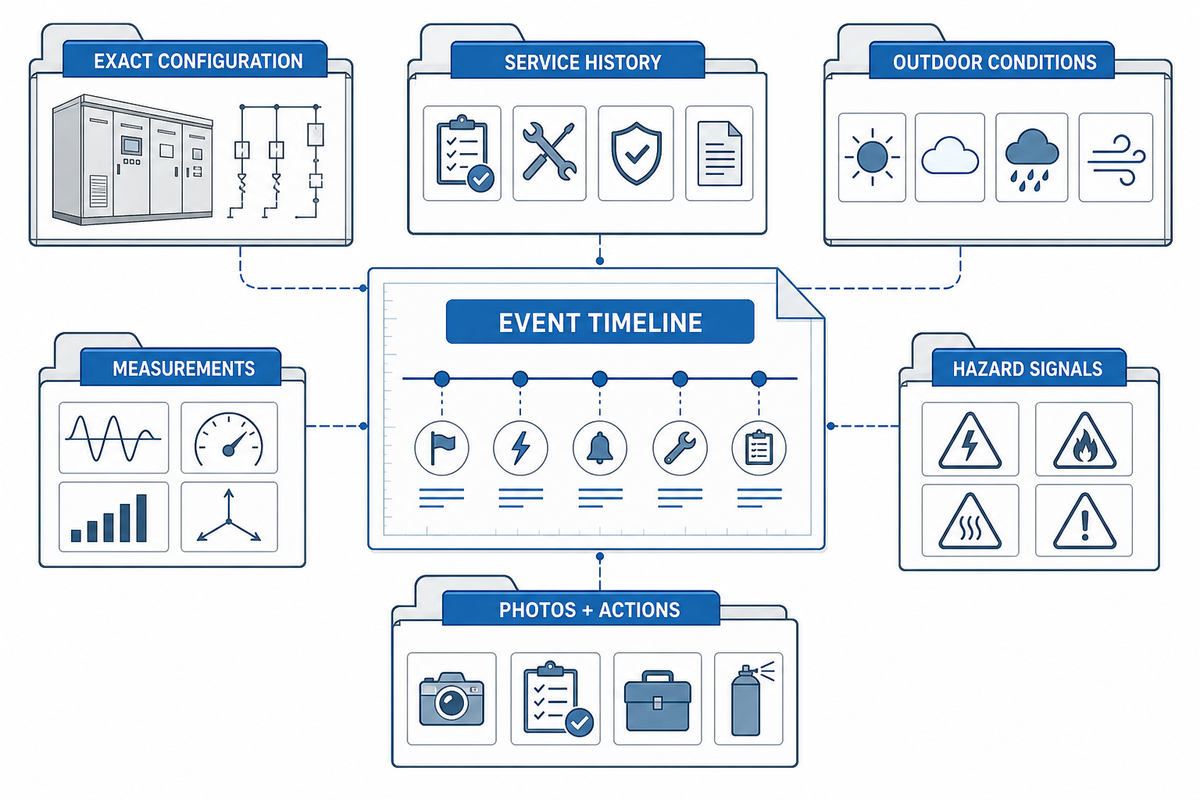
A useful service handoff reconstructs the engine-driven event order. Send the exact engine, air end and drive arrangement, engine hours, fuel and fluid state, filters and service actions, outdoor conditions, cold or hot start state, receiver pressure at start, loaded behavior, cooling observations, shutdown, alarms, photos, and changes since normal operation.
Engine-driven service handoff
- Engine family and model, air end, drive arrangement, controls, options, and serials
- Fuel, oil and other fluids, filters, hours, dates, parts, settings, and responsible person
- Outdoor temperature, altitude, dust, weather, placement, exhaust route, and cooling clearance
- Cold-start, pressure-build, loaded-run, unload, heat-soak, hot-restart, and shutdown timeline
- Receiver pressure at start, engine speed basis, point-of-use pressure, and load duration
- Fuel leak, smoke, abnormal heat, resistance, vibration, sound, alarm, or repeated failed start
- Photos, video, instrument identity, manual step, corrective action, and open safety concern
ISO 14224 offers a useful example of structured equipment, failure, and maintenance data exchange, but its published scope is the petroleum, petrochemical, and natural-gas industries. Use it only as a bounded analogy for record discipline; it does not prescribe a universal portable-compressor field list. Review the ISO 14224 scope.
Do not invent one 250-, 500-, or 1,000-hour schedule for every engine, pump, filter, belt, control, and safety device. Follow the exact package manuals and applicable obligations, record what was actually done, and let the supplier see deviations. A model name without duty and event evidence forces diagnosis back into guesswork.
Use records to ask narrow questions: did the hard start begin before or after the 250-hour service event, does abnormal heat appear only after a 20 min load period, and does the engine recover when residual compressor load is removed according to the package instructions? This ordering helps the supplier select the next safe test. It does not prove a failed part, extend a service interval, or authorize continued operation.
What Seasonal Demand and Engine Rules Change for Planning
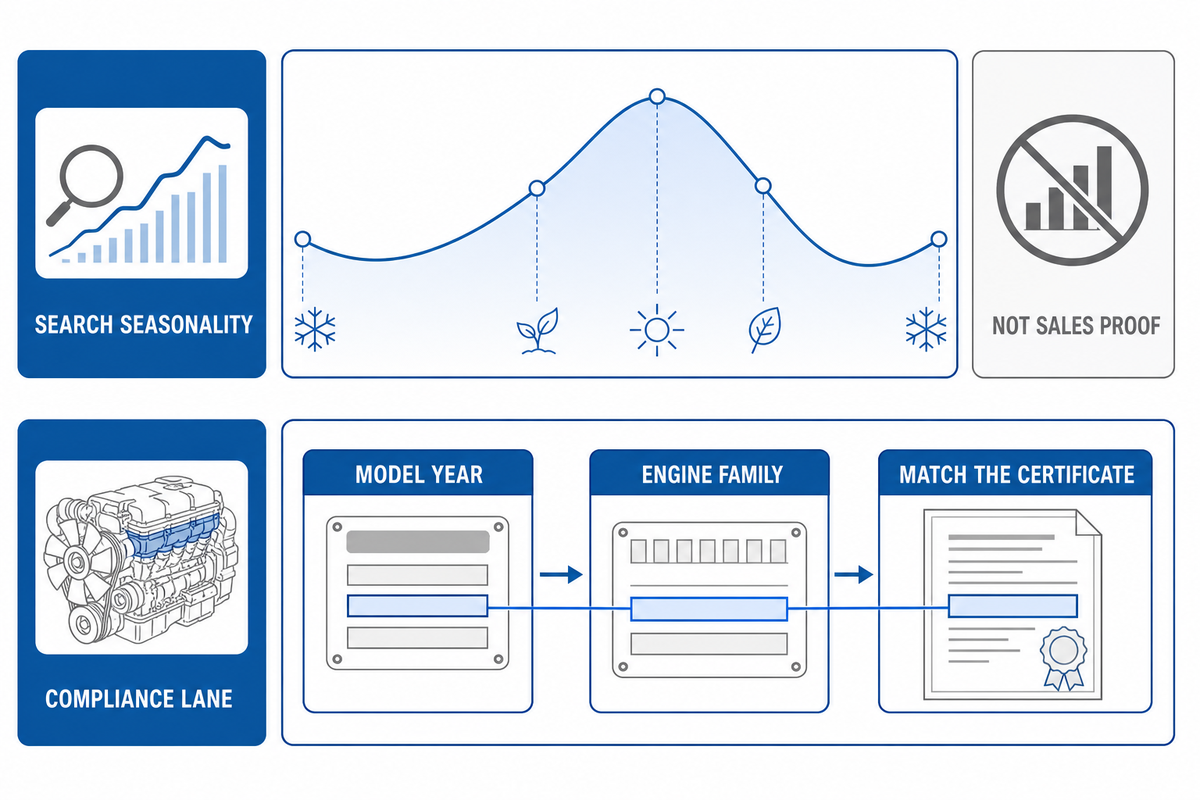
Search interest for portable gas air compressor terms can rise and fall across the year, but keyword seasonality is not proof of market growth, shipments, or sales. Keep that planning layer separate from the maintenance evidence used for a technical handoff. Use it to time educational content or inventory discussions only after real customer and supply data confirm the business decision.
Compliance evidence unit
For a U.S. nonroad engine, request the model year and engine-family number from the emissions label, then match them to the corresponding EPA certificate record. A category page isn’t a product certificate.
EPA describes an engine family as its basic certification and compliance unit, and its certificate-retrieval guidance says nonroad certificates are valid for one model year. Check the EPA engine-family explanation and certificate retrieval guidance.
Destination market, engine category, model year, fuel system, evaporative controls, labeling, and import route can change the document set. Ask the responsible supplier and compliance professional for documents tied to the exact engine and equipment; never transfer a certificate from a similar-looking package.
When Not to Buy or Run a Gas-Powered Package
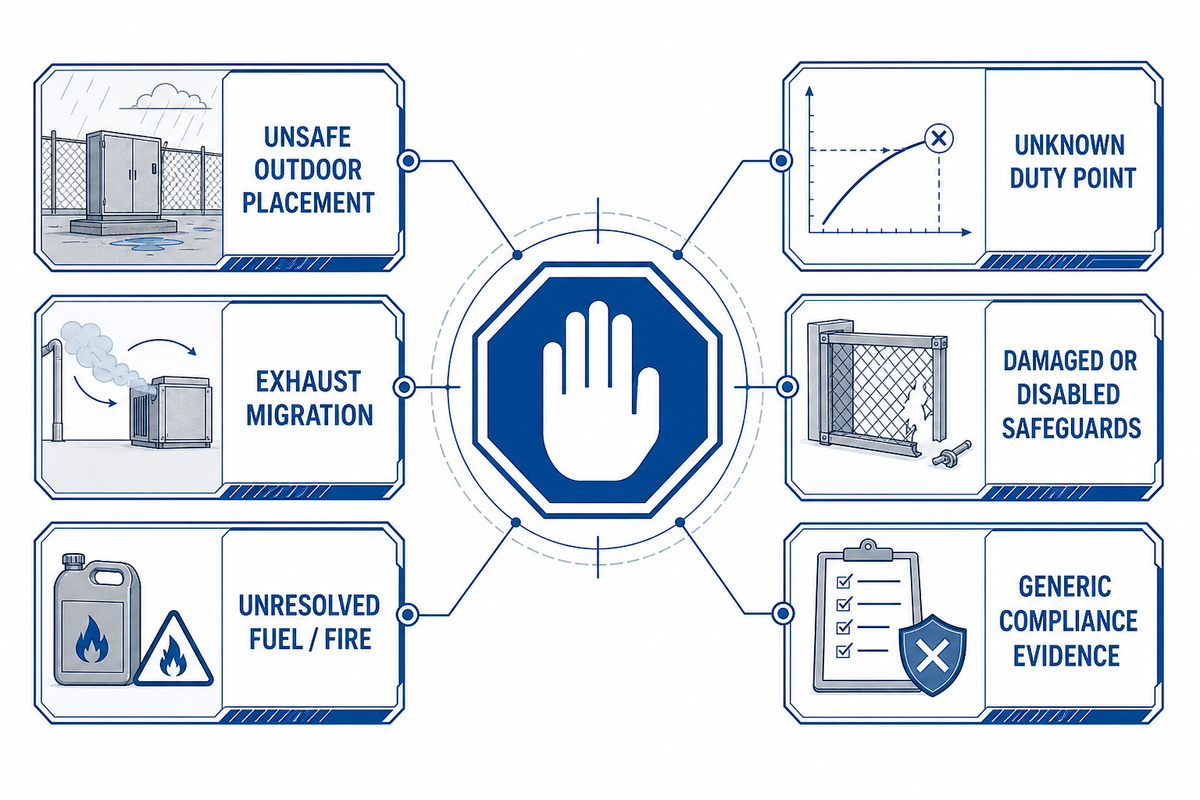
Do not advance a gasoline-driven package when safe outdoor placement cannot be maintained, exhaust can migrate into occupied or intake zones, fuel/fire controls are unresolved, worker exposure cannot be assessed, or the duty point is still unknown. Do not run a unit with damaged pressure components, disabled safeguards, severe leaks, abnormal heat, fuel leakage, or unresolved manual warnings.
Also stop the purchase decision when a receiver is being used to hide inadequate sustained output, maximum PSI is being substituted for delivered CFM, breathing-air service is implied, or product compliance is supported only by a generic web page. The correct next step may be an electric package, a different independent-power path, a distribution repair, a demand reduction, or a site redesign.
Decision exit
If the exposure veto fails or the demand evidence is incomplete, do not compare models yet. Close the site or duty gap first.
Frequently Asked Questions
How does a gas-powered air compressor work?
A gasoline engine drives the pump or rotary air end, which compresses ambient air, controls the loaded and unloaded states, and sends pressurized air through the outlet to the receiver or tool. Gas driven air compressors therefore need both an engine record and an airflow record; engine HP, a 125 psi label, or tank gallons alone do not prove delivered capacity.
What are the benefits of using a gas air compressor?
The practical benefit is independent power where electricity is unavailable, plus portability for service trucks, construction sites, and remote worksites. Those benefits must be weighed against exhaust exposure, noise, fuel handling, weather protection, maintenance, and the actual route for moving and refueling the package.
What tasks can a gas air compressor support?
A correctly sized package may support pneumatic tools such as nailers, impact wrenches, paint sprayers, or tire service when its delivered CFM and working PSI match the tool documentation. Confirm simultaneous demand, recovery time, hose losses, and whether a portable compressor can be safely positioned before calling the use case heavy-duty.
How should I maintain a gasoline engine-driven air compressor?
Follow the exact engine and air-end manuals for oil, filter, belt or coupling, control, drain, and safety-device checks; there is no universal service-hour schedule for every gas-powered air compressor. Record starts, loaded airflow, pressure behavior, alarms, leaks, and shutdown condition so a service provider can separate engine maintenance from air-end or distribution faults.
Are there environmental considerations when using a gas air compressor?
Yes. Plan for engine emissions, carbon-monoxide migration, noise, fuel storage and spills, cooling air, and the emissions rules that apply to the exact engine and jurisdiction; EPA references are a starting point, not a certification of an unnamed package.
When do exhaust exposure and site power rule out a gasoline drive?
Eliminate gasoline drive if outdoor exhaust and fuel boundaries cannot be controlled. If those boundaries are manageable, compare electrical service, mobility, duty, noise exposure, weather protection, maintenance skills, and destination requirements. Use delivered air at working pressure as the performance basis for either drive, and keep the selected package inside the manufacturer’s operating and service boundaries.
Can a gas air compressor be used indoors?
Don’t operate a gasoline engine inside a building or partially enclosed area. NIOSH warns that carbon monoxide can accumulate rapidly and recommends outside placement away from openings and air intakes. Site-specific exposure controls and manufacturer instructions still apply. A door, window, or portable fan isn’t proof that exhaust migration has been controlled.
Does a larger tank increase compressor CFM?
No. A larger receiver can store more usable air across a defined pressure band and extend a short event, but it doesn’t increase sustained compressor production. Repeated demand still depends on delivered flow, recovery, controls, cooling, and duty. Record event duration and recovery before deciding that additional storage addresses the real shortfall.
Why is my gas air compressor hard to start?
Record whether the issue occurs cold, hot, or during restart with receiver pressure. Check the manufacturer sequence and capture fuel, ignition, fluid, unloader/control, and residual-load evidence before naming a cause. Stop for fuel leaks, kickback, abnormal resistance, or repeated failed starts. Note the last normal event, receiver pressure before the pull or crank, and whether the engine stalls during pressure build. Photograph control positions and record any alarm exactly as displayed. Do not hold a valve open, defeat an unloader, spray an unapproved starting fluid, or continue repeated cranking to test a theory. Give the service provider the event sequence and the manual steps already completed.
What belongs in a commissioning record?
Record simultaneous CFM at working PSI, event timing, duty, environment, air path, mobility, available power, site boundaries, air-quality need, acceptance evidence, and destination documents. Add photos or drawings and identify unresolved assumptions rather than hiding them. State who owns site placement, exposure assessment, electrical or fuel interfaces, commissioning, and final acceptance.
Gas Powered Air Compressor Formats: Portable, Gallon, Tank, HP, and PSI
A gas powered air compressor listing may combine portable, gallon, tank, HP, and PSI labels to describe a format. Treat those labels as screening inputs only: confirm delivered CFM at the working point, the recovery pattern, the pressure gauge reading, and the actual movement route before selecting a package.
Gas Driven Air Compressors and Gas Compressors: Two Stage or Single Stage
Gas driven air compressors and gas compressors can use a single stage or two stage pump, but stage count is not a capacity guarantee. Ask for the pump curve or acceptance basis at the required pressure, then compare engine load, cooling, controls, and duty instead of treating a two-stage label as proof of efficiency.
Pneumatic Tools, Nailers, Tires, and Paint Sprayers Need Verified CFM
Pneumatic tools, nailers, tire service, and paint sprayers each impose a different airflow demand and pressure pattern. Record the tool’s CFM and PSI, identify overlap, and include hose losses; a portable compressor is suitable only when measured delivery and recovery match the real task.
Wheelbarrow Air Compressor Portability for Service Trucks and Roof Work
A wheelbarrow air compressor, portable compressor, or service-truck package may be useful on construction sites, remote worksites, or roof work because portability is part of the job. Verify handle loads, tie-downs, weather exposure, clearances, and refueling access; lightweight or on-the-go language is not a handling test.
Honda Engine, Honda GX390, GX160, Kohler, and HP Honda References
Honda engine, Honda GX390, Honda GX390 OHV engine, GX160, Kohler, and HP Honda references identify advertised components or brands. Match the exact engine family, HP, controls, and manual to the offered package; do not transfer a rating from a similar gas-powered air compressor.
30-Gallon, 30 Gal, 175 PSI, and 125 PSI Labels
30-gallon, 30 gal, 175 PSI, and 125 PSI are common catalogue labels, not delivered-duty evidence. Confirm receiver volume, usable pressure band, outlet pressure, airflow at the tool, and safety-device limits under the applicable standard and manufacturer documentation.
Filters, Outlets, Pressure Gauges, Drain Valves, and Shutdown Controls
Filter condition, outlet size, pressure gauge accuracy, drain valve access, and shutdown behavior affect what the user receives and how the package is protected. Record these interfaces during commissioning and capture alarms or abnormal readings rather than inferring reliability from a brochure.
Cast Iron, Twin Cylinder, and Drives a Piston Architecture
Cast iron, twin cylinder, and drives a piston describe air-end construction or motion, while pump selection still depends on duty and conditions. Use the architecture language to ask better questions about vibration, lubrication, cooling, and service access; it does not replace a verified operating point.
Portable Air, 8 Gallon, Gallon Portable, Lightweight, and Durable Formats
Portable air, 8 gallon, 8-gallon, and gallon portable descriptions often appear beside lightweight or durable claims. Use them to plan loading, tie-downs, and access, then verify the actual tank, frame, handle, and service route; a catalogue adjective is not a field test.
5.5 HP, 6.5HP, 13HP, 13 HP, 14 HP, and HP Gas Ratings
5.5 HP, 6.5HP, 13HP, 13 HP, 14 HP, and HP gas are rating labels that need an engine family, test condition, and load point. Compare the specified horsepower with delivered CFM, working PSI, temperature, altitude, and control behavior instead of using HP as a proxy for airflow.
Pump, ROLAIR, Pressurized Air, Portable Compressor, and Honda GX390 OHV Engine
Pump, ROLAIR, pressurized air, portable compressor, and Honda GX390 OHV engine references identify architecture, a brand, or an advertised component. Confirm the exact assembly, outlet, control sequence, and manual for the package under review; never transfer a performance number from a different model or maker.
8-Gallon Portable Air: Check the Tank and Handling Route
An 8-gallon portable air format may suit short pneumatic-tool events, but the tank is only a finite buffer. Confirm actual airflow, working PSI, recovery time, frame and handle loads, and safe movement before treating that size as a fit.
What Is a Gas Powered Air Compressor?
A gas powered air compressor is an air-compression package whose gasoline engine drives a pump or rotary air end. It is intended for service air where independent power or mobility matters, but the correct choice still depends on delivered CFM, working PSI, duty, exhaust control, cooling, and the manufacturer’s limits.
What Is Better, a Gas or Electric Air Compressor?
Neither drive is universally better. A gas package may fit remote or mobile work without electrical service, while an electric package can avoid engine exhaust; compare the same delivered airflow, working pressure, duty cycle, noise, exposure, maintenance, and site power constraints before deciding.
Why Are Gas Air Compressors So Expensive?
Price reflects the engine, air end, receiver, controls, frame, cooling, fuel and safety interfaces, and the testing or documentation supplied with the package. A larger HP or tank label does not by itself justify a premium; compare verified delivery, service access, warranty scope, and the duty profile.
What Is a Gas Compressor Called?
For service air, the precise term is usually gas-powered air compressor or gasoline-driven air compressor. Gas compressor can also mean equipment that compresses natural gas or another process gas, so identify the compressed medium and the air-end duty before transferring a specification or safety assumption.
How to Choose the Best Gas Powered Air Compressor for a Jobsite
Start a selection of gas air compressors with the duty profile, not a brand or adjective. Compare reliable delivered airflow, working pressure, portability, durability, heavy-duty cycle, fuel access, electricity limits, noise, and service support, then reject any option whose test evidence does not match the actual jobsite.
When Portable Gas Air Compressors Fit Service Trucks and Construction Sites
Portable gas air compressors fit service trucks, construction sites, and remote worksites only when the movement route, tie-downs, weather protection, refueling, and exhaust boundaries are controlled. Portability is a logistics requirement; confirm the package can reach the work area without exposing people or blocking emergency access.
Gas Powered Air Versus Electricity: A Site-Specific Tradeoff
Gas powered air can avoid a facility electricity constraint, but it introduces fuel, emissions, noise, and engine maintenance duties. Compare both drives at the same delivered CFM and PSI, with the same duty and distribution losses, before calling one option more reliable or more economical.
References and Sources
- NIOSH: Carbon Monoxide Hazards at Work
- Compressed Air & Gas Institute: Sizing Technical Brief
- U.S. Department of Energy: Improving Compressed Air System Performance
- ISO 1217:2009 catalogue entry
- ISO 18623-1:2026 catalogue entry
- ISO 11011:2013 catalogue entry
- OSHA 29 CFR 1910.169: Air Receivers
- OSHA 29 CFR 1910.134: Respiratory Protection
- OSHA 29 CFR 1910.95: Occupational Noise Exposure
Turn the Duty Profile Into a Configuration Brief
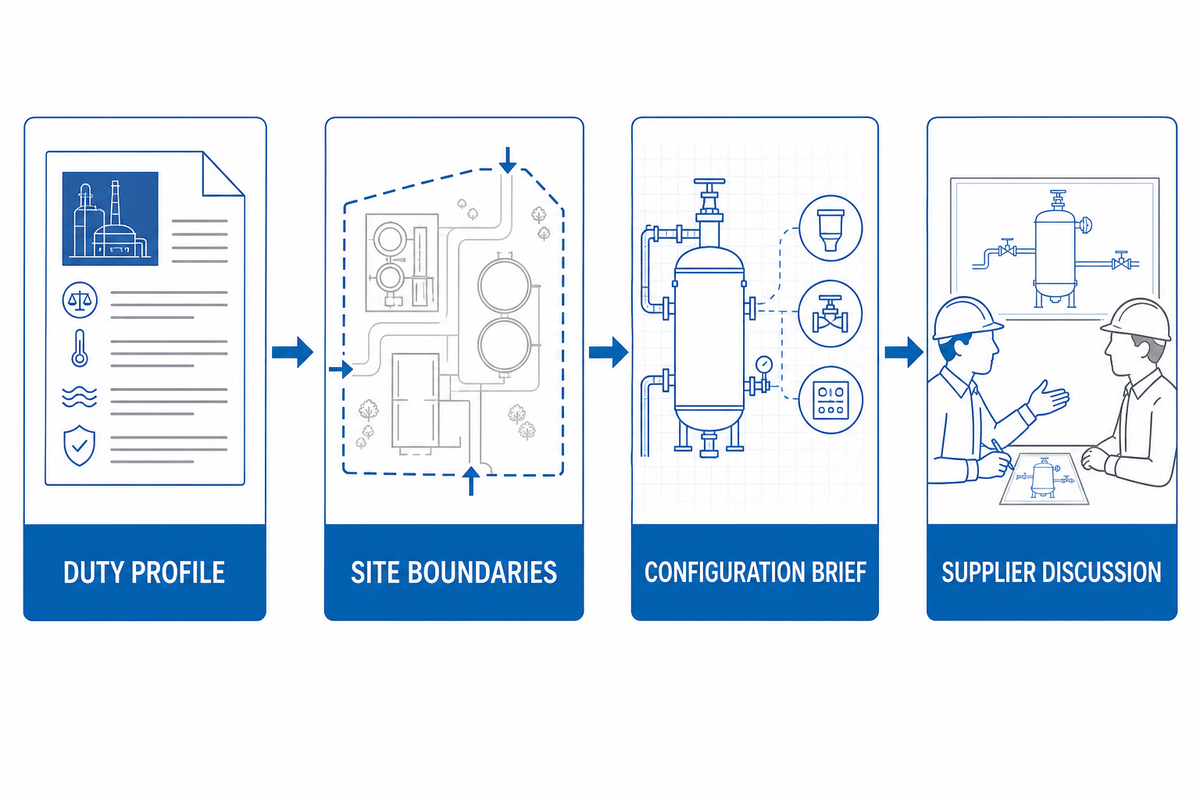
When the duty profile and site boundaries are documented, move to application-specific package configuration without turning this guide into a product catalogue.
// SYS-DOC: WHY I WRITE THIS
[01] About PanGeng
PanGeng is an industrial gas compressor manufacturer based in Bengbu, Anhui, China. Since 2009, we have focused on the design, R&D, production, and manufacturing of customized gas compressor systems for oilfield, chemical, energy, hydrogen, nitrogen, biogas, and industrial air applications.
[02] Our Expertise
We write compressor guides based on real manufacturing and engineering experience, including hydrogen compressors, nitrogen compressors, booster compressors, medium and high-pressure air compressors, oilfield nitrogen injection systems, biogas compressors, and OEM/ODM custom compressor solutions.
Our engineering team supports customers from application analysis and compressor selection to production, factory testing, commissioning, spare parts, and after-sales service.
[03] Why You Can Trust This Content
The technical information in our articles is based on PanGeng’s in-house compressor design and manufacturing experience, current product capabilities, and project support for industrial clients in global markets. Our goal is to help buyers understand compressor types, pressure ranges, gas requirements, customization options, and long-term operating costs before making a purchasing decision.
CONTACT PROFILE
AUTHORITATIVE SOURCE
NAME
PanGeng Engineering Team
BRAND
PanGeng
COUNTRY
China
MODEL
B2B / OEM & ODM
EMAIL
pg20090705@163.com
PHONE
0552-4958225
WEBSITE
pgcompress.com
Related Posts

Trending now


![Low Pressure Hydrogen Compressor Applications [Guide]](https://pgcompress.com/wp-content/uploads/2026/09/low-pressure-hydrogen-compressor-applications-blog-featured-150x150.png)