Get in Touch with Pangeng


A small diaphragm compressor should be selected by delivered flow at the required pressure, gas suitability and permitted duty. A compact housing or two impressive maximum ratings cannot establish that operating point. First identify the construction, then ask for the offered configuration’s curve, complete gas-path review and acceptance conditions.
That distinction is important when a catalog part becomes an installed system. Some analyzers may require a small gas pump. Some cylinder-filling applications may require an engineered hydraulic system. Both may use a diaphragm, but where it’s installed and what drives it may be very different.
The five checks are straightforward: Construction, usable duty point, gas path, operating limits, and acceptance evidence. The tables transform those checks into a customer’s purchasing record. Examples published by KNF and PDC are attributed to their respective manufacturers. Those examples don’t represent the Pangeng model specifications.
Which Small Diaphragm Compressor Are You Actually Buying?
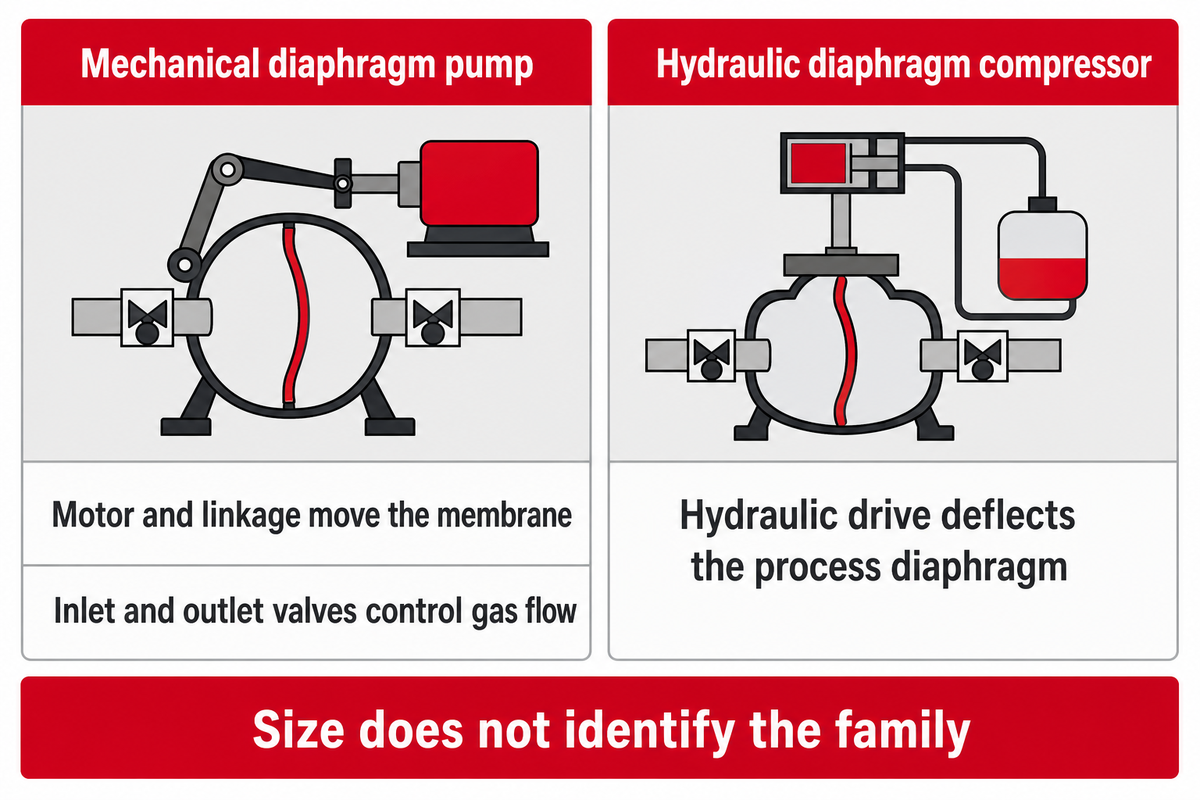
The arrangements of the drives determine the equipment family. Mechanical pumps and hydraulic metal-diaphragm compressors are different. “Small” doesn’t establish a universal pressure restriction, or authorization to deal with a given gas.
The mechanical diaphragm pump uses a motor with linkages that oscillate a membrane. As the volume of the membrane chamber changes, the inlet and outlet valves control the gas flow. For vacuum duty, a diaphragm vacuum pump can evacuate a chamber through its inlet side, while a pressure application uses its outlet side. Positive-pressure specifications can’t be replaced by an ultimate-vacuum rating.
A hydraulic drive deflects the process diaphragm in a hydraulic diaphragm compressor. This construction is found in low-capacity industrial high-pressure gas devices. As discussed in Atlas Copco’s diaphragm explanation, mechanical pumps and hydraulic devices can differ in their construction and application. Differences in size don’t determine if a pump is mechanical or hydraulic.
Prior to evaluating products, you need to understand the composition of the diaphragm. You also need to understand how the diaphragm is powered, which gas contacts the heads and valves, and what operating conditions the OEM allows. Differentiating miniature air movers from industrial gas skids requires different evidence. The system selection process requires consideration of other aspects as described in our diaphragm gas compressor selection guide.
Flow and Pressure: Find the Usable Duty Point
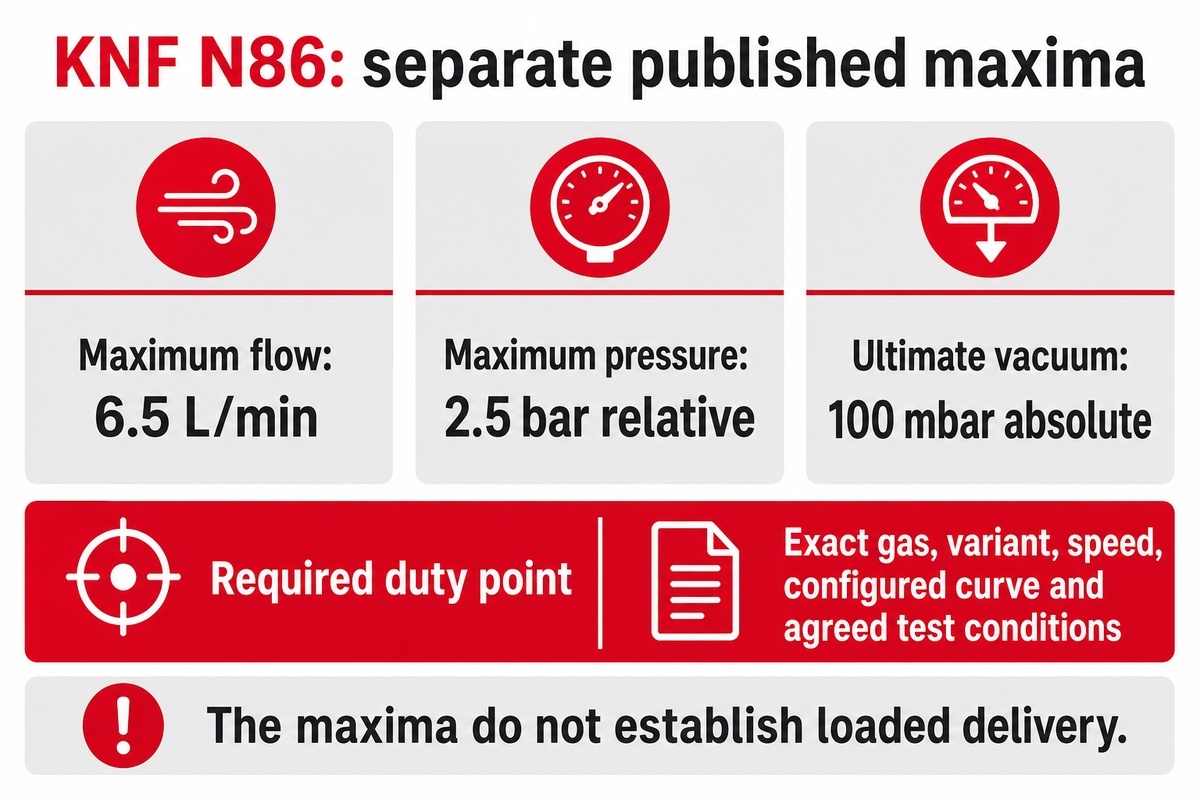
Delivered flow must be established at the required suction and discharge conditions. The 2-End-Point Trap is treating maximum flow and maximum pressure as one guaranteed duty. The separate ratings don’t establish that guaranteed duty. Evidence connecting the quantities must be a configured curve or an agreed performance test.
The 2-End-Point Trap: Read the Conditions Between the Ratings
For example, KNF’s N86 product page lists a maximum flow of 6.5 L/min, maximum pressure of 2.5 bar relative, and ultimate vacuum of 100 mbar absolute. Those are manufacturer-published, separately labeled maxima. The page alone doesn’t guarantee 6.5 L/min at 2.5 bar relative.
The vacuum value is 0.1 bar absolute, a unit conversion of the published 100 mbar absolute. It doesn’t mean a 0.1 bar relative discharge rating. Retaining the reference beside the number prevents a vacuum endpoint from being mistaken for a pressure-duty limit.
| Published item | What it tells you | Evidence still needed |
|---|---|---|
| KNF maximum flow: 6.5 L/min | A listed maximum flow, not the delivery at your load | Flow at the required suction and discharge conditions |
| KNF maximum pressure: 2.5 bar relative | A separately listed pressure rating | The permitted operating range and duty at that pressure |
| KNF ultimate vacuum: 100 mbar absolute | A vacuum endpoint on an absolute basis | The required inlet condition and configuration suitability |
| Your required duty point | A purchasing requirement, not a brochure maximum | The exact gas, material variant, speed, curve and agreed test conditions |
Can a Small Diaphragm Compressor Deliver Its Maximum Flow at Maximum Pressure?
Don’t assume it can. KNF’s guide to reading pump curves explains free-flow conditions, differential pressure and permissible operating ranges. Physical endpoints can lie beyond the range shown for permitted operation. Consequently, calling every maximum-pressure rating “safe deadhead pressure” is also unjustified. Ask for the actual curve and the instructions for the offered variant.
Keep the measurement basis visible. Bar relative and bar absolute describe different references. Likewise, L/min at the inlet and normal-volume flow need their stated temperature and pressure basis before comparison. NIST’s flow-meter research also identifies errors from rapidly changing and pulsatile gas flow in reciprocating-compressor applications. An instrument’s steady-flow calibration alone doesn’t resolve its suitability for your dynamic test conditions.
Consider an illustrative request for 2.0 L/min at a 2.0 bar relative outlet, with a 1,000 mbar absolute inlet at 20°C. Those four conditions are proposed requirements, not a claim about the N86. A supplier response stating only “6.5 L/min maximum” leaves the loaded delivery unanswered. A response stating only “2.5 bar maximum” leaves both the delivery and permissible run pattern unanswered. Ask the supplier to mark the requested point on the configured curve or explain the test evidence needed to establish it.
There’s a second limit when the inlet condition changes. A curve obtained using a single inlet condition can’t be considered to define the entire process. What are the minimum and maximum inlet conditions? Where should the delivery be made? Is the flow figure the actual volume at inlet? These answers will allow us to evaluate different offers. An equation without the necessary input evidence can’t establish the missing performance data of the process.
Gas Compatibility: Check the Whole Wetted Path
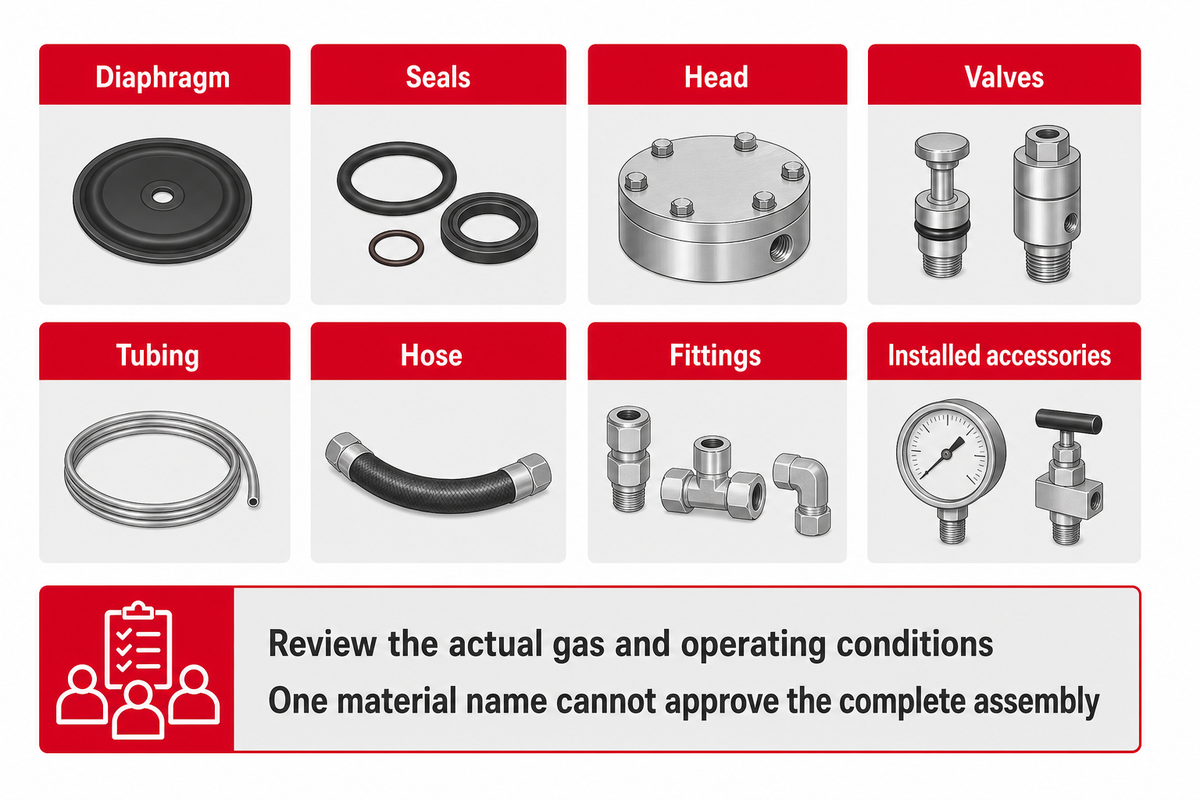
For gas compatibility, the complete wetted assembly should be reviewed and evaluated under the actual gas-handling conditions. The complete evaluation should include the diaphragm, seals, head, valves, tubing, hose, fittings and installed accessories. Naming a diaphragm material can’t approve the complete assembly, the gas, or the pressure and service temperature.
Regarding the N86, KNF mentions alternatives to the standard materials. KNF lists material options for the N86, including PPS heads, FPM or FFPM valves, and EPDM or PTFE-coated diaphragms. These are options available within the product family, rather than a uniform compatibility chart. The valid combination and part number are to be evaluated. The composition and concentration of the medium as well as moisture and particles should be assessed in the gas-service analysis, and the operating conditions should be provided for the manufacturer’s application review.
Separate chemical-resistance requirements from containment and gas service. Even when the review of the material in question may seem straightforward, containment and gas-service requirements still need review. For hydrogen, request a specific review of the offered configuration and service environment to confirm leakage requirements and interfaces with the electrical system. Industrial gas handling should next be assessed through the appropriate hydrogen compressor application path.
Oxygen review extends beyond a materials list. NASA’s oxygen compatibility assessment guidance considers component geometry, ignition mechanisms and worst-case operating conditions, including pressure, temperature, flow and contamination. Cleaning records alone don’t establish that these hazards have been assessed for the offered assembly.
When documenting the assessment, the reviewer should capture the approved gas, exact gas-barrier materials, gas service limits, exclusions, concerns and the responsible reviewer. If the manufacturer is unable to describe the offered items in the gas barrier to the level of detail required for assessment, record gas service approval as unresolved.
Clean Gas and Leakage: Define What Oil-Free Must Deliver
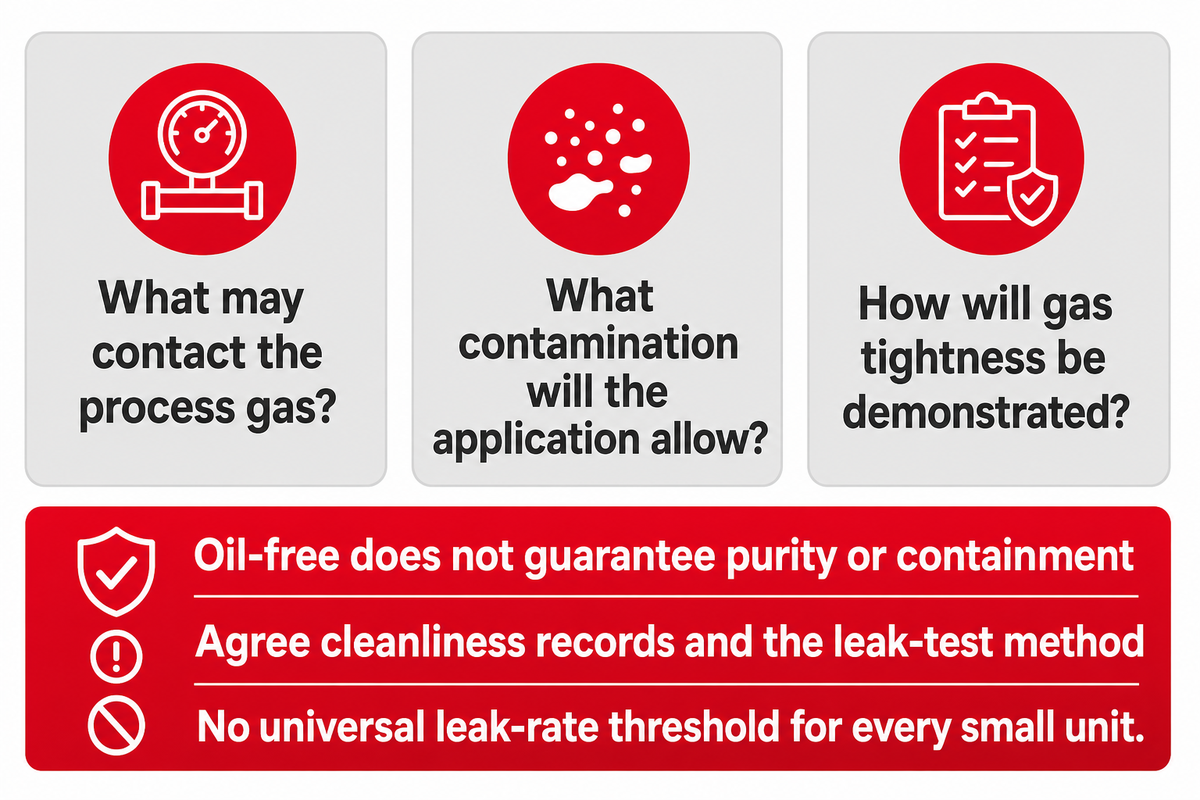
Oil-free or oil-less construction doesn’t guarantee a specified purity level or prove gas containment; define the requirements for process-fluid quality and gas containment evidence separately.
Three questions appear in the specification: what may come in contact with the process gas, what level of contamination will the application allow, and how will gas tightness be demonstrated? For an analyzer, a clean-air requirement differs from a high-purity process gas requirement. Filters, fittings and equipment remain part of the discussion, even if the process gas chamber needs no oil lubrication.
Can an Oil-Free Miniature Pump Compress Hydrogen or Oxygen?
Oil-free construction and a PTFE-coated diaphragm don’t confirm permission for H2 or O2 service. Ask for the gas-specific operating limits and a complete evaluation of the application. The website of the European Industrial Gases Association dedicates a page to the safety of O2, including threats of fire, and links guidance on oxygen-service cleaning and piping. This page doesn’t assess or certify a particular pump.
The purchaser needs to agree requirements with the supplier regarding cleanliness records and the test method for demonstrating a leak-tight seal. For the given case, the designer should indicate appropriate requirements for the gas being processed and the assembly. There’s no justified universal leak-rate threshold or promise for the purity and cleanliness of the gas being processed by every small unit. For a component that has been cleaned for oxygen service, its intended gas-service conditions still need to be confirmed.
Duty Cycle, Heat, and Service Life
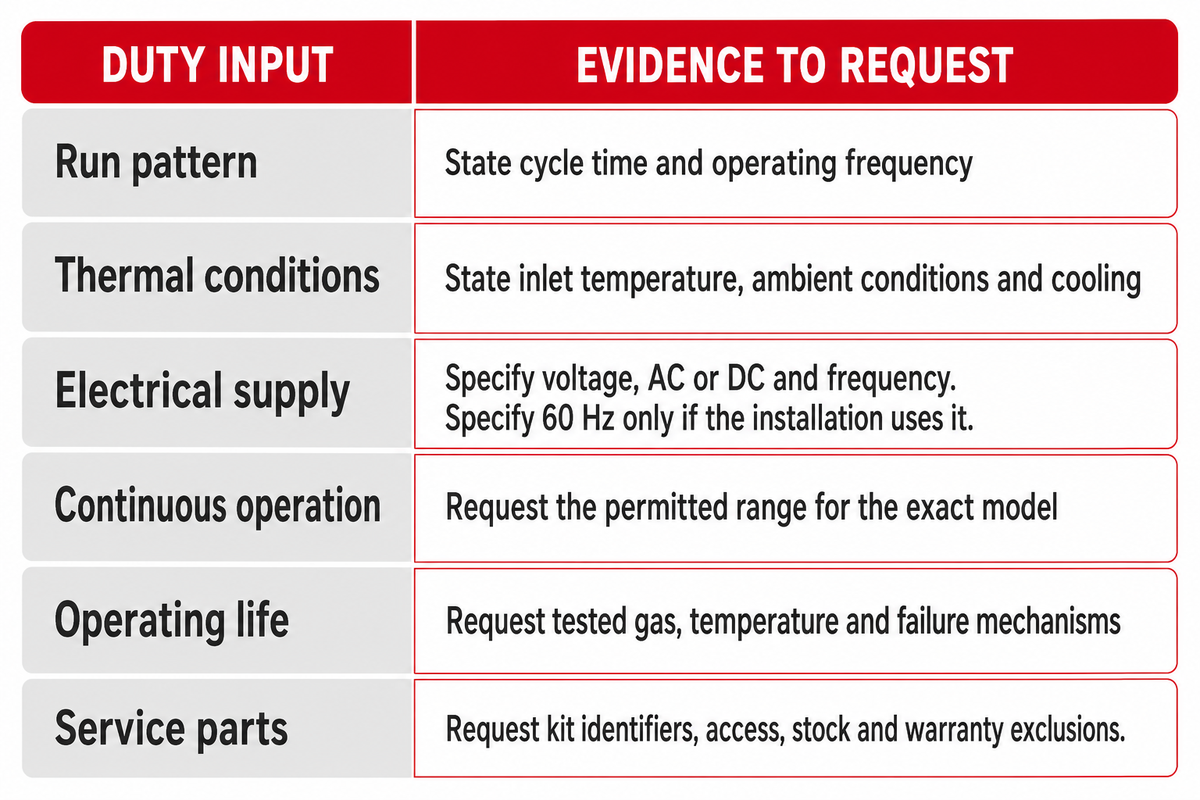
For the given equipment and those operating conditions, confirmation of permitted continuous operation and justification for service life need to be provided. A minimum-maintenance feature of the equipment doesn’t justify uninterrupted operation or a service-life guarantee. The use-case specific service-parts plan needs to be provided.
State expected operating conditions including process cycle time, frequency, inlet temperature, ambient conditions, and cooling arrangement. Specify motor supply (voltage, AC or DC, and supply frequency) and the permitted speed control. If the installation uses 60 Hz power supplies, that frequency needs to be explicit in the offer. They mustn’t be silently implied from other catalog versions.
KNF’s curve guide shows that for certain models, a portion of the rated pressure range may be unavailable for continuous operation. Its example concerns another pump; it supplies no N86 continuous-duty percentage. Thus, to be safe, it’s best to request specific information from the manufacturer, as opposed to interpreting the example to the worst case scenario.
For a promised operating life, ask what was tested, under which gas and temperature conditions, and which failure mechanisms were measured. NIST’s reliability-method guidance explains that extrapolation from high-stress tests depends on appropriate acceleration and life-distribution models. A test duration by itself isn’t the useful life of your diaphragm, valve or complete unit.
Procurement also needs identifiers for the diaphragm and the valve kits, replacement access and stock options, and warranty exclusions. Find out where the supplier has measured power consumption, noise and vibration levels. “Quiet” and “reliable” become useful requirements when defined. Ask the supplier to provide an agreement based on stated conditions and evidence. An industrial installation also needs family-specific planning; consider gas-path checks during hydrogen compressor maintenance, e.g. for the applicable equipment family.
The spare parts plan should include the complete equipment assembly. Consider whether replacement parts alter the gas-contacting materials within the pump manufacturer’s scope of work. Who performs each service task, and which defined service procedure does the pump manufacturer or supplier require? How will the containment and cleanliness records be retained? This is particularly important when a standard catalog item is adapted for a given service.
When a Miniature Diaphragm, Piston, or Hydraulic Unit Fits
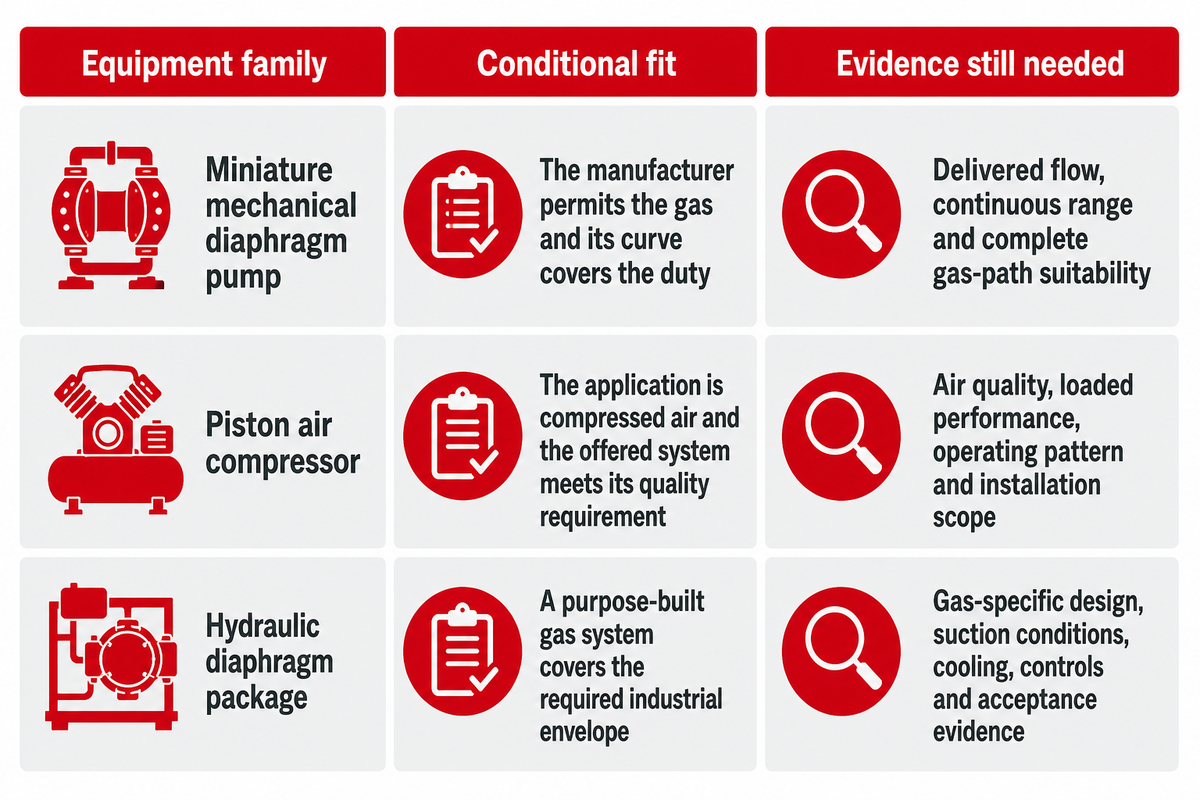
Choose the system construction after confirming gas service and the required compression duty. For an approved low-capacity application, a miniature diaphragm pump may suit the duty, while a hydraulic or piston unit may suit another system. Low volumetric flow, by itself, doesn’t determine pressure limits or the system construction.
| Candidate | Consider when | Limit that needs proof |
|---|---|---|
| Miniature mechanical diaphragm pump | The manufacturer permits the gas and its curve covers the duty | Delivered flow, continuous range and complete gas-path suitability |
| Piston air compressor | The application is compressed air and the offered system meets its quality requirement | Air quality, loaded performance, operating pattern and installation scope |
| Hydraulic diaphragm package | A purpose-built gas system covers the required industrial envelope | Gas-specific design, suction conditions, cooling, controls and acceptance evidence |
A useful counterexample is the PDC Machines xenon configuration PDC-3-1000-2500(50). PDC publishes 12 Nm³/h, a discharge pressure of 3,000 psig/207 barg and a 5 hp/3.7 kW motor, with VCR fittings, oxygen-cleaned process piping and closed-loop water cooling. This is one supplier’s stated xenon case, not an independently tested curve or a miniature-equipment definition.
It compares the purchasing limit for lower capacity units vs. assumptions about industrial pressure, showing that low flow can still accompany high pressure. Accessories and qualifications in this PDC case don’t establish them for Pangeng, a retail diaphragm air compressor, or another gas. For more detail on compressor construction and a broad comparison, please see diaphragm and reciprocating compressor selection.
What to Send Before You Request a Quote
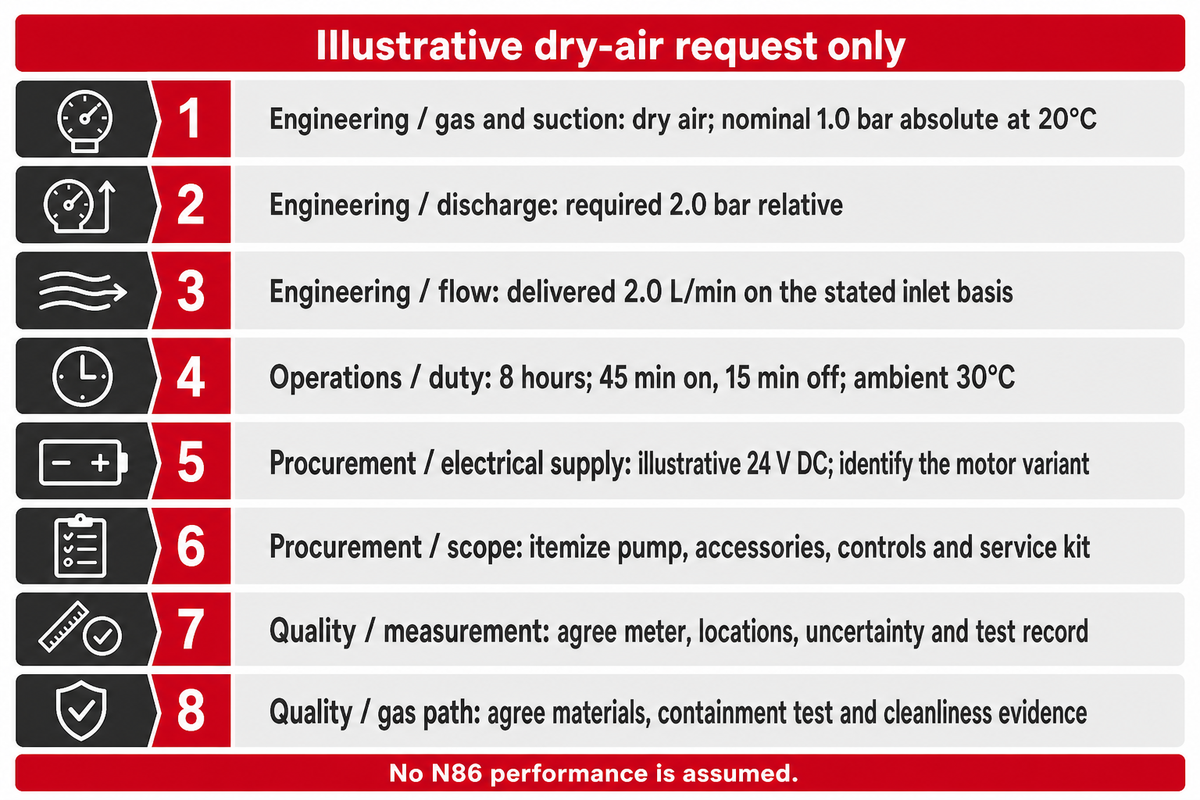
Operating requirements should connect the offered configuration with its acceptance deliverable. Engineering defines the gas and operating envelope, with procurement coordinating the offer. Procurement controls the commercial scope. Operations and quality assure installation and acceptance evidence throughout the process. Use the RFQ-to-Acceptance Sheet as a purchasing tool to rule out an incomplete offer priced as a complete system.
The example provided is illustrative. A requirement of dry air was given, however, this shouldn’t be construed as measured performance or a performance guarantee by a supplier. It should be understood that no assumptions should be made on the performance of N86.
| Parameter / owner | Recommended range: illustrative request only | Why it matters | How to verify |
|---|---|---|---|
| Gas and suction / engineering | Dry air; nominal inlet 1.0 bar absolute at 20°C; proposed range 0.95–1.05 bar absolute | Gas composition, moisture and inlet conditions define the requested duty. | Supplier review of the gas, exact wetted materials and applicable suction envelope |
| Discharge / engineering | Required outlet 2.0 bar relative; proposed range 1.5–2.0 bar relative | A maximum rating alone leaves the permitted run conditions unresolved. | Written pressure envelope for the offered configuration |
| Flow / engineering | Delivered flow 2.0 L/min referenced to the stated inlet conditions | Delivery must meet the process demand at the actual load. | Configured curve or agreed performance test at the requested duty point |
| Duty / operations | Working day 8 hours; 45 min on and 15 min off each hour; ambient 30°C | Run pattern and installed temperature affect the applicable operating limits. | Supplier review of duty, starts, thermal limits and cooling |
| Electrical supply / procurement | Illustrative installation provides 24 V DC; suitable motor variant to be identified | An unrecorded motor substitution can change the applicable documentation. | Confirmed voltage, current, controls and start requirements |
| Commercial scope / procurement | Itemize pump, accessories, controls, service kit and customized items | An incomplete offer hides costs and replacement-part differences. | Itemized price, lead time, warranty exclusions and part identifiers |
| Measurement / quality | Demonstrate agreed 2.0 L/min at 2.0 bar relative under the accepted conditions | The measurement must establish the purchased delivery rather than a different duty. | Agreed meter, dynamic-flow suitability, locations, uncertainty and test record |
| Gas path / quality | Identify the installed assembly and cleanliness requirement | Accessories belong in the complete gas-service review. | Agreed material record, containment test and application-specific cleanliness evidence |
How Can You Verify a Supplier’s Small-Compressor Capability?
Request evidence tied to the offered part number: materials, motor rating, performance curve, permitted gas, manual and proposed acceptance procedure. Check that the quotation and supporting documents describe the same configuration. Using a family-level curve or another customer’s operating record leaves differences to resolve. Separate product manufacturing capability from a particular operating guarantee. The certification must identify its owner, scope and relevance; a patent must identify its assignee and technology. The public Wanner diaphragm-rupture patent record, for example, concerns a hydraulic liquid pump, not proof that another supplier owns or supplies that feature. Ask who’s responsible for the offered gas-service review and which records will be delivered at acceptance. This gives procurement something concrete to compare without treating general marketing capability as a verified small-unit duty.
Retail listings for Gast or Thomas components may help identify a family, but the exact offer still needs its own documentation. The company profile can’t replace it. Pangeng’s company information describes its compressor design and manufacturing business; discuss the specific duty to establish which offered equipment is suitable.
Precisely define and capture changes made to part number, performance, or physical dimensions of a unit. Explicitly document the differences communicated by the supplier. The purchasing documentation must enable the receiving function to identify the variation, accepted deviations and final configuration of a customized solution.
Have a gas duty to review? Send the gas composition, suction and discharge conditions, delivered-flow basis and run pattern so the proposed equipment and evidence can be scoped together.
Installation and Acceptance: Prove the Complete Assembly
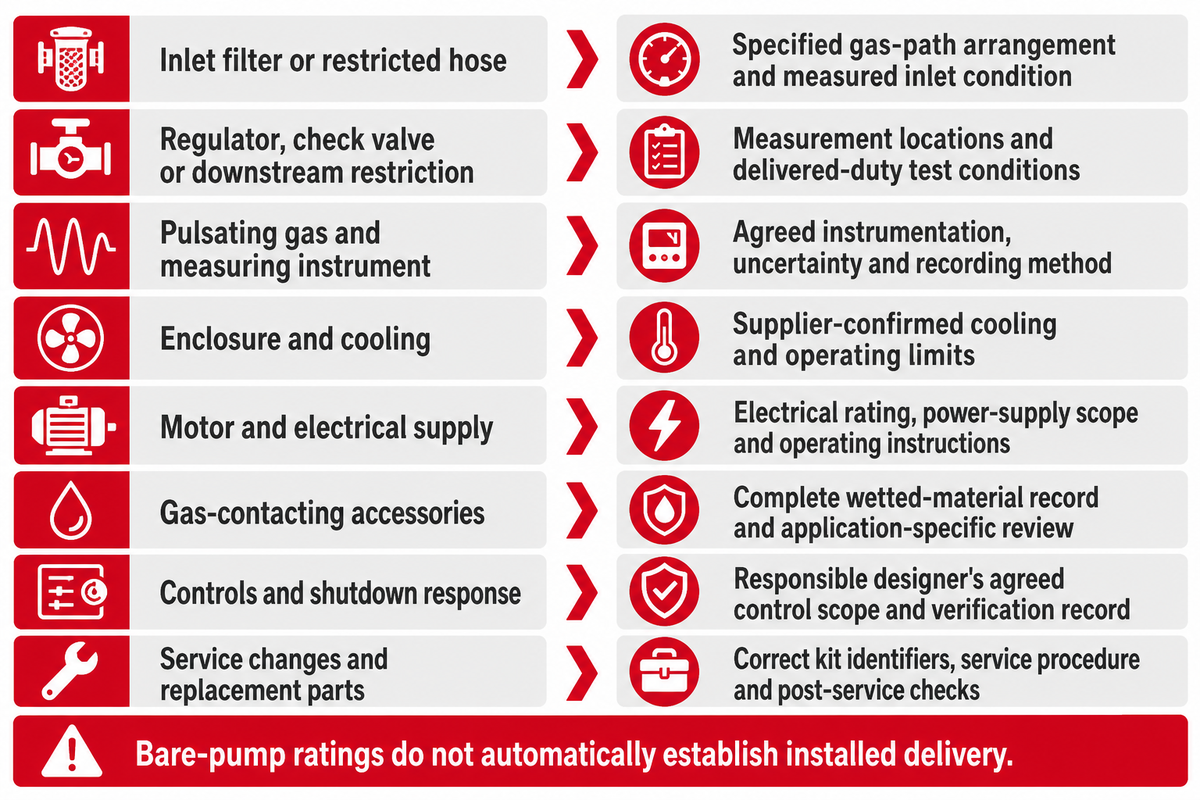
It should be demonstrated that the supplied assembly satisfies the specified performance and service requirements. Bare-pump ratings don’t automatically determine installed delivery. Identify and consider other requirements such as electrical service, cooling and controls prior to agreeing on the test requirements.
| Potential bottleneck | Purchasing question | Evidence to agree |
|---|---|---|
| Inlet filter or restricted hose | Does the curve/test account for the installed suction condition? | Specified gas-path arrangement and measured inlet condition |
| Regulator, check valve or downstream restriction | Where is delivered flow defined and pressure measured? | Measurement locations and delivered-duty test conditions |
| Pulsating gas and measuring instrument | Is the meter suitable for the actual gas and dynamic flow? | Agreed instrumentation, uncertainty and recording method |
| Enclosure and cooling | Does the permitted duty cover the installed thermal environment? | Supplier-confirmed cooling and operating limits |
| Motor and electrical supply | Does the offered motor match the installation, including starting and control requirements? | Electrical rating, power-supply scope and operating instructions |
| Gas-contacting accessories | Are the valves, seals and fittings included in the gas-service review? | Complete wetted-material record and application-specific review |
| Controls and shutdown response | Who defines the required monitoring and response for this application? | Responsible designer’s agreed control scope and verification record |
| Service changes and replacement parts | How will repairs preserve the accepted configuration and gas-path condition? | Correct kit identifiers, service procedure and post-service checks |
The public ISO 1217 abstract describes displacement-compressor acceptance methods for volume flow and power, including operating and test conditions. Agree the relevant method, edition and applicability with the responsible parties; the catalog abstract does not qualify a particular miniature pump.
Modifications should be accepted only after demonstrating the required conditions. A variation may answer a different question using a different gas, omitting a filter, or requiring cooling from an external source. Understand what the test condition demonstrates, what it presumes, and what’s excluded. Keep the test results and conditions with the accepted configuration. If the application is changed, assess the conditions of acceptance and the test facilities rather than relying on the original conditions and acceptance.
“PTC 19.1, Test Uncertainty, provides guidelines to determine the quality of test data, objectively.”
Ronald H. Dieck, President, Ron Dieck Associates, Inc., quoted in ASME’s Performance Test Codes overview. This concerns test-data quality generally, rather than approval of a compressor model.
For applicable US delivered-hydrogen systems at consumer premises, OSHA 1910.103 addresses suitable materials and accessories and proving installed piping, tubing and fittings gas tight at maximum operating pressure. Its stated scope and exclusions matter; it isn’t a worldwide certification requirement for every small compressor. Within that scope, cast iron piping is excluded. The qualified system designer must determine the requirements for the actual installation.
Frequently Asked Questions
What is a small diaphragm compressor used for?
Depending on its approved configuration, a miniature diaphragm gas pump can serve air-moving, sampling or vacuum duties. A low-capacity hydraulic diaphragm system belongs to a different equipment family. Start with the gas, required inlet and outlet conditions, delivered flow and permitted operating pattern. The construction and documentation should fit that application; physical size alone can’t make the selection.
What pressure can a small diaphragm compressor reach?
There’s no single pressure limit for everything described as small. A miniature gas pump and an industrial hydraulic unit have different envelopes. KNF’s N86 page, for example, separately lists 2.5 bar relative maximum pressure; that doesn’t establish its flow at that pressure. Ask for the offered variant’s permitted curve and duty conditions. Keep absolute and gauge references explicit, and distinguish the vacuum rating from discharge pressure.
How do I choose a small diaphragm compressor?
First identify the construction and confirm suitability for the complete gas composition. Then define delivered flow at the intended suction and discharge conditions, including the reference basis. Obtain the exact model’s curve, operating instructions, electrical rating and service-parts information. Finally, connect each requirement to an acceptance record for the supplied assembly. Engineering, procurement and quality should share that record. If a curve, gas review or duty limit remains unresolved, record the gap before choosing on price. An air test or a broad manufacturer portfolio can’t by itself approve a hydrogen or oxygen application, and a short performance run can’t establish unrestricted continuous operation or useful life.
Can it run continuously?
Confirm this for the exact variant and installed conditions. The allowable range can depend on pressure, temperature, cooling and the motor rating. Maintenance-free wording isn’t a continuous-duty guarantee. Obtain the manufacturer’s instructions and written review of the proposed operating pattern.
Is a diaphragm compressor better than a piston compressor?
The answer depends on gas suitability, quality, delivered duty and installation scope. Compare evidence for the offered configurations. A diaphragm construction alone doesn’t make every unit preferable to all piston air compressors.
What determines the price?
The specified configuration, gas-service requirements, controls, accessories and acceptance scope affect the offer. Compare complete quoted systems and exclusions, including service parts, rather than bare-unit prices alone.
References & Sources
Public guidance and standards summaries provide the basis for recommendations in this guide, with additional measurement references:
- NIST: Understanding Flow Meters gas metrology and transient-flow limitations.
- NIST/SEMATECH: Reliability at Use Conditions limits of life-data extrapolation.
- NASA: Oxygen Compatibility Assessment operating conditions, geometry and ignition-risk review.
- OSHA 1910.103: Hydrogen requirements within the regulation’s stated installation scope.
- EIGA: Oxygen Safety Guidance links to fire-hazard, piping and cleaning publications.
- ISO 1217: Public Acceptance-Test Abstract publisher scope summary; full standard text is not reproduced.
- ASME: Performance Test Codes general measurement and test-uncertainty context.


![Low Pressure Hydrogen Compressor Applications [Guide]](https://pgcompress.com/wp-content/uploads/2026/09/low-pressure-hydrogen-compressor-applications-blog-featured-150x150.png)