Get in Touch with Pangeng

Hydrogen Piston Compressor vs Diaphragm Compressor: A Duty-Based Selection Guide

Contents
show
Hydrogen Compression Engineering Guide
A useful answer to hydrogen piston compressor vs diaphragm compressor is a case-by-case decision. It is a traceable decision made from the gas specification, every credible operating case, the package’s contamination and leakage boundaries, its failure evidence, and the tests that will prove performance after installation.
The short answer
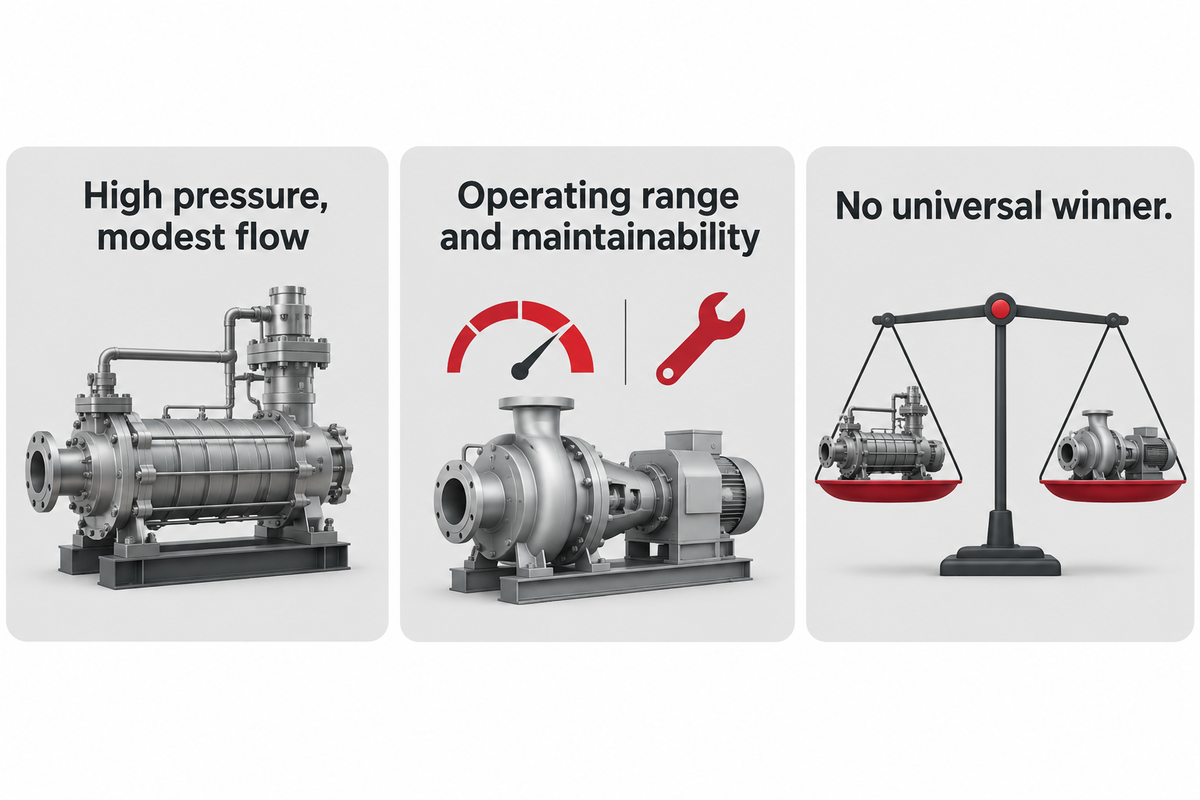
A diaphragm compressor is usually the stronger candidate if the project emphasizes significant physical separation between process gas and hydraulic drive with modest flow and high discharge pressure. A piston compressor can be the better fit when the required flow, operating range, maintainability, or intermittent duty aligns with a validated dry-running or otherwise controlled configuration. Neither option, in isolation, establishes purity, reliability, efficiency and lifecycle costs.
For a useful bid comparison, make both vendors answer the same duty envelope and acceptance plan. Stop the decision if either proposal substitutes a brochure limit for a guaranteed operating case.
This module focuses on hydrogen gas compression and positive displacement equipment. It doesn’t compare an air compressor, liquid hydrogen pump or hydride compressor, because each has a different working principle and system boundary.
To understand the two main mechanisms, see the existing diaphragm compressor vs reciprocating compressor guide. The present guide is focused on the mechanisms beyond the basic explanation.
Start with a Hydrogen Duty Envelope Record
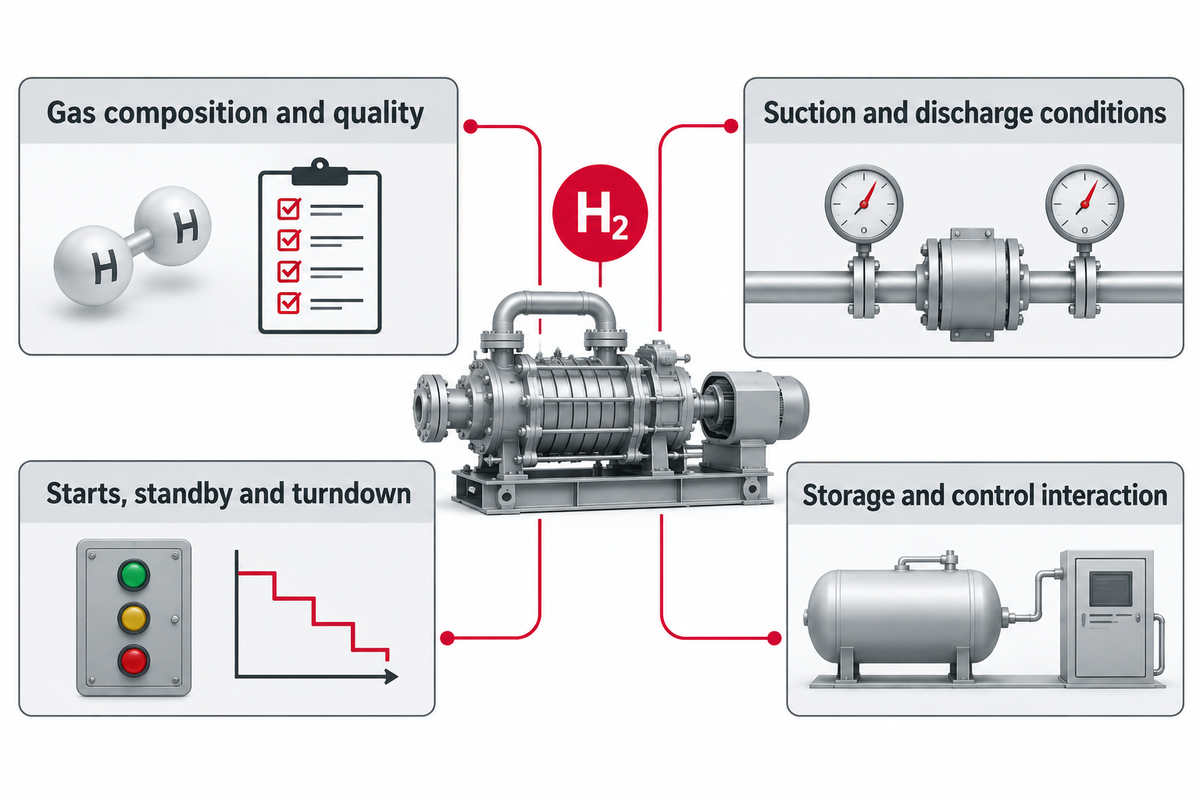
The first selection document should be a shared operating-envelope record, not a two-column list of advantages. It communicates what the compressor needs to do, where battery limits are, and what variations are plausible. This ensures that options for station layout and control don’t get misinterpreted as compressor-type advantages.
What inputs must be frozen before comparing bids?
Record the following inputs for the normal point and for each alternate case:
- hydrogen composition, moisture limit, particles, and the applicable end-use quality specification and edition;
- suction pressure and temperature ranges, including depleted storage and upstream upset cases;
- required discharge pressure at the stated delivery boundary;
- Normal, minimum, peak, and future flow demand in consistent reference conditions;
- expected starts per day, continuous run periods, standby duration, ramp rate, and turndown;
- available cooling water, ambient range, electrical limits, hazardous-area classification, and utilities;
- Storage inventory, buffer strategy, recycle philosophy and suction pressure control sequence;
- availability target, maintenance window, redundancy philosophy, and required evidence retention.
hydrogen compression in the U.S. Department of Energy describes hydrogen compression as a service spanning different production, storage, transport, and dispensing pressures. It’s important to include context with hydrogen compression. The same discharge goal can be represented by a very different machine duty with respect to suction pressure and flow profile and the downstream storage condition. See the DOE overview of gaseous hydrogen compression.
Use more than one comparison case
The minimum information required of a bid sheet is the normal guaranteed point, the worst pressure ratio point, the peak flow case, a case showing stable operation, a case showing startup after a standby, and a case showing a realistic upset or recovery. Other cases that may be added are a case showing a depleted source or a case showing low suction. If future expansion is plausible, state it as a separate case rather than quietly adding margin to every number.
This is also the anti-cannibalization boundary for this guide. For compressor families and commercial config options, use the hydrogen compressor pillar page. For a simple mechanism comparison, use existing comparison resources. This article owns the evidence needed to support an engineering decision for a specific project.
Which terms belong inside the comparison boundary?
Hydrogen production, hydrogen storage, and the final hydrogen fuel use all change the duty record. A fuel cell project may also target a different hydrogen purity from an industrial gas or petrochemical process.
State the condition of the low-pressure source, the final pressure, compression ratio, and all stages of compression. Include discharge temperature, intercooling duty, and if the package is water-cooled.
The volume of hydrogen should be defined at a reference condition. Show how gas pressure varies. This lets both vendors calculate compressor performance on one basis.
Do not mix atmospheric pressure values with gauge pressure or absolute pressure. This would introduce an error in the required compression system and electric motor duty.
A project can use an electrolyser, a trailer, or some other compressed gas source. The gas enters the package through a defined suction valve and leaves through a defined discharge valve.
The buyer should specify how the compressor works with storage controls, not just how it performs at one point. This requirement separates the effects of hydrogen energy systems from the type of compressor that’s being evaluated.
Build a Contamination and Leakage Boundary Map
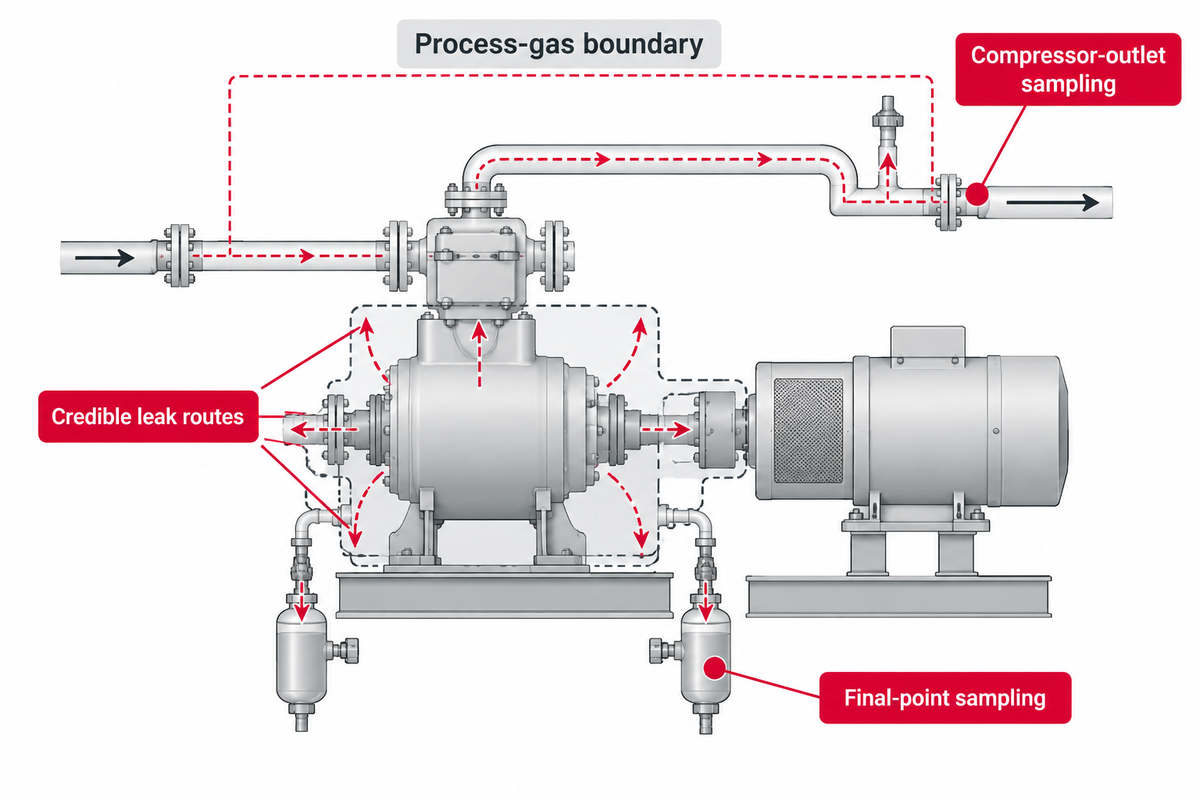
“Oil-free” isn’t a complete acceptance criterion. The buyer needs a boundary map showing every material and pathway that can reach the process gas, every credible leak route out of the gas system, and how each condition will be detected and managed.
What changes between diaphragm and piston architectures?
| Decision dimension | Diaphragm compressor | Piston compressor | Evidence to request |
|---|---|---|---|
| Process isolation | A diaphragm group separates process gas from the hydraulic drive. | Depends on cylinder lubrication strategy, piston rings or packing, distance pieces, vents, purges, and drains. | Section drawing, material list, vent/purge schematic, and contamination risk review. |
| Primary dynamic boundary | Diaphragm assembly, seals, check valves, and gas head. | Piston rings or seals, rod packing where applicable, valves, and cylinder boundary. | Leak paths, expected wear locations, monitoring points, and safe-state logic. |
| Failure indication | Rupture or inter-layer detection can provide a dedicated signal when designed into the head. | Packing leakage, vent flow, pressure, temperature, vibration, and gas detection may form the evidence set. | Alarm thresholds, proof-test method, response time, shutdown sequence, and retained event record. |
| Gas quality proof | Architecture supports separation, but final quality still requires sampling at the stated boundary. | A dry-running or controlled package can be suitable, but the result must be demonstrated for the project gas specification. | Sampling location, method, detection limits, pass criteria, and operating recheck plan. |
| Pressure and flow range | High pressure capability can be attractive, while capacity is configuration-dependent. | Conventional reciprocating and hydraulic designs can span broad duties, subject to staging and speed limits. | Guaranteed map for every duty case and the excluded region. |
| Transient response | Diaphragm compressors use hydraulic motion and check valves that must be validated through the stated sequence. | The reciprocating piston or piston assembly must be checked across starts, reversals, and low-load states. | Sequence trace, pressure and temperature trends, and trip recovery. |
| Wear mechanism | Metal diaphragm or flexible metal layers, valves, and seals require a stated fatigue-life basis. | Piston rod, rings, packing, crankshaft where fitted, and valves require wear and leakage criteria. | Component life basis, inspection trigger, and spare strategy. |
| Thermal behavior | Chamber volume and heat transfer affect temperature through the cycle. | Near-isothermal claims require a defined operating case and measurement boundary. | Temperature limits, sensor locations, cooling scope, and correction method. |
| Package acceptance | The compressor uses project utilities and controls; neither architecture proves installed performance by itself. | FAT, integration, SAT, and operating-quality records. | |
Sundyne’s diaphragm compressor explanation is a good reference to help understand the process head and hydraulic separation. It shouldn’t be interpreted to mean that every complete package is contamination-free under every possible failure scenario. The 2025 peer-reviewed review of diaphragm compressors for hydrogen service also treats capacity, pressure, operating challenges, and diaphragm failure as engineering constraints rather than marketing absolutes.
When diaphragm compressors work in hydrogen applications, oil pressure remains on the hydraulic side of the boundary. The acceptance plan needs to address oil contamination, leak detection, and materials on the gas side.
For piston packages, non-lubricated compressors reduce one direct pathway but do not erase every pathway. The distance piece, packing, vents, drains, and seal arrangement determine the actual boundary.
Terms such as membrane fuel, proton exchange membrane, and membrane appear in hydrogen literature, but they describe the end-use technology or other equipment rather than the compressor diaphragm itself.
For a detailed mechanism and application discussion, see the diaphragm hydrogen compressor guide.
Where should hydrogen quality be measured?
Define the required quality at the contractual delivery point. Compressor-outlet sampling can isolate package performance, while final-point sampling can reveal contamination introduced by downstream piping, storage, valves, or dispensing equipment. For refueling applications, the sampling method and location may be governed by a different document than the compressor package specification. Record the exact standard edition and distinguish normative requirements from informative guidance.
Use a Transient Duty Validation Matrix
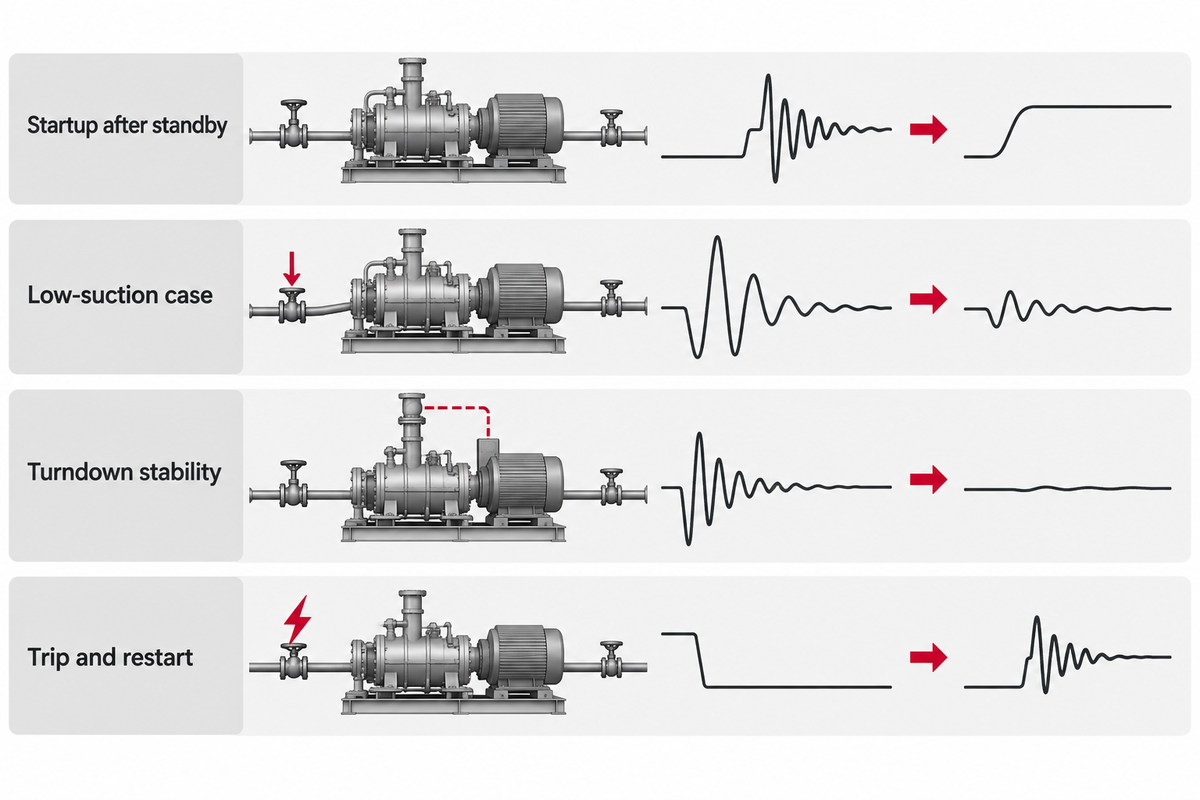
For steady state, flow and pressure aren’t representative of start up, shutdown, recycle, storage depletion, or rapid changes in demand. A transient validation matrix turns those events into testable cases and prevents the selection from being based on a single attractive duty point.
Which transient cases can reverse the decision?
- Low suction pressure: check capacity, temperature, pressure ratio, rod or diaphragm loading, and control stability.
- Minimum demand: show how capacity is controlled and whether recycle, unloading, speed reduction, or stop-start operation is required.
- Frequent starts: state the allowable sequence, thermal condition, lubrication or hydraulic readiness, and cumulative fatigue basis.
- Rapid storage recovery: assess the changing suction pressure and the impact of buffer dispatch on machine utilization.
- Loss of cooling or utility disturbance: define alarm, trip, depressurization, restart permission, and retained evidence.
According to a 2026 peer-reviewed analysis of hydraulically driven piston hydrogen compressors, suction pressure, stroke frequency, flow, and motor sizing are interrelated. For the units evaluated, instantaneous compression power peaking was approximately twice average compression power for a large part of the cycle. This doesn’t prove the existence of a universal piston penalty. This evidences why comparing average power can be insufficient as the basis for electrical and motor design.
The transient file should show how gas enters and leaves each chamber, how valve lift is controlled, and how the suction valve and discharge valve behave. It should also show peak gas pressure and discharge temperature.
Gas compressors are flexible boundaries. A piston compressor uses a moving piston and sealing system to achieve compression. Both require cycle-specific evidence.
The fatigue life of moving boundaries depends on the actual sequence, not only the nameplate. Higher temperatures, a changing chamber volume, and rapid cycling can move the package away from its intended envelope.
Hydrogen technologies, such as an electrochemical or ionic liquid compressor, aren’t considered in this two-type award decision. Listing them would weaken the evidence for the selected compression system.
The same paper also cites hydraulically-driven piston systems as a valid alternative for intermittent hydrogen-refueling duty. That is a useful counterexample to the rule that a piston architecture is automatically unsuitable whenever purity or cycling matters. The project still needs validated gas quality, containment, temperature, control, and service-life evidence.
Do not compare efficiency percentages until the denominator is identical
Establish one suction condition, discharge boundary, flow reference, gas composition, cooling basis, and auxiliary scope. For each of these, invite quotes against that basis from qualified suppliers. Distinguish average, peak, and annual energy. An “X% more efficient” claim is no help if the duty and package boundary are different.
Create a Failure-Mode Evidence Ladder
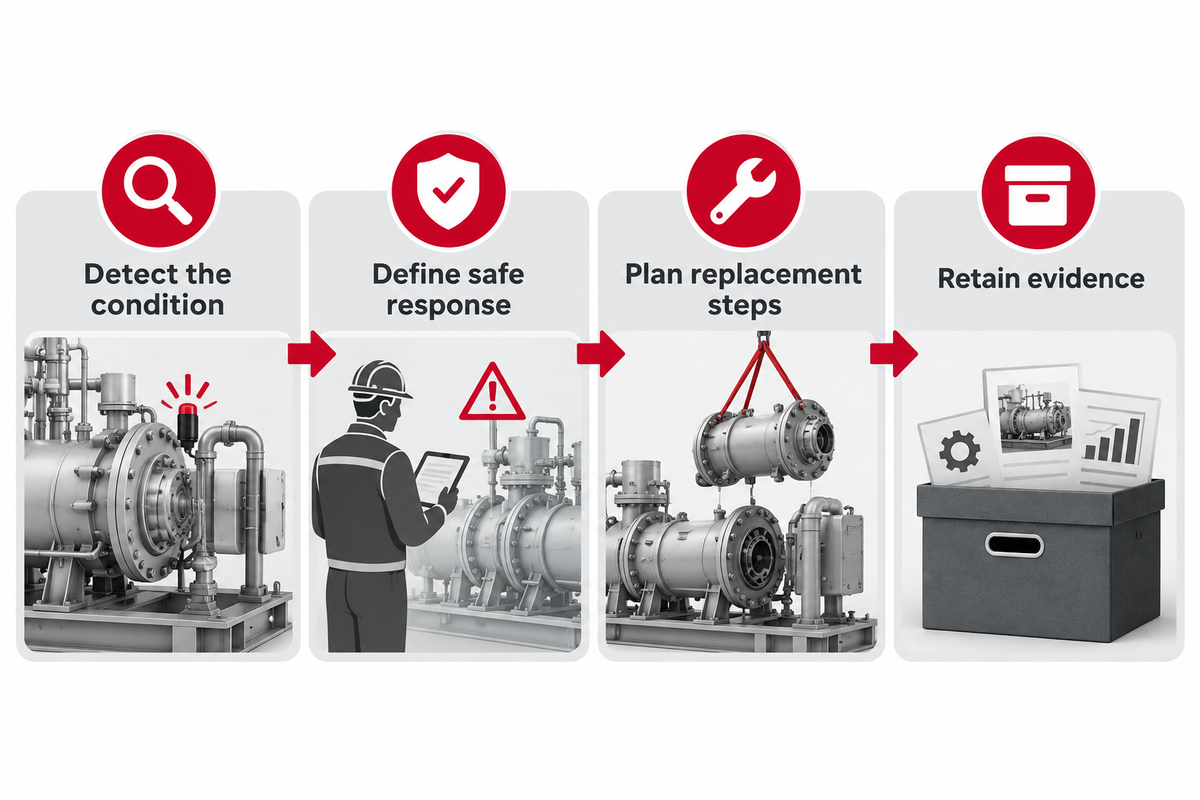
A maintenance interval is a planning input, not proof of availability. Strong proposals provide a record and defend against each failure mode.
What evidence is stronger than a brochure interval?
| Level | Evidence | Buyer question |
|---|---|---|
| 1 | Component claim | Which diaphragm, valve, ring, packing, seal, bearing, or hydraulic component is affected? |
| 2 | Failure mechanism | What initiates fatigue, wear, leakage, overheating, contamination, sticking, or control instability? |
| 3 | Detection method | Which sensor or inspection detects it, at what threshold, and with what proof test? |
| 4 | Safe response | What alarms, trips, isolates, vents, purges, or prevents restart? |
| 5 | Maintainability proof | What parts, tools, skills, access, lifting provisions, and elapsed repair time are required? |
| 6 | Operating evidence | Which event, trend, leak, vibration, temperature, and maintenance records are retained? |
H2Tools notes that valve malfunctions and valve leaks were significant contributors in reviewed NASA hydrogen incidents. Its inspection guidance supports documented leak checks, instrument checks, corrective actions and review of chronic problems. This isn’t a basis for refusing all valves or one compressor type. It is a reason to demand a component-level inspection and evidence plan.
For reciprocating equipment, dynamic packing leakage should be treated as a measured, routed, and maintained quantity. For diaphragm equipment, ask how diaphragm condition or rupture is detected, whether detection channels distinguish gas-side and hydraulic-side events, and what happens after an alarm. For diaphragm equipment, ask how diaphragm condition or rupture is detected, whether detection channels distinguish gas-side and hydraulic-side events, and what happens after an alarm. How does the system respond to an alarm? The proposal should explain the interval at which the test is performed and the evidence retained by the control system.
A type of reciprocating compressor may use a crankshaft, while a hydraulically driven unit may not. State the actual drive, piston rod arrangement, chemical properties of gas-contact materials and applicable maintenance.
The phrase diaphragm air compressor belongs to compressed air search intent, not this hydrogen decision. Likewise, a generic compressed air service interval can’t be used for hydrogen service without a project basis.
You can find an existing-site checklist relevant to this failure review in the API 618 reciprocating compressor checklist.
How should maintainability be compared?
Normalize the service scope. One vendor may quote hands-on replacement time while another may quote shutdown-to-return-to-service time. Ask for isolation, depressurization, purge, cooldown, access, removal, inspection, replacement, leak test, recommissioning, and documentation as separate steps. Then apply the project’s labor, spares, redundancy and outage assumptions.
Split FAT Evidence from SAT Evidence
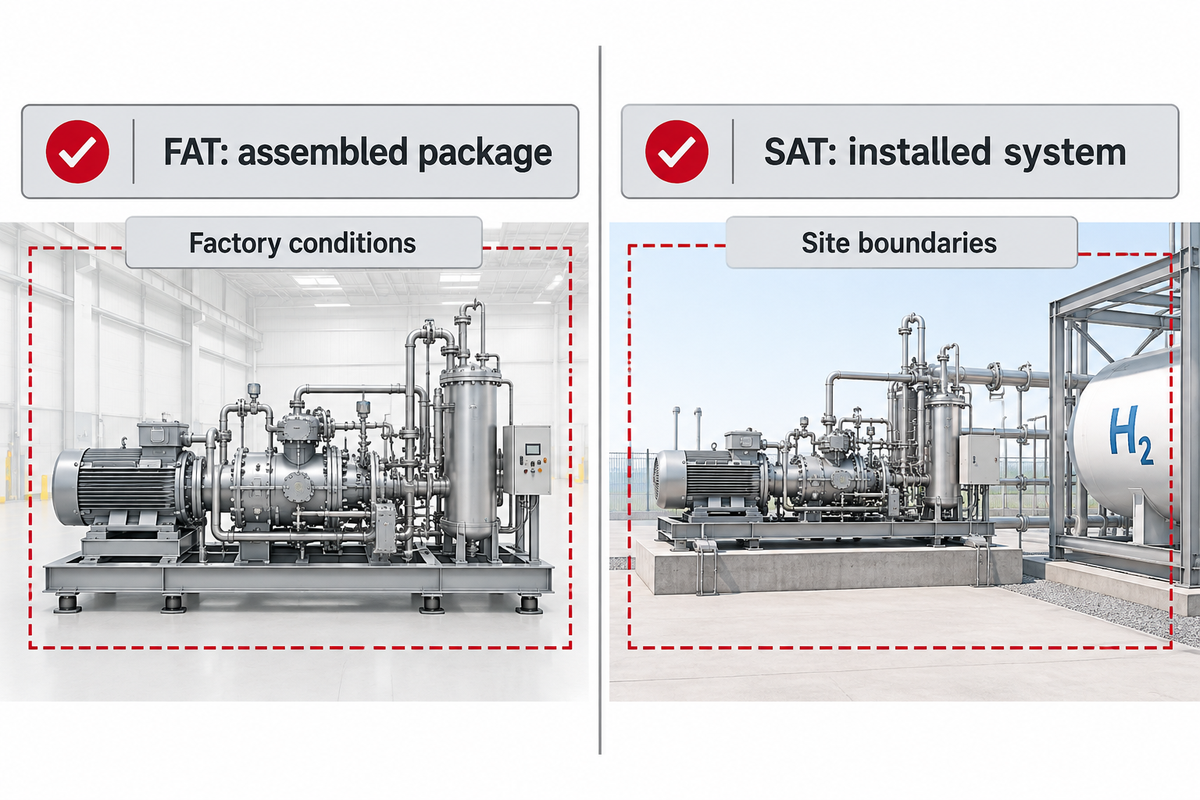
Factory acceptance testing proves the assembled package against an approved procedure under factory conditions. Site acceptance proves installation, utilities, piping, controls, safety interfaces, performance, and quality at the agreed site boundaries. Tests performed in the factory can’t replace site tests.
What should the FAT prove?
- material and document traceability for pressure-containing and gas-contact parts;
- Pressure and mechanical run and balance tests in the scope of the order, as well as pre-operational and functional tests to determine the status of the package (i.e., leak, temperature, and vibration tests);
- alarm, trip, permissive, emergency stop, sensor-failure, and safe-restart logic;
- capacity and power at agreed test points, with a documented correction method when test gas or conditions differ;
- evidence of gas quality or contamination at the boundary of the package if required in the contract;
- baseline condition data and the final turnover dossier.
The API source-inspection guide for reciprocating compressors refers purchasers to approved test procedures and API 618 testing requirements. Use the API inspection study guide as a structure reference, then bind the purchase order to the project’s applicable code edition and approved inspection and test plan.
What must wait for SAT and operating verification?
Rotation and utilities tests should prove piping cleanliness, routing of vents and purges, interfaces with hazardous areas, cause and effect logic, integration with the plant control system, real suction variation, interaction with storage and control, final delivered gas, and stable recovery from credible trips. Tests should demonstrate the operating team can retrieve evidence required for troubleshooting.
Independent assurance provider RINA distinguishes factory acceptance, string testing, system integration, and site acceptance in its FAT/SIT/SAT service framework. That separation is useful because an isolated package test cannot demonstrate the installed system’s piping, utilities, control handoffs, or downstream contamination boundary.
Apply the No-Decision Stop Rule
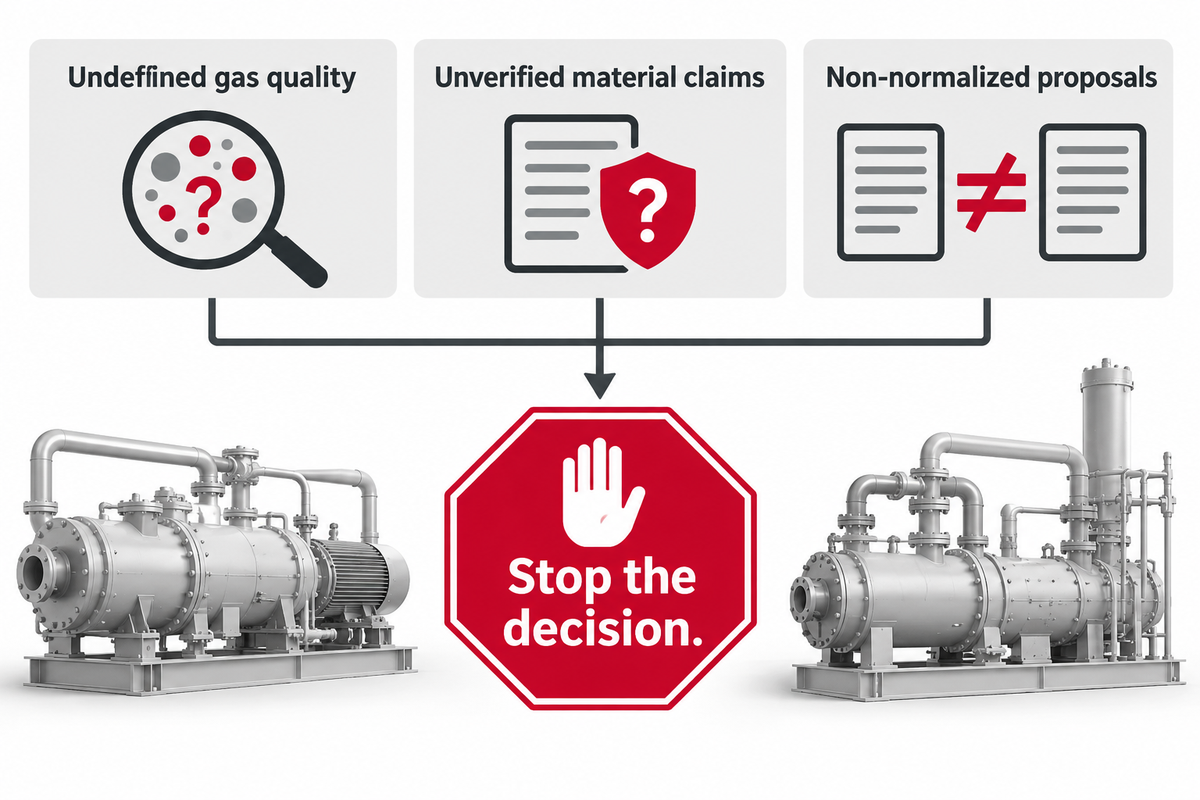
The compressor type shouldn’t be awarded in the absence of sufficient evidence to support a like for like comparison. A disciplined “not yet” is safer and cheaper than having to choose a winner between proposals that aren’t comparable.
When should the comparison stop?
- The bids use different suction, discharge, flow, gas, cooling, auxiliary, or power boundaries.
- The hydrogen quality specification, end use, edition, sampling location or detection limit isn’t defined.
- Turndown and transient claims aren’t tied to operating cases that are tested or guaranteed.
- Leakage or contamination claims do not identify paths, monitoring, thresholds, and safe response.
- Maintenance claims don’t show isolation, purge, leak testing, recommissioning, labor or parts cost.
- FAT is provided to demonstrate site integration or long term delivered gas quality.
- Efficiency or lifecycle cost uses non-equivalent package scopes or untraceable assumptions.
When a stop condition occurs, issue a clarification schedule and request revised guarantees. Depending on the results, a diaphragm compressor, a piston compressor, parallel smaller units, staged compression, or changes in storage and control strategy may be found acceptable. The decision should emerge from the same evidence boundary, not from whichever proposal contains the strongest adjective.
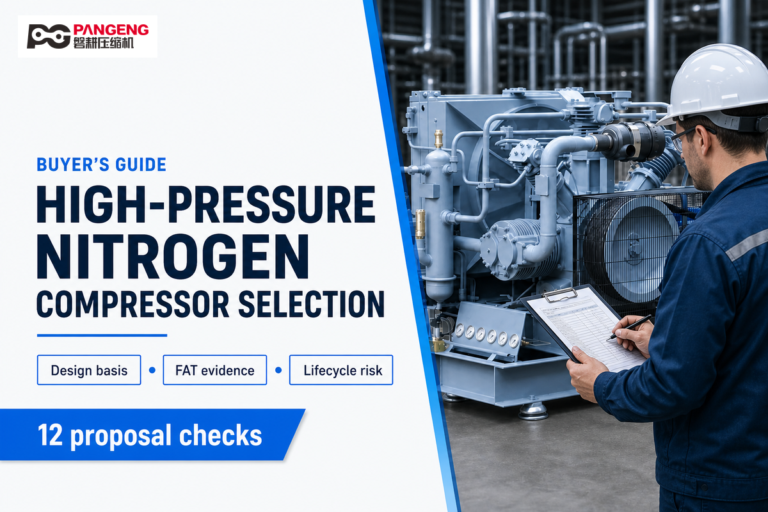
If the project requires a more complete review of pressure class and package configurations, the high-pressure hydrogen compressor selection guide will provide the adjacent selection context.
A practical bid-evaluation sequence
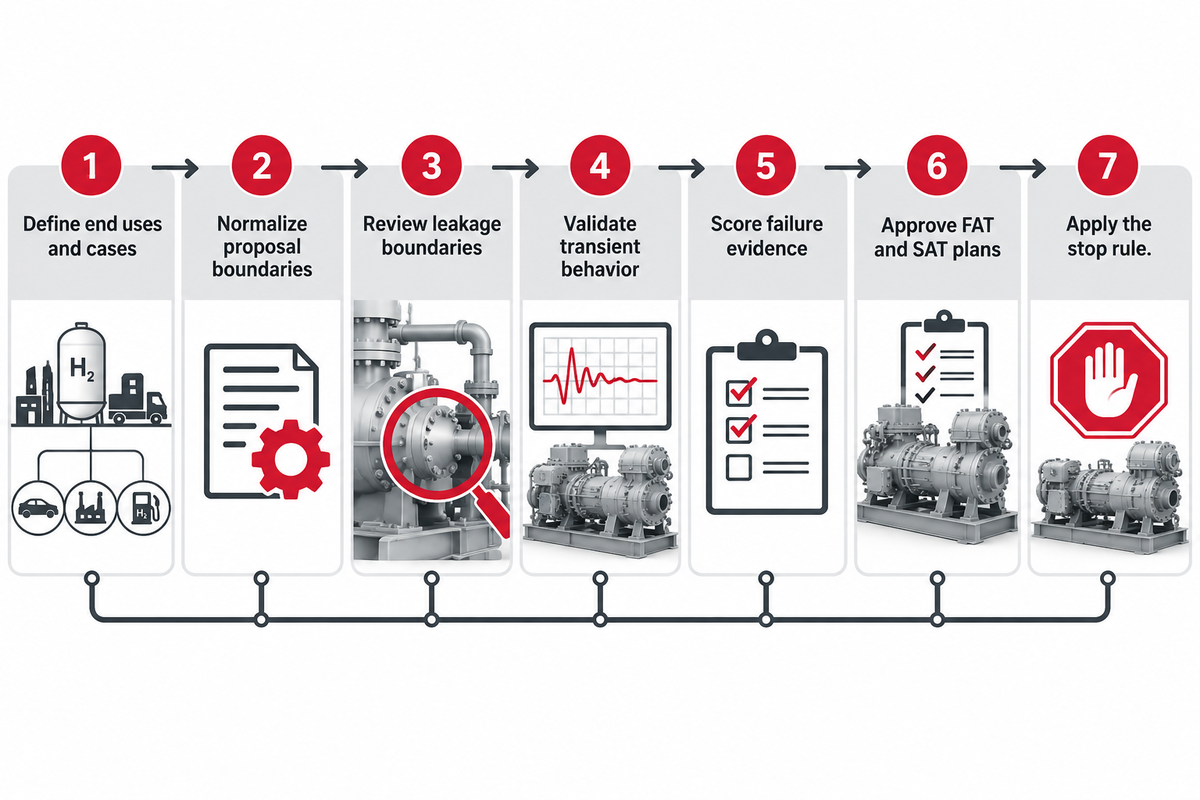
- Define all end uses, gas quality, battery limits, standards and editions, and all operating cases.
- Bring both proposals to the same pressure, flow, temperature, utilities, and auxiliaries and availability.
- Review the contamination and leakage boundary map for normal and failed states.
- Witness or document transient, turndown, alarm, trip and restart.
- Score component-level failure evidence and maintainability, not only claimed service intervals.
- Approve separate FAT, integration, SAT, and operating-quality evidence plans.
- Apply the no-decision stop rule to every unresolved material difference.
PanGeng Compressor designs and manufactures hydrogen compression packages in Bengbu, Anhui, with custom and OEM engineering available. A useful enquiry should include the completed duty envelope and acceptance requirements in order to address the project boundary rather than repeat a catalogue.
Frequently asked questions
Is a diaphragm compressor always better for high-purity hydrogen?
No. Its physical separation between process gas and hydraulic drive is a strong architectural advantage, but purity still depends on the complete package, materials, leak paths, downstream system, sampling location, and acceptance method. A properly validated piston configuration may also meet a defined gas specification.
Can a piston compressor handle intermittent hydrogen duty?
Some hydraulically driven piston systems are specifically suited to intermittent service. This project needs to validate starts, stops, suction variation, peak motor demand, temperature, sealing, control stability, and maintenance for the required duty.
Which type is more energy efficient?
No universally correct answer exists. Compare guaranteed power at identical suction pressure, discharge pressure, flow reference, gas composition, cooling basis, turndown, and auxiliary scope. Review peak power and annual operating profile as well as average power.
What is the most important document for vendor comparison?
The Hydrogen Duty Envelope record serves as the foundation. It should be joined by contamination and leakage boundary maps, a transient validation matrix, an evidence ladder for failure mode, and individual acceptance plans for FAT/SAT.
When should a buyer refuse to choose between the two?
Stop when gas-quality and/or operating bounds are undefined, material claims aren’t backed by test assurances, and/or proposals aren’t normalized. Ranking should be avoided when bids are incomparable.
References & Sources
- U.S. Department of Energy: Gaseous Hydrogen Compression
- Journal of Energy Storage: Overview of Diaphragm Compressors for Hydrogen Service
- Hydrogen: Hydraulically Driven Piston Systems Analysis
- H2Tools: Maintenance and Inspection
- American Petroleum Institute: Reciprocating Compressor Source Inspection Guide
- RINA: FAT, SIT, String and SAT Services
// SYS-DOC: WHY I WRITE THIS
[01] About PanGeng
PanGeng is an industrial gas compressor manufacturer based in Bengbu, Anhui, China. Since 2009, we have focused on the design, R&D, production, and manufacturing of customized gas compressor systems for oilfield, chemical, energy, hydrogen, nitrogen, biogas, and industrial air applications.
[02] Our Expertise
We write compressor guides based on real manufacturing and engineering experience, including hydrogen compressors, nitrogen compressors, booster compressors, medium and high-pressure air compressors, oilfield nitrogen injection systems, biogas compressors, and OEM/ODM custom compressor solutions.
Our engineering team supports customers from application analysis and compressor selection to production, factory testing, commissioning, spare parts, and after-sales service.
[03] Why You Can Trust This Content
The technical information in our articles is based on PanGeng’s in-house compressor design and manufacturing experience, current product capabilities, and project support for industrial clients in global markets. Our goal is to help buyers understand compressor types, pressure ranges, gas requirements, customization options, and long-term operating costs before making a purchasing decision.
CONTACT PROFILE
AUTHORITATIVE SOURCE
NAME
PanGeng Engineering Team
BRAND
PanGeng
COUNTRY
China
MODEL
B2B / OEM & ODM
EMAIL
pg20090705@163.com
PHONE
0552-4958225
WEBSITE
pgcompress.com
Trending now