Get in Touch with Pangeng


Updated August 2026
The api 618 reciprocating compressor checklist below is a buyer-side control for technical bids, vendor documents, inspection evidence, and post-award handoff. It doesn’t reproduce the standard, calculate a compressor, or replace the purchased API publication, the project specification, applicable law, or review by qualified engineers.
Vendors can state “API 618 compliant” while leaving study responsibility, test evidence, document dates, battery limits, or deviations unclear. Those gaps are where technically different packages begin to look commercially comparable. This checklist keeps those differences visible before price normalization or purchase-order award.
Short answer: API 618 establishes a technical framework for reciprocating compressors, but a compliance statement alone does not prove complete project scope. Buyers still need a completed duty basis, documented exceptions, named study owners, an agreed inspection plan, and evidence tied to the offered package.
Quick Reference
| Current edition verified | API Standard 618, 6th Edition, May 2024 |
| Article scope | Procurement, technical bid evaluation, source inspection evidence, deviations, and handoff |
| Not covered | Compressor sizing, operating instructions, copied clauses, or universal acceptance limits |
| Primary output | A comparable, evidence-linked technical bid record |
Five points to carry into the bid review
- A standard reference isn’t a completed project data sheet.
- A conformity claim isn’t proof of a product mark, management-system registration, or inspector credential.
- Hydrogen controls depend on gas conditions, system boundaries, inventory, jurisdiction, and intended service.
- Study reports and test records must match the offered machine and operating cases.
- Unresolved deviations remain technical and commercial liabilities even when the headline says “compliant.”
Quick Answer: What This API 618 Checklist Is For
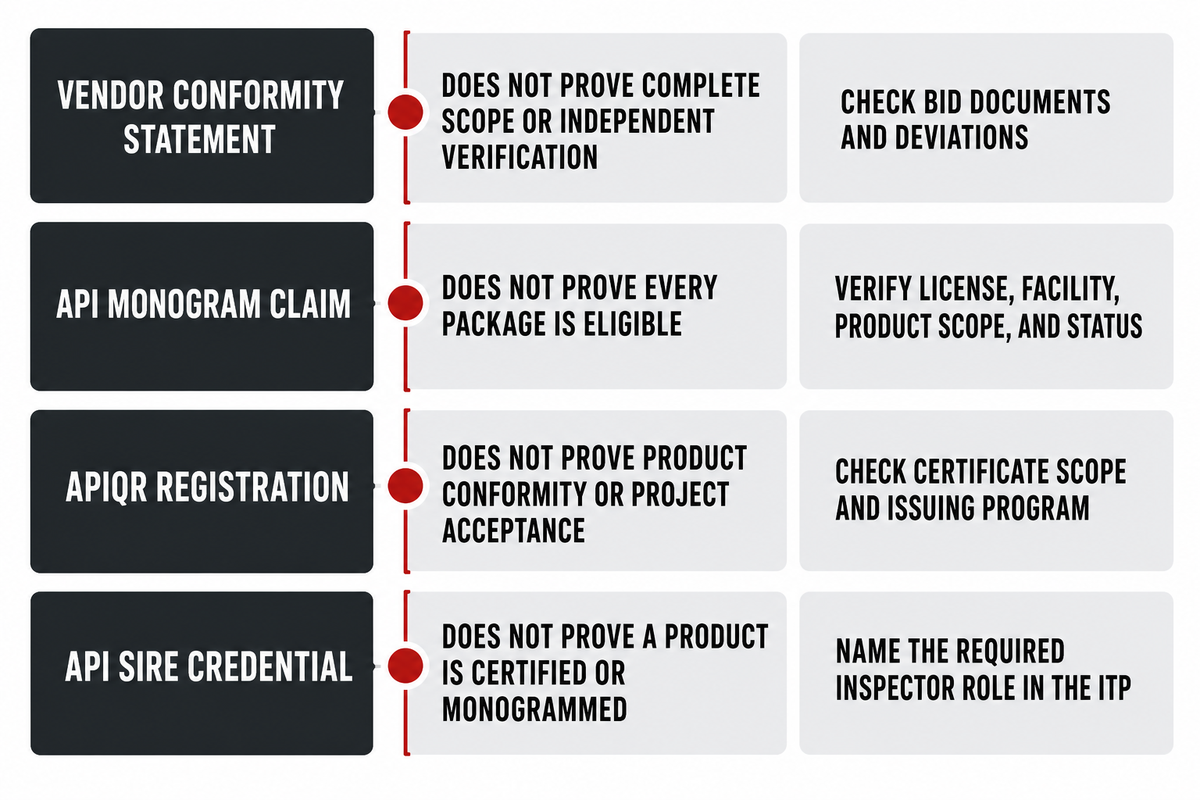
An API 618 buyer checklist is a traceability tool: it links the governing requirement to the bidder’s offered basis, supporting evidence, exception status, accountable owner, and closure date, turning the opening warning about unresolved deviations into a reviewable record. This overview does not restate the standard. It shows whether the technical bid is complete enough for a defensible approval decision.
Current edition metadata is straightforward. An API SIRE effectivity sheet lists API Standard 618, 6th Edition, May 2024. EFRC also hosts a two-part review of the sixth edition. These sources confirm edition control; they do not give permission to reproduce copyrighted clauses.
Buyers should write the edition, purchaser additions, project specification, and approved deviations into the contractual document hierarchy. “Latest edition” is weaker than a dated reference because a bid may have been prepared before the order, an addendum may apply, or a project document may intentionally modify a default requirement.
Queries such as “API 618 6th edition,” “API 618 latest edition,” and “API standard for reciprocating compressors” are edition-control questions, not substitutes for a contractual document list. Record the exact publication, purchaser additions, and project exceptions that each bidder must use.
Searches for an “API 618 reciprocating compressor checklist PDF,” “API 618 reciprocating compressor checklist Excel,” or “API 618 datasheet Excel” usually signal a need for a reusable bid-control form. This guide provides the field logic, not the copyrighted standard or an “API 618 6th edition PDF.” Build the project template from an authorized publication and the owner or EPC requirements.
| Evidence state | What it may prove | What it does not prove | Buyer check |
|---|---|---|---|
| Vendor conformity statement | The bidder claims its offer follows the named standard | Complete scope or independent verification | Tie each claim to bid documents and deviations |
| API Monogram claim | A mark may apply to licensed, conforming product | That every API standard or every package is eligible | Verify license, facility, product scope, and current status |
| APIQR registration | A management system may be registered to a named specification | Product conformity or project acceptance | Check certificate scope and issuing program |
| API SIRE credential | An individual is qualified for rotating-equipment source inspection | That a product is certified or monogrammed | Name the required inspector role in the ITP |
API describes Monogram as a voluntary licensing program for conforming product and APIQR as management-system registration. API SIRE qualifies individuals who perform supplier surveillance. These are separate evidence states. Do not let one label stand in for another.
Gate 1: Freeze Gas and Duty Cases Before Comparing Quotes
Following those evidence-state distinctions, comparable compressor bids begin with a shared duty basis, not a shared equipment name. Gas composition, contaminants, absolute suction and discharge conditions, flow basis, temperatures, turndown, starts, and alternate cases define the work. If bidders use different cases, a lower price may simply represent a smaller or easier duty.
Use the table below as a minimum comparison baseline. It isn’t a copy of an API data sheet and isn’t complete for every project. Add owner, EPC, jurisdictional, process-safety, environmental, electrical, and site information that applies to the installation.
RFQ checklist — copy these categories into your quote request:
| Parameter | Required basis | Why it matters | How to verify |
|---|---|---|---|
| Gas composition | Mole % for each case | Changes properties, leakage, materials, power, and temperature | Approved process basis or laboratory analysis |
| Contaminants | H2S in ppm, liquids, particles, moisture | Affects metallurgy, separation, packing, and corrosion risk | Feed specification and upset cases |
| Suction condition | Minimum/normal/maximum bar(a) and °C | Sets density, ratio, cylinder selection, and temperature path | Process cases in absolute units |
| Discharge condition | Required bar(a) for every case | Defines stage duty and interface pressure | Downstream hydraulic/process basis |
| Flow basis | Nm³/h, kg/h, or actual m³/h with reference conditions | Prevents unit and base-condition mismatches | Mass balance and stated reference state |
| Operating pattern | h/yr, starts/day, turndown, recycle, standby philosophy | Changes wear, control, cooling, and redundancy decisions | Operating narrative and case matrix |
| Site conditions | Ambient °C, elevation m, utility limits, hazardous area | Changes cooling, driver, electrical, and package design | Site data sheet and area-classification dossier |
| Guarantee cases | Named cases, tolerances, correction method, test evidence | Connects proposal numbers to enforceable acceptance | Guaranteed data sheet and agreed test procedure |
What information should a buyer send for an API 618 compressor quotation?
Buyers should send the approved gas analysis, absolute suction and discharge cases, flow basis, temperature range, contaminants, operating pattern, site conditions, utility limits, hazardous-area basis, package boundaries, and required guarantees. Bidders should respond against those cases, not replace missing inputs with silent assumptions.
Practitioner discussions show why a single compression ratio isn’t enough. Numerator and denominator can be misunderstood, gauge and absolute pressure can be mixed, and variable suction cases can disappear. Record the actual pressure and temperature cases; let the manufacturer show the stage arrangement and assumptions in its offer.
Where OSHA process safety management is applicable, the project information set isn’t limited to these compressor fields. Scope applicability depends on chemicals, inventory thresholds, and exceptions. For Category 1 flammable gas, the rule generally uses 10,000 lb (4,535.9 kg) in one location, subject to its stated exclusions. Owner or EPC teams must evaluate and confirm applicability; a compressor vendor checklist cannot do so.
Gate 2: Define Materials, Leakage, Packing, and Lubrication Boundaries
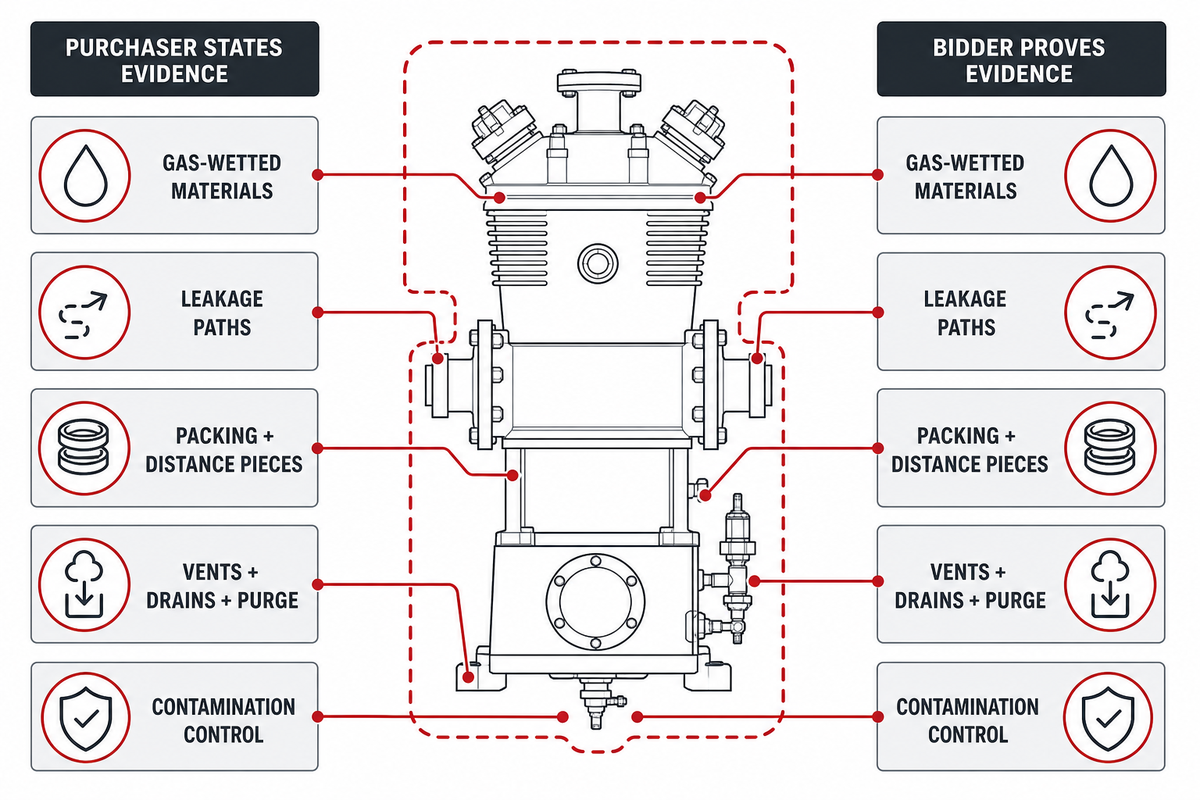
Hydrogen service shifts the burden of evidence around gas-wetted materials, leakage paths, packing, distance pieces, vents, drains, purge connections, and contamination control. It doesn’t make one size-fits-all material list; owners should define performance and hazard boundaries, and then require the vendor to document selections against actual composition, pressure, temperature, cycles, purity, and site rules.
DOE’s currently published safe-use guidance describes hydrogen-specific engineering controls that include adequate ventilation, leak detection, flame detection, and appropriate materials. The Congressional Research Service report also discusses leakage through joints, cracks, and seals plus embrittlement concerns. That report addresses pipelines, so use it as hazard context, not a compressor specification.
| Boundary | Purchaser states | Bidder proves | Closeout evidence |
|---|---|---|---|
| Gas-wetted metallurgy | Composition, contaminants, temperature, cycles, corrosion basis | Material selection and traceability basis | Approved material list and certificates |
| Packing and leakage | Allowable release destination and monitoring philosophy | Arrangement, materials, vents, drains, expected behavior | Drawing, procedure, test record |
| Distance piece | Containment, contamination, purge and vent objectives | Selected configuration and interface routing | Approved section drawing and line list |
| Cylinder lubrication | Purity and contamination limits | Lubricated or non-lubricated design basis | Data sheet, material list, operating manual |
| Purge system | Purge source, availability, hazardous-area philosophy | Flow, control, alarms, failure response | P&ID, cause-and-effect, functional test |
| Leak detection | Detection philosophy and system boundary | Detector interfaces and shutdown signals | Instrument index, setpoint approval, test record |
A 2024 Chinese utility-model publication for polysilicon hydrogen service describes an application-specific packing arrangement with separate high-pressure leakage, nitrogen-purge, and low-pressure leakage chambers. That patent is useful as a reminder that sealing architecture follows service conditions. It isn’t proof that Pangeng owns, applies, or has validated that design.
One practical rule is simple: never substitute a material name for a compatibility assessment. Proposals that say “stainless steel,” “oil-free,” or “hydrogen suitable” without a gas basis, component list, traceability path, and stated boundary remain assertions, not evidence.
Gate 3: Normalize Mechanical Configuration and the Operating Envelope

With materials and containment boundaries defined, mechanical bid normalization compares identical duty cases across frame, cylinders, stages, driver, speed, rod load, piston speed, power, efficiency, cooling, and off-design behavior. Purchasers need not prescribe every design choice. They do need enough offered values, curves, assumptions, and guarantees to detect when two vendors sized different machines.
Build one comparison sheet and leave no blank cell unexplained. “By vendor” is not an explanation unless the bidder supplies the proposed value and its evidence. “Not applicable” should state why it does not apply to the offered configuration.
| Comparison line | Bid value | Evidence | Assumption to expose | Limitation / not suitable for |
|---|---|---|---|---|
| Frame and throws | Offered configuration | GA and data sheet | Future capacity or spare throws | No inferred expansion capacity |
| Stages and cylinders | Per case | Selection sheet and curves | Interstage pressure and cooling | Not comparable across different cases |
| Rod and gas loads | Maximum and reversal by case | Load chart | Tolerance and upset assumptions | No acceptance without case coverage |
| Speed and piston speed | rpm and m/s | Data sheet and guarantee | Control range | No generic limit copied from another frame |
| Driver power | kW at each case | Power curve and margin statement | Site rating and utility conditions | Not a nameplate-only comparison |
| Operating envelope | All named cases | Envelope plot or case table | Recycle, unloaders, clearance, speed control | No guarantee outside the documented envelope |
Vendor-specific design details still need deliberate purchaser review; a standard reference does not resolve venting, purge, packing, piping, assembly, or interface decisions.
Purchasers are not redesigning the machine. What matters is a readable chain from duty to offered configuration to supporting calculation or drawing. Blank assumptions may become change orders; undocumented limits may become availability problems.
Gate 4: Put Pulsation, Piping, Vibration, and Foundation Studies in Scope
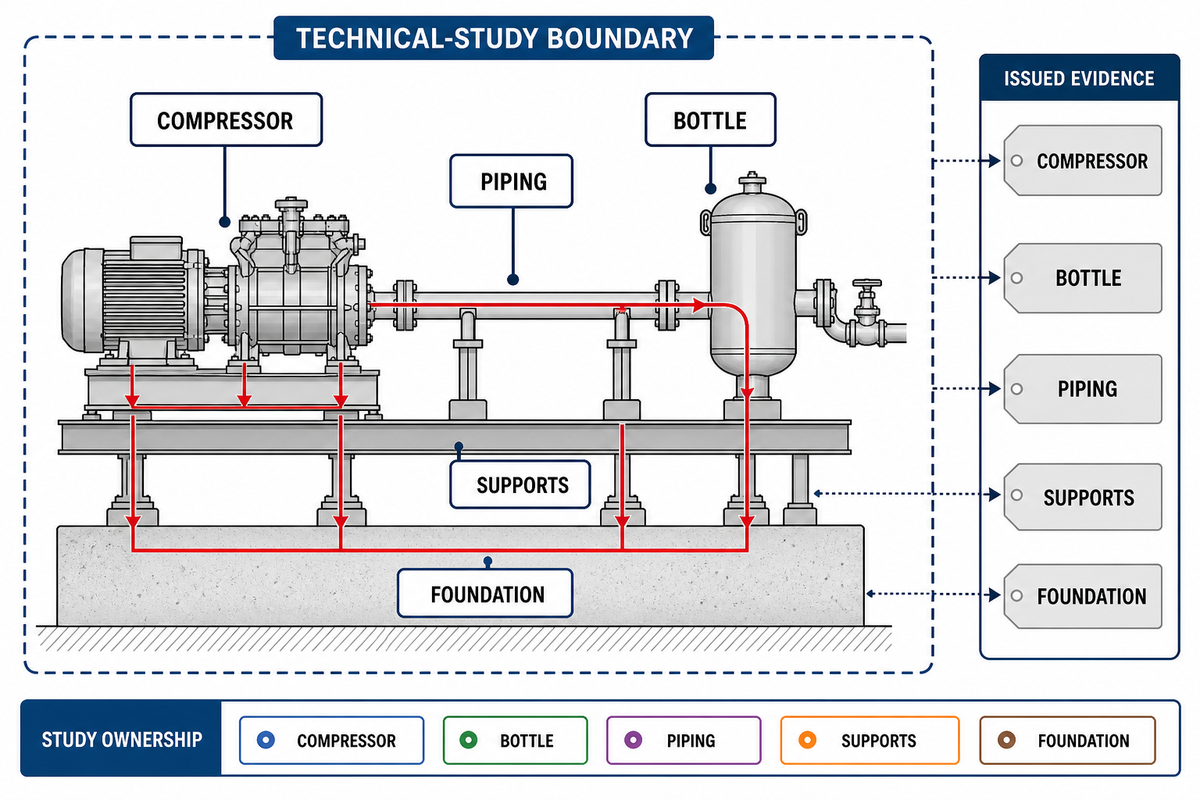
Once the offered configuration and calculations are aligned, pulsation and vibration evidence belongs to the whole compressor–bottle–piping–support–foundation system and its operating cases. Bid documents should name each required study, the party supplying inputs, the model boundary, velocity or displacement outputs, review stage, revision cycle, and issued deliverables. Labels such as “pulsation study included” leave those decisions unresolved.
A 2024 Scientific Reports case study identified pressure pulsation and mechanical coupling as root causes in one suction system. After the system-specific modifications, the paper reports 14.3% to 61.1% lower vibration and 75.56% lower peak-to-peak pressure pulsation at 1,000 rpm. It separately reports that the modified compressor’s processing capacity increased by 6.82%.
Those figures are not a vendor guarantee or an API acceptance limit. Their value is diagnostic: a measured problem depended on the coupled system, and the correction followed analysis of that system. Buyers should ask for the study basis and results, not borrow a fix or limit from another installation.
Does an API 618 package automatically include every pulsation and piping study?
No. Project teams must identify which acoustic, mechanical, piping, torsional, small-bore, nozzle-load, and foundation activities apply, who performs them, what geometry and operating cases they use, and which reports are contractual deliverables. Purchased standards and project specifications govern the final scope.
| Study / interface | Input owner | Bid evidence | Approval evidence | Limitations / not suitable for |
|---|---|---|---|---|
| Compressor performance model | Vendor + process engineer | Case list and model boundary | Issued curves and assumptions | Not valid for omitted cases |
| Acoustic pulsation | Named analyst | Method and boundary | Approved report and design actions | Does not replace field validation |
| Mechanical response | Vendor / specialist / EPC | Included components and load cases | Issued calculation and action list | Boundary depends on project scope |
| Piping flexibility / stress | EPC or named vendor | Interface loads and geometry exchange | Approved model and nozzle-load check | Not implied by package supply |
| Small-bore connection review | EPC / vendor | Line list and inspection boundary | Marked-up drawings and closeout | Needs as-built geometry |
| Torsional study | Driver/compressor train owner | Train data and cases | Issued report and resolved actions | Scope follows train configuration |
| Foundation input | Vendor to civil designer | Static/dynamic loads and anchor data | Approved civil interface pack | Not a foundation design by default |
| Field baseline | Owner / commissioning team | Planned measurement points | Baseline readings and disposition | Does not validate untested cases |
| Action closure | Named project owner | Open-item list | Closed revisions and evidence | No closure by meeting note alone |
Gate 5: Lock Auxiliaries, Instrumentation, Safeguards, and Utilities
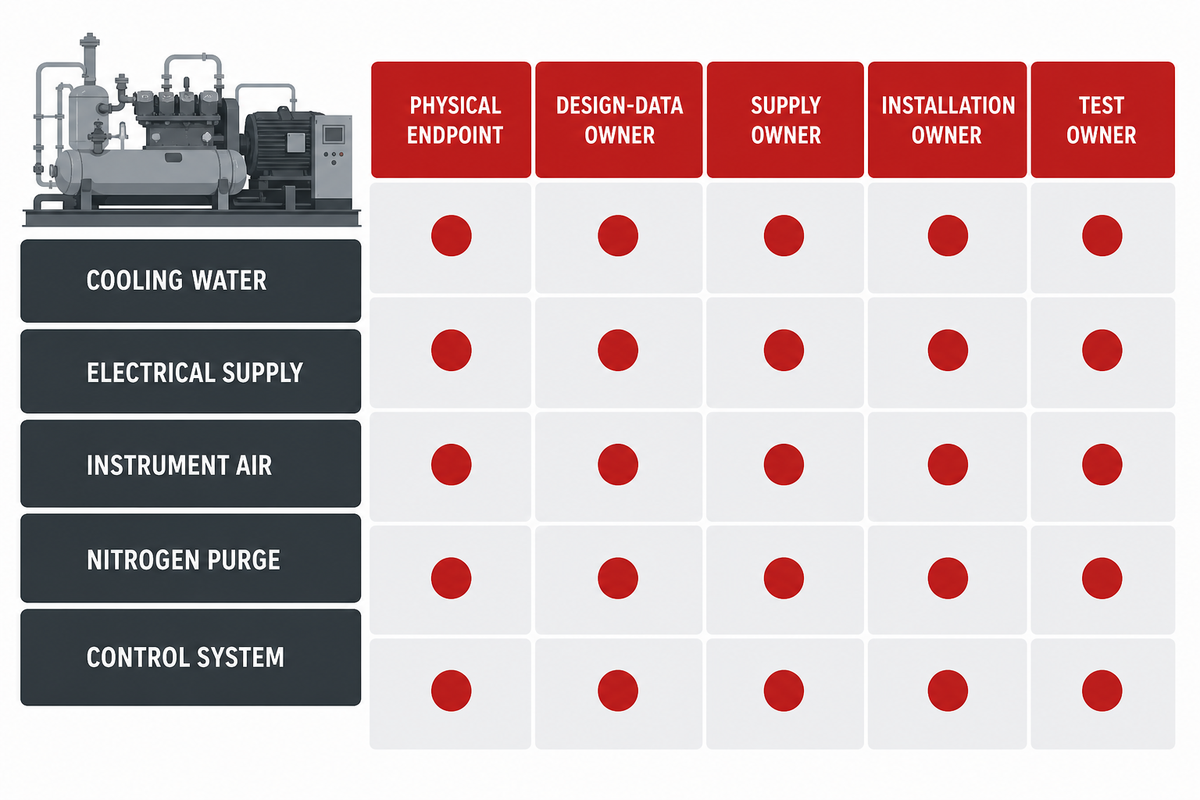
After study boundaries are assigned, auxiliary and utility scope becomes a change-order risk when the proposal names the compressor but leaves the surrounding package implicit. Bid documents should identify who supplies, sizes, wires, tests, and guarantees each cooler, separator, filter, pump, lubricant system, panel, detector, shutdown, relief interface, vent, drain, purge connection, cable, pipe spool, and utility tie-in.
Place a battery-limits matrix beside the P&ID and equipment list. This matrix is not a marketing “included/not included” chart. It should identify the physical endpoint, design-data owner, supply owner, installation owner, test owner, and document that closes each interface.
| Interface | Required project value | Vendor boundary | Owner boundary | Verification |
|---|---|---|---|---|
| Cooling water | m³/h, inlet °C, pressure bar(g), quality | Nozzle / skid edge | Header and treatment | Data sheet + functional record |
| Electrical supply | V, Hz, fault level, area class | Motor/control terminals | Feeder and protection | Single-line + test record |
| Instrument air | bar(g), quality, peak flow | Skid manifold | Plant header | Utility list + leak test |
| Nitrogen purge | Purity %, Nm³/h, pressure bar(g) | Purge control package | Reliable source and backup | P&ID + cause-and-effect test |
| Control system | Protocol, signals, trip ownership, time sync | Local panel and package logic | Plant DCS/SIS interface | I/O list + integrated functional test |
Hydrogen does not turn every auxiliary into a vendor obligation. Some controls belong to the building, process unit, owner safety system, or EPC. DOE hydrogen safety guidance helps identify system-level ventilation and detection interfaces, but the project team still assigns ownership. Buyer teams must make the boundary explicit, then test the complete chain that matters to the project.
Gate 6: Build the Vendor Document Register and Deviation Schedule
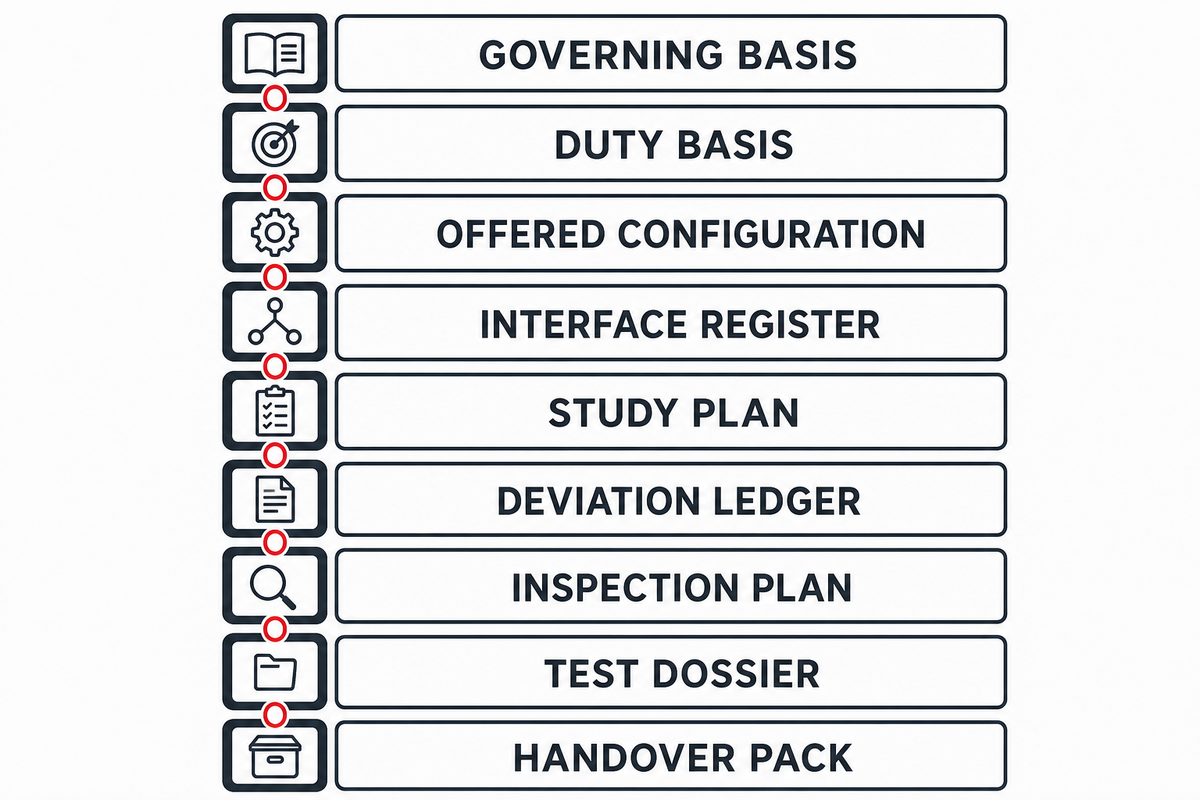
A vendor document register turns “documents included” into a dated contract deliverable. Each drawing, calculation, certificate, procedure, list, and manual needs a required stage, review code, responsible party, forecast date, actual date, and as-built status. Deviation schedules must remain separate so exceptions can’t disappear inside revised drawings.
Established source-inspection practice already uses project plans, inspection and test plans, document review, reports, nonconformance records, and deviation reporting. This RFQ-to-Handover Evidence Ladder adapts those controls to the buyer journey; it isn’t presented as a proprietary inspection system.
| Evidence ladder step | Required record | Decision unlocked | Failure if missing |
|---|---|---|---|
| 1. Governing basis | Edition, project specification, order of precedence | Which requirement controls | Conflicting interpretations |
| 2. Duty basis | Approved case table and gas analysis | Comparable sizing basis | Different machines priced |
| 3. Offered configuration | Data sheet, GA, curves, assumptions | Technical fit | Hidden design basis |
| 4. Interface register | Battery limits, utilities, loads, signals | Who supplies what | Late change orders |
| 5. Study plan | Owner, inputs, model boundary, deliverables | Analysis scope | Unmodeled system risk |
| 6. Deviation ledger | Exception, consequence, owner, due date | Whether risk is accepted | Exception buried after award |
| 7. Inspection plan | Evidence class, review/witness/hold/record points | How conformity is observed | Unwitnessed critical work |
| 8. Test dossier | Approved procedures, raw readings, results, dispositions | Acceptance against agreed basis | Pass/fail without traceability |
| 9. Handover pack | As-built drawings, manuals, spares, open-item closure | Ready for installation and commissioning | Operations inherits document debt |
Document review codes should say what the code permits: proceed, revise and resubmit, comment incorporated, or record only. An approval stamp shouldn’t erase the vendor’s design responsibility, and a comment shouldn’t silently expand purchaser scope.
Gate 7: Turn the Inspection and Test Plan Into Witnessable Evidence
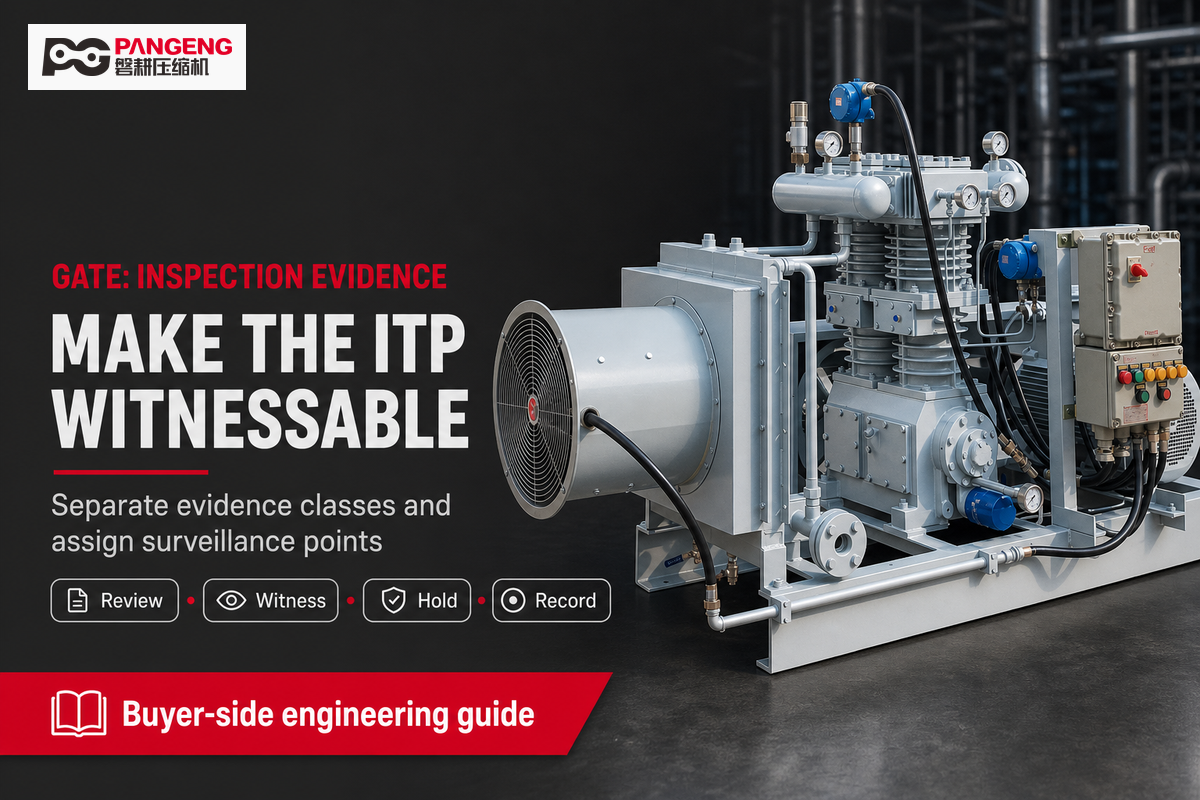
An inspection and test plan is useful when each activity names the evidence, acceptance basis, responsible party, notification period, surveillance level, and record retained. Generic online templates can suggest categories, but they can’t select project witness or hold points. Criticality, jurisdiction, purchaser capability, and contract structure determine those choices.
Separate evidence classes before assigning surveillance. Material traceability, fabrication, pressure integrity, dimensional checks, assembly, mechanical running, performance verification, package functions, preservation, and document closeout answer different questions. One “FAT” line can’t prove all of them.
A reciprocating compressor inspection plan or compressor inspection checklist should tell the inspector what evidence to inspect; it shouldn’t double as an operations or maintenance schedule. During an approved test procedure, the inspector may monitor bearing temperatures, discharge pressure, power consumption, vibration and noise, lubricant condition, oil level, alignment, condensate, debris, valve behavior, crankcase condition, and measurement-device calibration.
The manufacturer’s procedure supplies the project limits and logging intervals. Reviewers check continuous readings, stabilization, stability, vertical and horizontal measurement axes where applicable, and any result that may exceed an approved criterion. The procedure should also state when to pressurize, unload, cool, stop, or repeat a loop; generic best practices can’t replace that approved sequence.
Routine compressor maintenance, preventive maintenance, air compressor maintenance, and performing maintenance are separate lifecycle tasks. A reciprocating air compressor or other air compressors may use familiar terms such as filter, fluid, engine, bearing, and air leaks, but natural gas, hydrogen, and petrochemical service add different hazards and evidence duties. Procurement records should support a later maintenance schedule without pretending to be one.
| Evidence class | Typical record | Buyer question | Project decision |
|---|---|---|---|
| Material identity | Certificates and traceability map | Are specified materials linked to actual parts? | Review, witness, or hold |
| Fabrication | Procedures, personnel qualifications, inspection reports | Was critical work performed under approved controls? | Surveillance level by risk |
| Pressure integrity | Approved procedure and calibrated readings | Was the agreed boundary tested? | Witness/record point |
| Dimensions and assembly | Measured report and released drawings | Does the built machine match the approved configuration? | Selected critical dimensions |
| Mechanical running | Procedure, raw readings, alarms, post-test checks | Was stable mechanical operation shown under the agreed test setup? | Witness and result disposition |
| Performance | Agreed method, corrected results, guarantee comparison | Were contractual cases and tolerances demonstrated? | Only if required by order |
| Package function | Loop checks, cause-and-effect, trip/alarm record | Do controls and safeguards act through the full chain? | Integrated test boundary |
| Preservation and packing | Preservation procedure, photographs, release note | Will accepted condition survive shipping and storage? | Record point |
| Final dossier | Indexed records, deviations, as-built status, open-item closure | Can the owner trace what was accepted and why? | Release only after completeness check |
The API SIRE credential concerns individuals performing rotating-equipment source inspection. If the project requires that credential, state it in the inspection plan. Don’t treat the inspector’s credential as a product certification or proof that every test result passes.
Clause-to-Proof Bid Matrix: Turn Requirements Into an Approval Decision
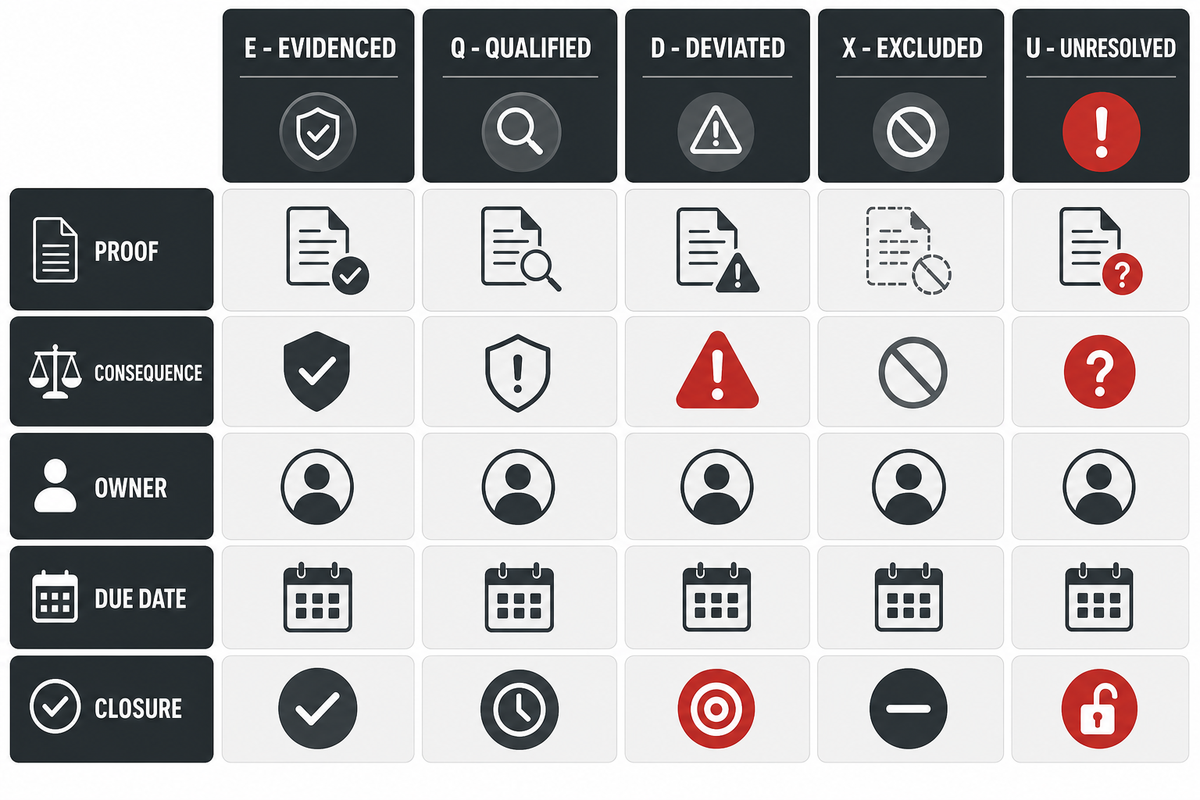
The Clause-to-Proof Bid Matrix prevents a common evaluation error: treating a promise, a drawing, a calculation, a certificate, and a completed test as equivalent evidence. Built on established source-inspection logic, it doesn’t claim a new inspection method. Its value is keeping status, consequence, ownership, and closure visible on one buyer-facing sheet.
| Requirement family | Bidder offer | Proof expected | Status | Consequence / owner / due date | Limitations / not suitable for |
|---|---|---|---|---|---|
| Governing documents | Named edition and exceptions | Signed compliance/deviation schedule | E/Q/D/X/U | Resolve before technical approval | Not system-level compliance |
| Duty cases | Completed case table | Selection data and guarantees | E/Q/D/X/U | Process engineer | Not complete without project additions |
| Materials and containment | Selected materials and arrangements | Basis, certificates, drawings | E/Q/D/X/U | Materials/process owner | No universal alloy list |
| Mechanical basis | Frame, cylinders, stages, loads | Data sheet, curves, load charts | E/Q/D/X/U | Rotating-equipment engineer | Only for named cases |
| Studies | Named methods and boundaries | Study plan and issued reports | E/Q/D/X/U | Vendor/EPC/specialist | No implied studies |
| Auxiliaries and controls | Included/excluded scope | Equipment list, P&ID, I/O list | E/Q/D/X/U | Package/control engineer | No boundary by silence |
| Inspection and tests | ITP and procedures | Records and dispositions | E/Q/D/X/U | QA/source inspector | Project-specific points |
| Performance guarantees | Cases and tolerances | Guaranteed curves and agreed test | E/Q/D/X/U | Engineering + commercial | No extrapolated guarantees |
| Documentation | Register with dates/revisions | Reviewed/as-built dossier | E/Q/D/X/U | Document control | Approval is not design transfer |
| Handover outcomes | Spares, maintainability, controls, training | Approved lists, manuals, integrated records | E/Q/D/X/U | Operations/project team | Shop tests do not prove field outcomes |
Status key: E = evidenced; Q = qualified; D = deviated; X = excluded; U = unresolved. Qualified items are not automatically acceptable. Deviations can be accepted only after their technical, schedule, and commercial effects are understood and recorded.
Finance enters the matrix through consequence, not by setting technical limits. Missing studies may create later engineering purchases; excluded coolers may shift capital cost to the EPC; incomplete spares lists may raise downtime exposure. Keeping those effects beside the technical status prevents cheap scope from being mistaken for low total risk.
Red Flags That Should Stop Technical Bid Approval
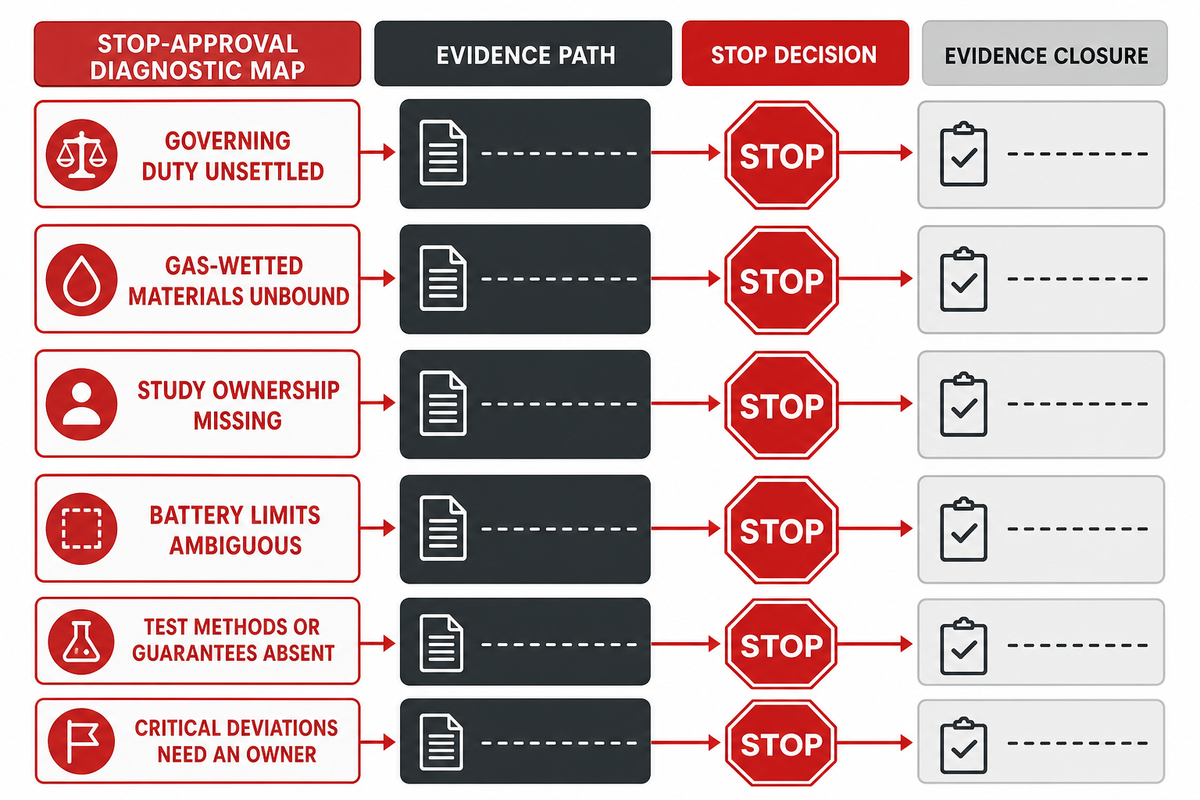
Use the Red-Flag Deviation Ledger as the closeout view of the Clause-to-Proof matrix’s technical and commercial status, carrying unresolved scope, evidence, ownership, and schedule effects into one approval decision. The name is a working label for established deviation-control fields, not a proprietary inspection method.
Technical bid approval should stop when a safety-critical or scope-defining item is unresolved, unsupported, or hidden in narrative qualifications. “Clarify after award” is not closure. Reviewers should know what evidence is missing, who can accept the consequence, and whether the commercial bid still represents the same package after the gap is closed.
Do
- Name the governing edition and document hierarchy.
- Close deviations against evidence and consequence.
- Normalize duties, interfaces, guarantees, and test scope.
- Verify every certification, registration, mark, and credential separately.
- Keep owner, EPC, vendor, and inspector responsibilities distinct.
Don’t
- Accept “API compliant” as a complete scope statement.
- Copy limits from an old or unauthorized standard file.
- Generalize one vendor’s model, cost, purity, or maintenance claim.
- Treat a shop pass as proof of field reliability.
- Average an unresolved safety gap into a total score.
When not to approve the bid
Do not approve the technical bid when the governing duty is unsettled; gas-wetted materials are unbound; study ownership is missing; battery limits are ambiguous; test methods or guarantees are absent; critical deviations have no consequence owner; or the final document register cannot show how design, inspection, and as-built evidence will be handed over.
Pangeng’s current product page publishes three reciprocating hydrogen/process-gas compressor families and vendor-stated operating bands. Those pages can help a buyer reach the right commercial team, but they are not independent proof of project fit. For model and package discussions, review the reciprocating hydrogen compressor packages and request case-specific evidence.
Edition Control and Evidence Handoff From PO to Commissioning
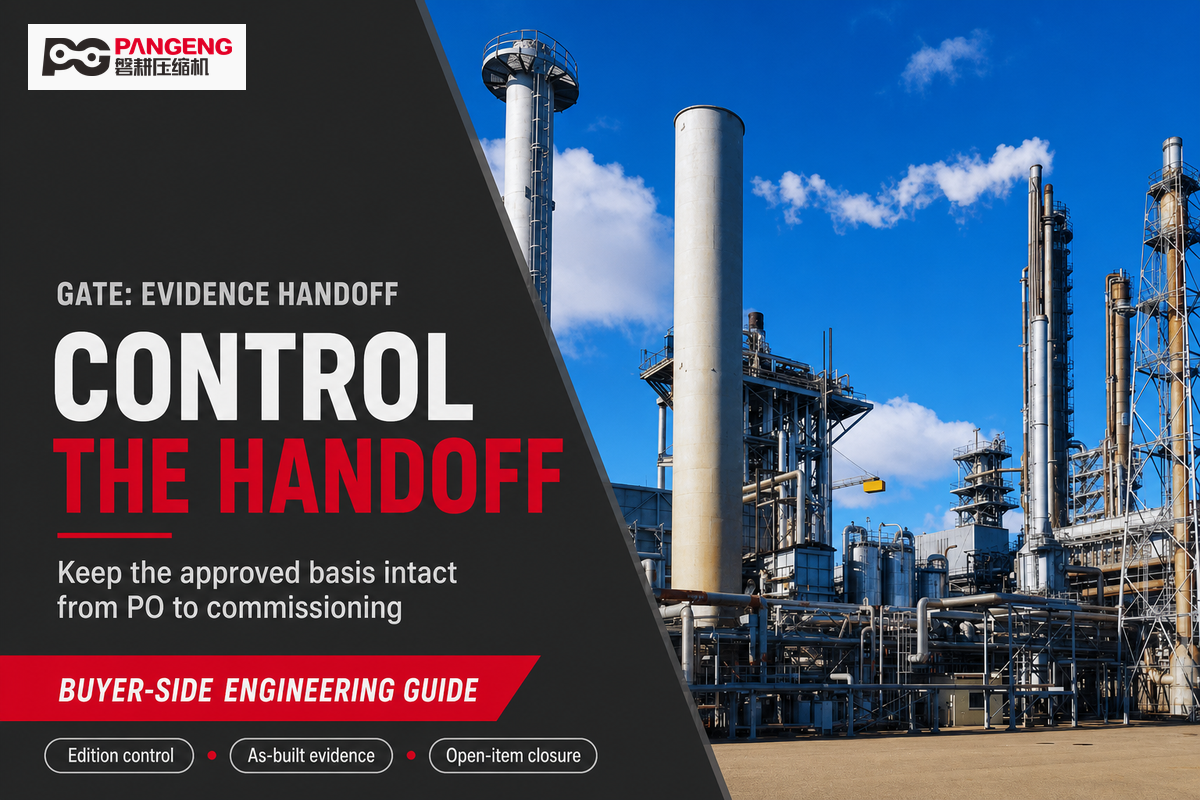
Case-specific evidence must persist after technical bid approval, so edition control keeps the approved basis from drifting between inquiry, purchase order, detailed engineering, manufacture, testing, shipment, installation, and commissioning. Handover packs should preserve the governing documents, approved deviations, study revisions, raw and issued test records, as-built drawings, manuals, spares basis, control interfaces, and open-item closure.
Keep an adjacent-standards register rather than assuming API 618 is the only changing document. Applicable standards depend on application and jurisdiction. For example, ISO 19880-1:2020 treats compression as one element within a hydrogen-fueling station and covers the station lifecycle; ISO marks it for revision. That fueling-station scope does not automatically apply to a refinery or chemical plant.
📐 Engineering note
Configuration control needs two clocks: the document revision that governs the order and the evidence revision that proves the built package. Newer files aren’t automatically contractual; contractual files aren’t automatically as-built.
Shop acceptance is also not the end of the result obligation. Field reliability, maintainability, spare-parts dependence, control-system integration, installation quality, and sustained performance under actual duty cycles need separate owner requirements and operating evidence. Handover packs should make those unresolved outcomes visible rather than implying that documentary closure proves them.
Key takeaway
A defensible purchase decision links each requirement to evidence, exception status, ownership, and closure—then keeps that chain intact through as-built handover and field verification.
Frequently Asked Questions
After the handover path is defined, these answers clarify the edition, application boundary, study scope, and evidence record.
What is the latest edition of API 618?
API Standard 618 is in its 6th Edition, dated May 2024. Buyers should state that edition plus project specifications, purchaser additions, and approved deviations in the order.
An API-hosted SIRE publications sheet lists the title as Reciprocating Compressors for Petroleum, Chemical, and Gas Industry Services. Buyers should still state the edition, project specification, purchaser additions, and approved deviations in the order. Do not write only “latest edition” in the purchase order. This article does not reproduce the standard; obtain the current authorized publication from API.
Does API 618 apply only to hydrogen compressors?
No. API 618 addresses reciprocating compressors for petroleum, chemical, and gas-industry services. Hydrogen adds service-specific materials, leakage, purge, detection, purity, and site requirements where applicable.
Hydrogen is one demanding service within that wider scope. Hydrogen properties may add material, leakage, purge, detection, purity, and hazardous-area considerations, but application and jurisdiction still control what applies. Buyers must also decide whether API 618 is the governing compressor standard for the project rather than assuming every hydrogen installation requires it.
What should an API 618 compressor inspection and test plan include?
Effective plans should separate evidence classes; name acceptance criteria, owners, notice periods, and retained records; and assign project-specific review, witness, hold, and record points for each activity.
Useful classes include material traceability, fabrication, pressure integrity, dimensions and assembly, mechanical running, performance verification when ordered, package functions, preservation, and final documentation. Each line needs an acceptance basis, responsible party, notice period, evidence record, and disposition path. Generic templates cannot choose critical points for a specific contract. Record final disposition and retained evidence for every point.
Is an API 618 compliance statement enough for technical bid approval?
No. It is a claim that must be checked against the governing edition, duty basis, deviations, studies, test scope, guarantees, document register, and offered package boundaries.
Check the governing edition, completed duty basis, deviations, mechanical offer, interfaces, study responsibility, inspection plan, guarantees, and document register. An unresolved exclusion does not become acceptable because the bidder uses the word “compliant.”
Who should own pulsation, piping, vibration, and foundation studies?
Ownership should be assigned by deliverable and interface across the vendor, specialist, EPC, civil designer, driver supplier, and owner, then recorded with inputs, milestones, issued reports, and action closure.
Compressor vendors, specialist analysts, EPC piping teams, civil designers, driver suppliers, and owners may each provide inputs or calculations. Bid documents should state the model boundary, operating cases, geometry exchange, loads, review milestones, issued reports, and action-closure owner. Purchased standards and project specifications determine the final allocation.
How is this procurement checklist different from a maintenance checklist?
Procurement checklists define what is bought, what each party supplies, and how evidence will support technical approval; maintenance checklists govern service tasks, intervals, and records after installation.
Combining the two can import irrelevant intervals or overlook purchase-order documents, deviations, guarantees, and source-inspection records.
Move from checklist to a case-specific compressor discussion
Pangeng’s hydrogen compressor portfolio is the commercial next step when your process basis, gas analysis, pressure cases, flow basis, purity boundary, package scope, and required evidence are ready for review.
How this checklist was built
The buyer guide uses current public API edition metadata, government hydrogen-safety material, peer-reviewed compressor research, industry-association resources, current search data, and live Pangeng page-role checks. Vendor claims remain first-party context. Project requirements, calculations, and acceptance limits must come from the purchased standard and qualified project engineering.
Related Pangeng Resources
- API 618 compliance checker preliminary application and certification triage.
- Engineered gas compressor package RFQ broader duty-envelope preparation.
- Hydrogen compressor safety standards cross-standard safety context.
- Hydrogen gas compressor selection pressure, flow, cooling, purity, and safety inputs.
- Hydrogen recycle compressor refinery guide refinery service context.
References & Sources
- API SIRE Exam Publications Effectivity Sheet American Petroleum Institute.
- Safe Use of Hydrogen U.S. Department of Energy.
- Pipeline Transportation of Hydrogen: Regulation, Research, and Policy Congressional Research Service.
- Safety Issues With Reciprocating Compressor Design, Operating Practices and Maintenance ASME Turbo Expo Proceedings.
- Vibration and Pressure Pulsation Elimination in a Reciprocating Compressor Suction System Scientific Reports, 2024.
- EFRC Reports for Reciprocating Compressor Systems European Forum for Reciprocating Compressors.
- 29 CFR 1910.119 Process Safety Management U.S. Occupational Safety and Health Administration.
- API Monogram and APIQR Programs American Petroleum Institute.
- API SIRE: Source Inspector Rotating Equipment American Petroleum Institute.
- ISO 19880-1:2020 Gaseous Hydrogen Fuelling Stations International Organization for Standardization.
- CN221170747U: Sealing Packing for a Hydrogen Compressor patent publication used only as innovation context.



![Low Pressure Hydrogen Compressor Applications [Guide]](https://pgcompress.com/wp-content/uploads/2026/09/low-pressure-hydrogen-compressor-applications-blog-featured-150x150.png)