Get in Touch with Pangeng


By Aurora · Updated November 2026
A non api 618 compressor vs api 618 compressor comparison is an engineering design-basis decision for process gas compression. As seen in the history of the API 618 design documentation, the American Petroleum Institute Standard 618 (6th Edition, May 15, 2024) has in mind a service life of 20 years with 3 years of continuous operation. Non-API machines follow an alternative specification or a manufacturer standard.
Commercial proposals often blur that boundary by quoting a bare compressor frame against a complete refinery skid. Make sure to normalize both the bid on the same gas composition, suction pressure, discharge pressure, pulsation bottles, cooling utilities, and factory testing.
Quick Comparison Basis
- Active API 618 basis: 6th Edition published May 15, 2024 (189 pages). It covers low- to moderate-speed reciprocating compressors and package auxiliaries.
- Alternative named standards: API Spec 11P 3rd Edition (August 2025, 314 pages, current) governs upstream oil and gas production packages. ISO 13631:2002 (80 pages) was withdrawn on October 27, 2026.
- Design target difference: As discussed in historical Section 2 data, API 618 has a 20-year design life and 3-year continuous run. As noted in gas-field comparisons, upstream high-speed units have an 18-month engine maintenance interval at 1,000 to 1,500 rpm.
- Pulsation analysis update: Design Approach 1 was eliminated in API 618 6th Edition. New projects use acoustic and mechanical simulation under Design Approaches 2 and 3.
Choose an API 618 reciprocating compressor when owner specifications, refinery or chemical processing criticality, and unspared continuous uptime justify full package engineering. Choose a documented manufacturer-standard or API Spec 11P unit when the gas service, installed redundancy, and project code permit a lighter specification on equal safety boundaries.
Key Decision Takeaways
- The label non-API is incomplete until the supplier names the governing manufacturer standard or alternative code such as API Spec 11P.
- API 618 is a document for Equipment Purchase Specification and not an Organization Certificate or a Wear-Part Warranty.
- Showing a bare compressor frame beside an engineered skid with pulsation bottles, intercoolers and instrumentation skews capital investment analysis.
- Refinery hydrogen recycle compressors typically specify API 618, whereas ISO 19880-1:2020 fueling stations qualify equipment under station safety rules.
What API 618 and non-API actually mean
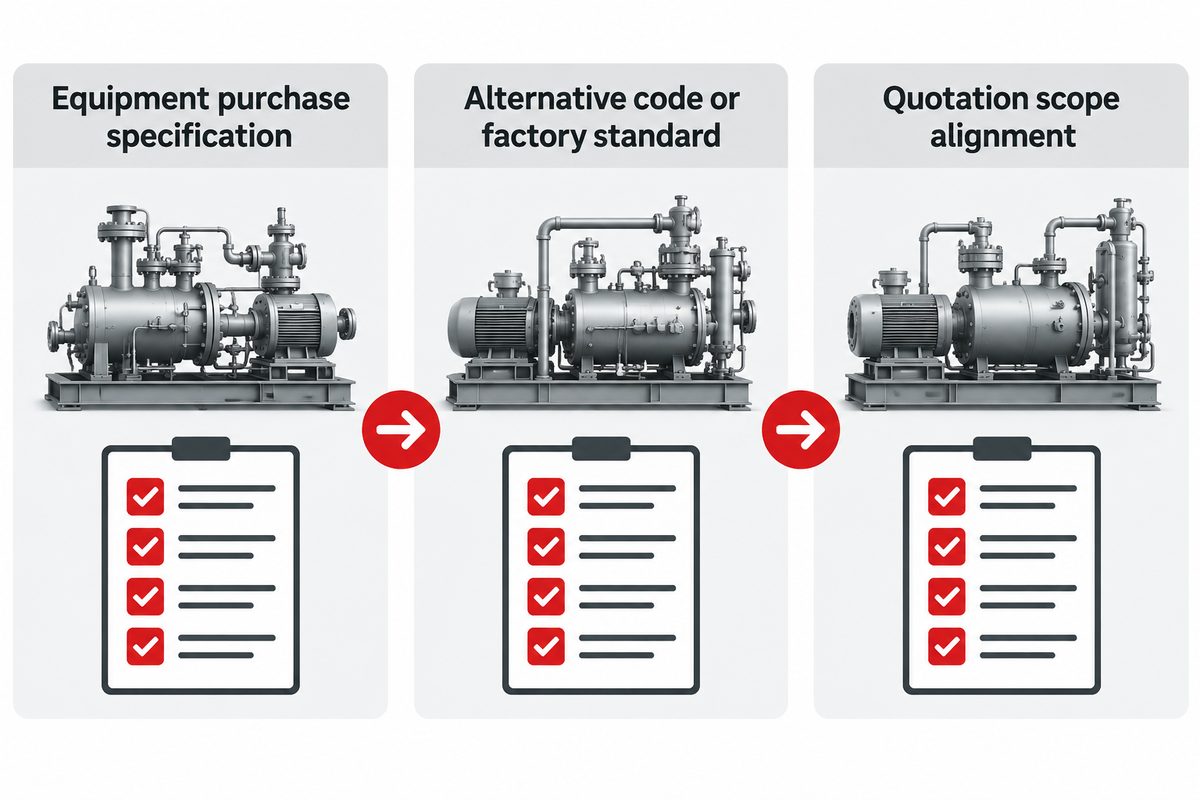
An API 618 compressor is a low- to moderate-speed reciprocating compressor built to American Petroleum Institute Standard 618 (6th Edition, May 15, 2024, 189 pages). It serves petroleum, chemical, and gas industry applications. A non-API unit is a machine built to an alternative code or an internal factory standard.
Separating those design bases prevents procurement teams from treating two unequal quotation scopes as interchangeable compression equipment. According to the API Webstore official listing for API Standard 618, the 6th Edition supersedes the 5th Edition (December 2007), 4th Edition (June 1995), and 3rd Edition (February 1986). The publisher defines the machine boundary directly in its scope statement:
The low- to medium-speed compressors are within this standard.
Beyond the bare compressor frame and driver, the API 618 standard covers lubricated or nonlubricated cylinders where pistons reciprocate to handle process air or process gas. Related lubrication systems, control systems, instrumentation, intercoolers, aftercoolers, pulsation suppression devices, and auxiliary equipment sit inside the same normative boundary.
A non-API proposal falls into one of two distinct categories. First, the machine may follow another named industry rule, such as API Spec 11P 3rd Edition (August 2025) for packaged reciprocating compressors in upstream oil and gas production. Second, the supplier may build the unit to an internal factory specification for industrial gas, inert gas, or utility service.
Engineers checking older specifications also encounter ISO 13631:2002 in the ISO standards catalogue. That 80-page standard for packaged skid-mounted reciprocating compressors with lubricated cylinders was formally withdrawn on October 27, 2026. ISO 13631:2002 excluded nonlubricated cylinders and utility air units at or below 9 bar discharge gauge pressure.
API 618 in its entirety will create a verified contract pack for process gas service. Buyers reading a generic industry analysis on the global api 618 reciprocating compressor sector will often see claims about what the reciprocating compressor market was valued at. Separate investor commentary on the api 618 reciprocating compressor market never replaces a mechanical datasheet.
Design differences that change a reciprocating compressor package
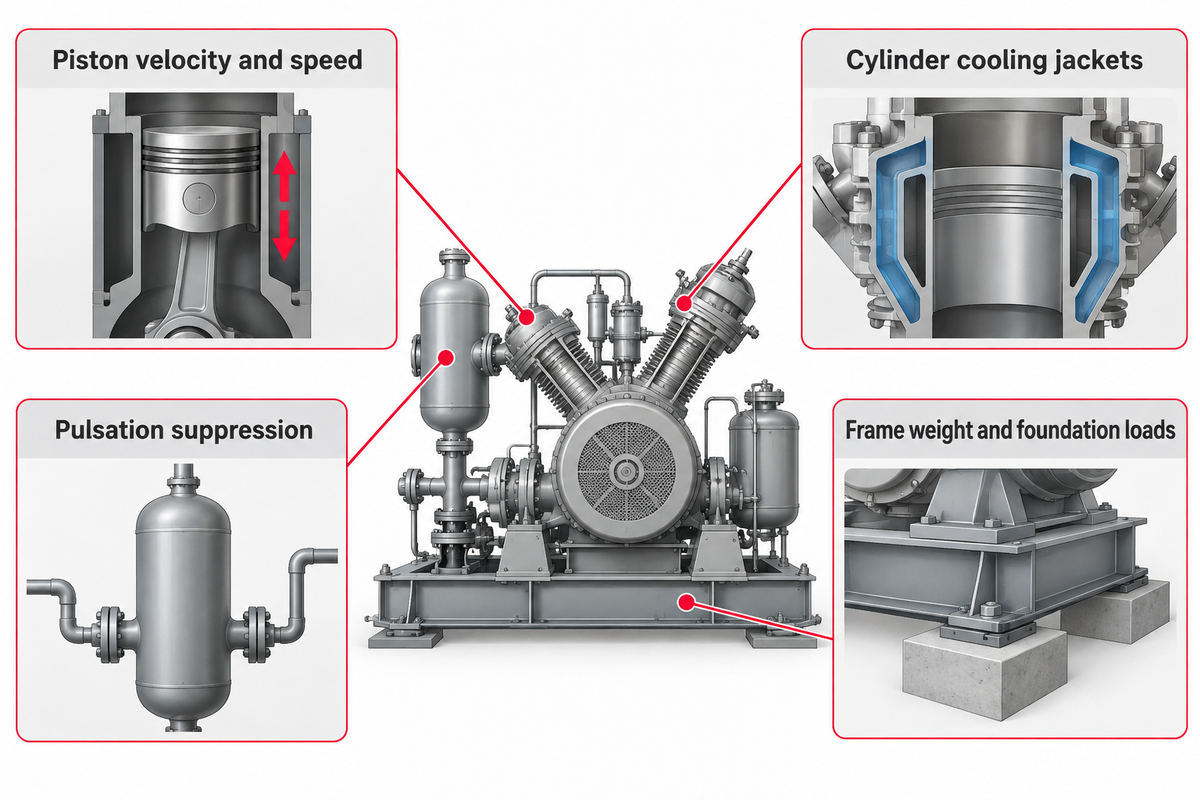
Mechanical variations between an API 618 reciprocating compressor and a manufacturer standard package are the number of rotation per unit time, piston velocity, firing valve energy, cooling jackets on the cylinders, pulsation suppression calculations. These mechanical considerations, among other factors, alter frame weight, foundation loads and skid dimensions long before a compressor arrives in gas service.
Building on the scope definitions above, a buyer cannot evaluate two bids by comparing shaft power and discharge pressure alone. In a peer-reviewed historical paper from the Texas A&M 30th Turbomachinery Symposium on reciprocating compressors, author George M. Kopscick notes that API 618 first appeared in April 1964. As documented in Section 2 of that standard, the design criteria targeted a 20-year service life and 3 years of uninterrupted operation.
That 2001 symposium paper contrasts three speed classes across the reciprocating compressor industry. Low-speed refinery frames run at 200 to 600 rpm, moderate-speed units run at 600 to 1,200 rpm, and high-speed separable field units operate at 1,000 to 1,500 rpm. Early 1964 empirical limits held average piston speed to 750 ft/min (3.8 m/s) for lubricated cylinders and 700 ft/min (3.6 m/s) for nonlubricated cylinders. Later designs offered 825 to 875 ft/min (4.2 to 4.4 m/s) lubricated and up to 750 ft/min (3.8 m/s) nonlubricated.
Slowing a high-speed separable compressor down does not convert it into a heavy-duty refinery unit. As the Texas A&M analysis explains, metallic valve plates were historically limited to 3 m/s (591 ft/min) impact velocity. High-speed nonmetallic valves running at 10 m/s (1,969 ft/min) lasted about 18 months. Moderate-speed API 618 designs reduce valve impact velocity to 7 m/s (1,378 ft/min), cutting impact energy in half to support 3 years of operation.
Cylinder thermal management and wear restoration also varies between classes of equipment. Water-cooled process cylinders maintain jacket water inlet temperatures at least 10°F (6°C) above the gas inlet temperature to prevent liquid condensation inside the bore. In a moderate-speed comparison from Texas A&M, replaceable liners hardened by ion-nitriding to 58+ RC enable crews to bring a worn bore back on line in as little as 5 to 7 days (around 1 week).
Acoustic and mechanical vibration control represents another major package boundary. According to Southwest Research Institute (SwRI) guidance on API 618 pulsation analysis, Design Approach 1 was removed from API 618 in the 6th Edition. New API 618 packages require Design Approach 2 (acoustic pulsation, pressure-drop, pulsation bottle sizing, and piping restraint review) or Design Approach 3 (which adds finite element analysis of the compressor manifold).
| Package Element & Class | API 618 6th Edition Process Package | API Spec 11P / Manufacturer-Standard Package | Buyer Verification Impact |
|---|---|---|---|
| Governing Standard Edition | API Std 618 6th Edition (May 15, 2024, 189 pages) | API Spec 11P 3rd Edition (August 2025, 314 pages) or factory standard | State exact edition and clause exceptions in the purchase order |
| Design Service Life & Run Target | 20-year design life; 3-year uninterrupted run system objective | Matched to 18-month engine overhaul (98% availability target) or duty cycle | Align turnaround schedule with valve and ring wear intervals |
| Typical Rotational Speed Class | Low-speed (200–600 rpm) to moderate-speed (600–1,200 rpm) | Moderate-speed or high-speed separable frames (1,000–1,500 rpm) | Check stroke length, rod load reversal, and foundation dynamic forces |
| Historical Piston Speed Benchmark | 3.8–4.4 m/s (750–875 ft/min) lubricated; 3.6–3.8 m/s (700–750 ft/min) dry | Up to 5.3 m/s (1,050 ft/min) on 1,400 rpm, 114 mm (4.5 inch) stroke units | Review rider band wear rates and dry-gas sealing limits |
| Valve Plate Impact Velocity | 3 m/s (591 ft/min) metallic; 7 m/s (1,378 ft/min) nonmetallic | Up to 10 m/s (1,969 ft/min) nonmetallic on high-speed frames | Lower impact velocity halves kinetic energy and extends valve life |
| Inertial Unbalance (1 MW at 3.8 m/s) | 300 rpm (381 mm stroke): 10 kg typical unbalance, 1.00x baseline inertial force | 720–1,200 rpm (159–95 mm stroke): 1.15 kg typical unbalance, 0.27x–0.45x relative force | Match civil foundation block mass to primary and secondary forces |
| Cylinder Cooling & Bore Liner | Water jacket inlet ≥ 6°C (10°F) above gas inlet; 58+ Rc nitrided liner | Water-cooled or air-cooled barrels; liner or stocked barrel swap in 5–7 days | Check thermal expansion clearance and condensation margin |
| Pulsation & Vibration Study | Mandatory Design Approach 2 or Design Approach 3 (Design Approach 1 removed) | Per project specification; acoustic simulation often optional unless ordered | Include bottle nozzles and piping restraint spans in the RFQ |
| Auxiliaries & Data Dossier | Full API datasheets, intercoolers, aftercoolers, lube console, and witness tests | Modular design skid with vendor-standard instrumentation and test records | Audit exact battery limits before comparing package prices |
Learn more about auxiliary battery limits with our engineered gas compressor package scope guide. Listing your coolers, separators, relief valves and local control panels on the same sheet helps keep every bidder within a single mechanical boundary.
When API 618 is worth specifying
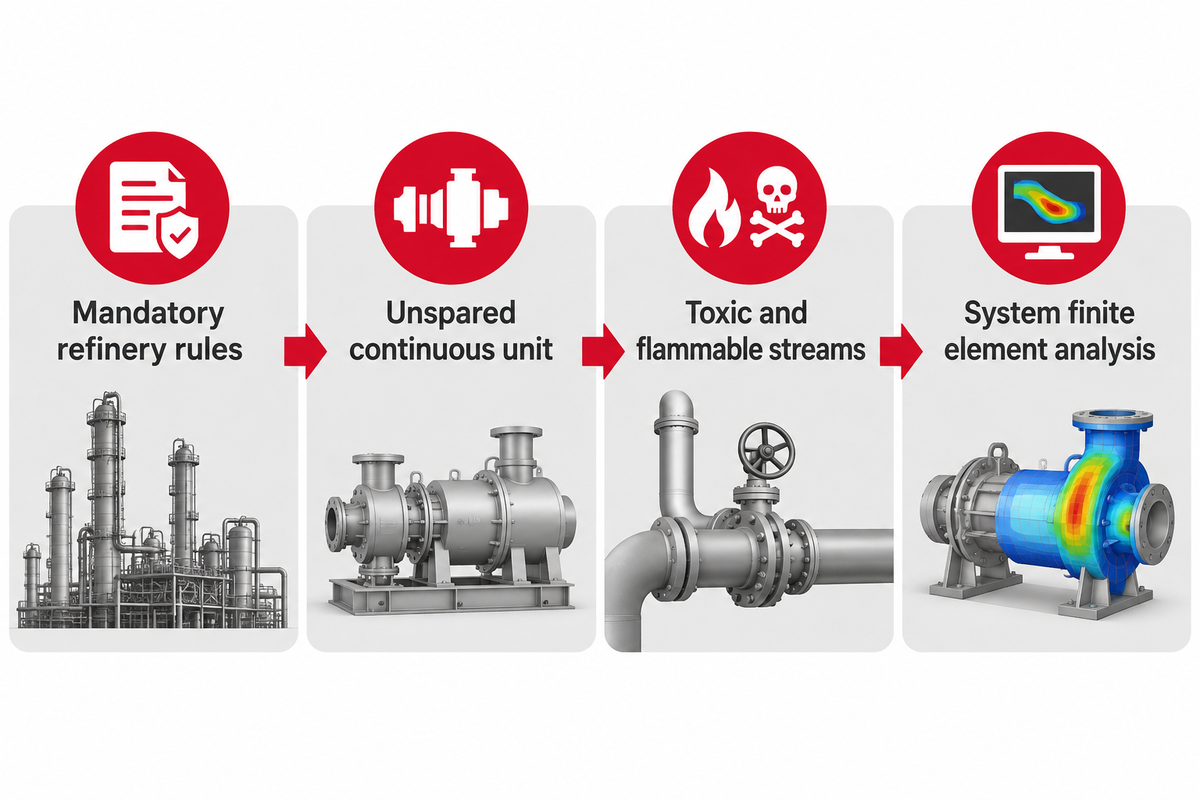
Provide API 618 on a project contract if refinery API rules are called for or if an unspared compressor feeds a continuous downstream oil or petrochemical unit. Streams of toxic and flammable gases also call for API 618 if Design Approach 3 system finite element analysis and total material traceability are necessary.
These package variations roll into a qualification sequence prior to engineering raising a purchase enquiry. For projects, application teams can use the 4-Step Standard Selection Decision Tree below to align equipment standard to actual plant risk.
Standard Selection Decision Tree: 4-Step Qualification
- Verify contractual and regulatory requirements first. If a document, such as a license, insurer or owner standard, calls for API 618 (6th Edition, May 15, 2024), make sure to include that particular edition in the tender documents.
- Evaluate gas hazard and process duty. Sour hydrocarbon gas, high-pressure refinery hydrogen recycle, and toxic chemical processing create severe safety and environmental exposure. Specify API 618 with Design Approach 2 or 3 pulsation studies per SwRI acoustic and mechanical study methods.
- Assess production criticality and standby redundancy. In a peer-reviewed study in the International Journal of Rotating Machinery by Kurz, Lubomirsky, and Brun (2012), a single unit on an 8,760 hours/year schedule with three planned 2-day shutdowns and one unplanned 3-day outage (216 hours total) achieves an availability factor of 0.975. Two operating units plus one standby unit at a 0.970 unit availability factor reach a 0.9991 station availability factor, allowing a qualified alternative package where codes permit.
- Match upstream or modular industrial duties to named alternatives. As reported in field gathering studies, gas exploration, shale gas gathering, and gas development often use 1,000 to 1,500 rpm units on 18-month engine maintenance cycles. Specify API Spec 11P (3rd Edition, August 2025) or a documented OEM process-gas specification with explicit test gates.
Owner engineers at gas processing and petrochemical plants are now requiring and increasingly mandate an explicit deviation list to be submitted during the bidding process. When a supplier proposes a manufacturer-standard compressor for an intermittent or redundant service, require documented rod load ratings, cylinder material certificates, and pulsation control calculations.
Reliability and energy use: compare the operating case
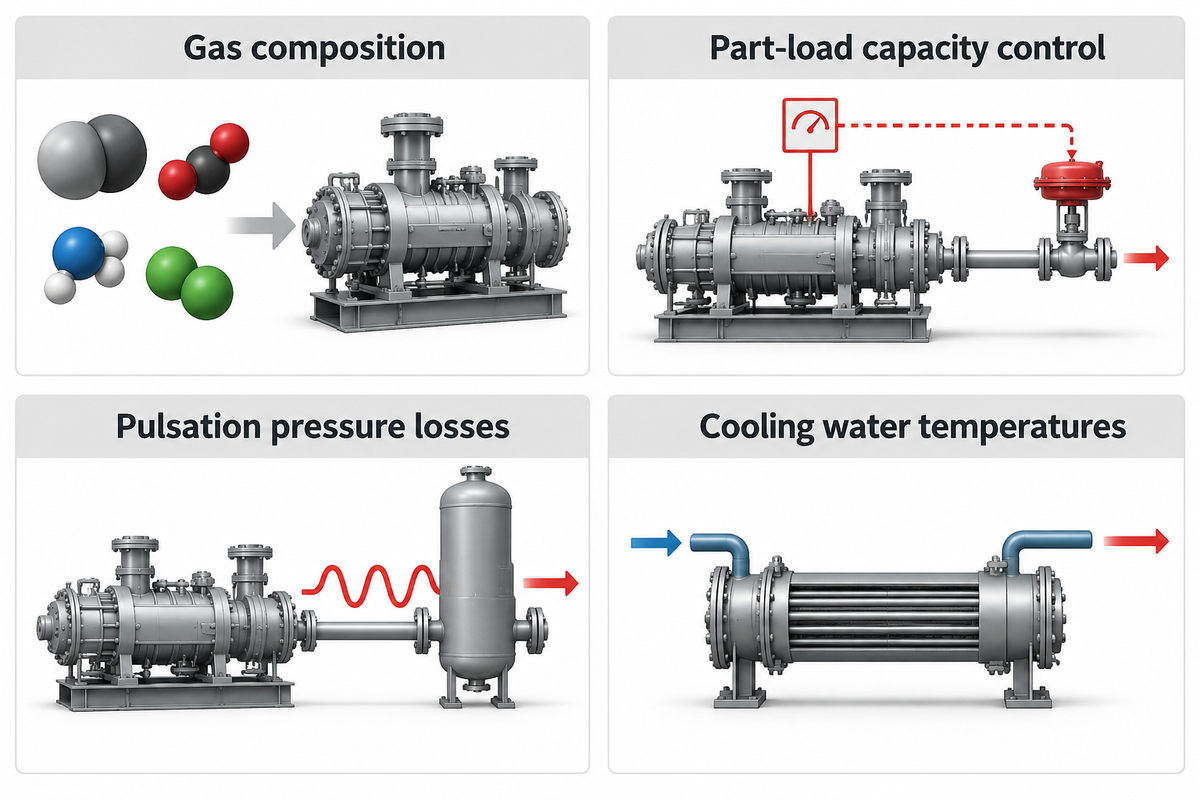
Featured compressor operation, compressor performance, mechanical reliability, and shaft energy consumption are driven by the matched operating case rather than by the nameplate value. Engineers comparing API 618 and non-API submissions must evaluate the gas composition, suction pressure ranges, part-load capacity control modes, pulsation bottle pressure losses, and cooling water supply temperatures at the same time.
Once the design basis is selected, evaluate performance and operational limits across every credible load point. A September 2, 2025 engineering comparison in POWER Magazine on API 619, API 618, and API 617 fuel-gas compression notes that gas turbine fuel headers require 200 psig to 900 psig delivery. In that power generation study, API 619 rotary screw units handle up to 1,500 psig with 100% to 20% stepless turndown. One example combined-cycle plant delivers 2,698 CFM from 287.4 psia suction to 644 psia discharge using a 5,100 hp driver, while centrifugal compressors under API 617 avoid turndown below 20% to 30% of design flow due to surge.
Reciprocating process gas compressors maintain strong operational efficiency across variable pressure ratios. However, continuous spillback recycle can waste shaft power if part-load controls are poorly specified. As shown in the Kurz, Lubomirsky, and Brun (2012) compression lifecycle study, energy consumption and fuel charges account for more than two-thirds of annual operating cost in continuous gas operations.
Modern instrumentation and predictive maintenance systems help operators catch valve leaks early. Published patent application WO2021003252A1 on reciprocating compressor monitoring describes fitting valve-cap pressure, vibration, and temperature (PVT) sensors across 2, 4, or 6 throws and 4, 8, 12, or 16 valves per cylinder. Its IP67 wireless gateway operates from -40°C to +85°C. While iot-enabled maintenance systems improve fault visibility, sensor hardware complements rather than replaces API 618 mechanical margins.
| System Bottleneck Type | Physical Mechanism & Condition | Plant Output & Financial Consequence | Specification & Bid Check |
|---|---|---|---|
| 1. Gas Composition & Molecular Weight Drift | Heavier or lighter gas alters specific heat ratio, discharge temperature, and rod load | Trips high-temperature shutdowns or overloads crosshead pins during upset feeds | Require performance curves for minimum, normal, and maximum molecular weight cases |
| 2. Suction Pressure Decay | Upstream header drop lowers inlet density and raises stage pressure ratio | Reduces delivered mass flow and spikes discharge gas temperature above seal limits | Size cylinders across the full suction envelope rather than one nominal point |
| 3. Part-Load Capacity Control & Recycle | Continuous spillback recycle cools and recompresses the same gas stream | Keeps shaft kW near full-load draw while net plant delivery drops to 20%–50% | Compare stepless unloaders, clearance pockets, or variable speed drive kW at part load |
| 4. Pulsation Bottle & Orifice Pressure Loss | Undersized dampeners or restrictive choke tubes create acoustic pressure drop | Increases brake power continuously across 8,760 operating hours/year | Enforce API 618 Design Approach 2 or 3 allowable pressure-drop limits |
| 5. Valve Impact Velocity & Liquid Slugs | Valve plates striking at 10 m/s vs 7 m/s or wet gas washing lube film | Fractures valve plates, raises cylinder leakage, and forces unscheduled outages | Specify suction knockout drums, mist extraction, and moderate valve lift |
| 6. Cylinder Jacket Cooling Margin | Coolant inlet less than 6°C (10°F) above gas inlet condenses heavy hydrocarbons | Destroys piston ring lubrication and accelerates bore scoring on lubricated units | Include thermostatic jacket water tempering in the package utility scope |
| 7. Distance Piece & Rod Packing Venting | Worn packing rings leak process gas into the distance piece and vent header | Triggers hazardous-area gas alarms and loses valuable process gas inventory | Match distance piece compartment type, purge gas, and vent monitoring to gas hazard |
| 8. Piping Restraint & Manifold Resonance | Mechanical natural frequency of pipe spans coincides with compressor excitation | Causes fatigue cracks at small-bore branch connections and manifold nozzles | Require mechanical restraint review and FEA manifold check on critical units |
| 9. Liner & Critical Spare Logistics | Unlined cylinder wear vs replaceable 58+ Rc nitrided liner restoration | As reported in overhaul studies, liner swaps take 5–7 days (about 1 week) vs multiple weeks for unlined bores | Include replaceable cylinder liners and warehouse spare holdings before award |
On the most efficient compression and highest efficiency, high-efficiency operation, you must make sure all of these nine system constraints are audited on the API and the manufacturer’s standard proposals. High-performance equipment cannot meet reliability and efficiency expectations if the contract neglects suction conditioning and upgrading advanced cooling utilities.
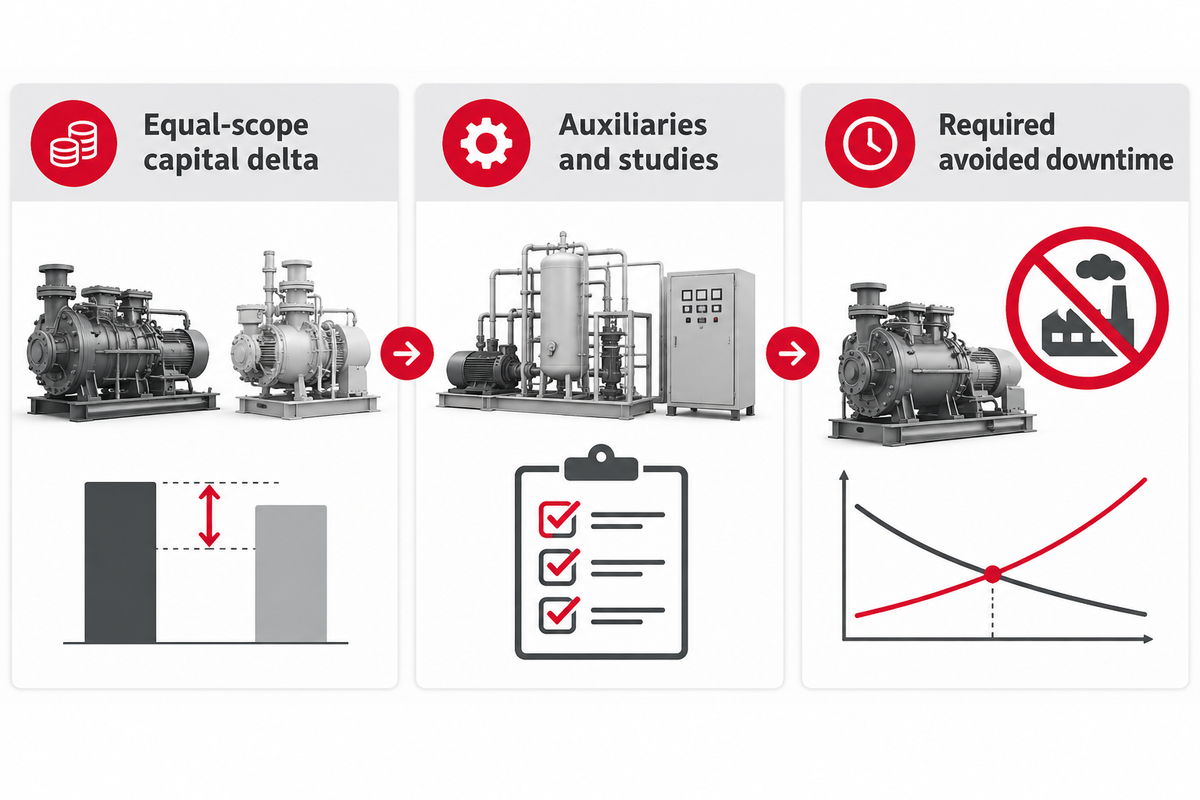
Equal-scope cost evaluation measures the verified capital delta between an API 618 package and a non-API package after adding missing auxiliaries, engineering studies, and witness testing. Required avoided downtime is calculated by dividing that annualized cost hurdle by the lost contribution of the plant per outage hour.
Since the operating bottlenecks identified in the previous section impact directly on maintenance and downtime costs, both finance and engineering require a common view of the life cycle. Under ISO 15663:2021 petroleum and natural gas life cycle costing (Clause 3.1.24), Life Cycle Cost (LCC) is the discounted sum of capital expenditure (CAPEX), operating expenditure (OPEX), and lost revenue from downtime (LOSTREV). Cost escalation is defined in Clause 3.1.7.
In the peer-reviewed Kurz, Lubomirsky, and Brun (2012) lifecycle cost formulation, total capital cost comprises equipment first cost and site installation cost. Equipment first cost covers the compressor frame, driver, skid or foundation, filters, intercoolers, aftercoolers, instruments, valves, pulsation bottles, and initial spares. When a non-API quote omits pulsation bottles, torsion studies, or witness tests that the plant must buy separately, add those items before comparing high capital figures.
Break-Even Outage Hours
After both quotations have equal installed scope and pass all the mandatory safety rules, use the Break-Even Outage Hours screen below to determine if the more expensive package costs less in unplanned outage hours by avoiding downtime:
Annual Cost Hurdle (USD/year) = (Additional Installed Capital ΔI /N) + Annual Operating-Cost Difference ΔCop Required Avoided Outage (hours/year) = Annual Cost Hurdle /Lost Contribution per Outage Hour Vd
Consider a hypothetical, undiscounted pre-tax screening calculation with an assumed additional installed capital cost (ΔI) of USD 60,000 after scope normalization. Set the evaluation term (N) to 5 years and the assumed annual operating-cost difference (ΔCop) to USD 2,000/year. Dividing USD 60,000 by 5 years equals USD 12,000/year, and adding USD 2,000/year yields an annual cost hurdle of USD 14,000/year.
| Plant Downtime Value Scenario | Assumed Lost Contribution (Vd) | Assumed Annual Cost Hurdle | Required Avoided Outage |
|---|---|---|---|
| Low-margin or buffered batch duty | USD 1,000/hour | USD 14,000/year | 14.0 hours/year |
| Moderate industrial gas production | USD 2,000/hour | USD 14,000/year | 7.0 hours/year |
| Unspared continuous process stream | USD 5,000/hour | USD 14,000/year | 2.8 hours/year |
In this simple worked example, at USD 1,000/hour of lost contribution, the higher priced option must avoid 14.0 hours/year of unplanned outage. At USD 2,000/hour it must avoid 7.0 hours/year and at USD 5,000/hour it must avoid 2.8 hours/year. Discounting, tax and residual value are outside this simple screen and actual outage savings need validated mechanical design and site maintenance.
Hydrogen: one gas, several acceptable design routes
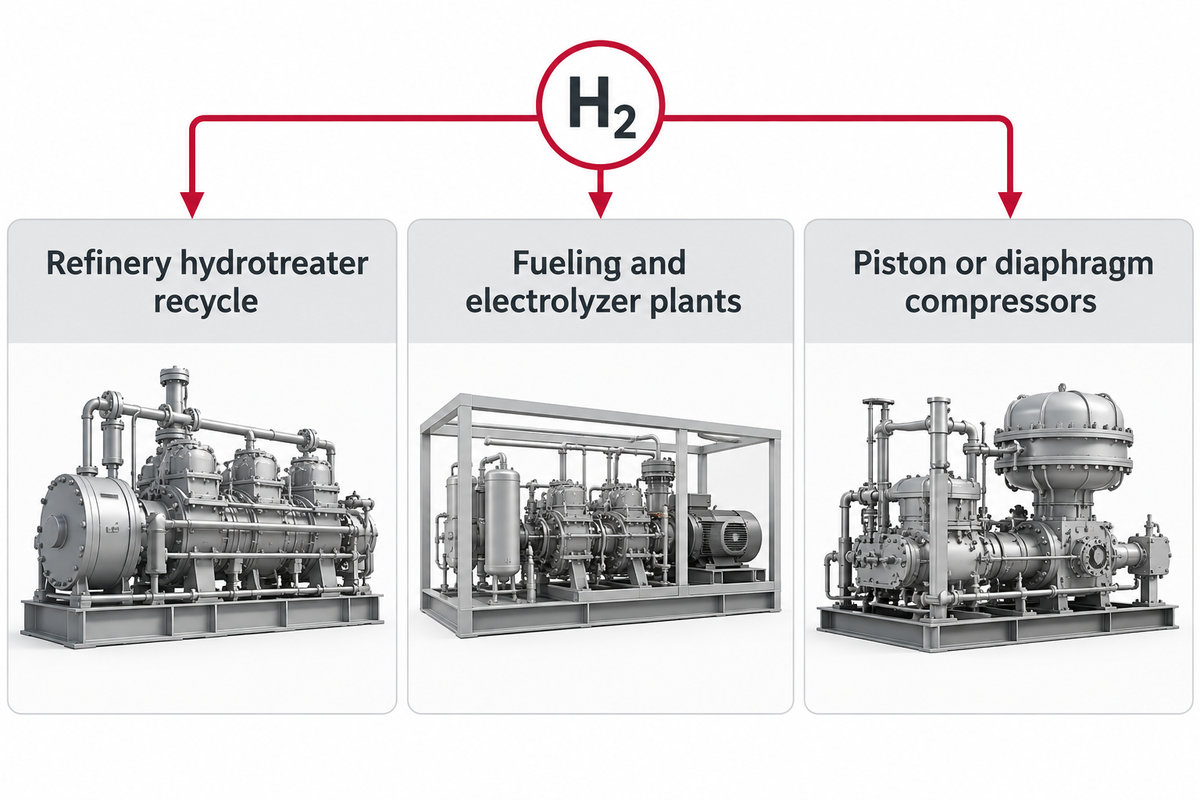
Hydrogen compression uses different equipment standards across refinery and mobility applications. Continuous refinery hydrotreater recycle units use API 618 reciprocating equipment, while hydrogen fueling stations, electrolyzer off-gas plants, and cylinder filling stations use piston or diaphragm compressors according to station and industrial gas codes.
By maintaining the same scope/risk logic as for the cost screen, it becomes clear that gas identity and equipment standard should be separate engineering choices: U.S. Department of Energy overview of gaseous hydrogen compression Hydrogen is generated at a pressure of 20-30 bar in most cases. Compressing hydrogen from 20 bar (inlet) to 200 bar (outlet) yields a compression ratio of 10.
Due to the low molecular weight of hydrogen, centrifugal compressors must operate with impeller tip speeds three times higher than units for natural gas. Positive-displacement reciprocating piston and diaphragm compressors are therefore dominant high-pressure compressor technologies for high-pressure applications.
In a petroleum refinery or large petrochemical complex, a continuous hydrogen make-up or recycle compressor sits inside a plant governed by API standards. Owner specifications routinely mandate API 618 with nonlubricated or distance-piece-isolated cylinders. Conversely, a gaseous hydrogen dispensing station follows ISO 19880-1:2020 for gaseous hydrogen fueling stations (173 pages, prepared by Technical Committee ISO/TC 197). ISO 19880-1:2020 sets safety and performance rules for station compression, buffer storage, pre-cooling, and dispensing without requiring an API 618 refinery frame.
Alternative compression technologies such as diaphragm units or hydraulically driven piston packages still require strict leak containment, material compatibility against hydrogen embrittlement, and purge verification. For commercial package configurations and pressure classes, visit our hydrogen compressor options pillar page. You can also review our comparison of piston and diaphragm hydrogen compression when selecting the compression mechanism itself.
Compressor manufacturers: comparing API 618 and non-API options
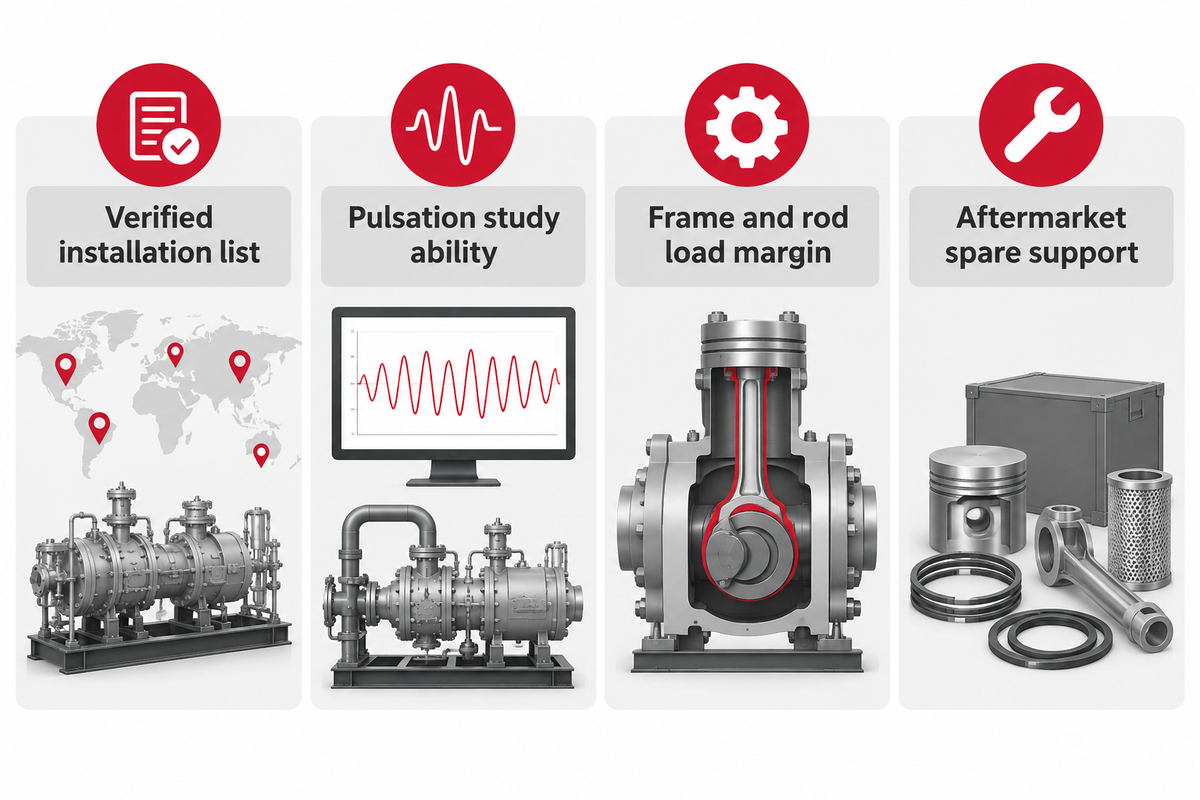
Qualified compressor manufacturers supply either dedicated API 618 6th Edition refinery frames, API Spec 11P field packages, or documented manufacturer-standard industrial gas compressors. Compare suppliers based on verified installation list, pulsation study ability, and aftermarket spare support for your gas service.
Which compressor manufacturers should you compare?
Shortlist compressor manufacturers that publish verified reference installations for your exact gas, pressure, flow, and named design standard. Many global OEMs and specialized package builders offer both API 618 6th Edition refinery frames and API Spec 11P or factory-standard industrial reciprocating compressors.
Whether the duty involves hydrogen, natural gas, or synthesis gas, a corporate brochure never proves that every model in a catalog conforms to API 618. As documented on the API Subcommittee 11 standards registry and the API Standard 618 publication page, API separates upstream production package specifications (API Spec 11P) from refinery process compressor rules (API 618).
Which manufacturer is best for an API 618 application?
The best manufacturer for an API 618 application is a supplier with documented API 618 6th Edition reference units, in-house Design Approach 2 or 3 pulsation capability, and local overhaul support. Select a API 618 vendor who can provide the vendor’s frame rating, cylinder pressure class, and rod load margin exactly to your gas duty.
In technical tenders across the reciprocating compressor industry, buyers frequently evaluate major players alongside specialized custom package builders. Public engineering literature cites multi-line OEMs such as Burckhardt Compression and Howden for process gas units. Tenders for projects also have Kobelco along with legacy GE Oil (GE) reciprocating product series.
When procurement teams try to buy equipment from a mature market or a nascent regional market, they pay especially close attention to regional aftermarket presence. Plants in North America and Europe (or Europe and North America), Asia and the Middle East will review four project-specific outputs:
- Design basis per model. Ensure that the frame quoted is a API 618 6th Edition, API Spec 11P 3rd Edition Field Package, or standard factory model.
- Complete package engineering. Check if the vendor has to manufacture pulsation bottles, intercoolers, distance pieces, and custom-designed tailored solutions by themselves or outsource the skid assembly.
- Aftermarket support and service contracts. Review regional supply chains, regional distribution networks, parts on hand, and service response times for your plant location.
- Quality & Test Traceability. Audit sample review of ITPs, material test certificates, and FAT procedure before award of contract.
For a broader look at supplier profiles across global gas infrastructure, consult our directory of reciprocating compressor manufacturers. Anhui PanGeng Gas Compressor Co., Ltd. (PanGeng) manufactures custom nitrogen, hydrogen, booster, and industrial gas packages. Submit your duty sheet so engineering can detail what our compressors offer for your specification.
What the latest API 618 edition changes for purchasing
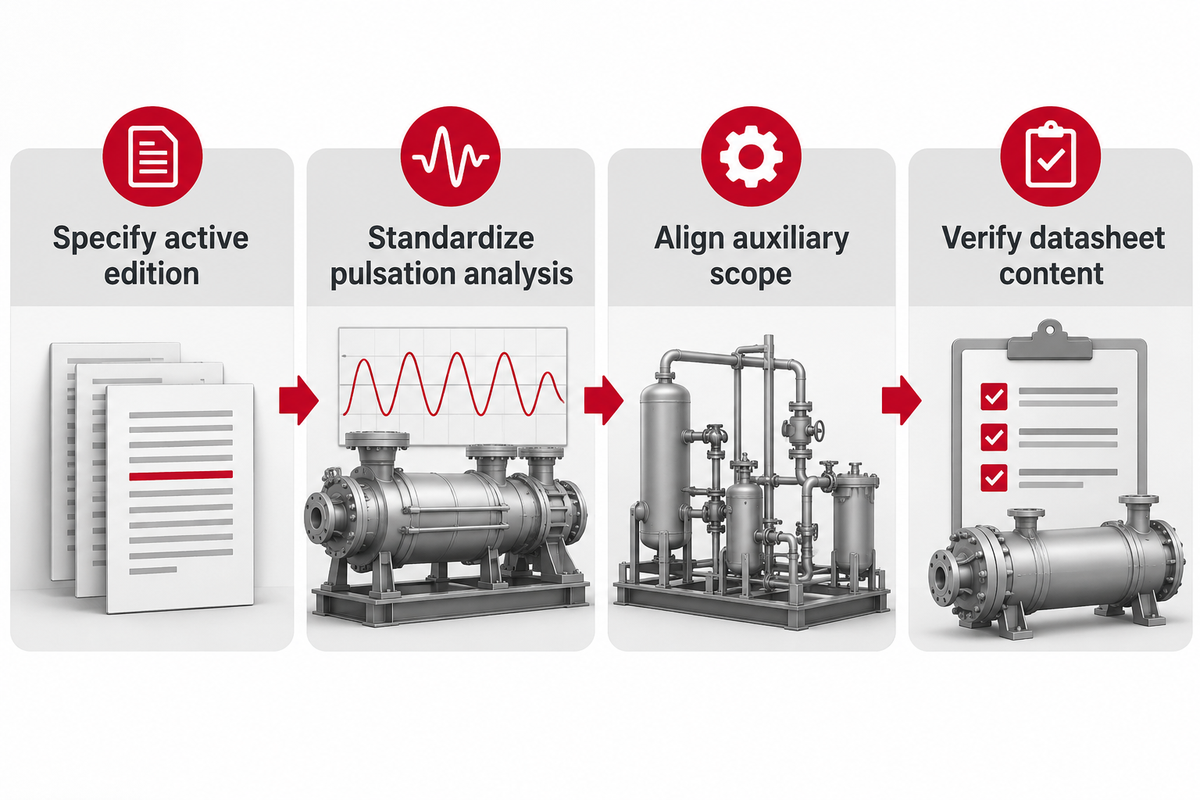
Request for quotation for new API 618 compressors should quote API Standard 618 6th Edition (May 15, 2024) rather than leave without date or reproduce 5th Edition (December 2007) boilerplate. Use the active edition to standardize vendor quotes on pulsation analysis, auxiliaries and datasheet content.
After a group of credible suppliers has been identified, purchasing must secure the precise document revision at the time of request for quotation (RFQ). Engineers searching for an API 618 PDF or an API 618 latest edition PDF often encounter outdated technical papers. Comparing an API 618 6th edition PDF against an older API 618 5th Edition pdf highlights important pulsation study changes.
What is the latest edition of API 618?
The latest edition of API 618 is the 6th Edition, published on May 15, 2024 by the American Petroleum Institute as a 189-page standard. It replaces the 5th Edition published in December 2007 and remains the active normative specification for reciprocating process compressors in petroleum, chemical, and gas services.
Recent industry developments within compressor standards have also influenced how buyers specify non-API alternatives. Commercial summaries typically cover market expansion, market growth, market appetite, market demand, and evolving market trends and market dynamics. Other analyst pages break down projects by market sectors, market segments, market potential, market opportunities, and geographic market expansion.
Rather than the typical forecast prose, procurement teams should monitor four tangible normative editions verified in official catalogues:
| Standard Designation | Current Edition & Date | Publication Status | Key Purchasing & Scope Implication |
|---|---|---|---|
| API Standard 618 | 6th Edition, May 15, 2024 (189 pages) | Current (Active) | Design Approach 1 removed per SwRI; specify Design Approach 2 or 3 |
| API Spec 11P | 3rd Edition, August 2025 (314 pages) | Current (Active) | Named upstream oil and gas packaged reciprocating specification with 2025-08 datasheets |
| ISO 13631:2002 | Edition 1, August 2002 (80 pages) | Withdrawn (October 27, 2026) | Withdrawn lubricated hydrocarbon package rule; do not cite as an active standard |
| ISO 19880-1:2020 | Edition 1, March 2020 (173 pages) | Current (Active) | Governs gaseous hydrogen fueling stations and dispensing compression safety |
When your project team is ready to audit the clause-by-clause vendor exceptions, we’ve created our API 618 bid compliance checklist: datasheets, pulsation studies, and inspection hold points prior to purchase order award.
Frequently asked questions
What is the API standard for reciprocating compressors?
API Standard 618 (6th Edition, published May 15, 2024) is the American Petroleum Institute standard for low- to moderate-speed reciprocating compressors in petroleum, chemical, and gas process services. API 11P (3rd Edition, August 2025) is used for Upstream oil and gas field packages, API 619 and API 617 for rotary screw units, and centrifugal units.
What are the different types of reciprocating compressors?
Reciprocating compressors comprise single-acting or double-acting crosshead piston frames, trunk-piston units, lubricated and nonlubricated process cylinders, and hermetically sealed diaphragm compressors. Speed categories cover low speed (200-600 rpm), moderate speed (600-1,200 rpm), and separable units (1,000-1,500 rpm) at high speed and each type of mechanical configuration can be designed to API 618, API Spec 11P, or a vendor standard for gas compression.
Which compressor components require most frequent replacement?
The most often replaced parts on a reciprocating compressor are suction and discharge valve plates, valve springs, piston rings, rider bands, and piston rod packing elements. Service intervals follow gas cleanliness, liquid entrainment, cylinder cooling margin, and valve impact velocity (such as 7 m/s versus 10 m/s) across actual operating hours in continuous or intermittent plant service.
Is API 618 legally mandatory for every compressor?
No, API Standard 618 is an industry purchase specification and not a statutory law. It is not mandatory unless placed by referring to the project contract, engineering standard of the concerned facility, insurance, or local permit.
What should I consider before purchasing a non-API compressor?
Demand the supplier specifies the exact alternative design basis, eg, API Spec 11P 3rd Edition or documented factory specification. Put the quotation into standard form with pulsation suppression bottles, intercoolers, distance-piece purging and local instrumentation included. Obtain performance curves at minimum, normal and maximum suction pressures and rod load and discharge temperature limits, for each design basis.
Review spare cylinder liner provision and conduct audit of all clause exceptions on a standard reciprocating compressor bid checklist prior to award.
Does API 11P mean the same thing as non-API?
No, API Spec 11P (3rd Edition, August 2025) is an active 314-page API specification for packaged reciprocating compressors in oil and gas production. By contrast, an unlabelled non-API quote uses a vendor factory standard.
Can an API certificate alone establish compressor suitability?
No, compressor suitability requires completed API 618 6th Edition datasheets, verified cylinder and distance-piece material certificates, and Design Approach 2 or 3 pulsation reports for the purchased unit. An ISO 9001 quality management certificate covers general factory procedures rather than machine performance. Always match the specific compressor frame, cooling circuit, capacity control mode, and witnessed factory acceptance test plan to your gas composition and operating pressure envelope.
Verification & Scope Boundary: Data found in standards metadata and published engineering papers do not offer a set price ratio, power-efficiency ranking, nor wear-part schedule between the API 618 vs the manufacturer-standard compressors. Final acceptance is specified as the project’s corresponding named standard edition, gas analysis, full-load and part-load duty sheets, pulsation study method, and factory/site test procedures. Audio signal processors with similar acronyms sit outside industrial gas compression.
Need an engineering comparison for your gas stream and operating pressures? Request a duty-based comparison from the PanGeng engineering team with your suction range, discharge target, and project specification.
References & Sources
- American Petroleum Institute (API Webstore): API Standard 618, 6th Edition (May 15, 2024)
- Southwest Research Institute (SwRI): API 618 & API 688 Compressor Pulsation Analysis
- Texas A&M University Turbomachinery Laboratories: Moderate-Speed Reciprocating Compressors in Process Service (30th Turbomachinery Symposium)
- U.S. Department of Energy (DOE): Gaseous Hydrogen Compression Overview
- International Organization for Standardization: ISO 19880-1:2020 Gaseous Hydrogen Fueling Stations
- International Organization for Standardization: ISO 15663:2021 Petroleum, Petrochemical and Natural Gas Industries — Life Cycle Costing
- International Journal of Rotating Machinery (Kurz, Lubomirsky & Brun, 2012): Gas Compressor Station Economic Optimization
- DIN Media Standards Catalogue: API Spec 11P 3rd Edition (August 2025) Packaged Reciprocating Compressors
- American Petroleum Institute Subcommittee 11 (SC11): Field Production Equipment Standards
- International Organization for Standardization: ISO 13631:2002 Packaged Reciprocating Gas Compressors (Withdrawn October 27, 2026)
- POWER Magazine (September 2, 2025): Comparing API 619, API 618, and API 617 Fuel-Gas Compression Technologies
- WIPO Patent Application WO2021003252A1: Real-Time Monitoring System for Reciprocating Gas Compressors