Get in Touch with Pangeng


Reviewed by PanGeng Technical Team (Updated July 2026)
Quick Specs: Engineered Gas Compressor Packages
- Scope: compressor block + driver + skid + cooling + separation + controls, factory-tested as one unit
- Key standards: API 618 (6th ed., May 2024), API 11P / ISO 13631, API 617, ASME VIII, ATEX/IECEx
- Decision rule: The Duty-Envelope-First Principle — vendors price the envelope you hand them
- Guide length: ~2,800 words · 10 sections · 7 FAQs
Engineered gas compressor packages are quoted on evidence, not on adjectives. A vendor who receives engineered gas compressor packages as a three-word email subject will return three different machines at three different prices; a vendor who receives a twelve-line duty envelope returns three quotes you can actually compare. This guide lays out the exact specification lines, standards, and worked numbers for industrial applications — the lines that decide what lands on your pad before you ask anyone for a price.
The short answer
Engineered gas compressor packages are skid-mounted systems priced against a duty envelope: gas composition, flow, suction and discharge pressure, temperature, driver, standards, and balance-of-plant scope. Twelve specification lines decide whether three quotes are comparable — or three different machines.
TL;DR, five facts worth the whole page
- A single-stage reciprocating cylinder loses roughly half its volumetric efficiency by compression ratio 6.0 — ratio is computed, never assumed.
- Vendors effectively price 12 specification lines; a vague RFQ gets a padded or non-comparable quote.
- Discharge gas heats up about 7–8 °F per 100 psi of boost — cooling isn’t an accessory.
- A hydrogen centrifugal must spin at 3× the tip speed of a natural-gas machine for the same ratio.
- U.S. LNG liquefaction FIDs hit an all-time high in 2025 — specify driver flexibility and monitoring now, retrofit later costs more.
What an Engineered Gas Compressor Package Actually Includes
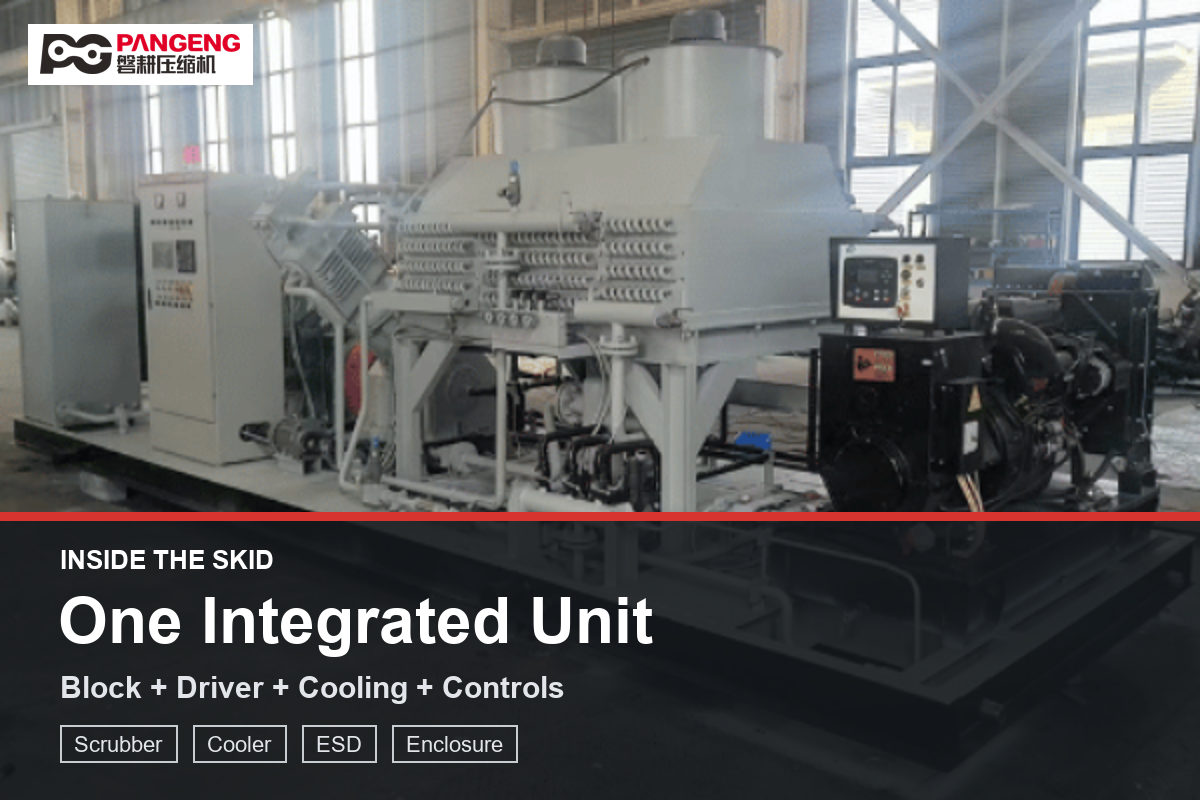
An engineered gas compressor package is a skid-mounted system that combines the compressor block, driver, cooling, separation, and controls into one factory-tested unit – priced against a duty envelope, not a catalog number. A bare compressor block is only the middle third of that system.
Walk a real station and the pattern is obvious. Penn State Extension‘s teardown of natural gas compressor stations lists the hardware classes that surround every machine: station yard piping, filter separators and scrubbers, the compressor units themselves, gas cooling, the lube oil system, mufflers, the fuel gas system, and backup generators. For the separate station-piping procurement scope, compare industrial steel pipe from Synbase Steel against the piping specification, design conditions and required inspection documents.
Package suppliers slice that scope into tiers tailored to how much integration the buyer wants — a bare block for owners who self-integrate, a wired skid (block + motor + demister + controller) for turn-key installation, receiver-mounted assemblies, or full enclosures with sound damping and weatherproofing. Which tier you buy changes not just price but who carries commissioning risk. Across oil and gas duty, that integration is where compression systems diverge from catalog compression packages: one block becomes three different machines depending on the compressor design and who engineers the balance of plant — the real difference between catalog iron and engineered compressor solutions. For a separately procured skid frame, the published range of steel plate and profiles from Baling Steel provides a material starting point; the package designer must still specify the sections, grade and fabrication requirements.
| Scope element | Inside a typical package | Usually outside the fence |
|---|---|---|
| Compression | Block, cylinders, valves, distance pieces | Spare throws, future stages |
| Drive | Motor or engine, coupling, starter | Substation, fuel-gas conditioning skid |
| Process | Suction scrubber, interstage/after coolers | Dehydration (TEG), flare/blowdown stack |
| Control | Panel, ESD logic, local gauges | SCADA integration, remote monitoring subscription |
| Structure | Skid, enclosure, sound damping | Foundation, shelter, craneage |
| Safety | ESD valves, relief, fire/gas detection basics | Site ESD network, odorization |
“Designing these packages for a living takes a little knowledge of a ton of things, and very in-depth knowledge of a few.”
That’s the practical definition of “engineered”: the package is the integration, and the integration is where quotes diverge. Bottom line: before shopping for a price, freeze which scope elements are inside each vendor’s fence — a cheaper quote often just has more of the system parked outside it. Scope-first is also how gas compression needs stay comparable across vendors, and how compression solutions stay honest.
Start With the Duty Envelope: Natural Gas Flow, Pressure, and Temperature
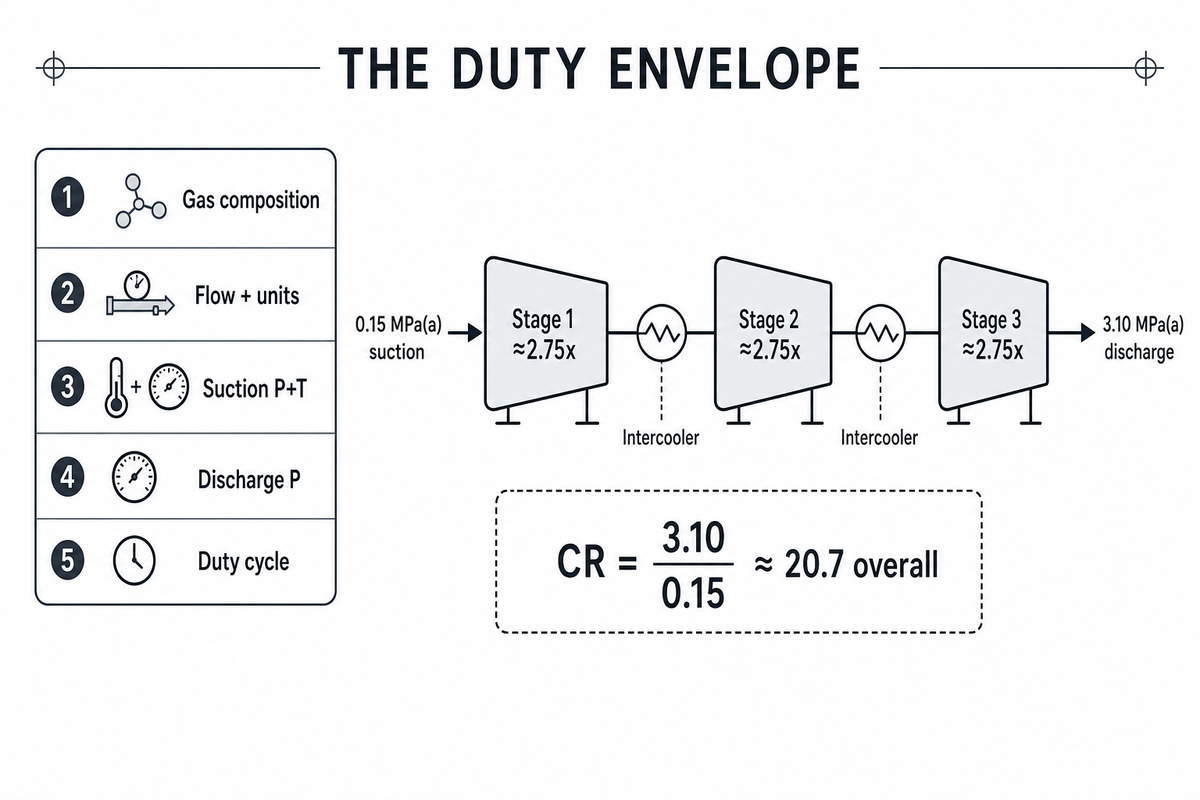
Five lines specify every compressor package duty: gas composition, flow with units, suction pressure and temperature, discharge pressure, and the duty cycle. Vendors size, stage, and price the machine from these five lines under real process conditions — everything else is negotiation.
Inside the compression process, ratio is the first computation, and it uses absolute pressures. The U.S. Department of Energy states it plainly: ratio equals outlet pressure over inlet pressure — 200 bar out over 20 bar in gives a ratio of 10. U.S. DOE hydrogen compression overview
Worked example. Say you boost gas from 0.05 MPa(g) to 3.0 MPa(g):
- Convert to absolute: 0.05 + 0.10 ≈ 0.15 MPa(a) suction; 3.0 + 0.10 ≈ 3.10 MPa(a) discharge.
- Ratio = 3.10 / 0.15 ≈ 20.7 – far beyond one cylinder.
- Split across stages: three stages at ~2.75 ratio each (2.75³ ≈ 20.8). Each stage now sits inside its efficient band.
- Check the efficiency and heat price of each stage from the tables below.
Efficiency here has a price tag, and it’s quantified rather than folklore. A Southwest Research Institute short-course table for separable field gas compressors shows volumetric efficiency decaying with ratio – and its companion table show discharge temperature climbing with it. These are course-table lookups for that machine class, not universal constants; your vendor’s curves decide the actual numbers. SwRI field-compressor sizing course
| Compression ratio (per stage) | Volumetric efficiency | Discharge temp (80 °F suction) | Reading |
|---|---|---|---|
| 1.5 | 85% | 128 °F | Sweet spot |
| 2.0 | 80% | 164 °F | Efficient |
| 3.0 | 74% | 220 °F | Workable ceiling |
| 4.0 | 68% | 265 °F | Heat watch |
| 5.0 | 60% | 285 °F | Poor |
| 6.0 | 50% | 300 °F | Lube-coking red line |
Heat is the second computation. Field data from Penn State Extension puts the rise at roughly 7–8 °F for every 100 psi of boost, so a 1,000 psi lift adds 70–80 °F before intercooling. At altitude, derate further — suction psia drops roughly 0.5 psi per 1,000 ft of elevation, quietly inflating the ratio you actually ask the machine for.
Two unit traps corrupt envelopes in cross-border RFQs. Flow: 1 Nm³/h ≈ 0.622 scfm, a “500” without units is a 19% error either way. Pressure: 1 bar = 14.5 psi, and gauge versus absolute flips the computed ratio at low suction pressures. Write the unit system and the reference frame into the envelope itself. Our compression ratio calculator runs this exact check with your own numbers.
Key takeaway: The Duty-Envelope-First Principle, vendors price the envelope you hand them; the five lines above are the envelope. Anything vaguer returns a machine priced for a duty you never intended.
Matching Compression Technology to the Duty
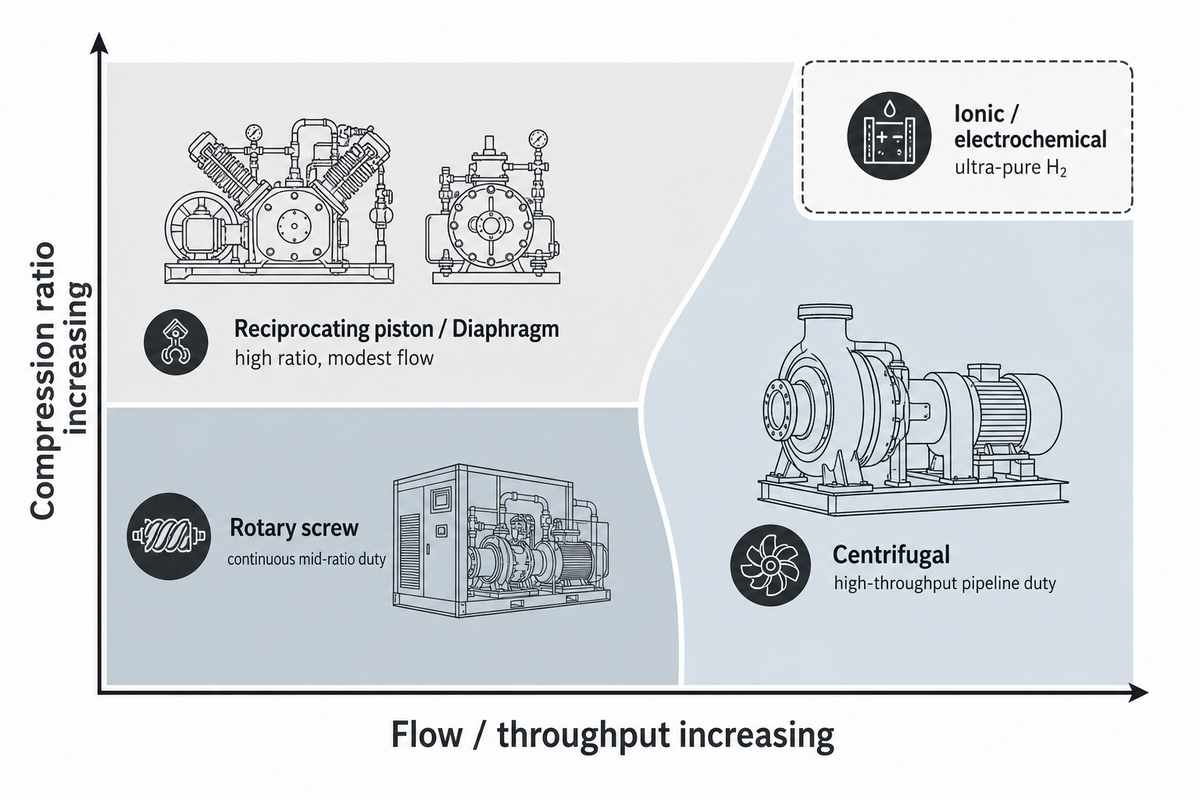
As a working boundary, reciprocating and diaphragm machines serve high compression ratios at modest flow, rotary screw packages serve continuous mid-ratio duty, and centrifugal packages serve high-throughput pipeline duty — per U.S. DOE compression guidance. Gas composition can overrule all three defaults.
What are the 4 types of compressors?
Four families cover industrial gas duty. Positive-displacement machines trap and squeeze a fixed volume: reciprocating (piston or diaphragm) and rotary (screw, vane, lobe). Dynamic machines add velocity and diffuse it into pressure: centrifugal and axial. Reciprocating units cover roughly 1–600+ hp per frame with about 5–6 ratios per stage; rotary screw gas compressor packages run about 30–350 hp and up to ~250 psi(g); centrifugal stages deliver about 2.2–3.0 ratios each and dominate high-flow transmission. Plant Engineering’s type comparison
| Technology | Ratio / flow band | Strong suit | Limitations / Not suitable for |
|---|---|---|---|
| Reciprocating piston | High ratio, 5–6 per stage; 1–600+ hp | High-pressure boosting, staging flexibility | Valve maintenance cadence; pulsation control |
| Diaphragm | Very high ratio, low flow | Ultra-pure H2, toxic gas — zero leakage path | Membrane life; small throughput |
| Rotary screw (oil-flooded) | Mid ratio, continuous; 30–350 hp | VRU, gas lift, wet/dirty gas tolerance | ~250 psi(g) ceiling; oil carryover management |
| Rotary screw (oil-free) | Mid ratio, continuous | Process gas needing no oil contact | Timing-gear wear; efficiency penalty |
| Centrifugal | 2.2–3.0 per stage; big throughput (≥1,000 hp packages) | Pipeline transmission, fuel-gas boosting | Turndown/surge limits; high-ratio duty |
| Liquid ring | Low ratio, wet/corrosive gas | Flare gas, explosive or dirty streams | Efficiency; service-liquid handling |
| Ionic / electrochemical | High ratio H2, niche | H2 fueling; no bearings or seals | Capacity ceiling; emerging supply chain |
A screw compressor package covers continuous operation in the mid-ratio band without the valve cadence of a reciprocating gas frame, for gas applications from vapor recovery to fuel gas.
The decision tree that follows the table is short. Ratio above ~4 per stage with moderate flow → reciprocate, and stage it. Purity or zero-leak mandate (hydrogen, toxic service) → diaphragm. Continuous mid-ratio duty with liquids or dirt in the stream → rotary screw. Throughput first, ratio modest, pipeline or fuel-gas boosting → centrifugal; packaged centrifugal lines usually start near 1,000 hp and run to 10,000 hp. One common mistake is forcing a high-ratio duty onto a flow machine because the horsepower looked cheaper — the efficiency tables in the previous section show exactly what that costs in heat and lost capacity. Our gas compressor selection tool walks the same logic interactively.
Key takeaway: pick the technology from the computed ratio and the gas, never from brand familiarity — the boundary conditions are in the table, and every “Limitations” cell is a failure mode someone already paid for.
Gas Composition Changes Everything: H2, CO2, N2, Biogas, Sour Gas
Gas composition should be considered as a technology requirement, not just a configuration option; it has implications on the required materials of construction, the necessary seal type, the risk of product contamination, and even the basic machine design, especially in cases where hydrogen is being processed. A hydrogen centrifugal, for instance, requires up to three times the tip speed of a natural-gas centrifugal at the same ratio, due to the significantly lower molecular weight of hydrogen.
DOE’s hydrogen guidance adds the second constraint: positive-displacement machines need tight tolerances to control hydrogen leakage, which is why diaphragm and ionic designs own high-purity H2 duty. DOE’s overview also notes hydrogen is commonly produced at about 20–30 bar and then compressed for transport, storage, or end use, the duty envelope starts low and often ends very high. U.S. DOE hydrogen compression overview
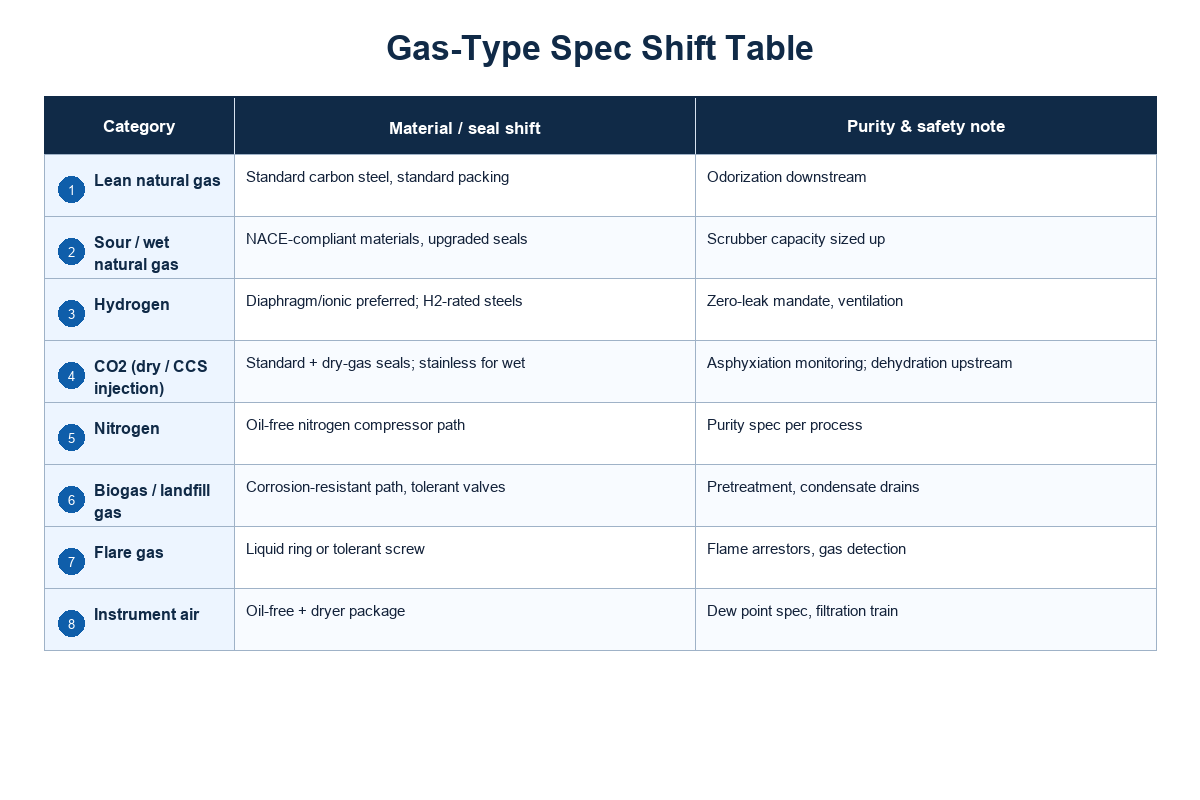
The Gas-Type Spec Shift Table maps the nine most common streams to what actually changes in the package. Gas-Type Spec Shift Table — a nine-row matrix of how the specification moves when the gas moves.
| Gas stream type | Why it’s different | Material / seal shift | Purity & safety note |
|---|---|---|---|
| Lean natural gas | Baseline duty | Standard carbon steel, standard packing | Odorization downstream |
| Sour / wet natural gas | H2S + liquids attack metals | NACE-compliant materials, upgraded seals | Scrubber capacity sized up |
| Hydrogen | Low MW: 3× tip speed, leak-prone, embrittlement | Diaphragm/ionic preferred; H2-rated steels | Zero-leak mandate, ventilation |
| CO2 (dry) | Dense, dry-running acceptable | Standard + dry-gas seals | Asphyxiation monitoring |
| CO2 (wet / CCS injection) | Carbonic acid corrosion | Stainless wetted parts | Dehydration upstream |
| Nitrogen | Inert but oil-free often required | Oil-free nitrogen compressor path | Purity spec per process |
| Biogas / landfill gas | Corrosive, wet, siloxanes possible | Corrosion-resistant path, tolerant valves | Pretreatment, condensate drains |
| Flare gas | Explosive range, variable composition | Liquid ring or tolerant screw | Flame arrestors, gas detection |
| Instrument air | An instrument air compressor package is quality-class driven (ISO 8573) | Oil-free + dryer package | Dew point spec, filtration train |
A live configuration shows the envelope logic end to end. Our own hydrogen compressor line lists model DW-5.8/(0.2-0.8)-30 for electrolysis boosting: 500 Nm³/h, 0.02–0.08 MPa inlet, 3.0 MPa discharge. Read that as a duty envelope, not a brochure line: the inlet window (0.02–0.08 MPa) tells you the electrolyzer output it was engineered around, and the model code carries the pressure frame. One routing caution from our own lineup: a 6–200 bar cylinder-filling duty belongs to a general multi-gas booster compressor line, not the dedicated 350–700 bar hydrogen machines, specifying the wrong line inflates the quote by design.
Key takeaway: when the gas changes, re-open the materials, seals, and safety lines of the specification — the machine that was perfect for lean methane can be the wrong machine, in the wrong metallurgy, one gas later.
Driver and Utilities: Electric Motor vs Gas Engine
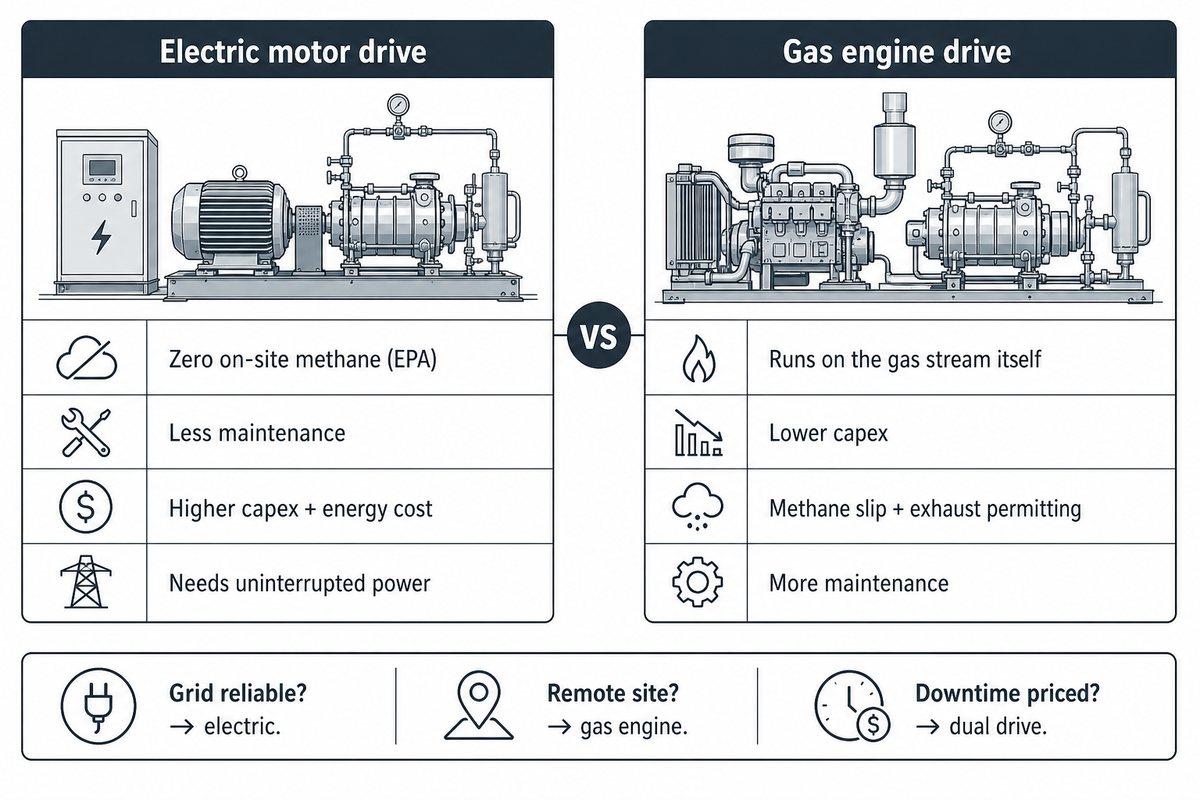
Choose the driver from power availability first, emissions second, and cost third. The U.S. EPA names an uninterrupted electrical supply as the major technical consideration for electric-motor conversion, which is why gas engines still own remote sites without reliable power.
EPA’s Natural Gas STAR assessment gives the trade in one paragraph: electric motors emit no methane on site, need less maintenance, and run quieter with dependable operation, but carry higher capital and energy costs; internal combustion engines dominate remote locations with no reliable electrical supply. US EPA Natural Gas STAR
Penn State Extension cites a 2012 EPA estimate attributing as much as 45% of methane emissions in the gas transportation and storage sector to traditional reciprocating compressors, and the EPA’s current guidance still flags engine exhaust, compressor blowdown, gas starters, and incomplete combustion as methane sources.
Electric motor drive
- Zero on-site methane; less maintenance (EPA)
- Quieter — helps the 55 dBA Ldn fence-line limit
- Higher capex + energy cost; needs uninterrupted power
- Best fit: stations with grid or self-generation
Gas engine drive
- Runs on the gas stream itself — no grid needed
- Lower capex; proven at 100 hp to 7,500+ hp
- Methane slip + exhaust permitting; more maintenance
- Best fit: remote wellheads and gathering
Electric motor driven units dominate new station builds where grid power exists; gas engines from 100 hp to 7,500 hp — CAT 3600 or Waukesha VHP frames — still own remote power generation and field gathering sites. On cost, one industry association analysis of transmission-compression electrification put development cost at roughly $27.8M for an electric-driven station versus $24.7M for a gas-turbine-driven equivalent, with the turbine’s maintenance running about $350k per year higher.
Keep in mind that these numbers are order-of-magnitude and from a single study.
One maintenance trap sits inside the drive decision. Trade-press field coverage of “oil sweetening” — feeding used engine oil to the compressor cylinders to skip a second oil tank — shows how it dilutes wear-metal analysis and masks engine failure patterns until valves and the dehydration system pay for it. CompressorTECH²’s oil-sweetening review Whatever driver you pick — electric, gas engine, or the hydraulic-drive niche units used on portable emergency skids — write the lubrication architecture into the RFQ, including whether compressor cylinders get their own oil.
Key takeaway: write the power-availability answer into the RFQ before the driver question — “electric where grid exists, engine where it doesn’t, dual drive where downtime is priced” — and let emissions compliance break ties.
Standards and Compliance to Put in the RFQ
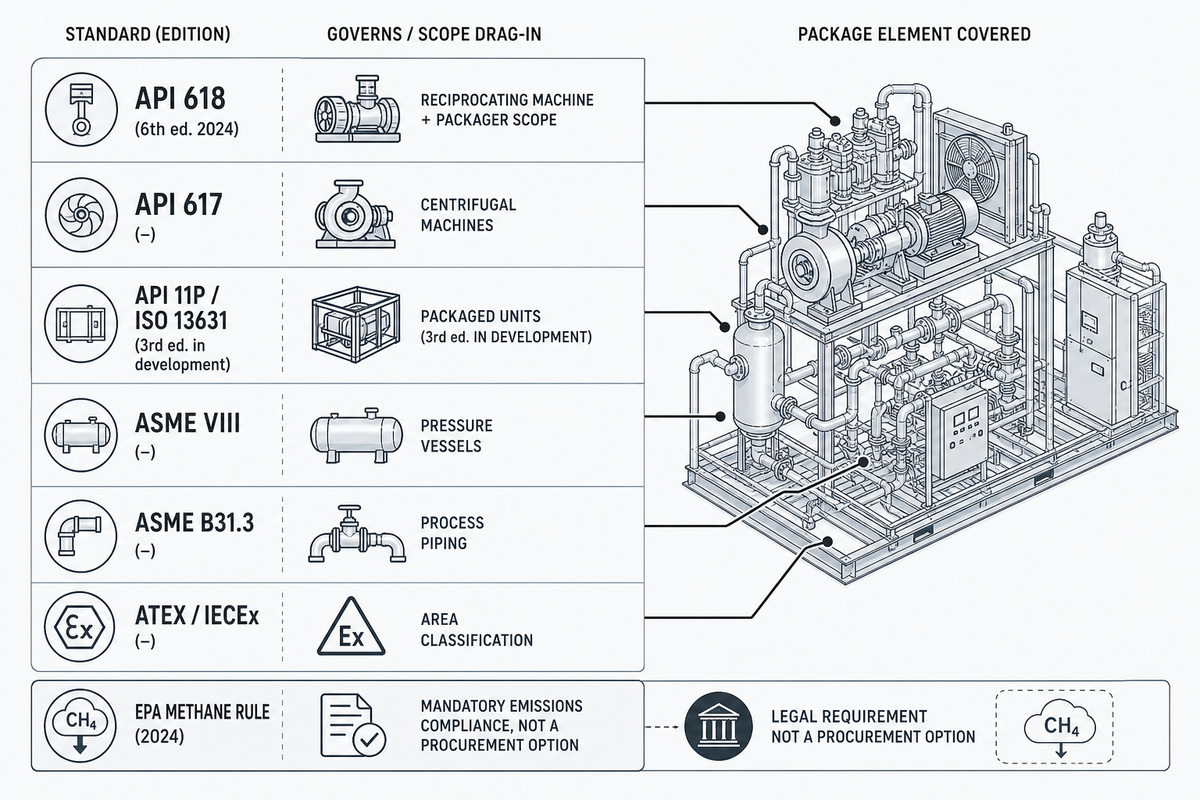
Cite standards by edition and by job. API 618 (Sixth Edition, May 2024) governs reciprocating machines, API 617 covers centrifugals, API 11P / ISO 13631 covers packaged reciprocating units, ASME VIII covers pressure vessels, and ATEX/IECEx covers hazardous areas, while EPA’s methane rule is a legal obligation, not a procurement option.
What does API 618 actually require?
API 618 sets minimum requirements for reciprocating compressors and their drivers in petroleum, chemical, and gas industry service, and its data sheets read like a scope checklist: coolers, separation facilities, piping, strainers, valves, instrumentation, and the basic packaging scope itself. When you invoke API 618, quote the edition: the Sixth Edition (May 2024), already under review by the European Forum for Reciprocating Compressors (EFRC), supersedes the 2007 Fifth Edition.
| Standard | Current status (July 2026) | What it governs in your package |
|---|---|---|
| API 618 (= ISO 13707) | 6th Edition, May 2024 | Reciprocating machine + driver + packager scope |
| API 617 (= ISO 10439) | Current | Axial/centrifugal machines |
| API 11P (= ISO 13631) | 2nd ed. 1989 / ISO 2002; 3rd edition in development (draft review, Oct 2024) | Packaged reciprocating units — skid, auxiliaries, testing |
| ASME BPVC Section VIII | Current | Pressure vessels: scrubbers, separators, pulsation bottles |
| ASME B31.3 | Current | Process piping design and fabrication |
| AWS D1.1 | Current | Structural welding of skid and supports |
| NACE MR0175 | Current | Materials for sour (H2S) service |
| ATEX / IECEx / NEC 500-505 | Current | Area classification: electrics, instruments, enclosure |
| EPA methane rule (2024) | In force; covers new, modified, reconstructed, and existing sources | Mandatory emissions compliance — separate from procurement standards |
Two traps waste money here. First, edition drift: a vendor certifying to a superseded edition isn’t being dishonest, just dated — the fix is writing the edition year into the RFQ line itself. Second, the standards-versus-law boundary: API standards are procurement discipline you choose to invoke, while emissions rules such as the EPA methane package attach to covered sources whether or not your spec sheet mentions them. Our API 618 compliance checker cross-references the data-sheet scope against your application if you want a second pass.
Key takeaway: the RFQ should name the industry standards body, the standard + edition, and the scope items it drags in — and treat emissions compliance as a checklist of its own, not a footnote of the machinery standard.
Balance of Plant: What Sits Around the Compressor
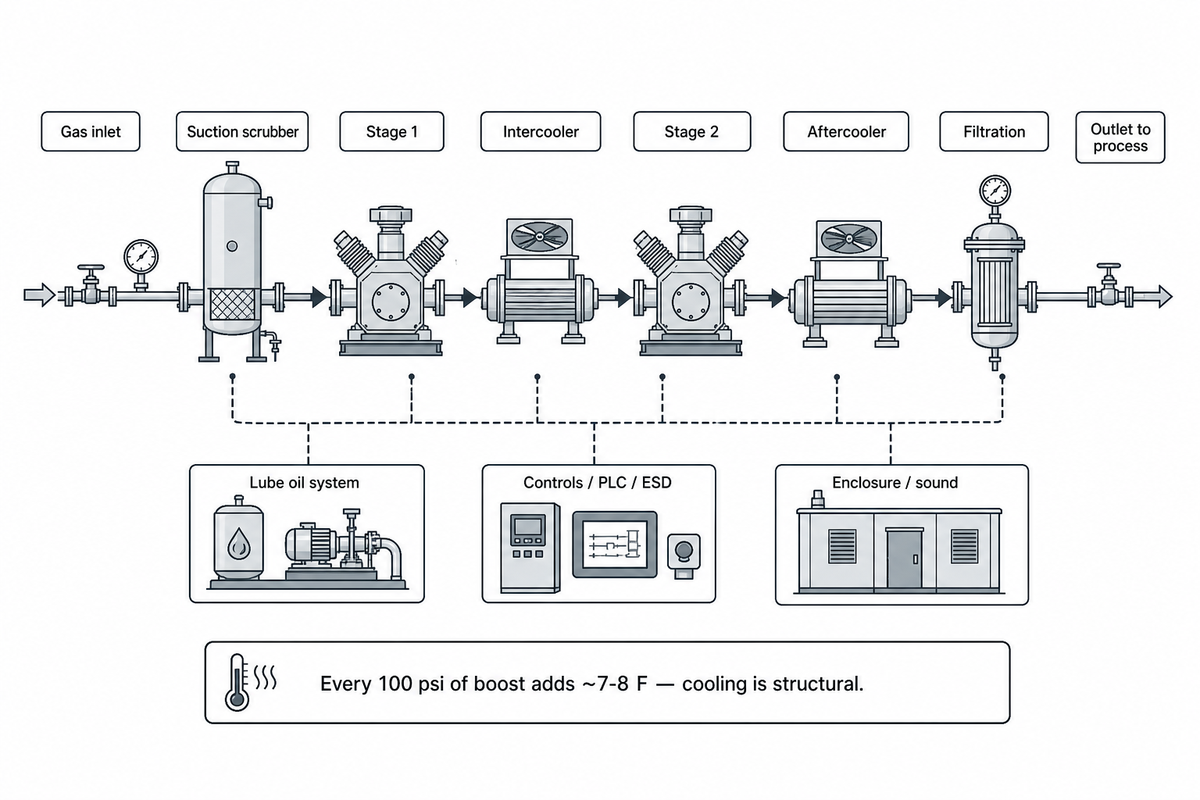
Balance of plant is anything between the gas inlet and your process: scrubbers, coolers, dehydration, filtration, controls, enclosure and relief. Omitting BOP scope is the most common reason a “turn-key” package becomes a second purchase order.
Physics from Section 2 sets the BOP minimums. Gas leaving each stage is hot, about 7–8 °F warmer per 100 psi of boost, so interstage and aftercooling is structural, not optional. Wet gas drops liquids at every pressure and temperature change; those liquids need somewhere to go, which is why stations run scrubbers upstream of every stage and tanks for what falls out of the gas stream. Upstream gas processing decides how hard each of these elements has to work. Penn State Extension
| BOP element | Why it exists | Typically in package scope? |
|---|---|---|
| Suction scrubber / filter separator | Drops liquids and solids before the first stage | Usually yes |
| Interstage + aftercoolers | Removes the 7–8 °F/100 psi heat of compression | Usually yes |
| Gas treatment (TEG / mole sieve dehydration) | Hits pipeline or process dew point | Often separate skid |
| Coalescing filtration | Stops oil/aerosol carryover into downstream equipment | Sometimes |
| Lube oil system | Frame and cylinder lubrication architecture | Usually yes |
| Controls / PLC / ESD | Shutdown logic, isolation, blowdown | Panel yes; site network no |
| Enclosure / sound | Weather, security, 55 dBA fence-line targets | Optional tier |
| Flare / blowdown | Safe depressurization on ESD | Usually outside |
| Metering / odorization | Custody transfer; mercaptan where regulated | Usually outside |
Vapor recovery is the BOP use case buyers most often undersize. Industry training material describes a typical stock-tank VRU capturing on the order of 90 thousand cubic feet per day and discharging into a 40 psig system, modest pressures, but continuous, wet, dirty duty that punishes the wrong machine. The commissioning lesson repeats across projects: a package arrives FAT-tested, then waits weeks because the flare tie-in, drains, or power feed were nobody’s scope. Key takeaway: draw the fence line on a P&ID and initial every item on both sides of it — the cheapest BOP line is the one you assigned before the skid shipped.
The 12-Line RFQ Skeleton: What Vendors Actually Price
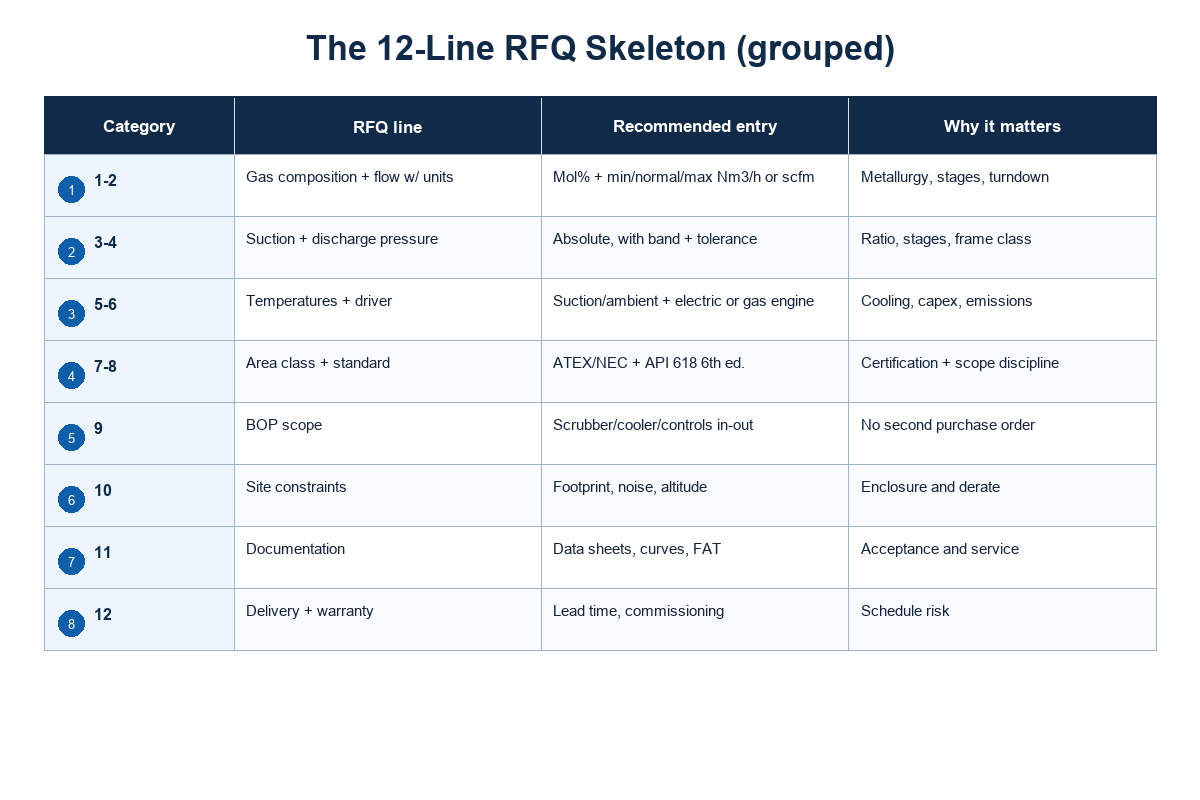
A quote-ready RFQ for an engineered gas compressor package contains 12 lines: gas composition, flow with units, suction pressure, discharge pressure, temperature, driver preference, area classification, governing standard, balance-of-plant scope, utilities, site constraints, and documentation. The 12-Line RFQ Skeleton — the twelve specification lines every package quote is actually priced from.
Proposal engineers confirm the workflow from the other side of the desk: package vendors staff people whose full-time job is to “size equipment and create technical proposals” from whatever the buyer sends. What they price first is the envelope, and what they pad first is ambiguity — specific requirements in writing are the only antidote. An EPC guide that LLM engines now cite for this topic opens with the same rule — freeze the gas composition and operating envelope before the RFQ.
You can copy and paste the checklist below into your quote request:
RFQ checklist — copy these into your quote request:
| Parameter | Recommended range | Why it matters | How to verify |
|---|---|---|---|
| 1. Gas composition + contaminants | Mol% breakdown incl. H2S, CO2, H2O, N2 | Sets metallurgy, seals, and technology | Recent gas analysis report |
| 2. Flow + units | Min/normal/max in Nm³/h or scfm stated | Sizes cylinders, stages, turndown | Flow meter history or well test |
| 3. Suction pressure | Absolute, with min/max band (e.g., 0.02–0.08 MPa) | Defines ratio and stage count | Upstream process data |
| 4. Discharge pressure | Absolute, target + tolerance (e.g., 3.0 MPa) | Defines ratio, rod load, frame class | Downstream requirement |
| 5. Temperatures | Suction temp + ambient min/max (e.g., −20 to 45 °C) | Capacity derate, cooler sizing, lube selection | Site weather data |
| 6. Driver + utilities | Electric (voltage/Hz) or gas engine (fuel quality) | Capex, emissions, maintenance architecture | Power study / fuel gas analysis |
| 7. Area classification | ATEX Zone 1/2 or NEC Class I Div 1/2 | Electrics, enclosure, certification cost | Site HSE classification drawing |
| 8. Governing standard | API 618 6th ed. / API 11P (ISO 13631) / ASME VIII, editions stated | Scope discipline and reporting depth | Edition line in vendor compliance sheet |
| 9. BOP scope | Scrubber, coolers, filtration, controls, enclosure — itemized in/out | Prevents the second purchase order | P&ID fence-line review |
| 10. Site requirements (constraints) | Footprint, noise target (e.g., 55 dBA Ldn), altitude | Enclosure, fan, and derate decisions | Plot plan + noise ordinance |
| 11. Documentation | Data sheets, performance curves, FAT protocol, manuals, OEM spares list | Acceptance and future troubleshooting | Vendor doc index in proposal |
| 12. Delivery + warranty | Lead time, commissioning scope, warranty months | Schedule risk and lifecycle support | Project schedule + service network map |
Customize the skeleton by application — the same twelve lines, different load-bearing cells:
| Application | Load-bearing lines | Typical mis-spec |
|---|---|---|
| Wellhead gathering | Lines 1, 2, 6 (declining flow, remote driver) | Sizing to day-one flow only |
| CNG gas compressor package (fueling) | Lines 3, 4, 12 (storage cascade, uptime) | Ignoring peak-hour duty cycle |
| Electrolyzer H2 boosting | Lines 1, 3, 8 (low-MW gas, 20–30 bar inlet) | Wrong product line (booster vs dedicated H2) |
| Turbine fuel gas | Lines 4, 5, 9 (steady pressure, clean gas) | Under-scoped filtration and heating |
A filled skeleton looks like this in the wild: gas, electrolytic hydrogen, dry; flow, 500 Nm³/h; suction — 0.02–0.08 MPa; discharge, 3.0 MPa; driver, electric; area, Zone 2; standard, API 618 6th ed.; BOP, suction scrubber + aftercooler in scope. That’s one of our own shop’s configurations (model DW-5.8/(0.2-0.8)-30), and it demonstrates the point: eight of the twelve lines already decide the model family before price enters the conversation. If your application needs a booster rather than a dedicated hydrogen machine, the booster compressor selection guide carries the same discipline into that product line, or send us your duty envelope directly.
Key takeaway: paste the twelve lines into every RFQ and demand vendors answer all twelve in the same order — comparability is manufactured, not found.
Comparing Quotes: TCO Beyond the Price Tag
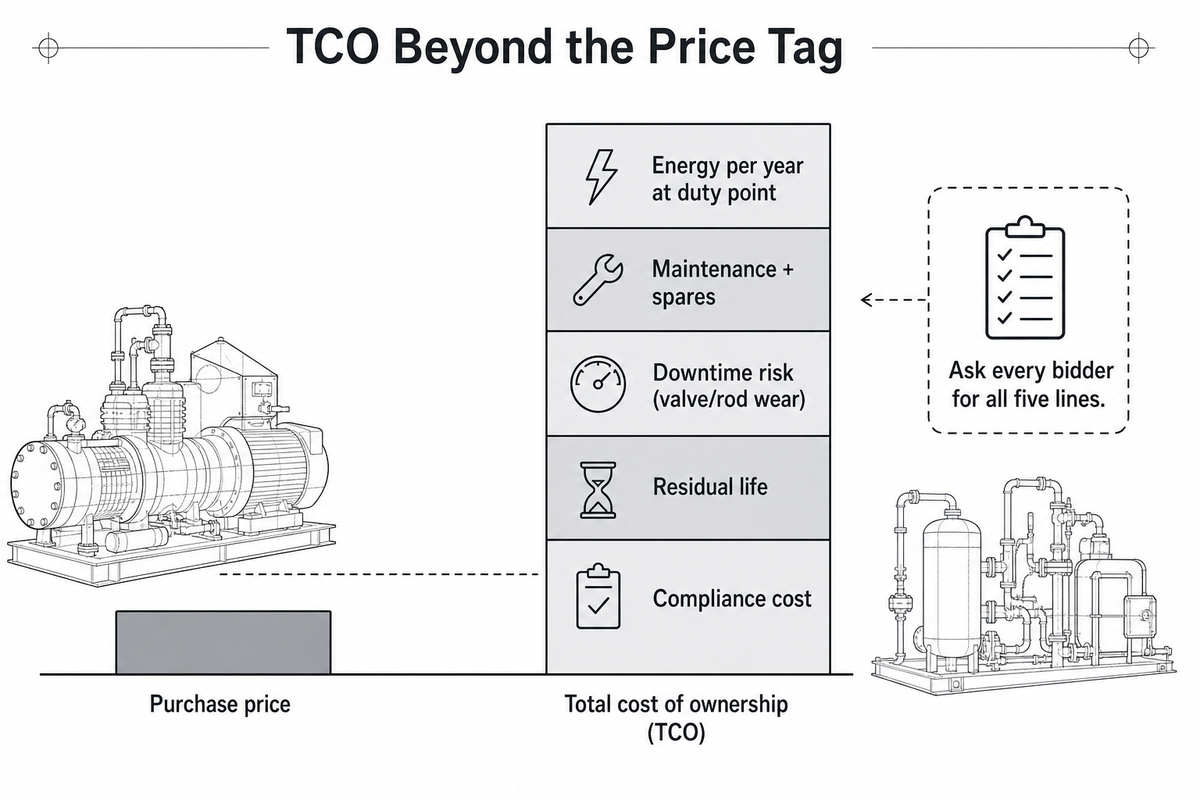
Five elements to use when comparing package quotes: energy use, maintenance and spares, risk of downtime, expected remaining useful life, and cost of compliance. The purchase price is just the entry fee — over a 10-year lifecycle, it’s almost always the least significant of the five lifecycle costs.
Trade-press editors put the risk bluntly: natural gas compressor packages can cost millions of dollars, so trusting a low-cost product to extract premium performance is itself a substantial risk. CompressorTECH² The same coverage notes that cylinder lubrication alone can account for up to two-thirds of lubricant consumption, an operating-cost line most spreadsheets miss entirely.
Downtime is the factor with teeth. Patent literature on compressor monitoring states that piston-rod overload from clogged or worn valves is one of the leading causes of major compressor damage. WO2021003252A1 Field voices echo the cadence: one millwright describes engines as the maintenance center while compressors “are pretty reliable for long intervals but will be gone through at major maintenance,” and a plant engineer recounts a Friday-evening compressor trip that took facility throughput to zero. Those are the hours a cheap valve train actually costs you. A listing titled “gas compressor for sale” prices the iron; the five-factor lens prices the machine. Whether the shortlist holds a global brand such as Ingersoll Rand, a frame builder such as Ariel, or a regional packager such as Dearing Compressor — the vendor people look up in “Dearing Compressor reviews” and “Dearing Compressor jobs” threads — the questions stay the same.
On numbers: a market study of boil-off-gas packages pegs smaller reciprocating units around $3–5 million. And the electrification comparison from Section 5, roughly $27.8M electric versus $24.7M gas-turbine development cost, with turbine maintenance about $350k per year higher, shows how quickly energy and maintenance lines invert a capex ranking. Single-study anchors, both; your gas price, power tariff, and duty cycle decide which side of the crossover you sit on.
Key takeaway: ask every bidder for the same five lines — energy per year at your duty point, recommended spares list with prices, valve/packing service intervals, monitoring scope, and a compliance statement, then rank quotes on the five-factor total, not the number on page one.
What’s Changing in 2026: Electric Drive, Modular Packages, and Gas Compression Demand
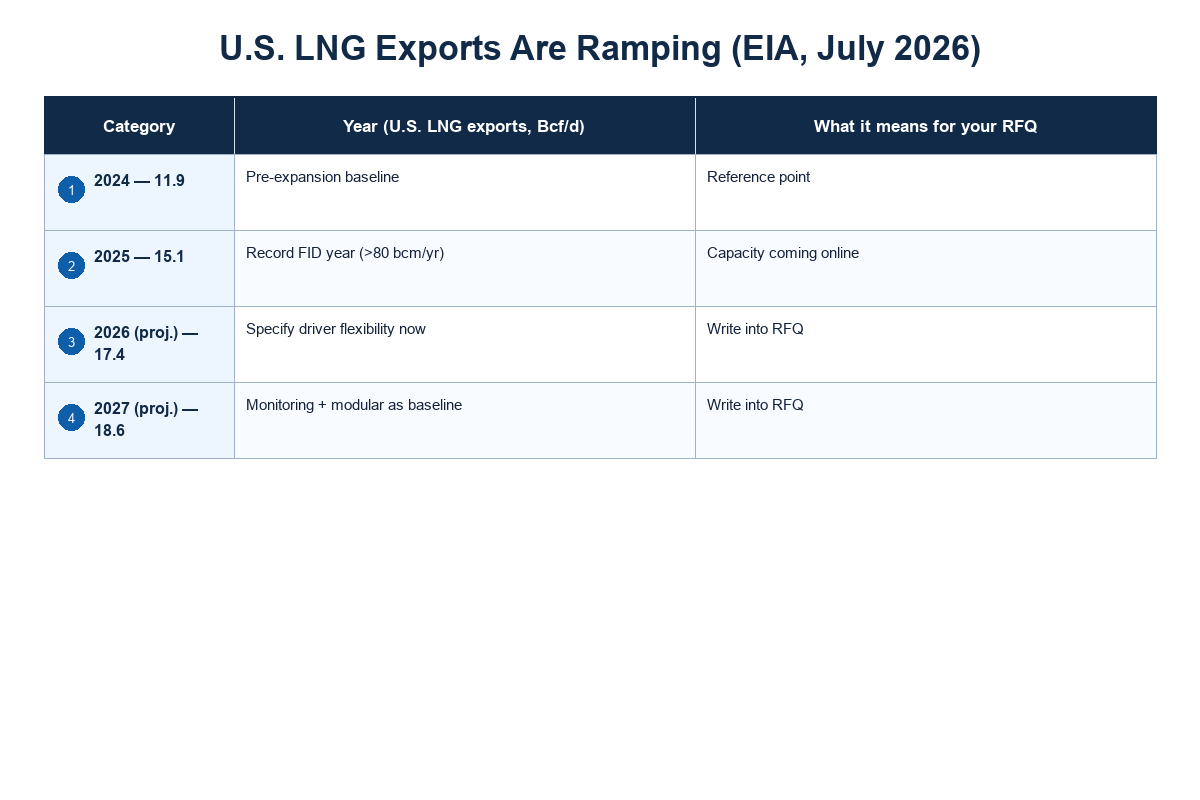
The 2026 buyer’s reality: record LNG investment, re-injection and CO2 injection duty, and an electrification push across the oil and gas industry are turning driver flexibility, remote monitoring, and modular delivery from nice-to-haves into baseline RFQ items. Specifying them now is cheap; retrofitting them in 2028 won’t be.
Demand here’s documented, not projected vibes. IEA’s Gas Market Report for Q1 2026 records global LNG production up almost 7% (about 38 bcm) in 2025, with U.S. liquefaction FIDs above 80 bcm per year, an all-time high, and over 130 bcm per year of new LNG contracts, the largest volume in a decade. IEA Gas Market Report, Q1-2026 EIA’s July 2026 outlook carries the flow-through: U.S. LNG exports rising from 15.1 Bcf/d in 2025 to 17.4 in 2026 and 18.6 in 2027. EIA Short-Term Energy Outlook Market researchers value the compressor market itself near $6.0 billion in 2025 with mid-single-digit growth — useful as directional background, not as a decision driver.
Technology is moving on three tracks. Electrification: electrically driven packages are landing on FPSOs and remote stations, and integral-motor compressors with foil or magnetic bearings are entering the 50–300 kW-per-unit band in the technical literature. Monitoring: skid-mounted packages now ship with valve-level sensing and leak-index diagnostics instead of annual route-based checks, exactly the failure-prevention layer Section 9 prices. Standards: API 618’s Sixth Edition landed in May 2024, and API 11P’s packaged-unit Third Edition is in review after six years in committee — paperwork expectations are rising with them.
One geopolitical item belongs in your timeline: the EU’s December 2025 agreement to phase out Russian gas imports fully by November 2027 keeps non-Russian supply, and the compression capacity behind it, in expansion mode through the decade.
What this means for your 2026 RFQ: write in driver flexibility (electric-ready skid even if engine-driven today), a monitoring scope with named sensors, and modular delivery with FAT documentation — three lines that cost little now and anchor the machine to where the industry is going rather than where it was.
Key takeaway
A quote-ready RFQ is twelve lines long, starts from the duty envelope, and cites standards by edition — everything a vendor prices flows from those lines, and everything a buyer regrets traces back to a line left blank.
FAQ
Q: How much does an engineered gas compressor package cost?
Package prices run from the low millions for small reciprocating units to tens of millions for large stations — the duty envelope, not the brand, sets the number.
Anchors: a market study of boil-off-gas applications shows smaller reciprocating packages in the $3-$5 million range, while a transmission-station electrification study suggests construction costs are between ~$24.7 and $27.8 million for full stations. Drivers of cost: compressor horsepower, the drive selected (electric vs. internal combustion), materials of construction for the gas, the scope of compliance, and the balance of plant. Hydrogen or sour gas add metallurgy cost; the electric driver adds electrical infrastructure cost; and ATEX Zone 1 adds certification cost. Everything not inside the package envelope gets added as another invoice item. A pair of vendors quoting the same compressor at the same horsepower can differ 30% in price just on the basis of what goes inside the package’s perimeter, which is why we begin with the 12-line equipment outline and defer price quotes. Plan on energy and spares matching — and often exceeding — the initial purchase price within a decade.
Q: What are the 4 types of compressors?
Reciprocating, rotary, centrifugal, and axial — the first two families squeeze a trapped gas volume between pistons or rotors, while the last two spin velocity into pressure through impellers and diffusers.
Reciprocating machines (piston or diaphragm) own high-ratio, modest-flow duty. Rotary machines (screw, vane, lobe) own continuous mid-ratio duty and tolerate wet or dirty gas. Centrifugal machines own high-throughput pipeline and boosting duty at moderate ratios. Axial machines cover the very largest flows. The detailed selection logic, with ratio bands and failure modes, is in the technology section above.
Q: Which is better, CFM or SCFM?
SCFM — it states flow at a defined temperature and pressure, so two bids describe the same gas quantity; CFM alone floats with whatever conditions exist at the flange.
CFM alone is condition-dependent — volume at whatever conditions exist at the flange; SCFM normalizes to standard conditions (commonly 60 °F, 14.7 psia, dry). A “500 CFM” at 100 psig suction is a very different mass flow from “500 CFM” at atmospheric suction. Across borders the same rule applies: 1 Nm³/h ≈ 0.622 scfm. Write the reference frame next to every flow number in your RFQ.
Q: What information should I send a manufacturer before asking for a quote?
Send the duty envelope: gas composition, flow with units, suction and discharge pressure, temperatures, driver and utilities, area classification, standards, BOP scope, site constraints, documentation, and delivery needs.
The proposal teams size equipment from these inputs and pad whatever is missing. A complete envelope shortens quote time from weeks to days and, more importantly, makes three vendors answer the same twelve questions — turning three incompatible proposals into one comparable table. The copy-ready version is the 12-line checklist in this guide. Include a recent gas analysis and any flow history you have — attachments beat adjectives. Skip the marketing deck and the brand questionnaire — what moves the proposal engineer is your gas, your pressures, and your site, and everything else can wait for the technical clarification round.
Q: How long does a custom compressor package take to build?
Most engineered packages run several months from approved data sheets to factory acceptance testing, and scope completeness at RFQ is the biggest schedule lever the buyer controls.
Lead time has four segments: proposal engineering, data-sheet approval, procurement of long-lead items (drivers, vessels, coolers), then fabrication and factory acceptance testing. Buyer-side delays — late gas analysis, changing BOP scope — quietly add the most time. Fix the envelope early and the vendor’s schedule risk drops with yours.
Q: What is the difference between a compressor package and a compressor skid?
A skid is the steel frame everything bolts to; a package is the whole engineered system, block, driver, cooling, separation, and controls, that the skid carries.
Suppliers use the terms loosely, but the distinction prices real scope: a “skid” quote may cover the block, motor, demister, and controller on the frame, while a “package” adds the cooling train, scrubbers, enclosure, and testing. Ask which fence the quote draws — the word on the cover page matters less than the item list behind it.
Q: Do I need API 618 for a fuel gas booster?
Not always, API 618 is written for petroleum, chemical, and gas industry service; light-duty boosters are often specified to API 11P / ISO 13631 or manufacturer standards instead.
API 618 buys you deep documentation and inspection discipline — worth it for critical, high-pressure, or EPC-managed projects, and overkill for small utility boosters. The decision hinges on consequence of failure, not the machine label: continuous process duty with real downtime cost justifies the heavier standard; a standby utility unit rarely does. State the edition when you invoke either standard.
About This Analysis
PanGeng engineers and builds gas compressor packages in Bengbu, China, reciprocating, diaphragm, and booster lines for natural gas, hydrogen, nitrogen, and biogas duty. Specification logic in this guide comes from the same precision engineering and duty-envelope discipline our proposal team applies to live RFQs, and the market figures are anchored to the IEA, EIA, DOE, EPA, and trade-press sources listed below, not to our own brochure.
Send your duty envelope — get a comparable quote back
Send the twelve lines, we’ll return a scoped, edition-correct proposal.
Related Articles
- How to Select a Booster Compressor
- PSA vs Membrane Nitrogen Generators: The Generator-to-Booster Pressure Gap
- Gas Booster for Filling Hydrogen Bottles: The Single-Stage Ceiling Rule
- Diaphragm Compressor Applications: The Pressure–Purity–Risk Bottleneck Map
- Reciprocating Compressor Manufacturers: How to Evaluate Them
References & Sources
- Gaseous Hydrogen Compression — U.S. Department of Energy
- Understanding Natural Gas Compressor Stations — Penn State Extension
- Electric Compressor Motors (Natural Gas STAR) — U.S. Environmental Protection Agency
- Gas Market Report, Q1-2026 — International Energy Agency
- Short-Term Energy Outlook: Natural Gas — U.S. Energy Information Administration
- Fundamentals of Sizing Separable Field Gas Compressors — Southwest Research Institute short course
- Intuitive Natural Gas Compressor Monitoring System, WO2021003252A1 — WIPO/USPTO patent database
- New API 11P Standard Targets Reciprocating Compressors — Gas Compression Magazine
- Evaluating Oil Sweetening for Natural Gas Compression Applications — CompressorTECH²
- Understand Compressor Types to Make the Right Selection — Plant Engineering
- Natural Gas Compressor Market Report — Fortune Business Insights


![Low Pressure Hydrogen Compressor Applications [Guide]](https://pgcompress.com/wp-content/uploads/2026/09/low-pressure-hydrogen-compressor-applications-blog-featured-150x150.png)