Get in Touch with Pangeng


Updated July 2026
Quick Specs
| Inlet pressure range | 0.2 – 20 bar (electrolyzer output, PSA generator, or a low-pressure cylinder bank) |
| Target outlet pressure | Up to 200 bar (this article’s scope — not the 350-700+ bar range used for vehicle refueling) |
| Typical drive types | Pneumatic (air-driven), electric, diaphragm |
| Typical flow range | 50 – 1,700 Nm3/h, model-dependent |
| Gas compatibility | Hydrogen requires oil-free or oil-isolated design, 316-series stainless wetted parts, and embrittlement-resistant materials |
A gas booster for filling hydrogen bottles is designed to accept hydrogen which has already been compressed (from an electrolyzer, a PSA generator or a low-pressure bank of cylinders) to a certain pressure and compress it to the additional required fill pressure. Your required pressure will most commonly range anywhere between 6-200 bar (which can be applied to industrial cylinders, small fuel-cell systems, or lab gas supply). However, selecting the wrong booster may result in paying for capacity you don’t require or realising too late that your chosen booster simply can’t reach the pressure ratio you need to successfully fill your bottles. In short, this type of pressure booster is used to increase the pressure of hydrogen gas that arrives from an upstream source at a lower gas pressure than your cylinders require.
This article guides you through the processes of cylinder and bottle filling in the 6-200 bar range. If you require a public vehicle fueling station or have similar requirements of this nature, then you should look at high-pressure hydrogen compressors which have been manufactured for this purpose (rated to 350-700+ bar and comply with protocols like SAE J2601/ISO 19880 fueling protocols). These instructions are not suitable for this specific range.
Key Takeaways
- Based on a white paper on the subject from EFRC/TNO, common compressor types such as centrifugal and screw aren’t suitable for use with hydrogen, unlike many applications for other gases. Instead, piston/reciprocating technology remains popular in this range due to its physical nature, rather than personal preference.
- Stage count is often determined more by the ratio required than by the final discharge pressure; in order to fill to 200 bar from an initial pressure of, for example, 6 bar (approximately a 33:1 ratio) will often require 4 stages of compression.
- Often the purity requirement of the gas is more critical than the actual final pressure when deciding between a lubricated and an oil-free system.
What Is a Gas Booster (and Why Hydrogen Bottles Need One)?
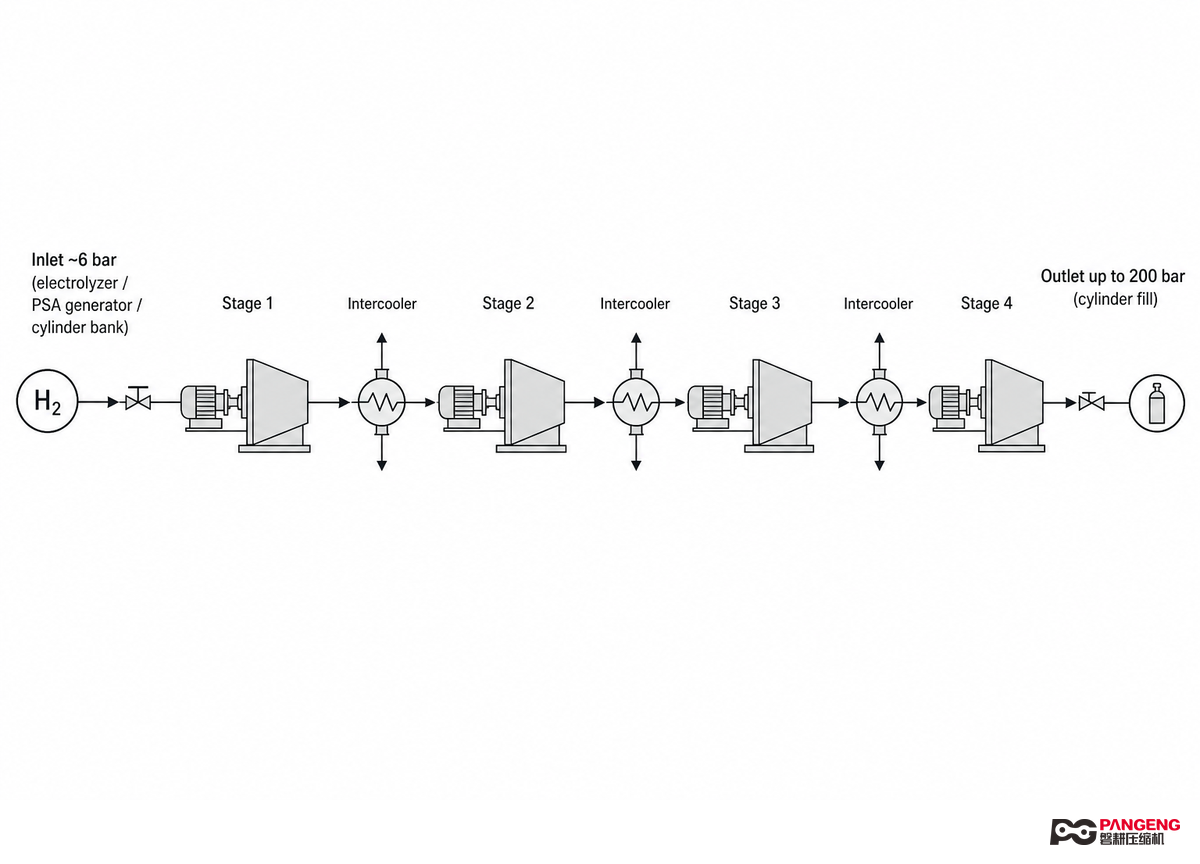
Gas boosters, sometimes called hydrogen booster pumps, work by increasing gas that is already under pressure through staged compression. Reciprocating piston or diaphragm pumps handle most of this work, reducing gas volume across several stages until it reaches the target pressure — the compression ratio between discharge and inlet pressure determines how much work each stage must do, per the U.S. Department of Energy’s explanation of gaseous hydrogen compression.
This system is typically used in a hydrogen cylinder filling application, as most forms of hydrogen generation (such as electrolyzers or PSA generators), or even storage tanks at lower pressure, don’t reach the final desired fill pressure of the cylinder without further compression to around 6-200 bar. This kind of unit is also marketed as a hydrogen booster pump or, in a compact hydrogen footprint aimed at lab benches, simply as one of several small portable hydrogen pumps; a number of manufacturers sell a dedicated series gas booster product line — sometimes shortened on datasheets to H2 hydrogen booster — built specifically for cylinder and bottle-filling duty rather than pipeline service.
Where it differs from compressing compressed air or nitrogen: hydrogen’s small molecule (2.89 angstroms) escapes past seals that otherwise work just fine with air or nitrogen, and it has the potential to embrittle certain steels over time and pressure. A gas booster rated for compressed air isn’t automatically safe for hydrogen service – if you’re comparing spec sheets by the pressure and flow numbers, the wetted materials and seals beneath are often very different. (Hydrogen also has an unusually wide flammability range, which contributes to the tighter sealing and area-classification standards for hydrogen boosters vs. air ones.) The mistake is expensive, not just risky: swapping in a mis-specified booster after a seal failure means downtime, a scrapped batch of wetted parts, and re-certification to ISO 11114-4 before it can go back into hydrogen service — because the standard requires proof the replacement material was actually tested for embrittlement resistance, not just rated for the same pressure.
Hydrogen Booster vs Hydrogen Compressor — Same Machine, Different Name
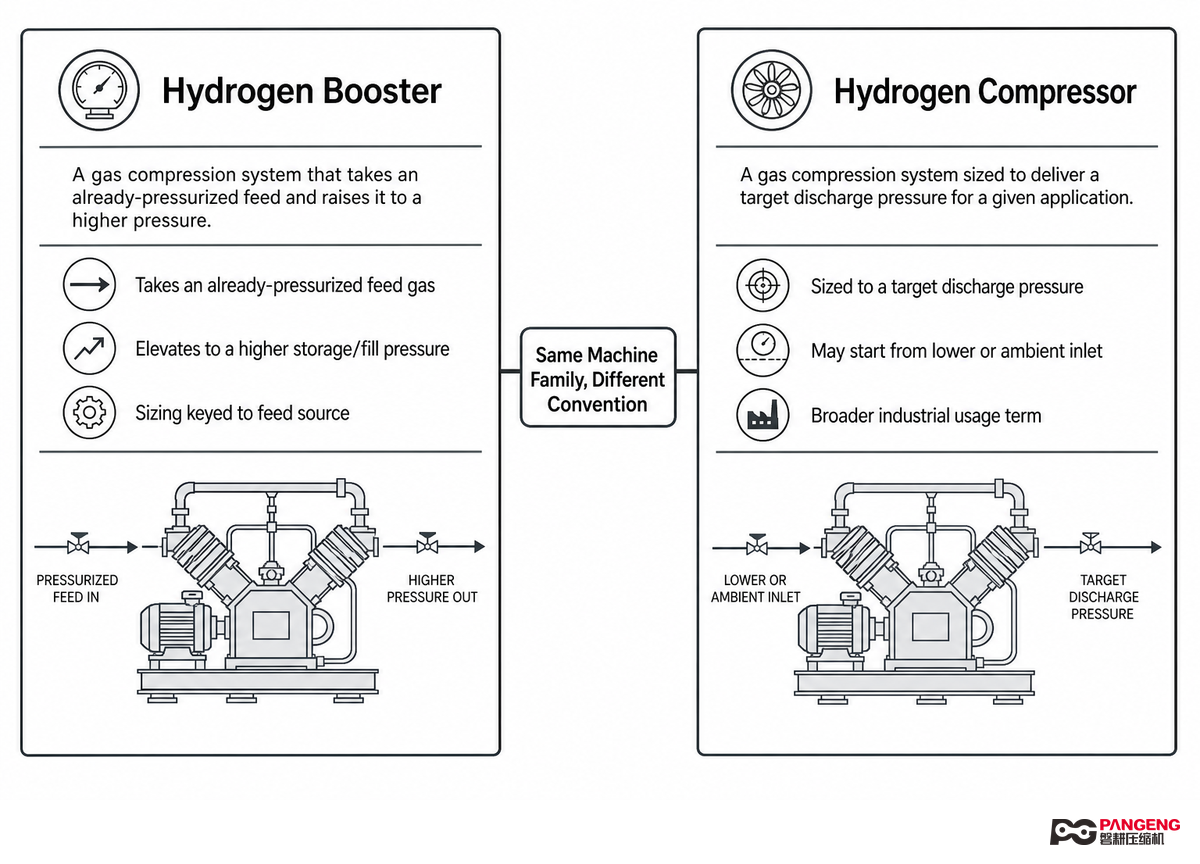
“Hydrogen booster” and “hydrogen compressor” generally describe the same family of products across manufacturer literature, and US patent databases have used the terms interchangeably for at least the last 10 years. One 2013 patent on ammonia synthesis lists “a hydrogen gas booster for producing pressurized hydrogen gas” as part of a standard system configuration, while a 2022 patent for a modular hydrogen-ammonia system specifies an “air driven hydrogen gas booster” alongside a pair of reciprocating and screw compressors as one of three noted compression technologies. Failing to search both will mean missing out on many of the available products.
A natural gas booster pump uses the same staged-compression principles discussed here, though hydrogen’s material and purity requirements make its equipment a distinct product line rather than a simple relabeling. Purchasers tend to favor “booster” slightly more for a device that elevates pressure on an already pressurized feed gas (e.g., an electrolyzer or generator output) to a higher storage or filling pressure, versus a “compressor” that’s sized based on the target output pressure irrespective of the feed gas source — however, this is simply convention, not a difference in function, and both terms will be seen on a single manufacturer’s site.
What Are the Types of Hydrogen Compressors?
There are four major architectural designs for compressing hydrogen gas: reciprocating (piston or diaphragm), rotary (screw, gear, or vane), ionic liquid, and centrifugal. Of these, only reciprocating piston or diaphragm compressors — by far the most popular technology for filling high-pressure storage — are routinely used for applications with pressure needs in the 6-200 bar range covered in this guide.
Rotary compressors are less common for hydrogen because internal leakage around the rotor is more pronounced with such a low-molecular-weight gas, and centrifugal designs require roughly three times the tip speed of a natural gas compressor to achieve the same pressure rise. Ionic liquid compressors use an all-liquid piston replacement with no wear-prone bearings or seals, and both centrifugal and ionic-liquid designs are mainly seen in high-volume, pipeline-scale applications rather than cylinder filling.
Hydrogen Bottle Types and Pressure Ratings You’re Filling Into
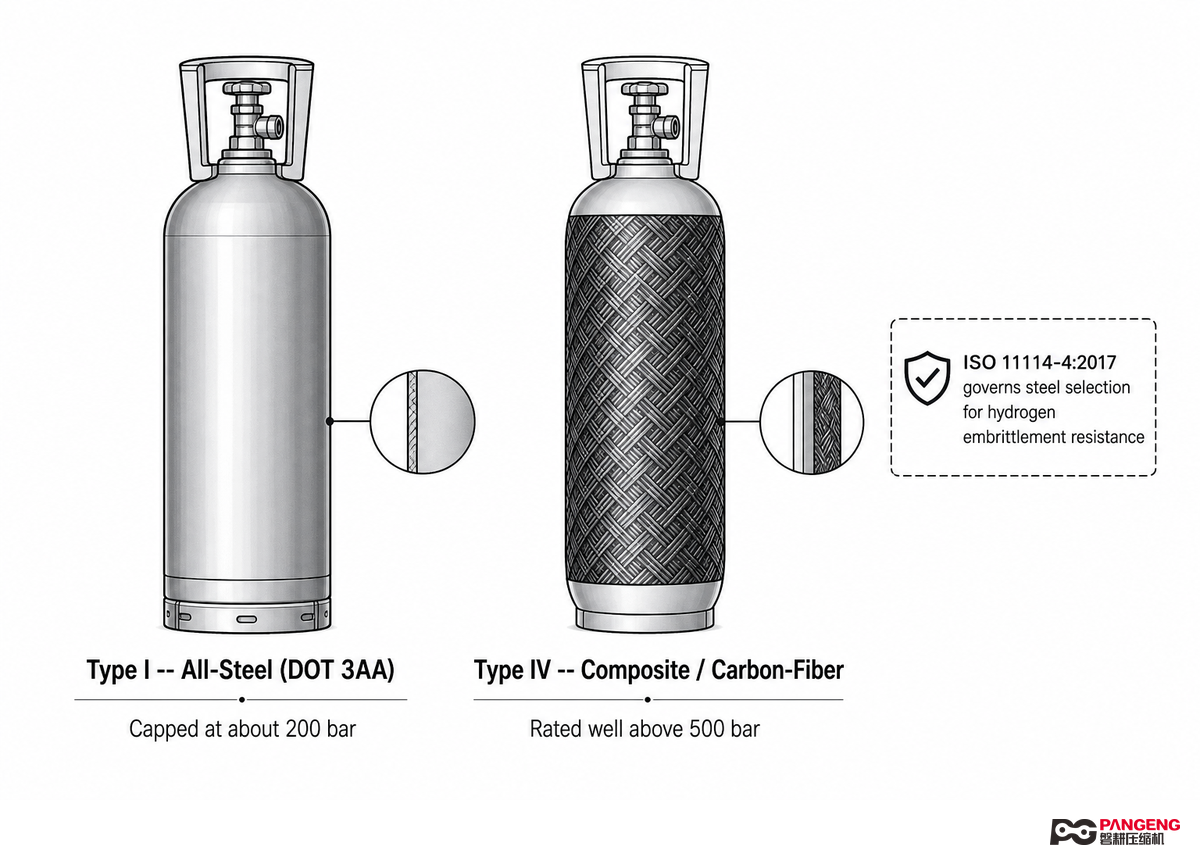
What you’re filling limits your pressure ceiling before the booster does. DOT 3AA cylinders continue to be probably the most widely utilized, small-quantity pressure vessel within the U.S. transport service, while cylinders made outside the U.S. using steel with tensile strength beyond 950 MPa also need ISO 11114-4:2017 (Edition 2) — the specification for selecting steels resistant to hydrogen embrittlement, which applies to single-piece (no-weld) steel gas cylinders up to 3,000 liters and has replaced the previous 2005 edition. The older Type I all-steel tube-trailer cylinders are capped at about 200 bar, though newer Type IV composite/carbon-fiber cylinders are rated well above 500 bar. This 200 bar ceiling on older steel tube trailers is no coincidence – it’s the main reason this article’s 6-200-bar scope is the practical operating envelope for most of today’s existing commercial hydrogen gas cylinders (H2) – it isn’t just arbitrary nomenclature.
📐 Engineering Note
Just about any gas receptacle substance authorised for use with H2 needs an embrittlement index — the ratio between the maximum pressure the material resists with helium and its maximum pressure resisted with hydrogen — of 2 or less, as determined under ISO 11114-4:2017. If the ratio is bigger than 2, your metal is just not suitable to be used within a high-pressure H2 cylinder, it doesn’t matter what the rated toughness is.
Matching Booster Pressure Ratio to Your 6-200 Bar Fill Range
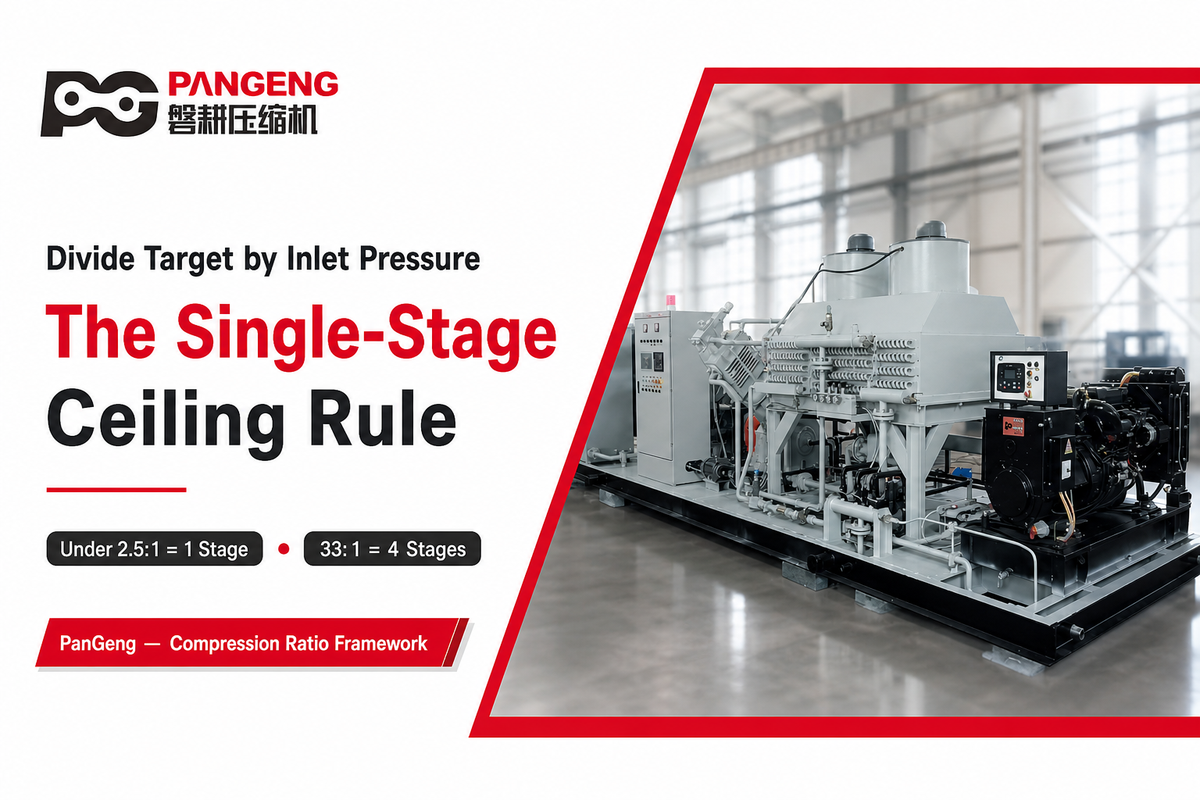
When your inlet is 6 bar and your goal is 200 bar, your compression ratio is 200/6, or approximately 33:1 — and that ratio, not the raw target pressure, is what determines whether a single-stage booster can do the job. The DOE’s own worked example uses similar math: a compressor taking hydrogen in at 20 bar and discharging it at 200 bar has a compression ratio of 10. Separately, an EFRC/TNO industry white paper puts the typical per-stage pressure ratio for a reciprocating hydrogen booster at 1.6 to 2.5, with larger total ratios reached by staging up to four compression stages.
The Single-Stage Ceiling RuleDivide your target pressure by your inlet pressure to get your compression ratio. If that ratio is under roughly 2.5:1, a single stage may cover it. Above that, you need multiple stages — and at 33:1 (our 6-to-200-bar example), that works out to log(33) / log(2.5), which is approximately 3.8 and rounds up to 4 stages. This is a screening estimate to narrow your shortlist, not a final design spec — your actual stage count also depends on flow rate, suction temperature, and gas conditions your supplier’s engineering team needs to confirm.
Where this calculation gets more interesting — and where a lot of buyers guess wrong — is that your inlet pressure often matters more than your target pressure. A technical paper from compressor manufacturer Ariel Corporation, presented at the 2023 EFRC conference, gives a real comparison: for an identical 200 bar(a) discharge target at 50 kg/hr, a compressor fed by an alkaline electrolyzer at 1.01 bar(a) needs a 6-throw, 8-stage machine drawing 129 kW, while the same duty fed by a PEM electrolyzer at 25 bar(a) needs only a 2-throw, 3-stage machine at 54 kW — less than half the power, purely because the feed pressure is higher. This is one manufacturer’s illustrative sizing example, not a universal ratio — treat it as a directional demonstration of how much feed pressure matters, and confirm your own numbers against your actual equipment. If you’re specifying a booster before you’ve confirmed your actual electrolyzer or generator outlet pressure, you’re guessing at the single biggest variable in the sizing math — the best starting point is always your own measured number, not a vendor’s default assumption. A related mistake is treating “increase the pressure” as a single lump-sum job: each stage produces its own pressure drop and heat load, so a booster spec that only lists the final outlet number, with no per-stage detail, is hiding the information you actually need to compare two quotes.
Pneumatic vs Electric vs Diaphragm — Which Drive Type Fits Your Fill Station
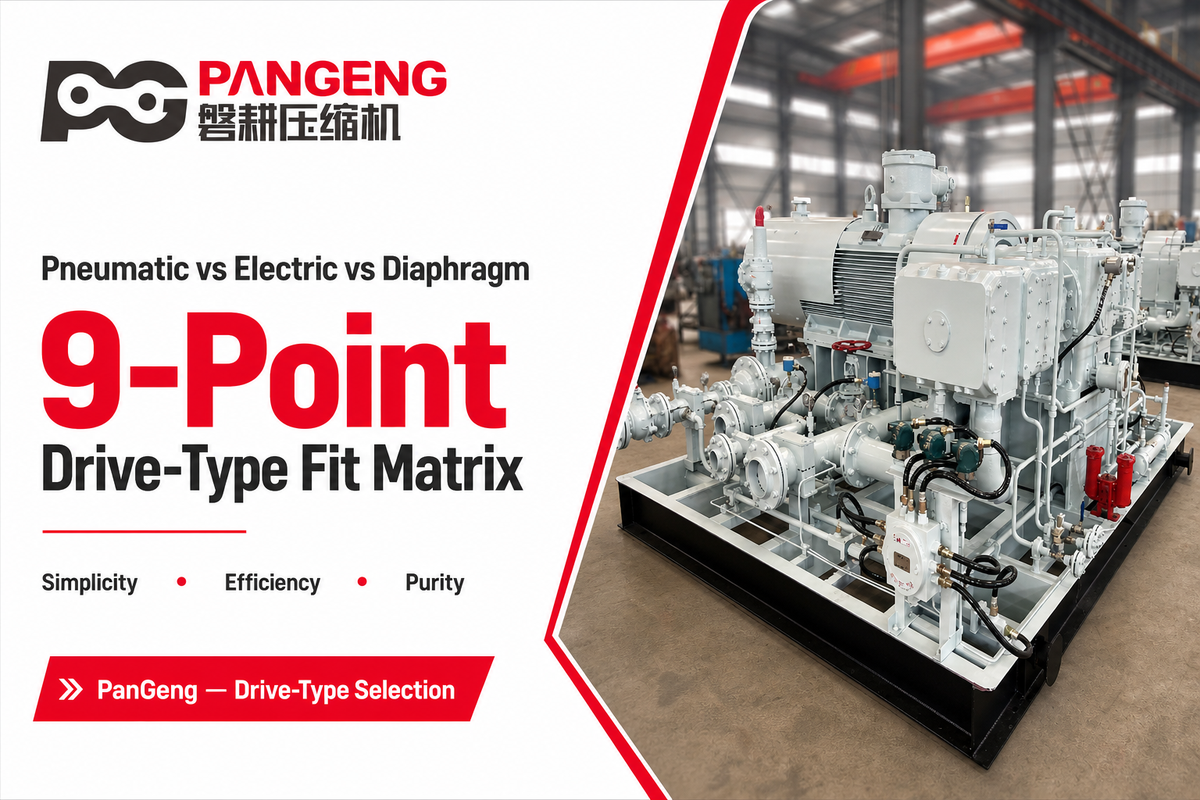
Almost every hydrogen compressor on the market is driven by one of three drive types; however, they aren’t interchangeable for hydrogen as they might be for compressed air. In the context of pure hydrogen, an industry white paper from EFRC/TNO identified that centrifugal compressors — frequently used for compressing natural gas — achieve a maximum pressure ratio per stage of about 1.1 even at speeds of around 350 m/s, and that screw compressors are “rarely used” to compress hydrogen, due to hydrogen’s low molecular weight causing internal leakage around the rotor that’s more pronounced than in other gases. That means that reciprocating designs — either piston or diaphragm — remain the typical choices for hydrogen compressors in this pressure range. Between those two options, double-acting pistons — which compress gas on both the up and down strokes of the piston — are most commonly seen in air-drive units, and they can generate greater output from a given volume of compressed air than single-acting pistons. This explains why air-driven boosters can be economically competitive even with the additional compressed-air infrastructure needed to operate them. If you need a portable gas booster for filling hydrogen bottles at a temporary site or a field location without grid power, an air-driven unit paired with a rental or towable air compressor is usually the most practical option — electric and diaphragm units both assume a fixed electrical connection. Before ordering an air-driven system, confirm your shop air supply can sustain the booster’s driving air pressure and rated flow without dropping out mid-fill — undersized shop air is the most common site-readiness failure installers report. Also check whether the package includes matched pressure switches for automatic cutoff at your maximum outlet pressure, exhaust air routing away from the operator, and dedicated exhaust cooling if the unit will run a long double stage or two stage fill cycle back to back. An electric driven system swaps this compressed-air dependency for a hard-wired connection, but a driven system of either kind still needs correctly sized pipes and tubing between the booster and your cylinder manifold — undersized lines choke hydrogen flow regardless of how the unit itself is powered.
1.7-6.4
kWh/kg, piston-electric
2.0-8.3
kWh/kg, diaphragm-electric
2.1-3.8
kWh/kg, ionic-liquid piston
Source: Peer-reviewed energy consumption comparison, MDPI Hydrogen Journal
| Parameter | Pneumatic (air-driven) | Electric | Diaphragm |
|---|---|---|---|
| Typical max pressure | Up to 220 bar (PanGeng general line); air-driven boosters elsewhere run higher on non-hydrogen gases | Up to 1,034 bar (published competitor Q-Drive figures) | Up to 400 bar+ lubricated / 225 bar non-lube, per EFRC benchmark |
| Oil-free capability | Available, model-dependent | Standard on most electric units | Standard — gas never contacts lubricant |
| Energy use (approx.) | Depends on compressed-air source efficiency, not directly comparable | 1.7-6.4 kWh/kg (piston) | 2.0-8.3 kWh/kg |
| Noise level | Moderate, driven by air exhaust | As low as 58 dB (variable-speed units) up to ~77 dB | Generally lower than reciprocating piston |
| Maintenance driver | Seals, driving-air quality | Motor/drive electronics, seals | Diaphragm replacement interval |
| Power source needed | Compressed air supply | Electrical grid connection | Electrical grid connection |
| Portability | Good with a portable air source | Lower — fixed installation typical | Lower — fixed installation typical |
| Best fit | Intermittent, lower-duty-cycle filling | Continuous or high-duty-cycle operation, efficiency-sensitive sites | Fuel-cell or high-purity-grade filling |
| Not suitable for | Continuous 24/7 duty without a matched, sized air compressor upstream | Sites without reliable grid power or that need full electrical isolation | Very high flow rates — a diaphragm compressor is comparatively low-flow (per EFRC benchmark, roughly under 100 Nm3/h in most models) |
Once you’ve narrowed down your options for a drive type, verify whether pressure gauges and maximum output interlocks are standard on the quote, and if electric drive controls are included for inter-stage cooling, a detail that frequently distinguishes between a well-integrated package and just a skid.
“More oil is not always better. If the discharge temperature is allowed to exceed the API 618 limit but stay under 150°C, only seven compression stages would be required rather than eight — reducing the capital cost of the compressor system.”
✔ Advantages of electric-drive boosters
- Best measured energy efficiency of the three architectures
- Precise, automatic pressure control — no separate compressed-air source to manage
- Well suited to continuous or high-duty-cycle filling
⚠ Limitations of electric-drive boosters
- Requires a reliable, adequately sized electrical supply on site
- Higher upfront capital cost than a comparable pneumatic unit in most published pricing
- Less field-portable than an air-driven unit for temporary or mobile filling setups
Materials and Safety Standards That Matter for Hydrogen Booster Service
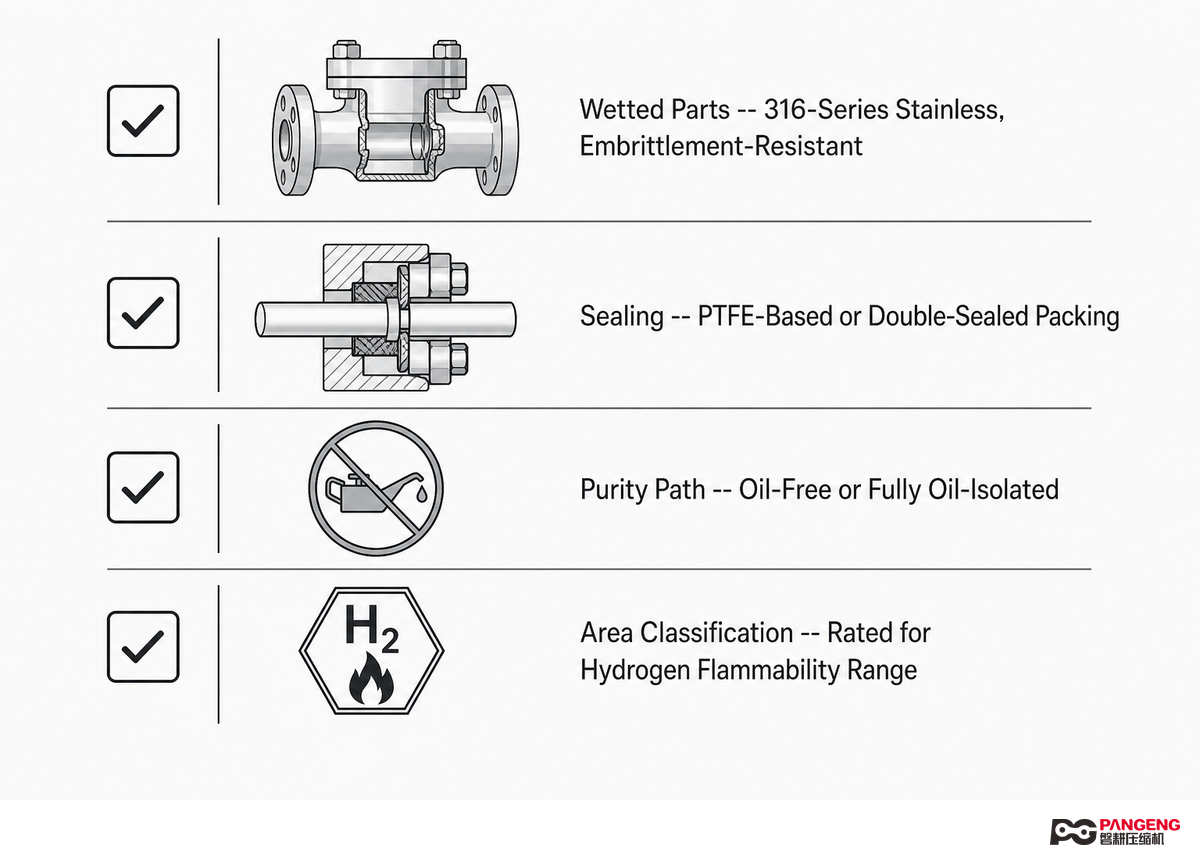
What truly makes a booster hydrogen-safe – not just “hydrogen-rated” – comes down to two separate considerations: will the wetted parts avoid embrittlement from the tiny hydrogen molecules, and will the booster deliver a purity suitable for your end application? These are two distinct criteria to assess, not a generic “safety” check box. Material concerns generally advise against anything other than 316-series stainless steel and other embrittlement-resistant materials for the wetted components, and either oil-free or fully oil-isolated compressors to prevent contaminating your delicate downstream processes, and either PTFE-based or double-sealed packing to contain those small hydrogen molecules. In terms of purity, the current standards appear to be set by ISO 19880-8:2024 – published in December 2024 by ISO/TC 197 – defining a process for verifying the quality of gaseous hydrogen at fuel distribution and fueling stations, tying in with the ISO 14687 purity ratings used for most fuel-cell applications. The EFRC white paper states plainly that, for feedstock- or fuel-cell-grade applications, the purity requirement — rather than pressure — is what usually disqualifies a lubricated booster design. Because hydrogen is flammable across an unusually wide concentration range, area classification for the compression skid and any adjacent gas storage must follow local electrical codes, not just the booster’s pressure rating. Oil-free compression is not optional for fuel-cell or feedstock service — confirm the vendor is quoting a genuine oil free gas path end to end, not just an oil-free label on the compression stage while the driving-air side still carries lubricant into the shop.
API 618, Sixth Edition (published May 2024), is the industry standard for petroleum, chemical and gas industry reciprocating compressors, covering all of the relevant codes for high-pressure applications except plant and instrument-air compressors discharged below or at 9 bar. In the United States, 29 CFR 1910.103 from OSHA sets additional requirements related to facility safety, bonding, and system location, that go above the equipment-level codes referenced above – be sure to check these with your facility safety manager prior to installation. All bids should include an appropriate rated safety relief valve and a discharge check valve, which are essential last lines of defense in case of an overpressure event. The piping and vessels used between your booster and hydrogen storage system must also be suitable for the high-pressure operating conditions of the entire system, and not simply match a nominal pressure rating printed on a booster’s nameplate.
How PanGeng Compares to Haskel, Maximator, and Suncenter Boosters
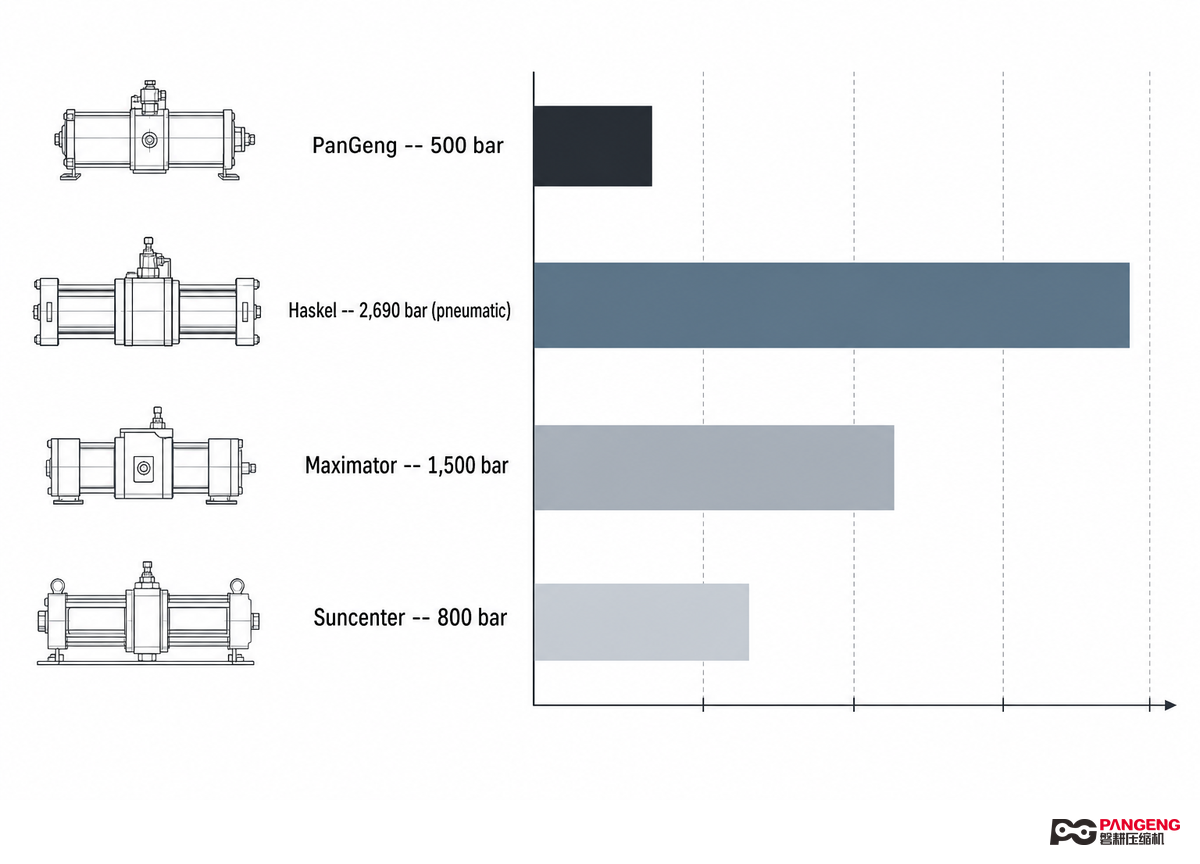
There’s no single best gas booster for filling hydrogen bottles for every buyer — the right pick depends on your pressure ratio, purity requirement, and duty cycle, not brand reputation alone. Researching this category tends to surface the same handful of names. Here’s an honest breakdown of how the various players stack up based on their published product specs. Not every dimension favours PanGeng — and that should be acknowledged outright.
| Manufacturer | Published max pressure | Wetted materials disclosed | Lead time |
|---|---|---|---|
| PanGeng (general Booster Compressors line) | Up to 50 MPa (500 bar) rated, 22 MPa (220 bar) common custom configuration | Stainless-cylinder options, oil-free variants available | Factory-direct, China manufacturer — typically shorter than Western OEM lead times per industry benchmarking |
| Haskel (Pneumatic/Q-Drive/H-Drive) | Up to 39,000 psi (2,690 bar) pneumatic; 15,000 psi (1,034 bar) electric/hydraulic | ATEX-rated hydrogen-compatible models, alloys not named on public page | Not published; quote-based |
| Maximator UK (GTU-DLE series) | 40-1,500 bar across 5 model tiers, pressure ratio 1:2 to 1:75 | 316ss / 1.4542 / 1.4305 by pressure class; PTFE/Viton seals | Not published on model page |
| Suncenter (DGA/DGD/DGT series) | Up to 80 MPa (800 bar); DGA25 model matches this article’s 7-200 bar band directly | Stainless high-pressure cylinder, self-degreased components | 10-15 working days after deposit (published) |
Some competitors market high-pressure hydrogen boosters up to 80MPa — far beyond the scope of this article’s focus on 200 bar (20MPa). It’s always worth comparing a listed figure to your specific need, and not assuming a higher number equates to a better choice. PanGeng lags the three western brands on one front: None of the three western manufacturers currently publish a documented methodology for testing against hydrogen embrittlement on their web product pages. You’ll need to make that a question to every vendor you’re considering on the shortlist — and yes, that means asking PanGeng too — to see the actual ISO 11114-4:2017 test data to support a claim of appropriate material selection.
What Drives the Cost of a Hydrogen Bottle-Filling Booster
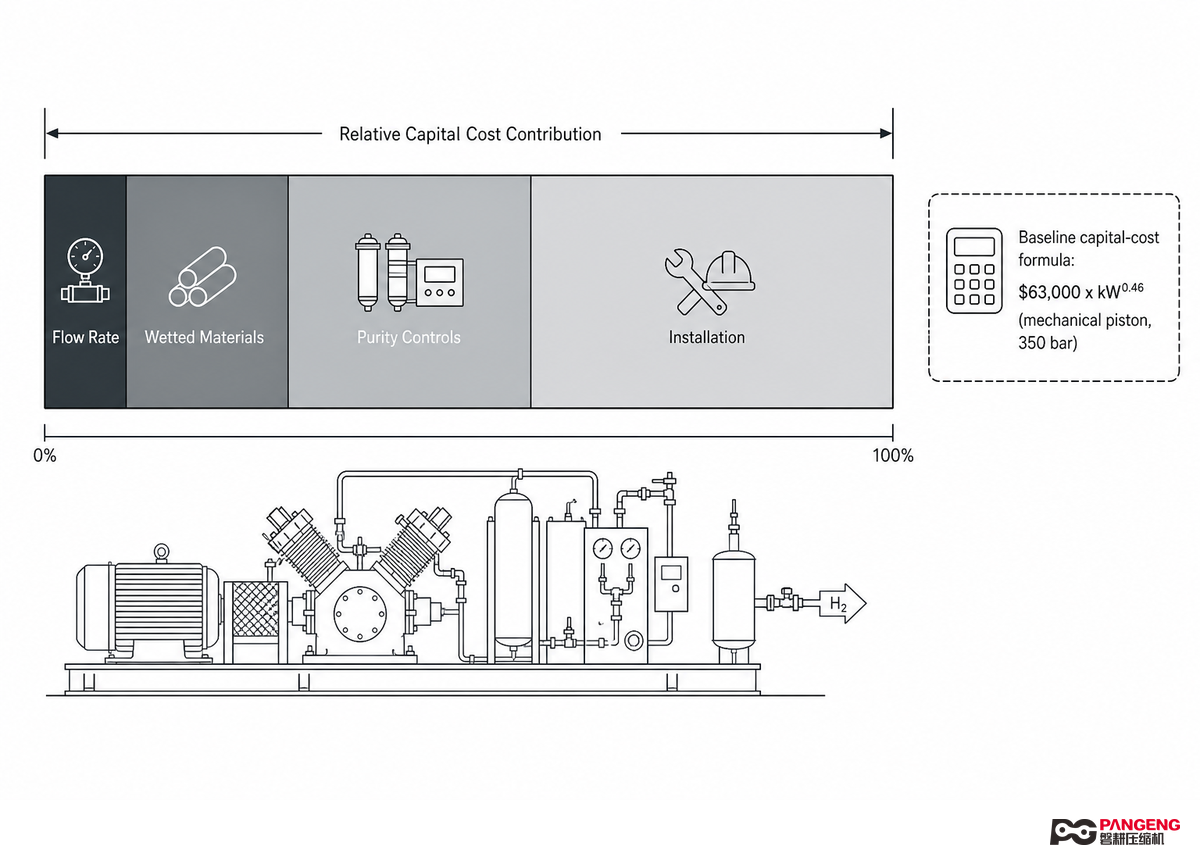
What actually drives a hydrogen bottle-filling booster’s price is flow rate, wetted materials, purity controls, and installation — not the pressure rating printed on the spec sheet. Treat any published baseline figure as directional guidance for budgeting, not a firm quote for your specific project, since real numbers vary considerably by configuration.
The real gas booster for filling hydrogen bottles cost is rarely the number on the quote alone. Published economic modeling offers a useful benchmark for your actual quote, although that number will be highly sensitive to flow rate, materials, and controls. One peer-reviewed capital-cost formula for mechanical piston compressors at 350 bar yields something on the order of $63,000 * kW^0.46 and includes an installation factor of about 1.3, working out to somewhere in the ballpark of $515,000 for a 33 kg/hr unit (2013 cost basis). Another academic analysis quotes a small target unit for a ~100 kg/hr 87.5 MPa device that comes in at around $275,000, uninstalled cost, with energy usage of 1.6 kWh/kg and annual maintenance of 4% of uninstalled cost. (As a quick aside for those building out any high-pressure gas system, not just a single booster: the NREL/DOE have noted that most of the existing cost models underestimate total ownership cost by failing to account for finite pressure-vessel lifetime and the stress from repeated cycling of cascaded storage.)
RFQ checklist — copy these into your quote request:
| Parameter | Recommended range | Why it matters | How to verify |
|---|---|---|---|
| Actual inlet pressure | Confirm your real source pressure, not a nameplate estimate | Drives stage count and power draw more than target pressure alone | Measure at the source or request electrolyzer/generator datasheet |
| Target fill pressure | State the exact bar rating of your cylinders, not “as high as possible” | Over-speccing pressure adds unnecessary stages and cost | Check cylinder DOT/ISO rating plate |
| Required flow rate (Nm3/h) | Based on fill volume and acceptable fill time | Undersized flow means long, costly fill cycles | Calculate from cylinder volume / target fill time |
| Required purity grade | ISO 14687 grade matching your end use | Disqualifies oil-lubricated designs for fuel-cell/feedstock grade | Request a certificate of analysis, not just a spec claim |
| Wetted-material certification | ISO 11114-4:2017 test data for the actual alloy used | Protects against embrittlement failure over the unit’s service life | Request the lab test report, not a marketing claim |
Industry Outlook — Why Hydrogen Bottle-Filling Demand Is Accelerating
While vehicle-refueling stations dominate the headlines, the primary driver for the boom in bottle-filling boosters is the scale-up of hydrogen production at industrial and lab sites — whether that hydrogen comes from green electrolysis or conventional production. Market-research figures are wide-ranging depending on the source, but all point to the same direction and order of magnitude: a recent, frequently-cited projection estimates the global green hydrogen market will jump from $12.3 billion in 2025 to over $231 billion in 2035 (a CAGR of 34%), with growth largely spurred by more widespread deployment of PEM electrolyzers (directional, not prescriptive data for any buyer to rely on for CapEx planning). As nearly every hydrogen production plant using electrolysis (except those connected directly to a pipeline) needs to deliver its output into cylinders or tube trailers for transport and use, an appropriately sized bottle-filling booster is needed to bridge that last-mile gap; this article isn’t concerned with those much larger, multi-stage compressors used for large public fueling station networks. To illustrate the scale-up gap: there were 59 public retail hydrogen fueling stations in operation in the US in 2024, with around 50 more under construction, but the total installed capacity of bottle-filling boosters for industrial/lab users (who outnumber those public stations by orders of magnitude) far exceeds this tiny, capital-intensive market segment. Unlike a public hydrogen refueling station built to fuel vehicles, the equipment in this guide serves lab, industrial, and fuel-cell backup hydrogen filling — a much larger and faster-growing installed base than the public station count above suggests.
So what does this all mean if you’re planning a project for the 2026-2027 timeframe? In practical terms, it’s a matter of sourcing timing: as the growing volume of electrolysis plants come online in line with projected growth, lead times from Western-brand suppliers of boosters are expected to lengthen before they contract — and that’s one reason that factory-direct sourcing is now a practical alternative for many buyers who value capability over deep pedigree.
Frequently Asked Questions
Q: How do I choose a gas booster for filling hydrogen bottles from 6 bar inlet pressure to 200 bar outlet pressure?
A 6-to-200-bar fill is roughly a 33:1 compression ratio, which typically needs about 4 reciprocating stages, plus confirmed flow rate, purity grade, and wetted-material certification before you request quotes.
Calculate compression ratio: Take your actual measured inlet pressure and the rated fill pressure of your cylinder, and divide the former by the latter to get the compression ratio, then compare it to a typical reciprocal stage limit of 1.6-2.5:1 to approximate your number of stages — likely four for a 33:1 ratio. Once that’s settled, clarify the required flow rate (Nm3/h), the necessary purity (dictates oil-free vs. lubricated), and the wetted-material certification, then solicit quotes.
Q: What’s the difference between a gas booster and a gas compressor?
In most manufacturer literature they’re the same category of equipment, used somewhat interchangeably, though buyers should search both terms when comparing suppliers to avoid missing relevant products from either naming convention.
The term “booster” is slightly more often applied to equipment that picks up an already-pressurized supply — from a generator or electrolyzer — and boosts it farther, while “compressor” tends to be applied more generally to equipment whose sizing is focused on a particular target discharge pressure. However, patents that date back more than a decade apply both terms to what appears to be functionally the same type of equipment for raising hydrogen pressure, so do not limit searches for suppliers to a single word.
Q: Does a low-pressure hydrogen gas boost compressor exist for smaller fuel-cell applications?
Yes — buyers in online engineering forums confirm this is a real, distinct product category from full-ratio industrial compressors, purpose-built for the smaller pressure lift that fuel-cell-vehicle-scale applications actually require.
In discussions among hydrogen practitioners, it appears that low-pressure boost compressors are indeed being designed for fuel-cell-vehicle-scale pressure lifting and generally have a smaller overall pressure range compared with high-ratio standard industrial compressors, thus constituting a distinct category for specialized applications. If your application only needs a modest lift — say, raising a few bar of onboard fuel-cell supply pressure rather than filling a full industrial cylinder — specifying a smaller, purpose-built unit instead of a general 6-200 bar industrial booster can save meaningful cost and complexity.
Q: What is the pressure regulator for hydrogen gas, and do I need one with a booster?
Yes — a downstream pressure regulator is standard practice alongside a booster to control final delivery pressure, and it must be explicitly certified for hydrogen service since seals rated for other gases often are not compatible.
Whereas the booster is designed to compress the gas to your target fill pressure for your cylinder, a hydrogen-rated pressure regulator handles downstream distribution of the gas to any given fuel cell, process, or instrument at a much lower and stable operating pressure. You should also always ensure your pressure regulator is explicitly certified for use with hydrogen; regulators rated for other gases likely lack the requisite compatibility of seal materials.
Q: How do you pressurize hydrogen gas safely?
Positive-displacement compressors — reciprocating or rotary — are the standard equipment used to compress hydrogen safely, provided the wetted materials, seals, and site installation all follow applicable facility safety codes.
According to U.S. DOE information, gas is most often produced at 20 to 30 bars and compressed via either diaphragm or reciprocating pistons, or else using rotary compressors, before transportation, though it notes that this could soon change. Practical safety relies on ensuring compatibility of materials with hydrogen, following applicable compression standards and installation procedures as dictated by local facility safety codes (e.g., 29 CFR 1910.103 for OSHA in the U.S.).
Q: What does a gas booster actually help with?
A gas booster lets you reach a high fill pressure without oversizing your primary gas source or generator, since it adds just one final compression stage instead of running the whole system at peak pressure.
A booster adds just one final compression stage, so your generator or primary compressor doesn’t have to reach full target pressure on its own — usually cheaper and more efficient than running an entire system at peak pressure for a fraction of your demand.
Q: What are the main types of hydrogen compressors?
Four main architectures exist: reciprocating, rotary, ionic-liquid, and centrifugal — with reciprocating dominant for cylinder-filling pressure ranges because rotary and centrifugal designs both struggle with hydrogen’s small molecule and low density.
Reciprocating compressors (both diaphragm and piston types) support higher compression ratios and have become standard for gas compression into cylinders for 6- to 200-bar ranges, but screw, vane and gear compressors rarely are used to compress hydrogen owing to their internal leakage rates for gases with low molecular weight. Ionic-liquid compressors employ liquid in place of metal pistons to eliminate dynamic seals entirely, and published energy figures put them at roughly 2.1-3.8 kWh/kg — often more efficient than a comparable piston or diaphragm unit. Centrifugal compressors are utilized at pipeline pressures and typically require approximately three times the tip speed of a natural-gas compressor to generate the same pressure rise, a constraint due to the fundamental properties of the gases, which is why this architecture rarely appears at cylinder-filling scale.
Why We Write This
PanGeng has been producing gas boosters and compressor systems in our Bengbu, Anhui location since 2009, with models for nitrogen, air, and hydrogen service. Its specification data and comparisons come from our own published hydrogen compressor and booster-compressor model tables, independently verified against data published by government, academic, and trade-association sources rather than restated from marketing copy alone. Reviewed by the PanGeng technical team.
References & Sources
- Gaseous Hydrogen Compression U.S. Department of Energy
- Material Compatibility Test Methods for Hydrogen Pressure Vessels National Institute of Standards and Technology
- Hydrogen Embrittlement Index Study, SA-372 Grade J Steel National Center for Biotechnology Information / PMC
- ISO 19880-8:2024, Gaseous Hydrogen Fuelling Stations, Fuel Quality Control International Organization for Standardization
- API Standard 618, Sixth Edition (May 2024) American Petroleum Institute
- Hydrogen Compression White Paper European Forum for Reciprocating Compressors (EFRC)
- Energy-Efficiency Comparison of Hydrogen Compression Technologies MDPI Hydrogen journal, peer-reviewed
- Hydrogen Compression Cost Analysis National Renewable Energy Laboratory / U.S. Department of Energy
- Green Hydrogen Market Size and Forecast Precedence Research
- Hydrogen Fueling Station Market Report Fortune Business Insights
- Reciprocating Compressors and the Hydrogen Economy Ariel Corporation, 13th EFRC Conference technical paper
- WO2022256907A1, Modular, Transportable Clean Hydrogen-Ammonia Maker Fuelpositive Corp, USPTO/Google Patents
Related Articles
- Industrial gas booster compressors for hydrogen, nitrogen, and compressed air the full PanGeng booster compressor product line covered in this guide
- Dedicated hydrogen compressor product line (350-700 bar) for vehicle refueling and large-scale storage, outside this guide’s 6-200 bar scope
- Reciprocating hydrogen compressor specifications
- Diaphragm hydrogen compressor specifications
- PSA vs membrane nitrogen generators: which technology fits your purity needs the same staged-compression selection logic applied to nitrogen
- Hydrogen booster compressor cost and market guide for total cost of ownership and market-pricing detail beyond this guide’s RFQ checklist
![Low Pressure Hydrogen Compressor Applications [Guide]](https://pgcompress.com/wp-content/uploads/2026/09/low-pressure-hydrogen-compressor-applications-blog-featured-150x150.png)