Get in Touch with Pangeng


A PSA vs membrane nitrogen generator decision is usually treated as a straightforward comparison between two similar-sounding processes, but the truth is, they tackle different challenges in the purity levels. Nor is either one a fully complete solution. PSA (pressure swing adsorption) systems push purity to 95%-99.999% using carbon molecular sieves, while membrane systems achieve slightly lower purity ceilings with more compact, continuously operating, no-moving-parts configurations. The selection is just the first step: either generator (PSA or membrane) generates a low-pressure nitrogen stream that still require compression to be put to use on the production floor.
Quick Specs
| PSA purity range | 95% – 99.999% |
| Membrane purity range | 95% – 99.5% |
| Typical generator outlet pressure | 0.5 – 1.0 MPa |
| Common flow range | 50 – 1,200+ Nm³/h |
| Footprint | Membrane: compact, modular. PSA: larger, twin-vessel skid |
| Maintenance interval | PSA: annual dryer/filter service. Membrane: ~10-year fiber replacement cycle |
PSA vs Membrane Nitrogen Generators: Key Differences at a Glance
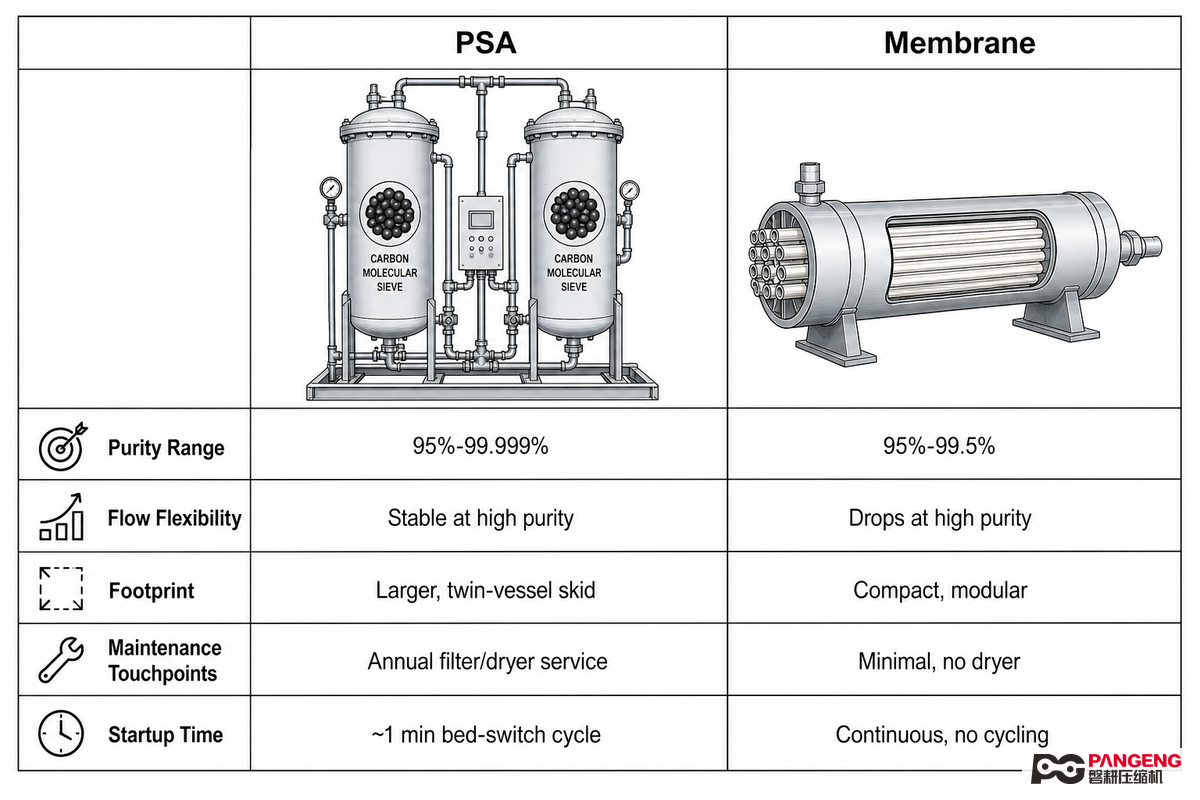
Nine parameters separate a membrane system from a PSA nitrogen generator-purity is the most talked about, but we also cover compressed gas issues like this when discussing how nitrogen compressors work. PSA systems get a higher purity limit (as high as 99.999% on manufacturer specifications) by actively “trapping”oxygen molecules with a dual-bed carbon molecular sieve; membrane systems passively filter gas through polymer hollow fibers, and often fall in the 99.5% purity range. That gap explains the differing cost, maintenance levels and physical sizes for downstream components shown below.
| Category | PSA | Membrane | Limitations / not suitable for |
|---|---|---|---|
| Purity ceiling | 95% – 99.999% | 95% – 99.5% | Membrane not suitable above ~99.5% purity requirements |
| Flow rate at high purity | Holds flow steady as purity rises | Flow drops as purity target rises | Membrane not suitable for high-flow + high-purity combined |
| Moving parts | Valves, actuators, 2 adsorption vessels | None (passive fiber bundle) | PSA not suitable for high-vibration/shock installs without isolation |
| Moisture sensitivity | High — CMS damage from moisture is irreversible | Moderate — brief exposure usually recoverable | Neither tolerates prolonged water carryover; both need a dryer upstream |
| Oil sensitivity | Severe, irreversible | Severe, irreversible | Both require an activated-carbon bed on oil-flooded compressor feed |
| Rated service life | 20+ years (CMS doesn’t lose capacity if uncontaminated) | ~10 years (fiber performance degrades gradually) | Field reports show units approaching/exceeding rated life need proactive inspection, not just calendar tracking |
| Routine maintenance touch | Low (annual filter/dryer service) | Very low (no dryer required) | PSA’s low touch still requires a dedicated refrigerated dryer system — a real added cost line, not zero-maintenance |
| Footprint | Larger — twin vessels + control skid | Compact, modular, stackable | PSA not suitable for tight mobile/skid-limited installs |
| Generator outlet pressure | 0.5 – 1.0 MPa typical | 0.5 – 1.0 MPa typical | Neither reaches typical process pressures alone — see the compression step below |
Neither the manufacturer specs, nor this page will mention the following key element: after leaving a generator (either PSA or membrane), the stream isn’t yet under enough pressure for your industrial application-compression is needed regardless of the generation technology chosen, and we detail how it’s accomplished at length below.
One quick vocabulary note before going further: whichever brand you’re comparing, you’ll see this equipment described several different ways. Manufacturers market PSA technology and membrane technology interchangeably with “nitrogen generation system,” “onsite nitrogen generation system,” or simply “generator.” A unit built to separate nitrogen from compressed air using membrane separation technology is sold as a membrane separation technique, a nitrogen separation membrane, a separation membrane module, or a hollow-fiber membrane cartridge — all describing the same membrane module hardware. On the PSA side, you’ll see pressure swing adsorption technology described as a system built to separate nitrogen using two beds that alternate: one bed working to separate nitrogen gas from compressed air, the other regenerating. Choosing between membrane or PSA (some vendors write it as membrane or psa, others as membrane vs PSA) comes down to matching your purity, flow, and footprint needs to the right nitrogen system, not the marketing name on the datasheet.
Two types of nitrogen generators dominate the on-site market, and both start from generating nitrogen out of the same input: compressed air. PSA systems are ideal when high purity matters more than footprint; membrane and pressure swing adsorption approaches both start from compressed air, but membrane and PSA nitrogen generators diverge sharply in how they get there. Adsorption is how a PSA system pulls nitrogen gas from compressed air, separating nitrogen from oxygen inside a sieve bed, rather than filtering compressed air through the membrane’s fiber wall. Either way, the goal is the same: pure nitrogen, purified nitrogen, or high-purity nitrogen output, drawn straight from the air around the plant rather than trucked in as pressurized or cryogenic cylinders.
Onsite nitrogen production has grown for a simple reason: nitrogen supply from a generator costs less over time than nitrogen cylinders trucked in from a distributor. A generator’s nitrogen output depends on three things working together — nitrogen flow capacity, purity target, and inlet air quality. Higher nitrogen flow generally means lower achievable purity unless you oversize the unit, which is exactly why matching purity to your application (covered above) comes before comparing sticker prices. Some engineers describe using a membrane system as choosing simplicity over ceiling purity, and note that PSA generators can produce a wider volume of nitrogen at a given purity band than an equivalent-footprint membrane unit can. Either technology draws nitrogen from the air on site, and either one can leave a facility with cost-effective nitrogen once the generator switches from a delivered-cylinder model to on-site supply — the right generator for your application is the one sized to your actual flow, purity, and pressure needs, not the one with the most impressive datasheet.
Whichever you pick — membrane or pressure swing adsorption — the generator becomes your primary nitrogen source. The key differences between PSA and membrane systems are the purity of nitrogen achievable, how larger nitrogen molecules and smaller ones separate, and how nitrogen is used downstream. All of them trace back to the same separate nitrogen gas mechanism each technology relies on, whether that means membrane generators produce a steady low-pressure stream or PSA cycles between two beds.
How PSA (Pressure Swing Adsorption) Nitrogen Generation Works
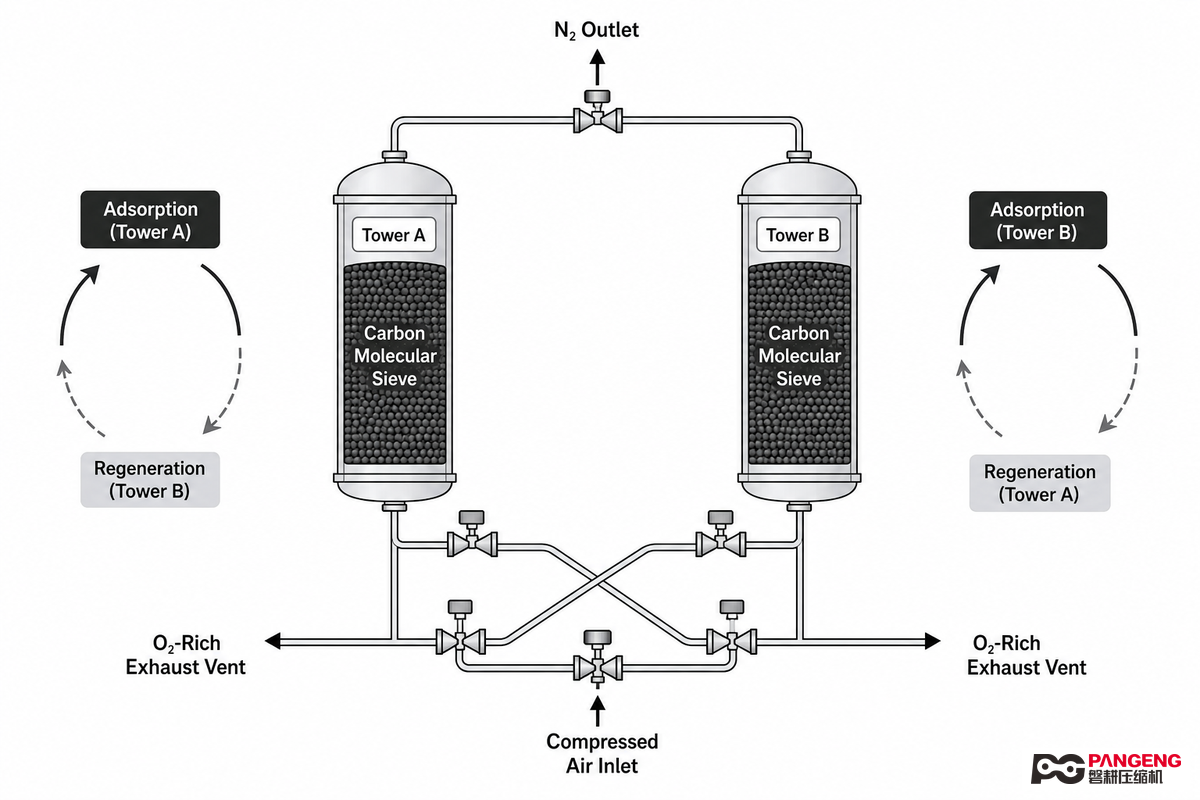
A PSA nitrogen generator works by oscillating between two carbon molecular sieve beds: one bed takes in pressurized air, the other vents and regenerates. The first bed collects oxygen, CO2, and water vapor as the oxygen is absorbed into the CMS material while the air moves on to yield its nitrogen.
When oxygen saturates the sieve material, the system depressurizes the first bed, venting the captured gases, while the second bed becomes active and receives air at pressure. In continuous operation, the cycle time is approximately one minute.
How Does a PSA Nitrogen Generator Work?
Twin-bed cycling between adsorption and regeneration lets a PSA unit run continuously without any interruption in production, though the machinery itself (multiple valves, sensors) and its dehumidification requirement — the CMS is damaged if moisture penetrates the sieve — add real mechanical complexity.
For an indication of ongoing R&D, the US patent application US20240174582A1 and the parallel Japanese application JP2024514498A, both filed in 2024, discuss improved release of nitrogen from sieve material.
Robustness is where the CMS material excels: it won’t lose its adsorptive capacity over time as long as contamination by moisture and oil are managed, which is why well-maintained PSA units often achieve more than 20 years of service life. But real-world field experience does reveal a practical downside to consider before you invest: process engineers inheriting a 20-year-old PSA unit that’s nearing the end of its design life find troubleshooting the eventual decline in capacity harder than sizing a new unit because a gradual drop can mimic sizing or feed-air issues for months before it’s the adsorbent’s fault.
How Membrane Nitrogen Generation Works
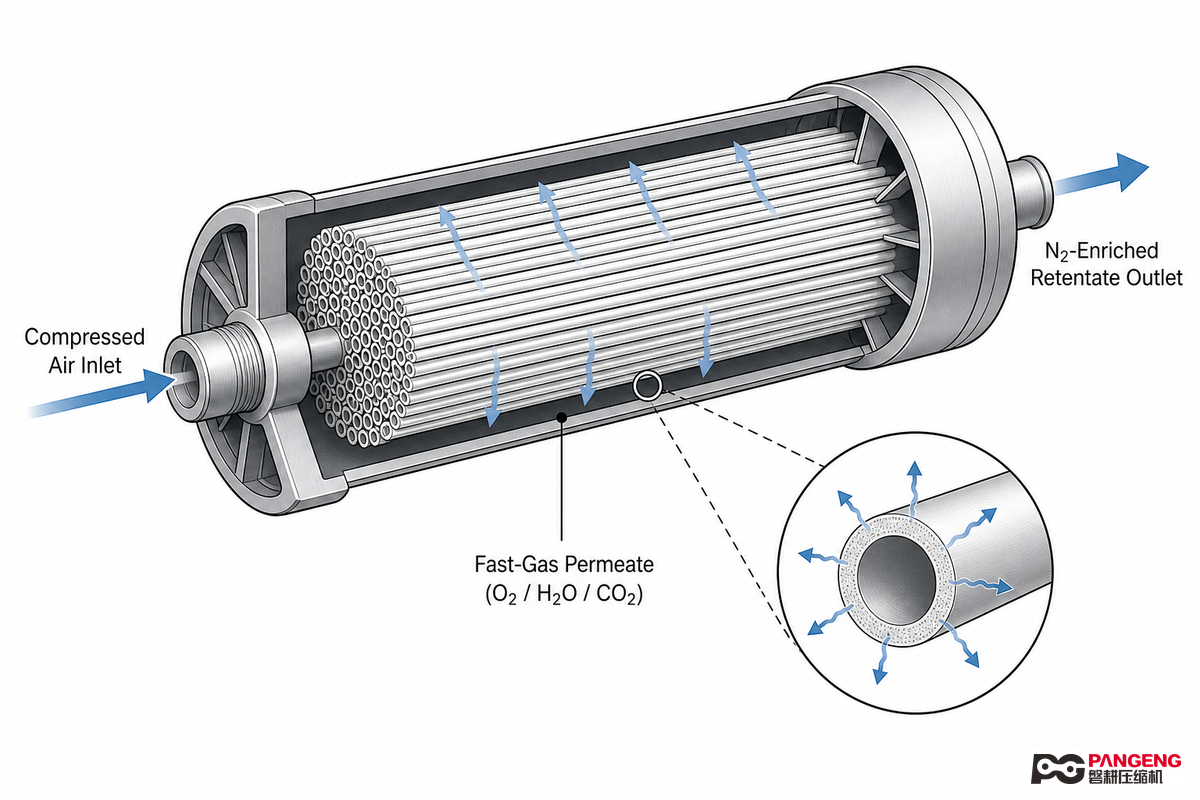
Membrane nitrogen generation relies on differential permeability instead of adsorption, a separation principle documented in peer-reviewed hollow-fiber membrane research: compressed air is supplied to the inside of a bundle of hollow polymer fibers, and oxygen molecules — smaller and more readily able to permeate the walls — are drawn out while the slower nitrogen stream passes through.
The benefit is that there are no valves, no cycling beds, no moving parts at all in a membrane system, allowing it to operate continuously without the periodic switching cycle of a PSA. Some manufacturers market the same hardware simply as a nitrogen membrane separator, emphasizing the passive-filtration angle over the “generator” framing — it’s the same equipment either way.
How Does a Membrane Nitrogen Generator Work?
Membrane simplicity in mechanical design is a major selling point: membrane systems have less to maintain, require less space, and are modular in scale — flow capacity can be adjusted simply by adding or removing membrane cartridges without a complete system redesign.
The trade-off, compared to PSA systems, works the other way around: the more purity you push toward 100%, the more you have to slow the flow rate, and purity and flow rate are in more direct conflict with one another than with PSA’s adsorbent beds. And unlike PSA’s sudden degradation from adsorbent failure, membrane performance degrades gradually over the course of about a decade — a useful capital budgeting item.
Membrane systems handle a short exposure to moisture better than the PSA approach, where temporary performance drops eventually recover as the fibers dry out, but neither can afford to operate for extended periods without upstream drying of the air. And neither system can withstand prolonged exposure to the compressed air stream if it contains oil.
Matching Purity to Your Application
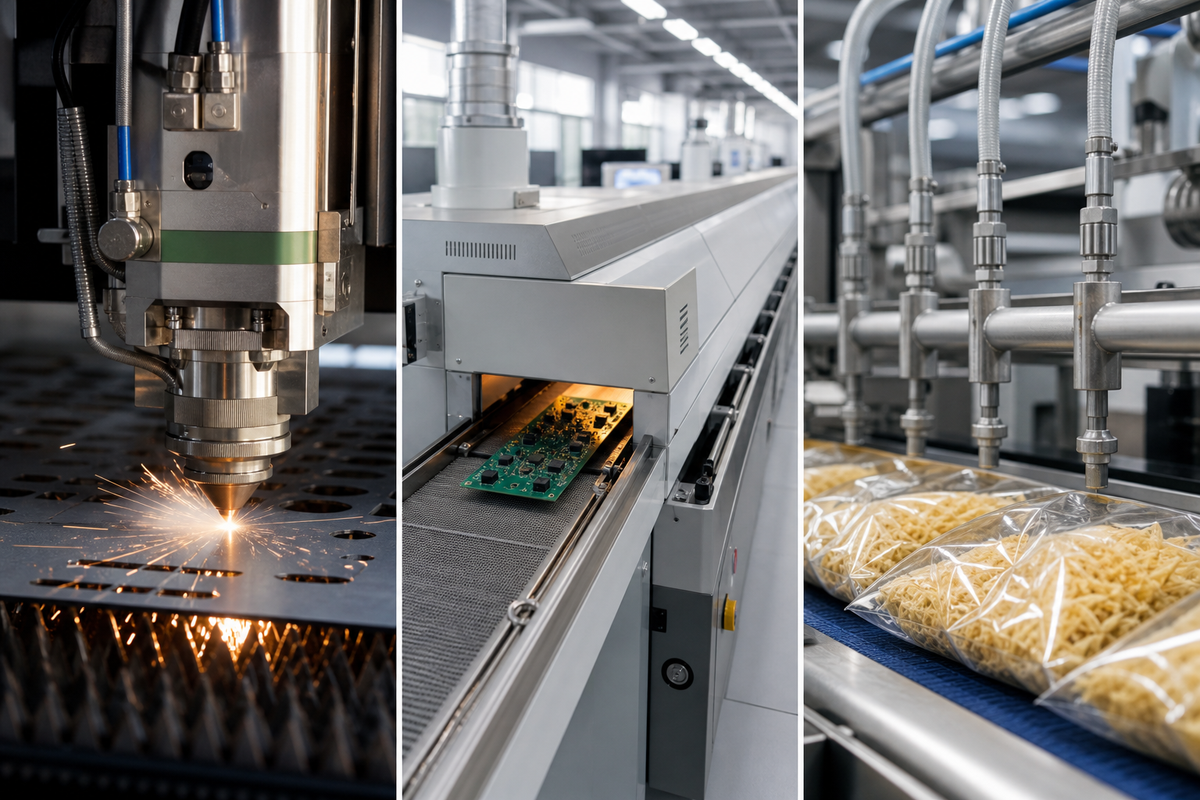
You’ll be better served by considering your application’s requirements for oxygen contamination levels rather than your budget in deciding between PSA and membrane systems. Ultra-high-purity processes such as semiconductor fabrication, pharmaceuticals production, and high-tolerance laser machining need to maintain purity in excess of 99.5% and thus favor PSA systems. Applications for less demanding purity, high-volume needs like food packaging blanketing, tire inflation, and general inerting, will work well with membrane systems for cost-effective and compact solutions at 95-99% purity. A useful reference is the account in a compressed-air trade journal of an R&D lab switching to a Mikropor MNG 2050 PSA generator, which reliably provided 56 SCFM at 99.99% purity and 93 psig from cylinders.
| Purity needed | Representative application | Recommended technology | Why |
|---|---|---|---|
| 99.9% – 99.999% | Electronics, pharmaceutical, precision laser cutting | PSA | Only PSA’s active adsorption reliably clears membrane’s practical purity ceiling |
| 99% – 99.5% | Heat treatment, chemical blanketing, general laser cutting | PSA or high-spec membrane | Overlap zone — decide on flow rate and footprint, not purity alone |
| 95% – 99% | Food/beverage packaging, fire-sprinkler corrosion prevention | Membrane | Lower purity accepted; membrane’s compact footprint and low maintenance win |
| 90% – 95% | Tire inflation, general inerting | Membrane | Lowest-cost tier where PSA’s extra purity has no application payoff |
Once you’ve matched purity to application, double check the result against the full nitrogen compressor specifications for your shortlisted downstream equipment before placing a generator order. Fire-sprinkler dry-pipe systems make a good edge case for this table: nitrogen purity requirements in that application have evolved over time as corrosion prevention standards has evolved, and field testing in actual installations has proven purity as low as 98.8% still effective- a reminder that “what purity do I need” is an application-standards question first, a generator spec sheet question second.
Total Cost of Ownership, the Sticker Price Is Not the Whole Story
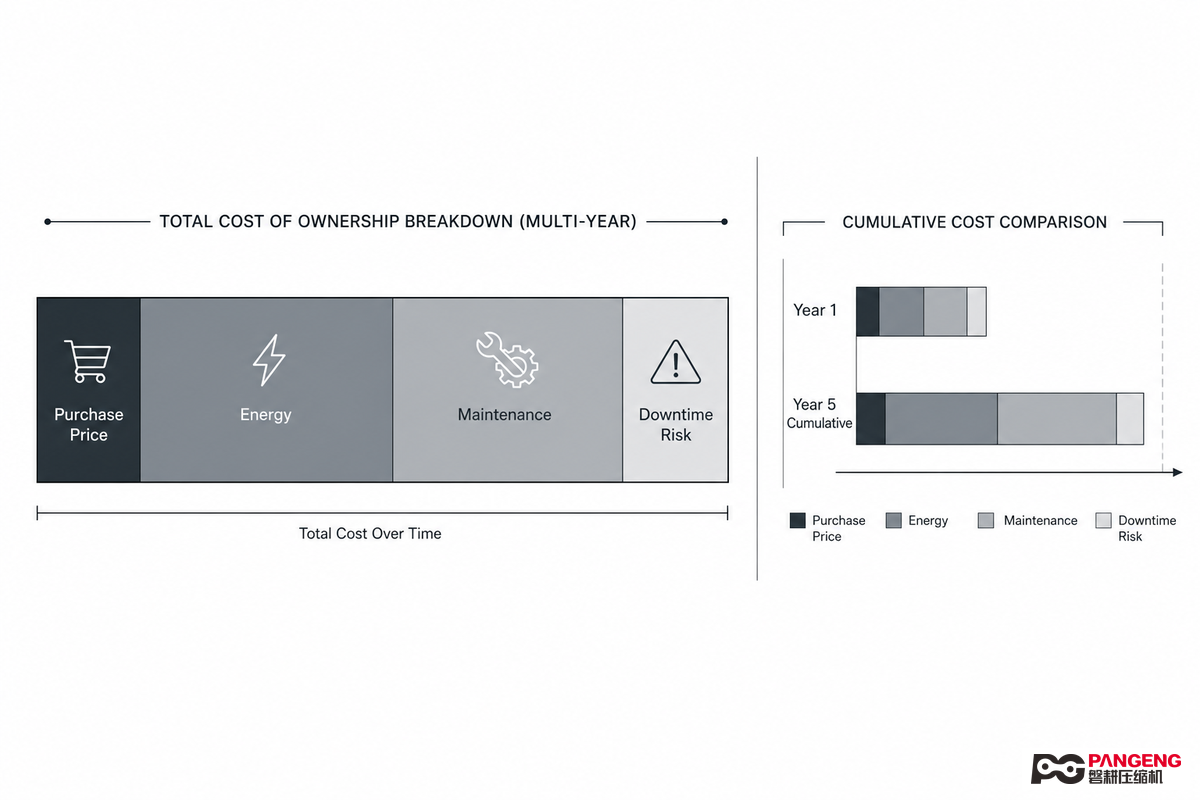
Operating nitrogen generation costs ~$0.20/100ft3 against several dollars/100ft3 for delivered cylinder or bulk liquid nitrogen- a gap wide enough that most plants consuming more than a few cylinders a month recover their generator investment in between 9 and 24 months, with a separately published industry estimate putting PSA payback at 12-14 months alone. These are different vendors measuring different fleets, so think of them as a rough band instead of a number you can quote to a controller without your own utility and usage data.
If using cylinder rental is your current baseline, compare the economics against a full rental vs. purchase calculation before adopting on-site generation. Comparing the sticker prices of PSA and membrane systems misses two real cost lines: PSA’s required refrigerated dryer and, for both technologies, the compression step that gets created nitrogen up to process pressure. A TCO calculation that counts only the generator artificially lowers the estimate of PSA’s initial installed cost, and ignores compression costs for either technology. PanGeng’s own quoting team sees this gap constantly: a buyer arrives with a budget that covers the generator alone, and the booster line item — often 20-35% on top of the generator price — becomes the thing that stalls a purchase order for weeks while finance re-approves the total.
5-year total cost of ownership — generation + compression, PSA vs membrane path:
| Cost item | PSA + booster path | Membrane + booster path |
|---|---|---|
| Generator purchase price | Higher (twin-vessel skid, controls) | Lower (compact fiber module) |
| Installation & commissioning | Includes refrigerated dryer skid | No dryer required |
| Energy (5-yr) | Lower air-to-nitrogen ratio at high purity | Rises sharply above ~98% purity target |
| Maintenance & spares (5-yr) | Annual filter/dryer service; CMS itself rarely replaced | Fiber module replacement near year 8-10 |
| Downstream compression (5-yr, both paths) | Booster sized to generator outlet + process pressure — same cost logic either way | Same |
Payback example: a facility spending $28,000/month on delivered nitrogen that switches to on-site generation at roughly $0.20/100 ft³ can plausibly cut that cost by half to two-thirds within the first year, based on the real fabrication-shop case in the next section — recompute against your own current cylinder or bulk-delivery invoice, since delivered-gas pricing varies by region and contract.
The Step Everyone Forgets, Compressing Generated Nitrogen to Process Pressure
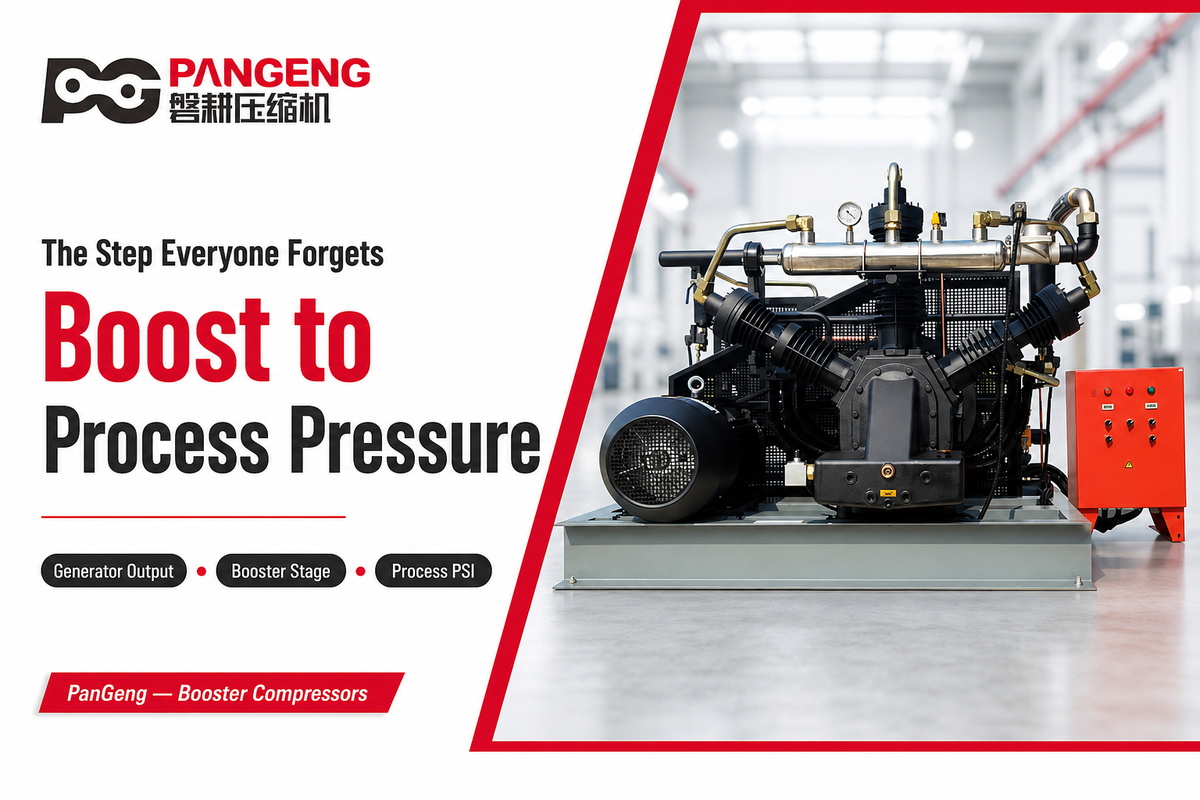
A PSA or membrane generator delivers nitrogen at roughly 0.5-1.0 MPa discharge pressure, but few processes run at that pressure. Laser cutting assist gas needs 1.5-3.0 MPa, enhanced oil injection needs 25-35 MPa, and pipeline pressure testing needs a maximum of 50 MPa- call this the generator-to-Booster Pressure Gap, and it’s the one factor that both PSA and membrane vendors in this space somehow consistently leave out. Choosing a generation technology without designing for this gap means choosing half a system- bridging it effectively depends on the 5-Point Generator-to-Booster Framework discussed in the RFQ checklist below: outlet pressure, target discharge pressure, required flow, drive type, and lubrication.
A booster compressor bridges that gap, and the compression design you select is just as important as the generation technology. PSA nitrogen generator technology pairs specifically with dual-stage twin-screw boosters designed for PSA’s higher inlet pressure range (0.1-9.0 MPa), while membrane systems usually supply single-stage screw-piston hybrids matched for their lower, steadier outlet flow.
| Parameter | Screw-piston hybrid | Pure reciprocating piston | Diaphragm |
|---|---|---|---|
| Max discharge pressure | 50 MPa | 35-45 MPa | 100+ MPa |
| Flow rate range | 200-1,200 Nm³/h | 50-500 Nm³/h | 5-100 Nm³/h |
| Purity maintained | Up to 99.99% | Up to 99.9% (oil-lubricated) | Up to 99.9999% |
| Wearing-parts interval | 4,000-8,000 hours | 2,000-4,000 hours | 8,000-12,000 hours |
Booster RFQ checklist — copy these into your quote request:
| Parameter | Recommended range | Why it matters | How to verify |
|---|---|---|---|
| Generator outlet pressure | State your actual generator’s rated outlet, typically 0.5-1.0 MPa | Sets the booster’s required compression ratio | Pull from generator datasheet, not an assumed default |
| Target discharge pressure | 1.5 MPa (laser) to 50 MPa (EOR/pipeline test) | Determines number of compression stages needed | Confirm against your process spec, not the generator’s max rating |
| Required flow (Nm³/h) | Match to generator’s rated output, not oversized | Oversizing the booster relative to generator flow causes cycling and inefficiency | Use generator nameplate flow, verified at your site altitude/temperature |
| Drive type | Electric for grid-connected sites; diesel for remote/field | Diesel adds ~15-25% cost but removes grid dependency | Confirm site power availability before quoting |
| Lubrication | Oil-free if purity spec is above 99.5% | Oil carryover permanently damages both generator and booster performance | State your minimum acceptable purity in the RFQ explicitly |
One engineering detail worth remembering: a screw-piston hybrid’s twin-screw first stage efficiently handles large inlet volumes, then passes them to reciprocating piston stages for the final pressure increase- a pure piston design struggles with PSA or membrane’s comparatively high-volume, low-pressure inlet stream, while a diaphragm compressor’s extremely high purity come at the expense of flow rate too low for most industrial boosting.
Real-World Case, Cutting Nitrogen Costs 67% at a Laser Cutting Shop
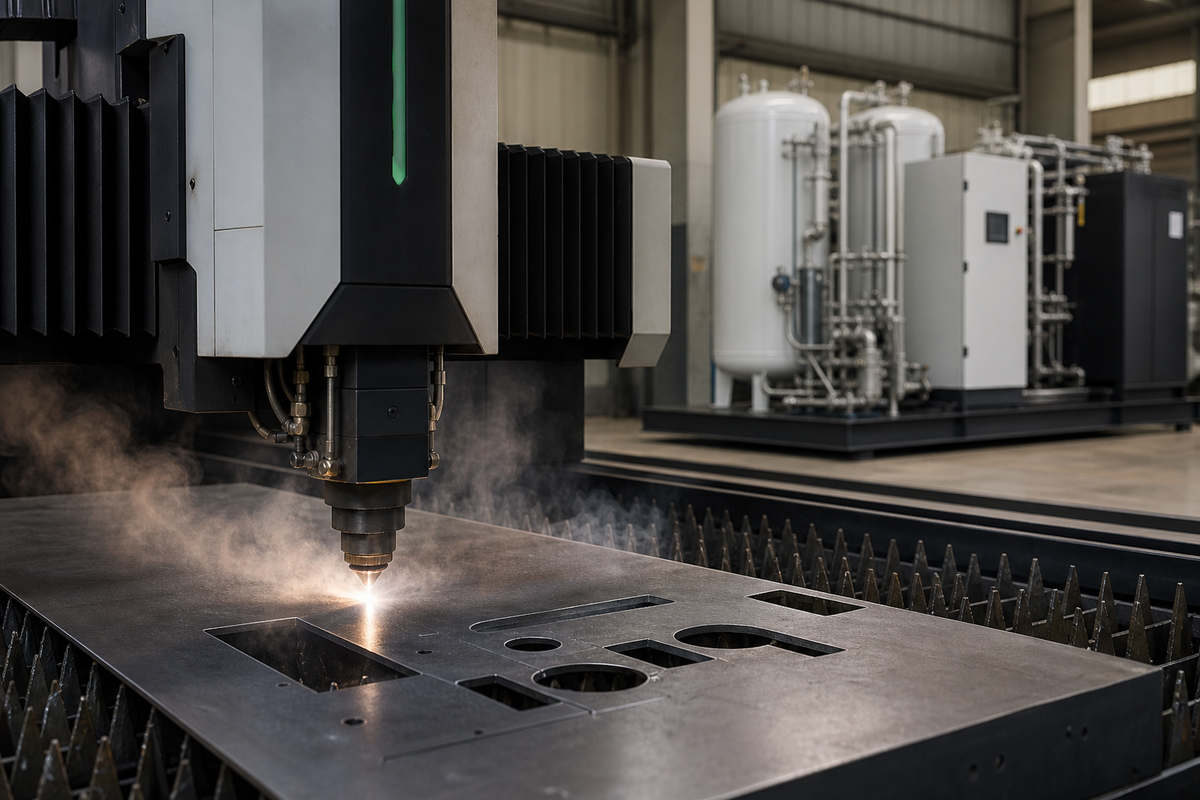
To reduce delivery delays, the team replaced monthly, over-delivery expenses of gas cylinders — some 180-plus per month — and issues related to cylinder pressure loss on deeper cutting with on-site nitrogen generation. MetalPro Fabrication LLC is a precision metal fabrication shop located in Houston that operates eight 4kW to 20kW fiber laser cutters. “Cylinder pressure loss on deeper parts in during peak hours caused cutting quality degradation on thicker materials,” explained the company. They paired a PSA generator, which delivers 99.999% purity at 7 bar / 120 Nm³/h, with a PanGeng nitrogen booster compressor rated to 300 bar, feeding eight 50-liter storage vessels to deliver enough nitrogen for all eight lasers operating at maximum cutting speeds.
The nitrogen costs monthly reduced from $28,000 to $9,200 – that’s a saving of 67%, approximately $225,600 a year, cylinder deliveries reduced to nil and the discharge pressure is a consistent 300 bar instead of the changing pressure delivered by cylinders. David Hernandez, Production Manager summarized the operation:
“We had no more cylinder deliveries, no more pressure drops during critical cuts, and operators could concentrate on producing parts instead of gas supply. The 67% reduction in nitrogen costs was great, but the system has been reliable and the support team has been responsive.”
David Hernandez, Production Manager, MetalPro Fabrication LLC
Common Mistakes When Choosing a Nitrogen Generation Technology
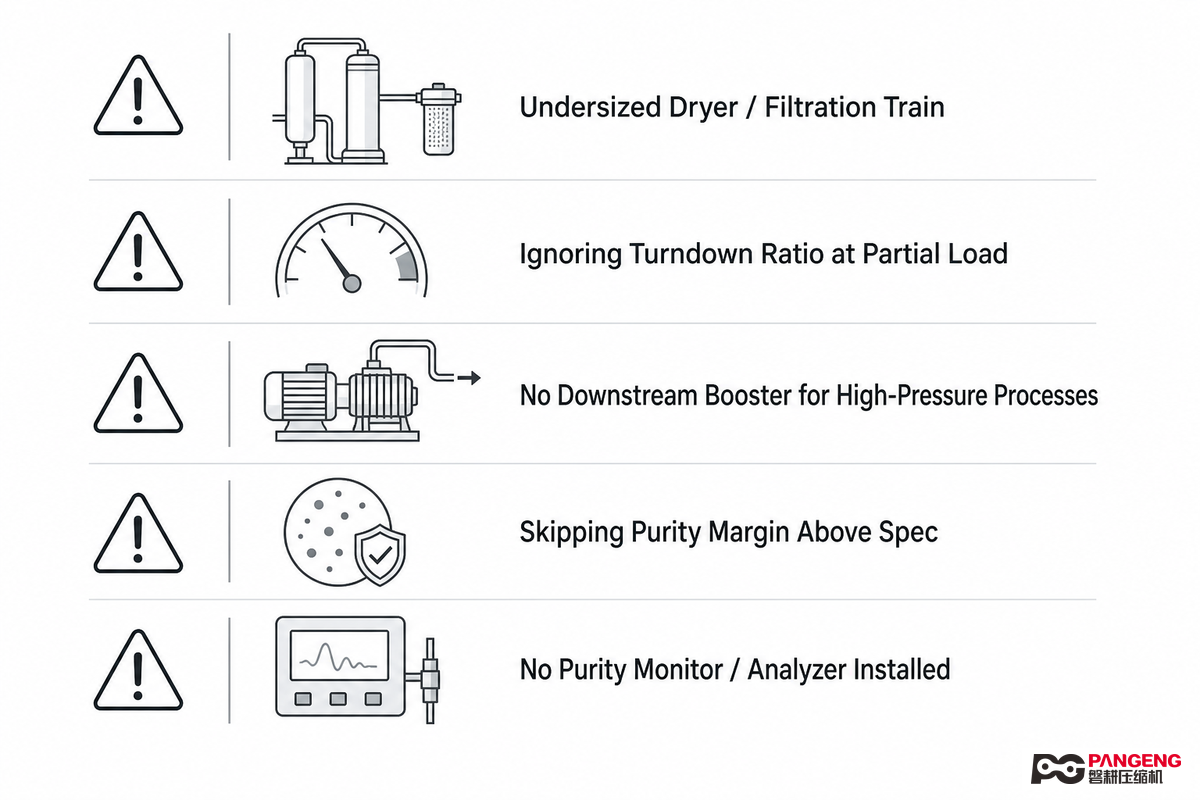
Two fundamental mistakes account for the vast majority of purity failures: sizing on steady-state numbers only and mistaking purity failures as a generator issue when in fact the issue is with the feed air. In our experience, field reports detailing a loss of purity always reference one or two factors on this short list: an inlet air pressure dropping below 0.6 MPa or a cold dryer, suction dryer or filter in a blockage or fault condition, passing moisture and/or particulate matter before it ever reaches the sieve or the membrane.
| Do | Don’t |
|---|---|
| Size the booster to your generator’s actual rated flow and outlet pressure | Size a booster off the primary compressor’s discharge pressure alone |
| Budget for a dedicated refrigerated dryer if you choose PSA | Assume PSA’s “low maintenance” claim means zero added equipment |
| Account for well shut-in or process back-pressure spikes (15-20% above steady-state) | Spec a booster for steady-state flow only |
| Verify feed-air quality (pressure, dryer, filter condition) first when purity drops | Assume a purity drop means the generator itself has failed |
| Get an independent oil-carryover check on your compressed-air feed | Skip filtration because “the compressor is oil-free-rated” |
These potential feed-air problems are mostly spotted during nitrogen compressor maintenance and log reviews and prevented before they get to the generator. Nor is an on-site generated solution inherently more reliable than delivery in cylinders; this issue is often brought up by practitioners when they compare experiences-cylinders themselves don’t always deliver at the purity spec listed on the label, and some buyers find a switch to the generator to be a step up in purity consistency, not down.
Integration & Utility Requirements
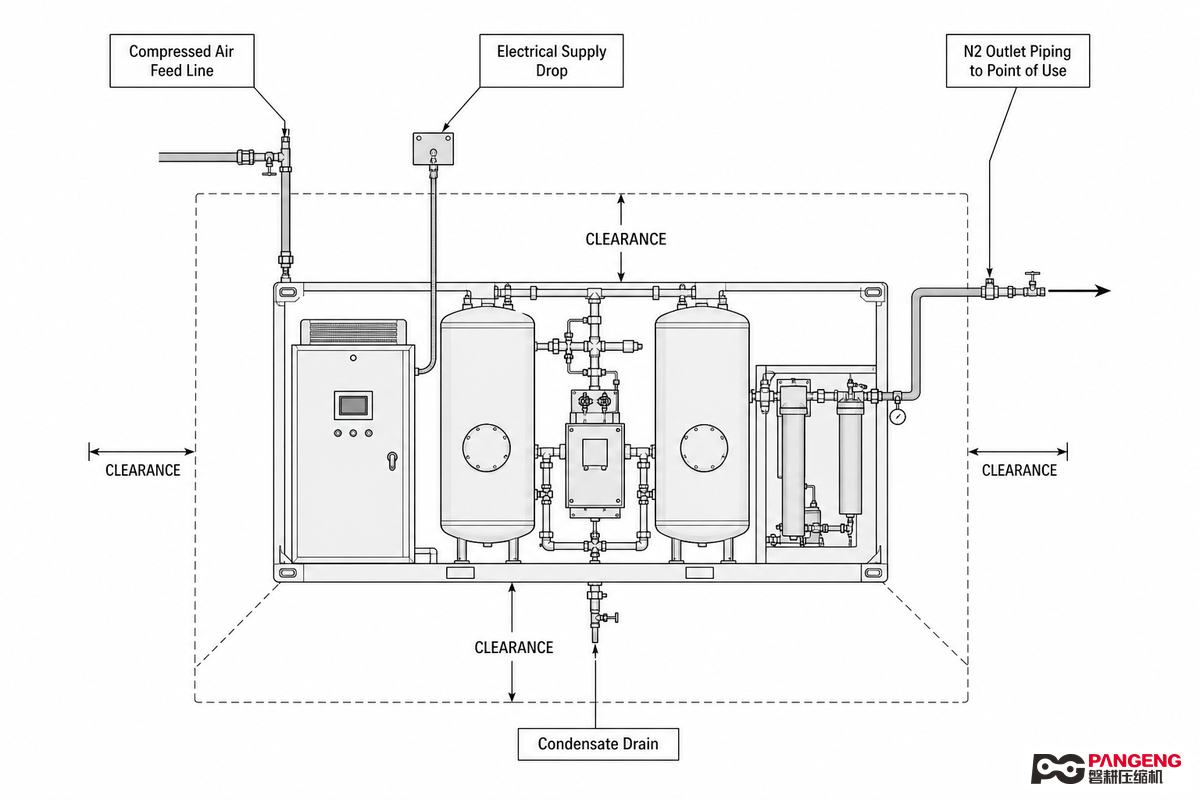
Confirm four site utility considerations before soliciting bids: electrical service capacity, the quality of your compressed-air supply, floor space and upstream/downstream pressure coordination. Your PSA system’s refrigerated dryer and control skid pull substantially more current than a comparable-flow membrane unit — the U.S. Department of Energy’s compressed-air system guidance is a useful independent reference for estimating full-load electrical draw before you commit to a design, rather than after you’ve purchased the machine.
Another integration factor often underestimated by buyers: Both PSA and membrane generators need clean, dry compressed air feed-air; any oil-flooded primary compressor supplying either technology will require an activated-carbon pre-filter (an actual budget line item, not a passive assumption). You’ll also want to factor floor space: the twin-vessel PSA skid will need substantially more room than a modular membrane of equivalent capacity, and whether you’re on the mountains or at the coast, ambient temperatures or altitudes much higher than roughly 45C can impact cooler size in the compression section no matter which technology you pick.
Buyers researching a nitrogen generator’s working principle rarely check price against utility cost in the same pass — but even a small nitrogen generator paired with a booster draws real electrical load, and PanGeng’s own field engineers routinely see quotes stall for weeks once a client’s facilities team flags a breaker panel that cannot take the added draw. Whatever generation system you land on, and however the pros and cons of PSA versus a membrane separator play out on your spec sheet, the utility checklist above does not change — confirm it before requesting a formal quote, not after equipment ships.
Which Should You Choose? Decision Framework
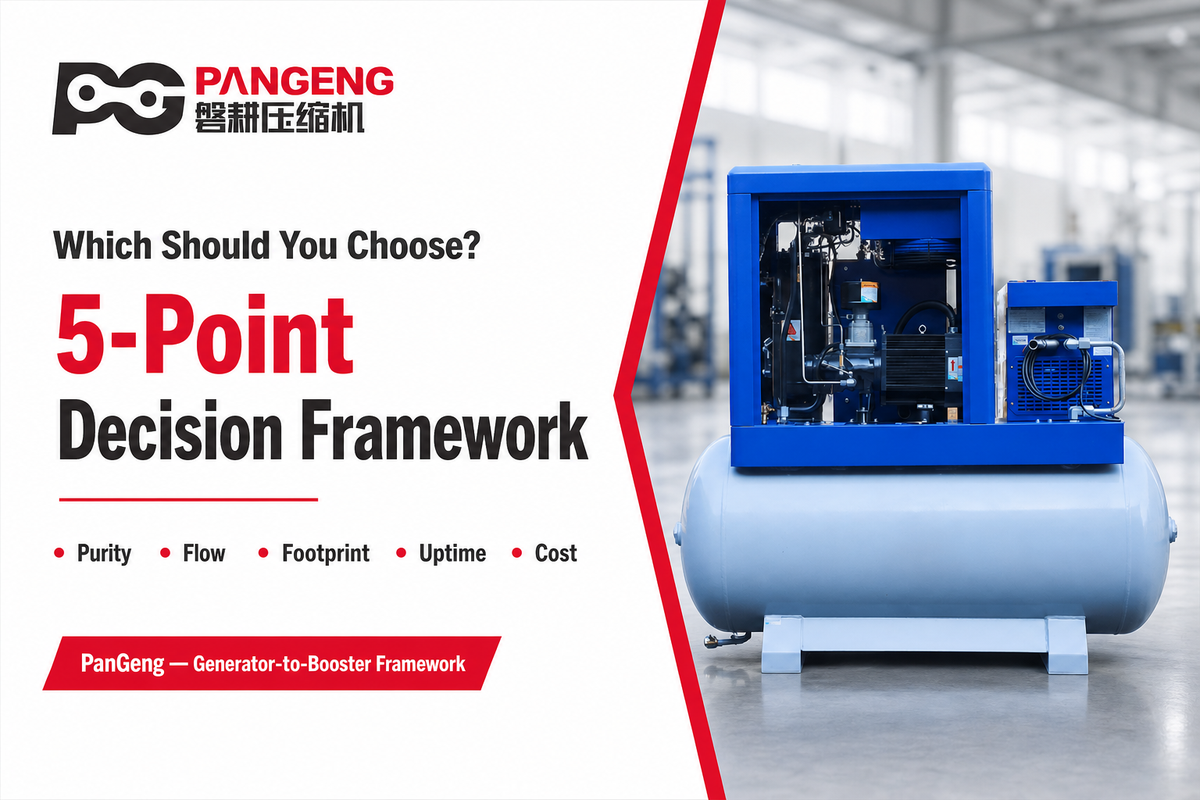
If you’re contemplating the generator selection and already operate nitrogen compression, check out our “nitrogen booster vs. nitrogen compressor” explainer; we address the closely related question directly. Simply work through the next four questions, and the appropriate technology and booster architecture will become obvious.
Selection Logic
- Above 99.5% purity? Choose PSA and plan to install a dedicated refrigerated air dryer.
- 95-99% purity and a preference for compact equipment? Select membrane and budget for new fiber-modules around years 8-10.
- Processes with output pressure >1.5 MPa (laser-cutting, EOR injection, pipeline testing)? A booster is a necessity regardless of which generator you select; properly size it for your generator’s actual output, not for what seems right.
- Are you getting deliveries? If you’re spending thousands a month on delivered cylinders, do the 5-year TCO math before jumping to on-site generation – though for most in this category, the investment pay off.
Here is how that logic plays out for a mid-size electronics manufacturer needing 99.9% purity at 400 Nm³/h for reflow-oven blanketing: question one points straight to PSA, question three confirms a booster is mandatory since the reflow line runs at 1.8 MPa, and the 5-year TCO math from the section above typically shows payback inside 18 months once the facility’s existing cylinder spend is plugged in. Buyers who skip straight to a generator quote without running these four questions are the ones who end up back on an explainer page eighteen months later, asking why a brand-new system still cannot hit their process pressure.
Whether you arrived here comparing nitrogen generator price quotes, looking for a plain psa nitrogen generator working principle explainer, a membrane nitrogen generator working principle breakdown, or a straight psa vs membrane nitrogen generator pros and cons summary, the same underlying nitrogen generation system logic applies once you add the compression step this article covers — the FAQ below rounds out the details.
Frequently Asked Questions (FAQs)
Q: What is the difference between PSA and membrane nitrogen generators?
PSA generators use a carbon molecular sieve to actively adsorb oxygen and reach higher purity; membrane generators passively filter gas through hollow fibers and reach a lower purity ceiling with fewer moving parts.
PSA (pressure swing adsorption) operates by cycling a pair of adsorption beds packed with carbon molecular sieve material, which captures oxygen, water vapor, and other contaminants while passing nitrogen to purity levels of up to 99.999%. Membrane relies on pumping the compressed air through bundles of hollow polymer fibers which permit smaller, more-permeable oxygen molecules to diffuse away from the nitrogen, exiting at the generator’s outlet at typically 95-99.5% purity. The twin PSA adsorber beds make it a higher-moving part machine than membrane, and it will require a stand-alone dryer, whereas membrane runs continuously.
Q: What purity can PSA vs. membrane nitrogen generators actually achieve?
PSA generators commonly reach 95-99.999% purity; membrane generators commonly reach 95-99.5%, though both figures vary meaningfully by manufacturer and should be confirmed against your specific unit’s datasheet.
Many users may not realize just how much manufacturers’ figures vary for each technology; some PSA data sheets quote limits as high as 99.999% purity, whereas case-study and lab tests can show real-world units delivering 99.99% purity and 93 psig output. Similar spread appears on membrane spec sheets, from the standard 95-99% range to higher (though sometimes reduced-capacity) values as high as 99.5% purity, depending on which fiber technology and output flowrate you prioritize. Because purity and flowrate have inverse relationships in both technologies, it’s always better to request the supplier’s purity vs. flowrate chart than to settle for a single “up to” number.
Q: Is PSA or membrane nitrogen generation cheaper?
Membrane systems typically cost less upfront and require less maintenance infrastructure, but PSA becomes the more cost-efficient option once your required purity climbs above roughly 98%.
At purity values up to around 98%, operating costs for membrane and PSA are quite similar. Usually, membrane has an advantage for its lower upfront equipment cost because it doesn’t require a dryer skid. Above 98% purity, membrane efficiency drops drastically, while PSA operating cost per unit remains flat, making it the cheaper solution at high purity levels, even though the equipment investment is higher. Remember to also include downstream booster compressor cost in your comparisons as this is common to both approaches.
Q: Do I still need a compressor if I already have a nitrogen generator?
Yes — almost always, unless your process runs at or below the generator’s own outlet pressure (typically 0.5-1.0 MPa), since neither PSA nor membrane generators produce nitrogen at process-ready pressure on their own.
A generator on its own seldom provides the pressures needed for oilfield injection, pipeline testing or laser cutting. These are applications that require a booster compressor to add pressure to the supply.
Q: How long do PSA and membrane nitrogen generators last?
PSA units commonly reach 20-plus years of service if kept free of moisture and oil contamination; membrane units typically run around a decade before fiber performance degrades enough to warrant replacement.
Lifespan depends heavily on contamination control for both technologies.
Q: Can nitrogen generators be used for laser cutting?
Yes — on-site nitrogen generation paired with a booster compressor is a common, cost-effective replacement for cylinder-supplied assist gas in fiber laser cutting operations, as the real-world case on this page demonstrates.
A laser cutting assist gas typically requires pressure from 1.5-3.0 MPa with a high purity value for maintaining the quality of the cut edge when cutting aluminum and stainless steel. This is far beyond the capacity of a single generator. In one application at a fabrication shop using eight fiber lasers on a PSA generator and booster system, the facility realized a 67% reduction in nitrogen costs versus delivery via cylinder, maintaining a stable 300 bar outlet pressure with simultaneous laser operation. You need to match the boost capacity and flow to your number of lasers and the thickness of material to be cut.
Q: What is the difference between PSA and cryogenic nitrogen?
Both PSA and cryogenic plants extract nitrogen from ambient air, but PSA uses molecular sieves at room temperature while cryogenic plants liquefy and distill air at extremely low temperatures.
Cryogenic air separation is a completely different, and much larger scale, technology and operates at a different capital level than PSA or membrane for on-site production. Most on-site N2 facilities fall into the PSA or membrane categories.
Q: Is a nitrogen generator worth the investment?
For most facilities spending more than a few thousand dollars a month on delivered nitrogen, yes — typical payback runs 9 to 24 months, after which ongoing costs drop to maintenance and energy only.
Your business case gets stronger as you use more nitrogen, or as your reliance on traditional supply sources such as cylinder delivery or bulk liquid tanks increases. Beyond simply paying for a unit of gas, there are additional costs such as delivery, hazmat handling and the management of large pressure or cryogenic storage tanks. If you have low or intermittent usage, you may find that cylinder delivery is more practical, but analyze your monthly N2 expense against the ~ $0.20 / 100 scf generation cost mentioned earlier on this page to understand your payback period.
References & Sources
- SBIR Award #217426, Compact Nitrogen Generator for Cold Spray and Naval SustainmentU.S. Small Business Innovation Research program
- Shivaji Sircar (1944-2020)National Academy of Engineering
- US20240174582A1, A Nitrogen Gas Generator (2024)Google Patents / USPTO filing
- Selecting a Reliable and Efficient Nitrogen Generation SystemCompressed Air Best Practices
- R&D Labs Shifting to N2 GenerationCompressed Air Best Practices
- NACE Study Estimates Global Cost of Corrosion at $2.5 Trillion AnnuallyInspectioneering
Our Perspective
PanGeng builds the compressors and boosters that sit downstream of PSA and membrane nitrogen generators, not the generators themselves, which is exactly why we wrote this comparison the way we did. The cost and case-study figures here come from our own booster deployment at MetalPro Fabrication and from published third-party sources cited above, not from a generator vendor with a purity ceiling to sell. Reviewed by the PanGeng technical team.
![Low Pressure Hydrogen Compressor Applications [Guide]](https://pgcompress.com/wp-content/uploads/2026/09/low-pressure-hydrogen-compressor-applications-blog-featured-150x150.png)