Get in Touch with Pangeng


Rotary screw vs reciprocating air compressor is the buyer’s choice between continuous rotary displacement and cyclic piston displacement for a defined plant duty. Selection starts with pressure, flow, and the plant’s real operating cycle—not a generic claim that one design always wins. Rotary screw packages often suit sustained base load; reciprocating packages can remain the better fit for intermittent, lower-flow, higher-pressure, standby, or serviceability-led duty.
Updated August 2026
Direct answer: choose rotary screw for a verified steady base load and reciprocating for a verified intermittent or pressure-led duty. Choose neither by label alone: compare model data, control states, receiver behavior, air treatment, maintenance access, and standby capacity.
Quick specification brief
- Primary gate: required pressure + required flow + operating cycle
- Energy basis: loaded, unloaded, stopped, and variable-speed states
- System boundary: compressor + control + receiver + treatment + distribution + end use
- Purchase evidence: ISO 1217 test basis, site measurements, and model-specific limits
What most comparisons miss
- A low purchase price can lose to unloaded power and downtime.
- A variable-speed drive can add losses when demand is steady.
- A receiver and master controller can change the preferred fleet.
- Delivered-air purity is a separate specification from compressor type.
Rotary Screw vs Reciprocating Air Compressor at a Glance
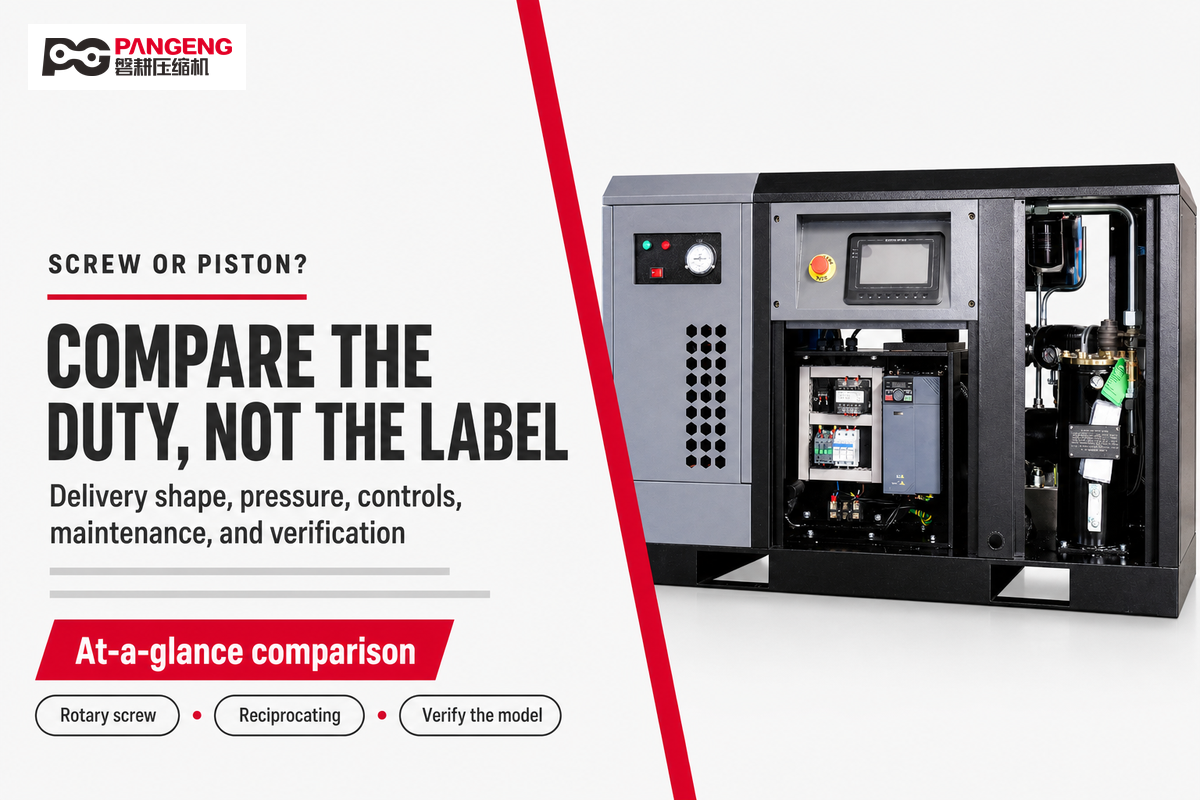
Both machines compress the air by positive displacement: rotary screw compressors use intermeshing rotors, while reciprocating compressors use piston strokes and valves. That mechanical difference affects delivery smoothness, pressure range, cycling, vibration, and service work, but it does not establish energy cost or plant fit without model and system data.
The University of Michigan compressor overview describes screw machines as positive-displacement equipment sized by flow and pressure, and reciprocating machines as cyclic positive-displacement devices. It also identifies a useful boundary: reciprocating equipment remains relevant for low-to-moderate flow and higher required discharge pressure, while screw performance is sensitive to operation away from its designed pressure ratio.
Broad rotary vs reciprocating compressor discussions often use category labels. “Piston compressor” describes a reciprocating or piston-type air compressor that draws air into the cylinder and displaces air in one stroke after another; helical screws in a rotary screw unit create a stream of compressed air. In both types of compressor, air is compressed by positive displacement. Both rotary screw and reciprocating compressors can compress air at the same specified pressure only when their model data allows it. Rotary air compressors may produce air continuously, while reciprocating compressors produce air intermittently for short bursts of air. Those differences between reciprocating and rotary mechanisms do not decide which type of air compressor fits the plant.
| Decision dimension | Rotary screw | Reciprocating | Verification required |
|---|---|---|---|
| Compression event | Continuous rotor displacement | Cyclic piston displacement | Manufacturer cutaway and data sheet |
| Typical shortlist role | Sustained base-load air | Intermittent, standby, or pressure-led air | Measured demand profile |
| Air delivery | Steady displacement | Pulsating displacement | Point-of-use pressure trace |
| Control question | Fixed speed, load/unload, or VSD | Start/stop, load/unload, staged capacity | Loaded/unloaded/stopped hours |
| Pressure question | Check design pressure ratio | Check stages, cooling, and valve limits | Rated flow at required pressure |
| Maintenance shape | Fluid, filters, separator, airend, controls | Valves, rings, cylinders, bearings, controls | OEM task list and parts lead time |
| Receiver role | Control stability and transient support | Pulse smoothing and cycle management | Storage model and pressure band |
| Air quality | Oil-injected or oil-free package | Lubricated or oil-free package | Point-of-use purity test |
| Cost evidence | Measured power and service scope | Measured power and service scope | Same tariff, hours, horizon, and downtime method |
| Not suitable for | Unverified low-load or off-design operation | Duty beyond the model’s thermal rating | Written vendor exceptions |
Pressure, Flow, and Duty Cycle Form the First Selection Gate
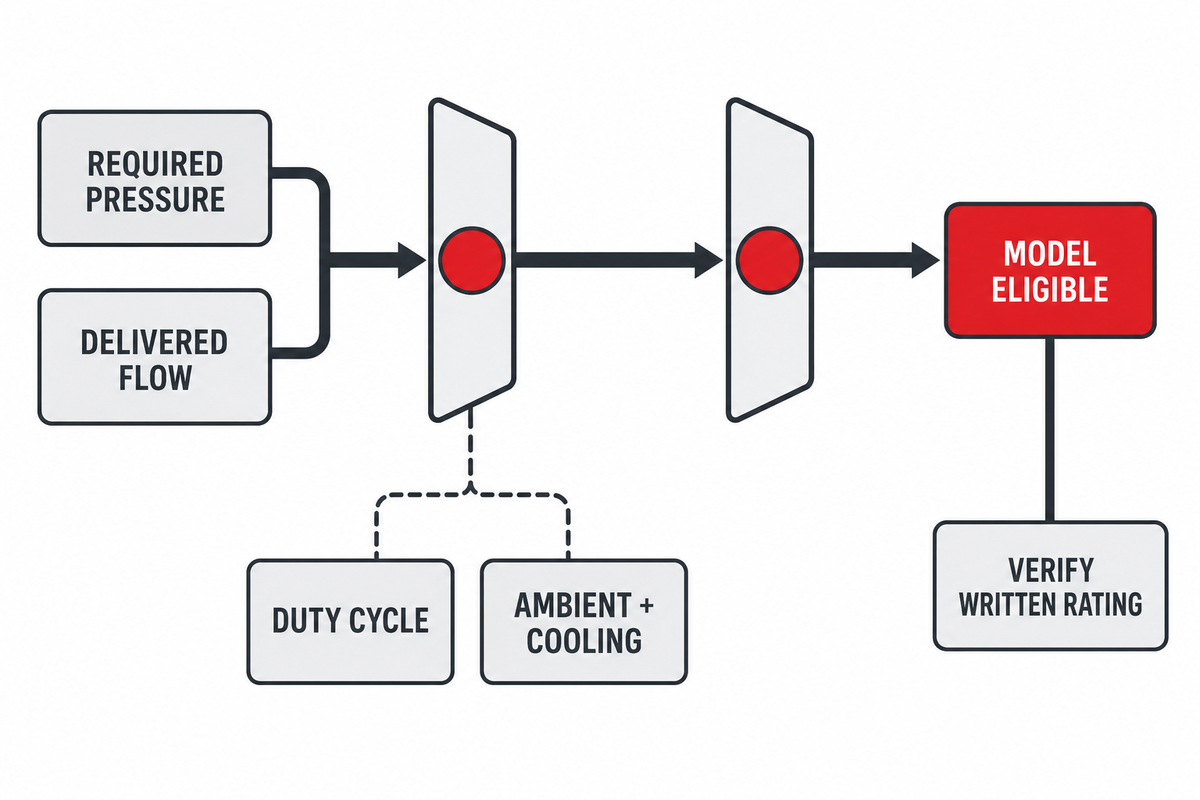
Required discharge pressure and delivered flow establish candidate eligibility; duty cycle then tests whether it can sustain the plant’s run/rest pattern under real ambient and cooling conditions. Generic percentages printed in comparison pages can’t replace the manufacturer’s rating at the required pressure, flow, temperature, and control state.
Use the ISO 1217:2009 acceptance-test scope to explore how volume flow and power were measured. It is a test basis, not an in-service promise. Ask each vendor for rated flow at your discharge pressure, inlet condition, cooling arrangement, and expected ambient range.
If a proposal says the unit can compress air to 120 psi, verify its rated flow at that pressure instead of assuming either compressor family qualifies.
What duty cycle can a reciprocating air compressor handle?
Reciprocating compressors can address only the duty specified for each model and configuration. Single-stage, two-stage, air-cooled, water-cooled, small-shop, and engineered industrial packages don’t share one percentage. Record the longest continuous run, starts per hour, loaded minutes, unloaded minutes, stopped minutes, ambient temperature, and required recovery time, then compare those values with the vendor’s written rating.
Do
- State pressure and flow on the same reference basis
- Record the longest continuous event
- List ambient and cooling conditions
- Ask for starts-per-hour and thermal limits
Don’t
- Copy one category-wide duty percentage
- Compare free-air flow at different pressures
- Treat unloaded running as zero power
- Ignore recovery and receiver behavior
Match the Machine to the Plant Demand Profile
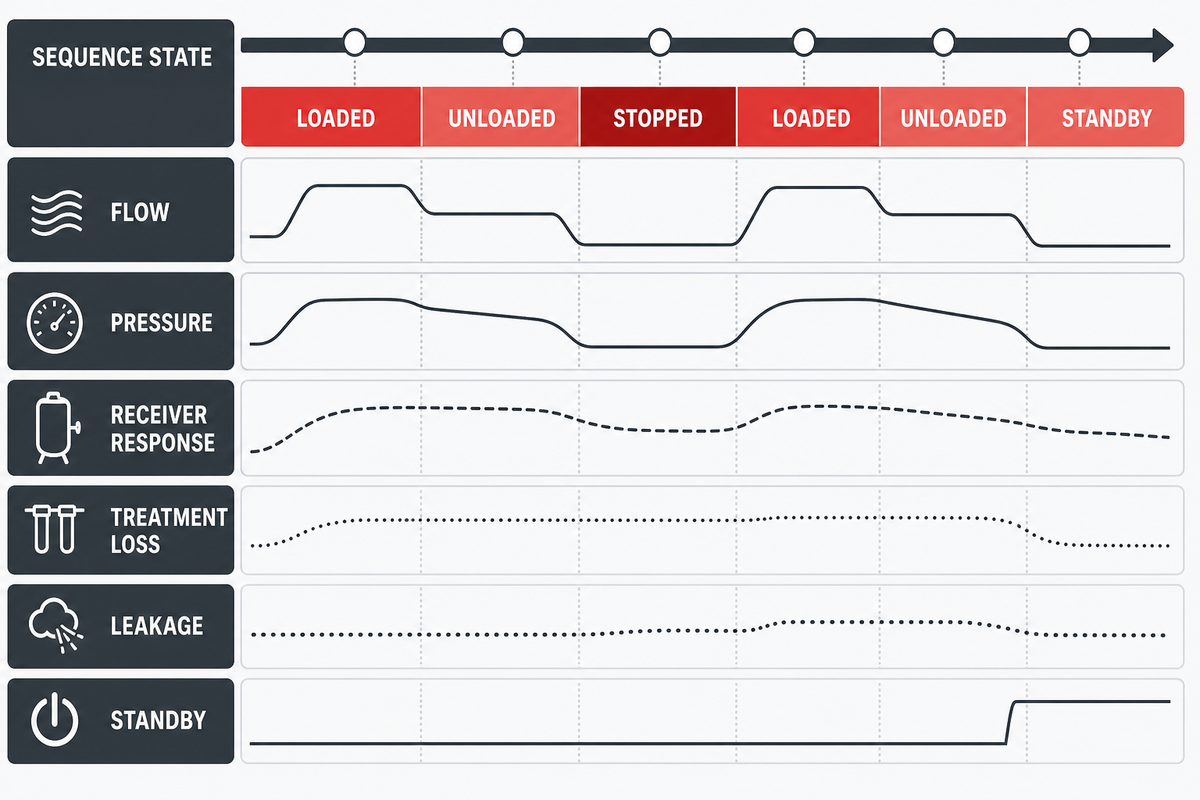
Measured compressed-air operating profiles turn a category argument into a plant decision. Capture flow and pressure with compressor states, storage response, treatment losses, leakage, and standby events over a representative production cycle. Sampling must include normal shifts and the peaks that drive capacity; no fixed number of days fits every plant.
In a supplier-authored Air Best Practices article, Neil A. Mehltretter of Kaeser Compressors explains that the preferred profile measures demand downstream of treatment and dry storage, then pairs it with compressor operating signals, power, and system pressure. That distinction matters: storage charging can look like end-use demand when the meter is placed on the supply side.
“Variable speed control for air compressors is not the panacea for compressed air system efficiency.”
| Operating-profile field | Unit or state | Why it changes the decision | Your measured value |
|---|---|---|---|
| Average demand | scfm or Nm³/h | Sizes the sustained base load | Enter measured value |
| Peak demand | scfm or Nm³/h + duration | Tests storage and trim capacity | Enter measured value |
| Minimum point-of-use pressure | psig or bar(g) | Prevents supply pressure from hiding distribution loss | Enter measured value |
| Longest continuous run | minutes or hours | Tests thermal duty | Enter measured value |
| Loaded / unloaded / stopped | minutes or % of logged time | Separates useful air from idle loss | Enter measured value |
| Receiver response | pressure versus time | Shows whether storage can serve short peaks | Enter measured value |
| Dryer purge and pressure drop | flow + psid/bar | Exposes treatment demand | Enter measured value |
| Leakage estimate | flow during non-production | Avoids buying capacity for waste | Enter measured value |
| Standby requirement | N, N+1, or planned outage | Prices the cost of unavailable air | Enter measured value |
| Sequence state | base, trim, standby | Tests a mixed fleet | Enter measured value |
Flow Stability, Pressure, and Receiver Strategy
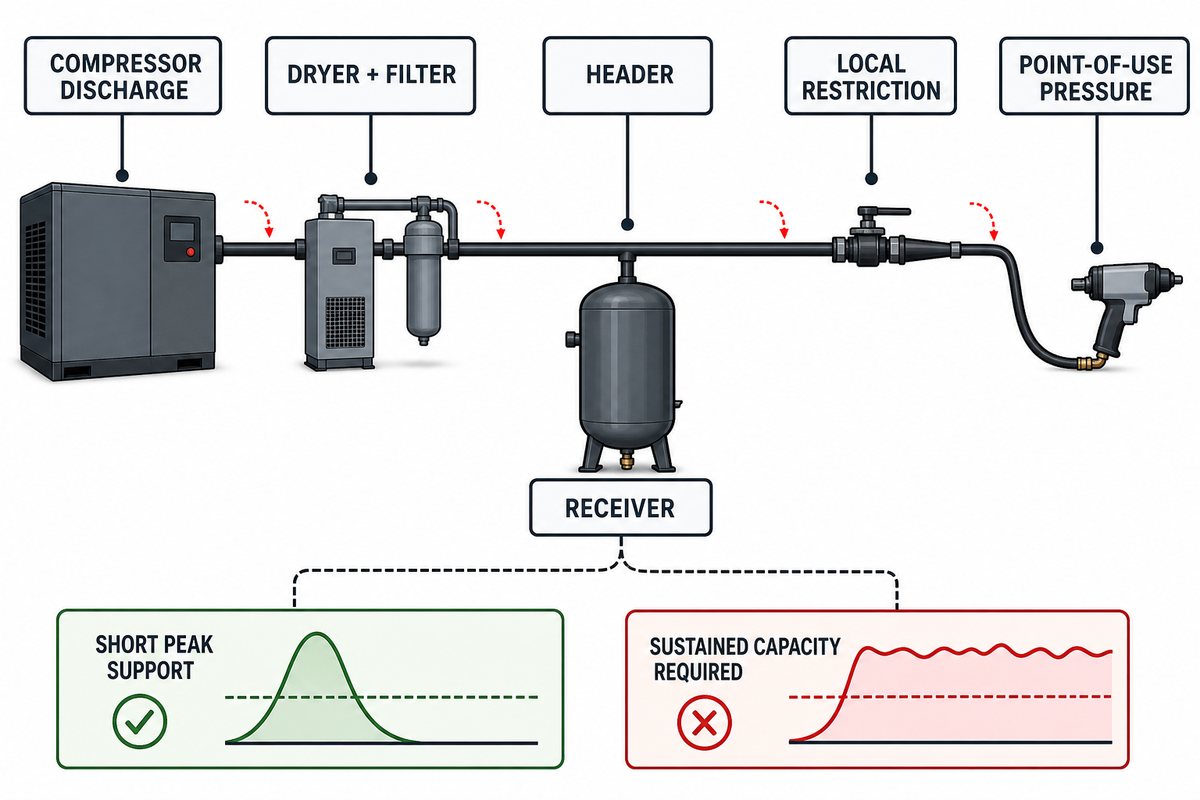
Rotary screw packages normally offer smoother displacement, whereas reciprocating packages cause cyclic flow that piping and storage must absorb. Plant decisions are not “tank or no tank.” Rather, test whether available storage, control band, distribution loss, and compressor response can keep the minimum pressure at the end use during each demand event.
The U.S. Department of Energy compressed-air library treats storage, controls, pressure stabilization, air quality, maintenance, and end-use efficiency as separate system topics. That is the correct boundary for a comparison: the machine creates supply, while the system determines what reaches production.
What size air compressor do I need for air tools?
Sum the simultaneous tool flow on a consistent reference basis, then add measured leakage and any justified growth allowance. Check the minimum pressure at the tool, not only the compressor discharge. Receiver storage can cover a short peak, but sustained demand still requires compressor capacity. PanGeng’s air compressor sizing calculator can organize initial inputs; a supplier must still confirm the final package.
Air pressure at the point of use depends on the whole air supply. Track the flow of compressed air, air storage response, air use, leakage, and treatment loss. A large volume of compressed air in a receiver can support a short event; it does not replace the required continuous air capacity. Record the volume of air and flow of air on the same reference basis, including when air is needed and how much compressed air each coincident end use demands.
Natural Resources Canada’s compressed-air reference guide notes that a typical dryer pressure drop is 3 to 5 psi and that undersized dryers can be higher. Use that range as a diagnostic prompt; the quoted dryer and filter data still govern.
Pressure rule
Record compressor discharge pressure, dryer and filter pressure drop, header pressure, and minimum point-of-use pressure at the same timestamp. Raising the whole plant because one end use has a local restriction is a system fault, not a compressor-type advantage.
Energy Cost Depends on the Load Profile
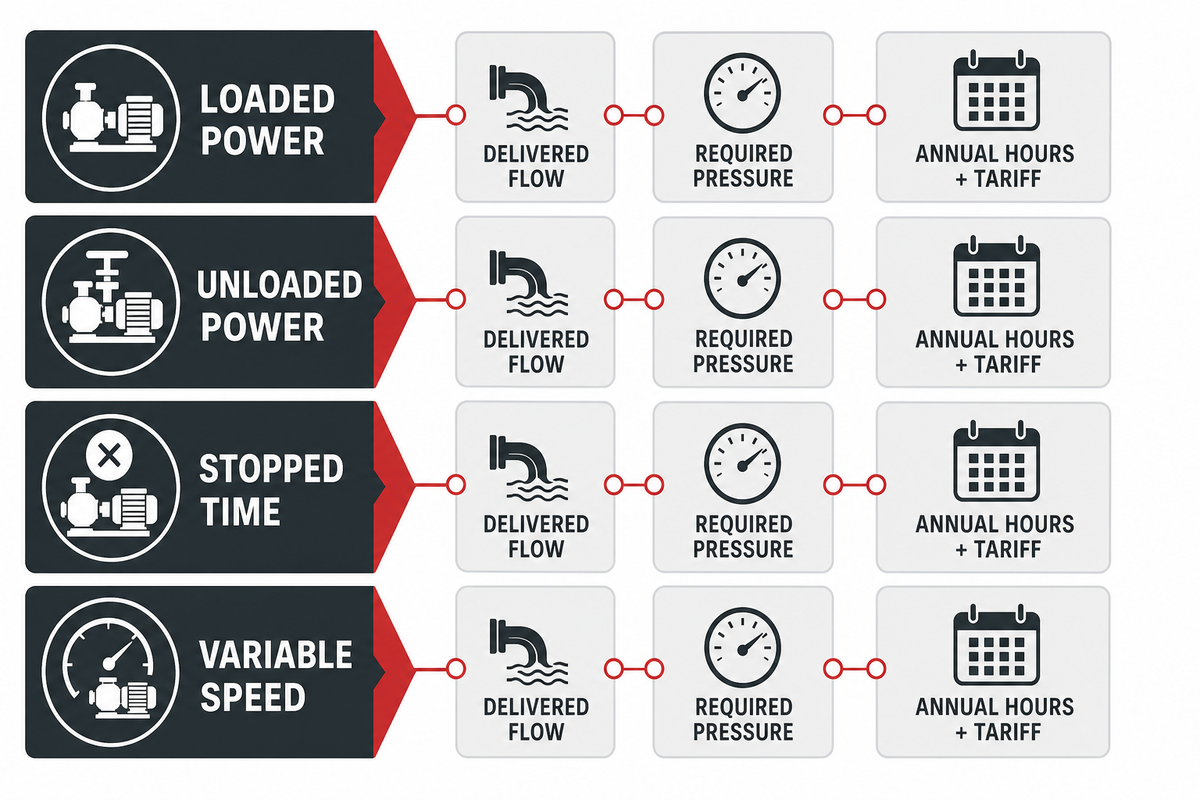
Energy cost follows operating state, not the screw-or-piston label by itself. Compare full-load power, unloaded power, stopped time, delivered flow, pressure, motor efficiency, annual hours, and electricity tariff. Variable-speed machines can help a changing load, while correctly sized fixed-speed base-load units can be better at steady demand.
Reciprocating compressor vs screw compressor efficiency must be measured at the required flow and air pressure rather than inferred from the compressor label.
When air is continuously required, a well-selected base-load machine may run for long periods, but that does not prove a screw package must run longer than reciprocating equipment between service events. The efficiency of reciprocating machinery compared to rotary equipment depends on measured operating states. Compared to reciprocating machines, a screw package may deliver smoother flow; compared to rotary screw packages, a piston machine may suit pressure-led intermittent duty. Piston and rotary designs still need the same power-at-flow comparison. Include fixed-speed rotary, variable-speed, start/stop, load/unload, and sequenced bids where relevant.
The advantages of rotary screw compressors are most credible when their continuous-duty packaging and smoother delivery match the measured load. Rotary screw compressors are designed in many control and lubrication configurations, so category language cannot replace a data sheet. High-pressure air at lower flow may instead keep a properly rated reciprocating design on the shortlist.
The Oak Ridge National Laboratory MEASUR calculator separates loaded and unloaded annual cost. Its method uses full-load power, annual hours, loaded fraction, electricity rate, loaded and unloaded motor efficiency, and the machine’s unloaded-power fraction. This is stronger than multiplying motor nameplate power by annual hours.
In a supplier-authored Air Best Practices article, Mark Krisa of Ingersoll Rand warns that the familiar “power per psi” shortcut is an estimate, not a law. Internal package losses and motor power factor can distort the result. Measure actual kW when possible; amperage alone can make a pressure project look better than it is.
Which compressor is more energy-efficient?
Whichever compressor produces the required air at the required pressure with lower measured energy over the real load profile is more efficient for that plant. Start/stop reciprocating units may beat under-loaded screw packages in intermittent duty. Rotary screw units may win at sustained flow. Sequenced fleets may beat both single-machine choices.
Worked energy example, replace every input
For this hypothetical calculation, assume Bid A draws 30 kW loaded and 9 kW unloaded. Over 4,000 h/year at 60% loaded and 40% unloaded, annual energy is (30 × 2,400) + (9 × 1,600) = 86,400 kWh. At $0.12/kWh, the annual electricity scenario is $10,368. These are invented worksheet inputs that demonstrate the method; they do not describe a real bid or compressor family.
Maintenance Burden and Downtime Risk
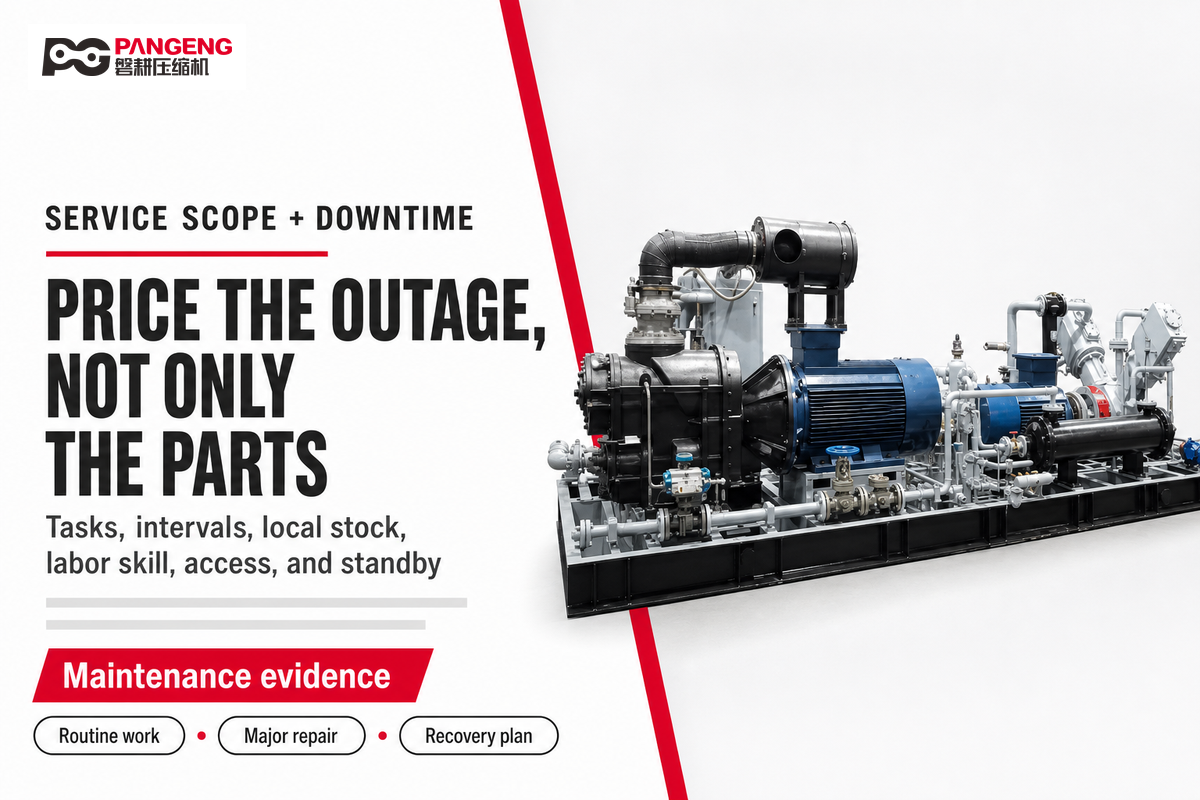
Maintenance comparison needs a task list, interval basis, parts lead time, labor skill, and outage consequence for each quoted model. Reciprocating packages expose valves, rings, cylinders, and cyclic forces; screw packages expose fluid, separators, airend bearings, controls, and heat-management needs. Neither list predicts downtime until the plant prices access and standby.
Natural Resources Canada’s compressed-air reference guide places maintenance beside energy, installation, treatment, and other system costs. Use those categories to normalize vendor service scopes rather than treating purchase price as the whole comparison.
Useful vendor comparisons ask the same questions: Which tasks are performed at operating-hour intervals? Which require a shutdown? Which parts are stocked locally? What condition triggers a major repair? How long can production tolerate unavailable air? Those answers may favor a technically simpler reciprocating package at a remote site or a base-load screw package with local service support.
Field-language signal
Machine-shop discussions repeatedly distinguish full load, unloaded idle, and complete stop. They also tie screw economics to sustained demand. Treat that as a prompt to measure the states, not as a substitute for model data.
| Maintenance evidence | Rotary screw bid | Reciprocating bid | Buyer consequence |
|---|---|---|---|
| Routine task list | Vendor entry | Vendor entry | Labor and consumables |
| Major service trigger | Vendor entry | Vendor entry | Planned outage |
| Local parts stock | Days | Days | Inventory or downtime |
| Required technician | Skill / certification | Skill / certification | In-house or outsourced |
| Standby plan | N, N+1, rental | N, N+1, rental | Production exposure |
Installation and Air Quality Constraints That Change the Decision
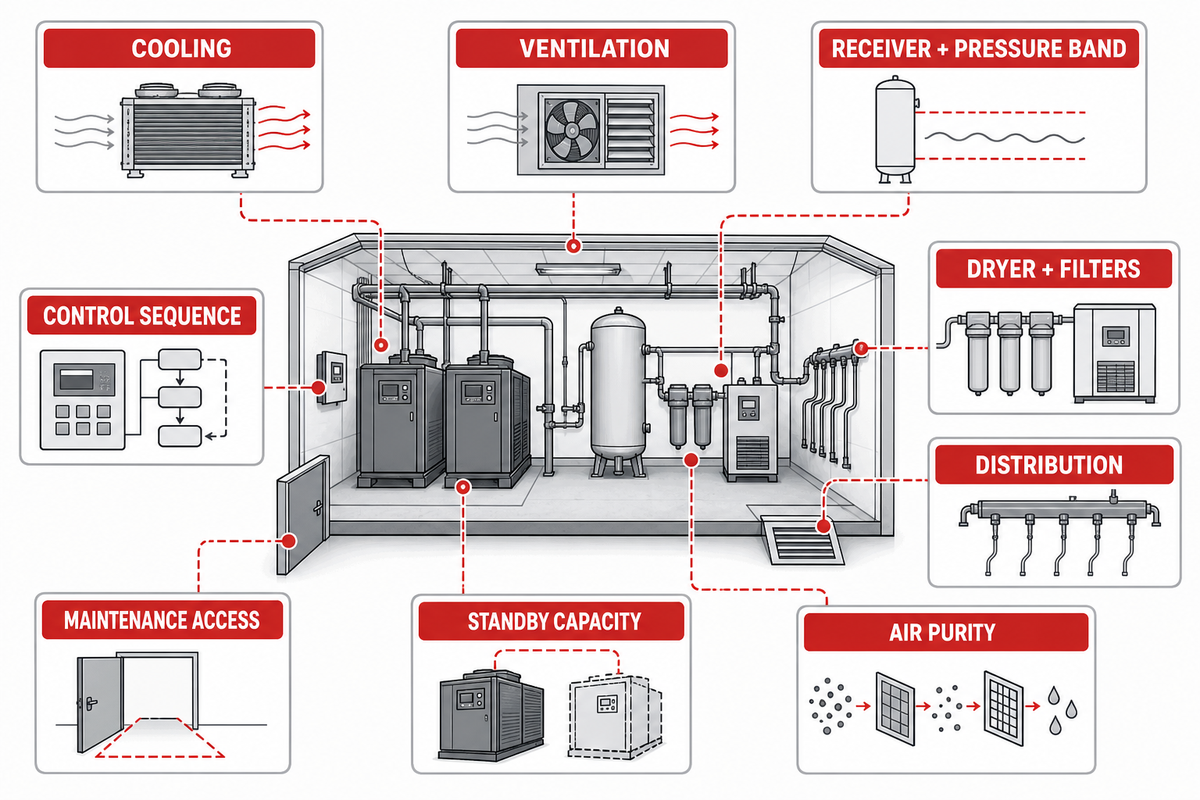
Heat rejection, ventilation, noise, vibration, foundation, access, treatment, drains, storage, and point-of-use purity can overturn the machine shortlist. Combine compressor and auxiliary layout before comparing floor space or price. Compact packages that force larger dryers, difficult service access, or higher room temperature may become the larger plant solution.
Peer-reviewed compressed-air research treats compressors, controls, dryers, filters, receivers, piping, storage, and end uses as an interacting system. That evidence supports a Hidden Bottleneck Map: the preferred compressor can still fail the project if the room, treatment train, storage, or distribution network remains the binding constraint.
| Hidden bottleneck | Evidence to collect | What it can change | Not suitable when |
|---|---|---|---|
| Cooling air or water | Heat rejection + ambient range | Room ventilation and package cooling | Rejected heat cannot leave the room |
| Receiver and pressure band | Pressure/time trace | Cycling and peak response | Storage cannot cover the event |
| Control sequence | Base/trim/standby logic | Fleet mix | Machines fight within overlapping bands |
| Dryer and filters | Purge, kW, pressure drop | Capacity and energy | Treatment consumes the margin |
| Distribution | Header-to-tool pressure loss | Discharge setpoint | Local restrictions drive plant pressure |
| Maintenance access | Clearances and lift path | Building layout | Major parts cannot be removed |
| Standby capacity | Critical-load list | N+1 or rental plan | One outage stops production |
| Air purity | Point and class to verify | Compressor + treatment architecture | No validation method exists |
Air quality is a separate specification
The ISO 8573-1:2010 public scope classifies particles, water, and oil independently of where compressed air is specified or measured. Write the required purity class, measurement location, treatment train, and validation responsibility into the request. Do not assume “oil-free compressor” alone proves point-of-use purity, and do not use “Class 0” as a marketing synonym.
Clean air is a system outcome. Screw compressors can deliver clean air only with suitable intake conditions, treatment, distribution, and verification; a different oil path does not automatically mean cleaner air. State compressed air needs as a purity class at the defined measurement point.
Build a Five-Year Cost Scenario, Not a Price Shortcut
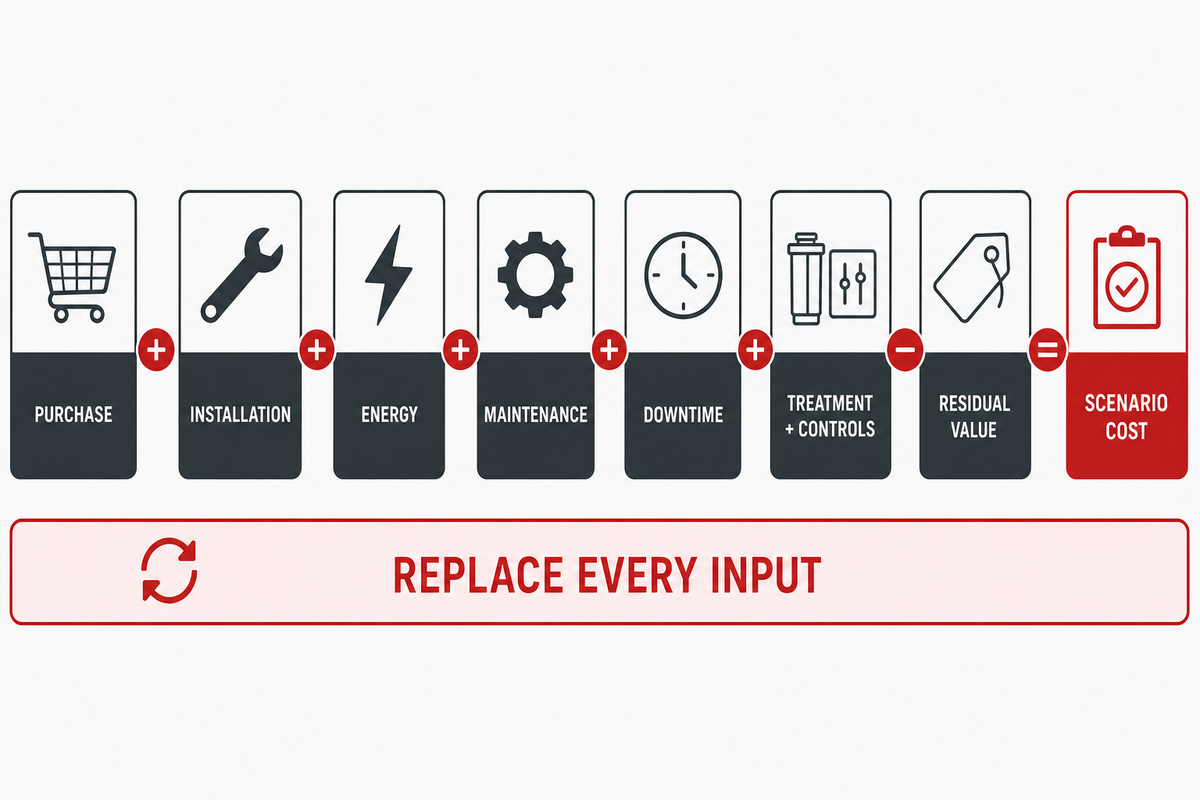
Five-year comparisons are declared study scenarios, not automatically lifetime total cost of ownership. Normalize purchase, installation, state-based electricity, maintenance, auxiliaries, downtime, replacement, disposal, and residual value under one tariff and one operating profile. Replace the five-year horizon when the plant’s ownership or depreciation period is different.
Rotary screw vs reciprocating air compressor cost depends on the quoted package, measured operating profile, service scope, and study horizon.
Natural Resources Canada’s compressed-air reference guide uses a ten-year example to show why electricity and maintenance can dominate acquisition. More importantly, it includes water, sewer, cooling, pumping, treatment, dryer, filter, storage, pressure, and end-use effects. Those categories belong in the buyer’s model even when the exact shares differ.
Adjustable-Horizon Duty-Cycle Cost Scenario
Illustrative five-year cost scenario — replace every cell:
| Cost item | Bid A | Bid B |
|---|---|---|
| Purchase | $18,000 | $12,000 |
| Installation and commissioning | $6,000 | $7,000 |
| Energy for 5 years | $51,840 | $50,880 |
| Maintenance and spares | $7,500 | $10,000 |
| Downtime allowance | $5,000 | $8,000 |
| Treatment and controls | $4,000 | $6,000 |
| Replacement / overhaul exposure | $0 | $0 |
| Disposal less residual value | −$2,000 | −$1,000 |
| Scenario total | $90,340 | $92,880 |
Worked result: Bid B saves $6,000 at purchase but costs $2,540 more over this illustrative five-year scenario. The conclusion changes when any input changes. Replace the tariff, power states, hours, service plan, downtime rate, horizon, and residual value before using the table.
Industrial Duty-Cycle Crossover Boundary
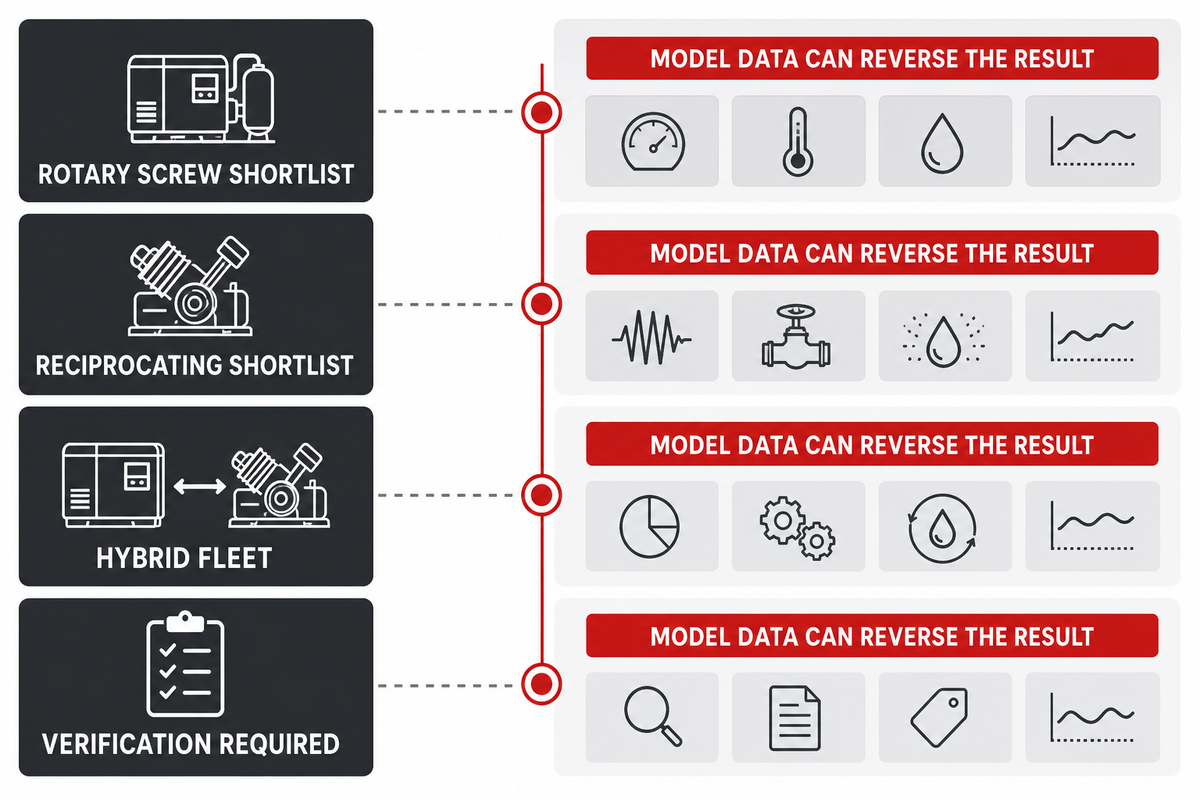
The Industrial Duty-Cycle Crossover Boundary converts plant conditions into a shortlist, not a final award. It gives rotary screw, reciprocating, hybrid, or verification-required outcomes, then names the evidence that can overturn each result. That last column is essential: category guidance must yield to the quoted model’s data and measured plant profile.
The U.S. Department of Energy compressed-air systems library separates controls, storage, pressure, maintenance, air quality, and end uses. Keeping those system constraints visible prevents a compressor-family shortlist from hiding the evidence that may reverse it.
| Plant condition | First shortlist | Why | Limitations / not suitable for | Verification required |
|---|---|---|---|---|
| Stable multi-shift base load | Rotary screw or efficient base-load bid | Steady demand favors sustained operation | Off-design pressure or poor cooling | Measured specific power at duty point |
| Short, infrequent demand | Reciprocating or start/stop package | Avoids long unloaded running | Duty beyond model thermal rating | Starts/hour and recovery trace |
| Stable base load plus sharp peaks | Hybrid base + trim + storage | Separates sustained and transient work | Uncoordinated pressure bands | Master-control sequence simulation |
| Wide variable demand | VSD trim plus base-load review | Speed control can follow variation | Steady operation outside efficient speed band | Power/flow curve and drive losses |
| Higher pressure, lower flow | Reciprocating / verify | Staging can suit pressure-led duty | Excess pulsation, cooling, or maintenance burden | Stage data, valve limits, pulsation control |
| Tight point-of-use pressure band | Verify control + storage first | Distribution and controls may dominate | Local restriction mistaken for supply shortage | Synchronized pressure trace |
| Critical production with no outage tolerance | N+1 fleet / verify | Availability outranks unit efficiency | Single machine without rental path | Failure mode and recovery plan |
| Remote site with limited specialist service | Serviceability-led comparison | Parts and labor can dominate downtime | Complex package without local support | Parts stock and technician response |
| Strict delivered-air purity | Verify compressor + treatment architecture | Purity is measured at a defined point | Unverified “oil-free” or “Class 0” label | ISO 8573-1 class, location, test method |
Is rotary screw always better than reciprocating?
No. Rotary screw equipment is often the first shortlist for sustained industrial base load, yet it can lose when demand is too low, pressure is off design, controls are poor, or specialist service is unavailable. Reciprocating equipment can remain credible for intermittent, standby, lower-flow, pressure-led, or field-serviceable duty. A hybrid fleet can be better than either forced binary answer.
Key takeaway
The winning bid is the model-and-system combination that meets pressure, flow, operating-state, purity, maintenance, and availability requirements at the lowest verified cost—not the compressor family with the strongest brochure.
Build the RFQ Around the Duty, Not the Compressor Label
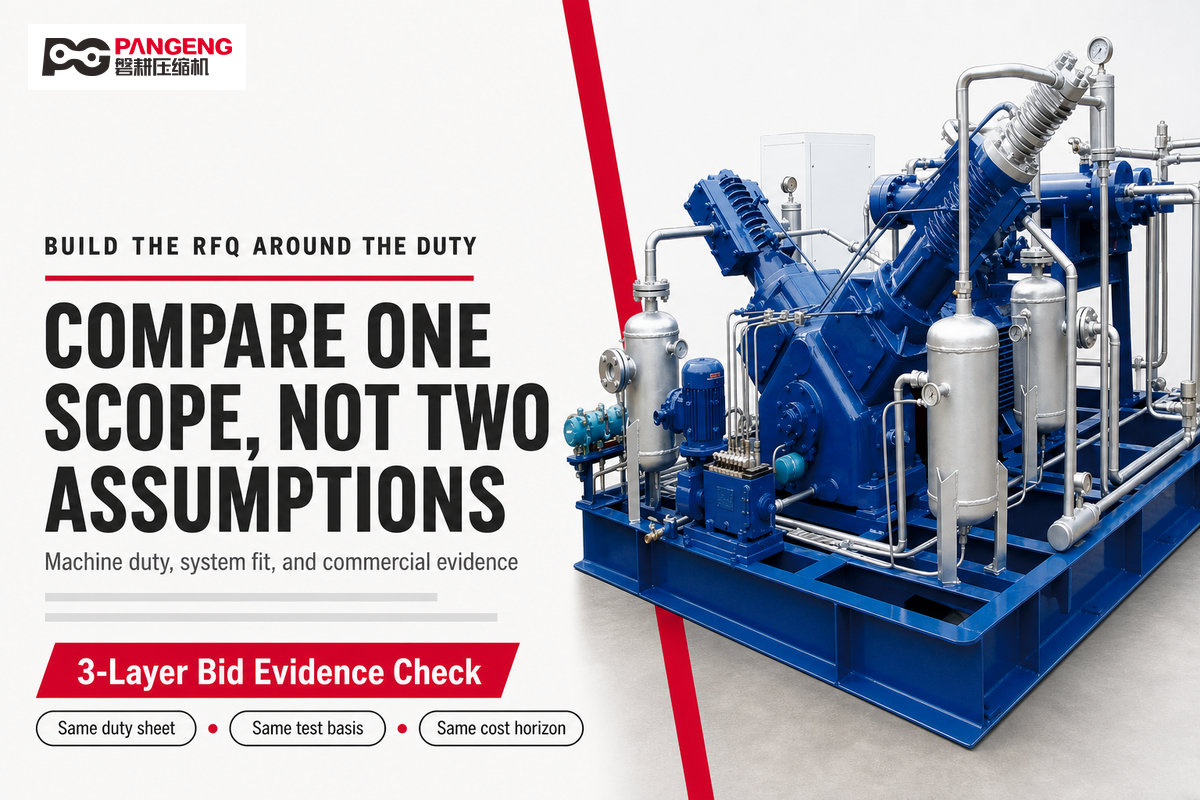
A fair request for quotation gives every vendor the same pressure, flow, reference conditions, operating states, environment, power, air-quality, control, storage, redundancy, test, and documentation requirements. That normalized duty prevents suppliers from pricing different assumptions and lets procurement compare two packages without mistaking a lower scope for a lower cost.
Choosing the right air compressor means selecting a compressor for your application, not merely choosing a category. Ask each vendor to nominate a reciprocating or rotary screw model and explain whether a rotary screw or reciprocating air package is the right air compressor for your application. A screw or reciprocating air compressor bid should state when air is needed, the required volume of air, and whether the plant needs a new air compressor or a sequenced addition. Compare reciprocating and rotary screw compressors on that same duty sheet; “reciprocating or rotary” is only the start of the decision.
Start with PanGeng’s industrial air compressors hub to identify the relevant package families, then send the same duty sheet to each bidder. The rotary screw and reciprocating product pages can supply model options, but the bid must answer the plant profile.
3-Layer Bid Evidence Check
Screen each bid in three layers: machine duty, compressed-air system fit, and commercial evidence. Any bid that fails a layer returns to clarification instead of advancing on price alone.
RFQ checklist — copy these fields into your quote request:
| Parameter | Required entry | Why it matters | How to verify |
|---|---|---|---|
| Flow | scfm / Nm³/h + reference conditions | Normalizes capacity | ISO 1217 test basis |
| Pressure | Inlet, discharge, point-of-use | Sets work and pressure ratio | Rated point + pressure trace |
| Operating profile | Loaded, unloaded, stopped, peaks | Sets control and thermal duty | Representative log |
| Environment | Ambient, elevation, dust, indoor/outdoor | Affects cooling and derating | Site data + vendor curve |
| Air quality | ISO 8573-1 class + measurement point | Defines treatment | Test method and acceptance record |
| Controls and storage | Sequence, band, receiver, master control | Changes cycling and energy | Control narrative and simulation |
| Availability | N, N+1, rental, recovery time | Prices downtime | Failure and recovery plan |
| Commercial basis | Tariff, study horizon, service, spares | Normalizes cost scenario | Itemized quotation |
What Is Changing in Industrial Compressor Procurement
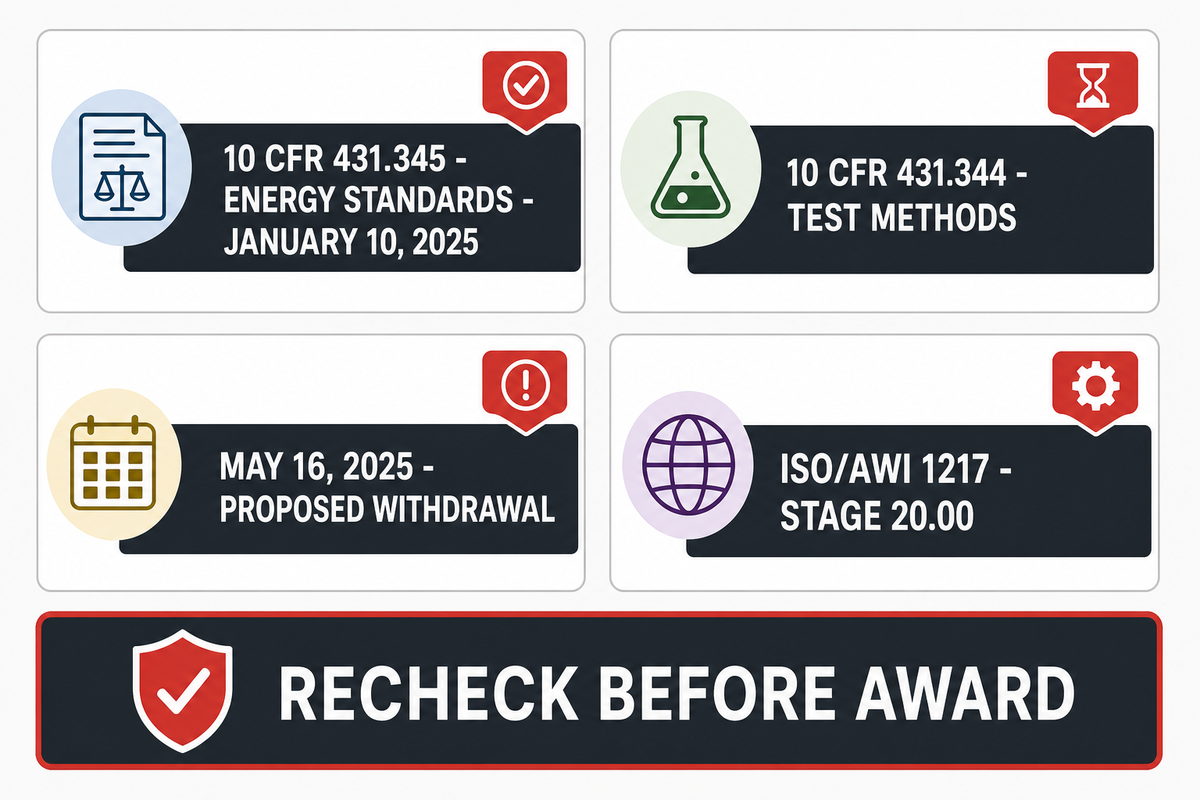
Industrial compressor procurement is moving toward explicit test basis, measured operating states, and documented regulatory scope. Buyers planning a 2026 project should record the standard edition and rule status in the bid file, then preserve the model’s flow, power, pressure, and control evidence instead of relying on an undated comparison chart.
DOE’s current product page says covered compressors manufactured starting on January 10, 2025 must meet the energy conservation standards in 10 CFR 431.345, while manufacturers must use the test methods in 10 CFR 431.344. The live 10 CFR Part 431 text limits those provisions to a defined subset of rotary equipment; it does not regulate this entire head-to-head category.
A May 16, 2025 Federal Register document proposes withdrawing the compressor coverage determination. It is a proposal, not a final withdrawal. Keep the current DOE page and the project’s compliance date in the purchasing record, and recheck status before award.
ISO currently lists ISO/AWI 1217 as an approved work item at stage 20.00 that will replace ISO 1217:2009. Until a replacement is published and adopted in the project specification, write the actual edition and amendment into the bid rather than saying “latest ISO.”
Frequently Asked Questions
Which is better, a reciprocating or a rotary screw compressor?
Neither is universally better.
Rotary screw equipment is usually shortlisted for steady, long-duration industrial air demand. Reciprocating equipment remains credible for intermittent, standby, lower-flow, pressure-led, or serviceability-led duty. Final choice follows pressure, flow, operating states, controls, storage, treatment, maintenance, availability, and model-specific evidence, not a category label. A sequenced mixed fleet may be the right answer when base load and peaks differ sharply.
What are the downsides of rotary screw compressors?
Poor sizing and control can erase the expected benefit.
A rotary screw package can carry a higher purchase price, require fluid and separator management, and need specialist airend or control service. At steady demand, variable-speed drive losses may not pay back. At low utilization, unloaded running, moisture management, and off-design pressure can weaken the case. Check the actual control curve, service scope, and measured plant profile.
What is the main difference between a reciprocating and rotary screw air compressor?
A reciprocating compressor compresses successive piston volumes, while a rotary screw compressor uses rotating screw elements to deliver smoother flow under the rated pressure and control conditions.
That mechanical difference affects pulsation, cycling, vibration, pressure range, cooling, and service tasks. It does not by itself determine delivered-air purity or electricity cost. Those results depend on the complete package, pressure ratio, control method, receiver, treatment, distribution, ambient condition, and time spent loaded, unloaded, stopped, or at variable speed.
Can a reciprocating compressor run continuously?
Only when the model is rated for it.
Verify pressure, flow, cooling, ambient condition, starts per hour, run time, recovery time, and the written thermal rating.
Is a rotary screw compressor always more energy-efficient?
No; energy performance depends on operating state, delivered flow, required pressure, control method, treatment losses, storage behavior, annual tariff, and time spent loaded, unloaded, or stopped.
Compare measured loaded and unloaded power, stopped time, delivered flow, pressure, motor efficiency, tariff, control curve, storage, treatment losses, and demand profile. A start/stop reciprocating unit can beat an under-loaded screw package; a rotary screw package can win at sustained demand.
Do I need an oil-free compressor?
Start with the required purity and measurement point.
Specify the ISO 8573-1 class, location, treatment train, and acceptance method. Compressor type alone does not prove point-of-use purity.
Send PanGeng a measured duty sheet
Provide pressure, flow, operating-state logs, ambient conditions, air-quality requirement, controls, storage, power supply, and standby plan. Ask PanGeng to review rotary screw, reciprocating, and mixed-architecture options against the same plant evidence.
Related PanGeng resources
References & Sources
- Compressed Air Systems — U.S. Department of Energy
- Compressors Visual Encyclopedia — University of Michigan
- ISO 1217:2009 — International Organization for Standardization
- Applying Variable Speed Compressors in Multiple Applications — Air Best Practices
- MEASUR Compressor Operating Cost Calculator — Oak Ridge National Laboratory
- Air System Pressure Influences Compressor Power — Air Best Practices
- Compressed-air system energy-efficiency research — Energy Efficiency journal
- ISO 8573-1:2010 — International Organization for Standardization
- Energy Efficiency Reference Guide: Compressed Air — Natural Resources Canada
- Commercial and Industrial Air Compressors — U.S. Department of Energy
- 10 CFR Part 431 — Electronic Code of Federal Regulations
- Proposed Withdrawal of Compressor Coverage Determination — U.S. Department of Energy
- ISO/AWI 1217 work item — International Organization for Standardization



![Low Pressure Hydrogen Compressor Applications [Guide]](https://pgcompress.com/wp-content/uploads/2026/09/low-pressure-hydrogen-compressor-applications-blog-featured-150x150.png)