Get in Touch with Pangeng


Quick Specs: information to send with a hydrogen compression inquiry
- Pressure basis: 200, 350, or 700 bar. Specify delivery, storage, or vehicle location. Identify bar (a) or bar (g).
- Supply envelope: Specify minimum and maximum pressure, temperature, and composition of gas.
- Guaranteed output: Specify net flow of hydrogen in kg/h at the agreed discharge conditions.
- Operation: Continuous process. Operating pattern: Storage replenishment or back-to-back vehicle fill.
- Information: Package power. Evidence: Gas quality and purity. Cooling. Package performance. Acceptance limits.
High pressure hydrogen compressor selection begins with a duty envelope. Buyers asking for “700 bar, 30 kg/h” have identified two useful numbers, but the quotation still needs a supply-pressure range, a delivery boundary and an operating cycle. The offered package may achieve the pressure but not the quantity if the source is depleted or if cooling becomes the limiting factor.
This guide compares the decisions behind 200, 350 and 700 bar projects. It covers hydrogen applications using gaseous H2; industrial applications and vehicle stations require separate duty descriptions. A pressure-boundary worksheet and a two-corner performance request are included.
High pressure hydrogen compressor selection requires defined inlet and delivery conditions. The 350 or 700 bar vehicle class is not a compressor discharge specification. Compare guaranteed net flow, measured package power and gas quality across the operating envelope.
Key decisions
- Separate the headline pressure from the operating and rated pressure.
- Check the supplier’s low-suction capacity and other operating limits.
- Consider fuel quality, cooling, storage, dispensing and other process limits.
- Consider electrical consumption of the packages only after limitations of the application are satisfied.
Updated September 2026. Public references used below. Examples don’t represent guarantees, warranties or test results for PG Compressor products.
High pressure hydrogen compressor selection: start with pressure boundaries
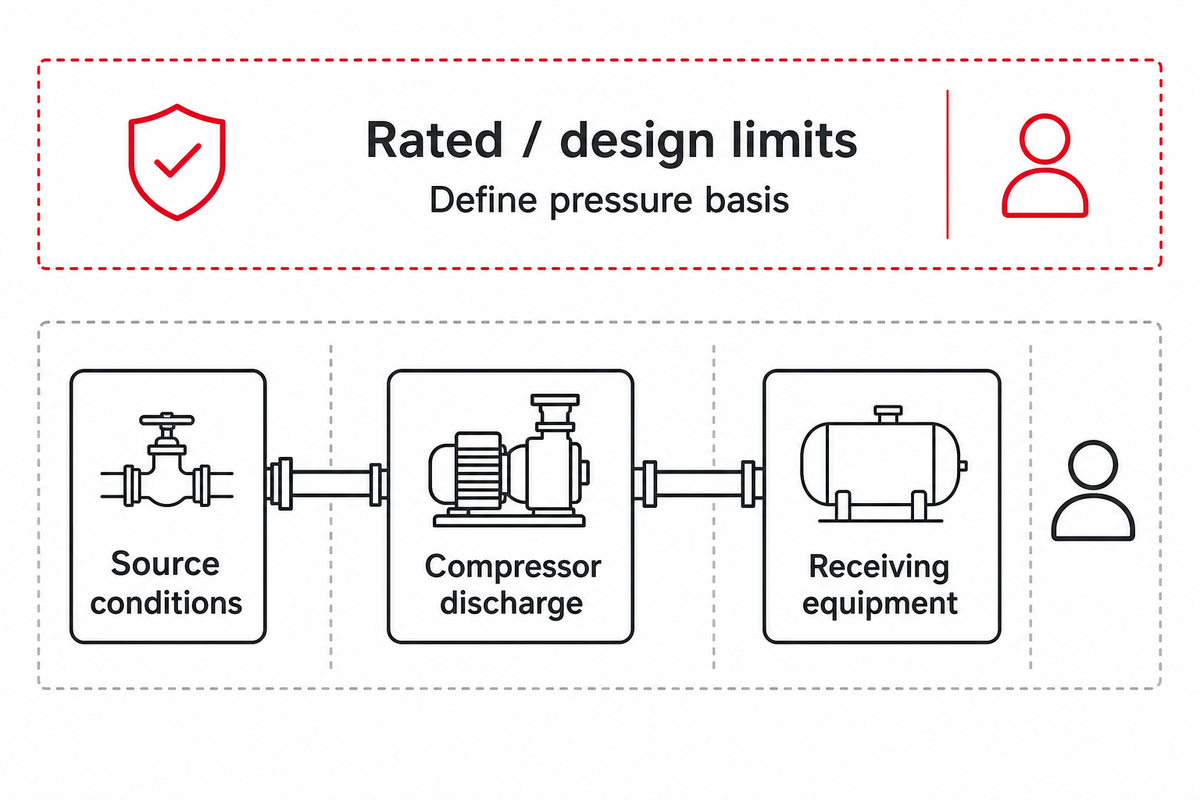
High pressure hydrogen compressor selection requires identification of the physical limits of the system, and determination of the supply connection and compressor discharge. These must be stated with their gauge or absolute pressure basis. Include the rating of the downstream equipment. For each of these, identify the pressure limits and measurement basis. Define the guaranteed flow at its delivery pressure and temperature. Indicate the operating point of interest to the equipment supplier.
The U.S. Department of Energy’s storage overview describes 350–700 bar as high-pressure tank storage. Its separate compression explanation defines inlet-to-outlet pressure ratio and mass throughput. Those descriptions address different parts of the system. Define the compression process as part of the project specification, with a named inlet, outlet and receiving connection.
4-Boundary Pressure Sheet
The 4-Boundary Pressure Sheet defines the pressure limits and responsible owner for each element of the process.
| Item | Example inquiry entry | Who must confirm it |
|---|---|---|
| Delivery boundary | Process-user inlet: 200 bar(g) | Process owner |
| Source pressure range | 20–70 bar(g) at compressor suction | Hydrogen supply owner |
| Source temperature | 30°C normal; 40°C maximum for the inquiry | Supply and process teams |
| Net delivery requirement | 20 kg/h at the process-user boundary | Process owner and supplier |
| Compressor operating discharge | To be calculated from the receiving requirement and defined losses | Package supplier and integrator |
| Receiving-equipment pressure envelope | Document operating range and permitted limits separately | Receiving-equipment owner |
| Package rated/design limits | Model documents required; not inferred from 200 bar(g) | Package supplier |
| Protection and shutdown basis | Documented setpoints and cause-and-effect responsibilities | Responsible engineering team |
| Pressure measurement basis | Operating entries marked bar(g); calculations use bar(a) | All parties |
| Acceptance location | Measured net hydrogen delivered at the agreed outlet boundary | Buyer and supplier |
This completed example leaves the discharge calculation with the responsible designer. It does not add an arbitrary pressure margin. For a broader starting point, use the hydrogen gas compressor selection guide, then bring the defined envelope into the pressure-specific quotation.
200 bar hydrogen compression: specify the delivery endpoint
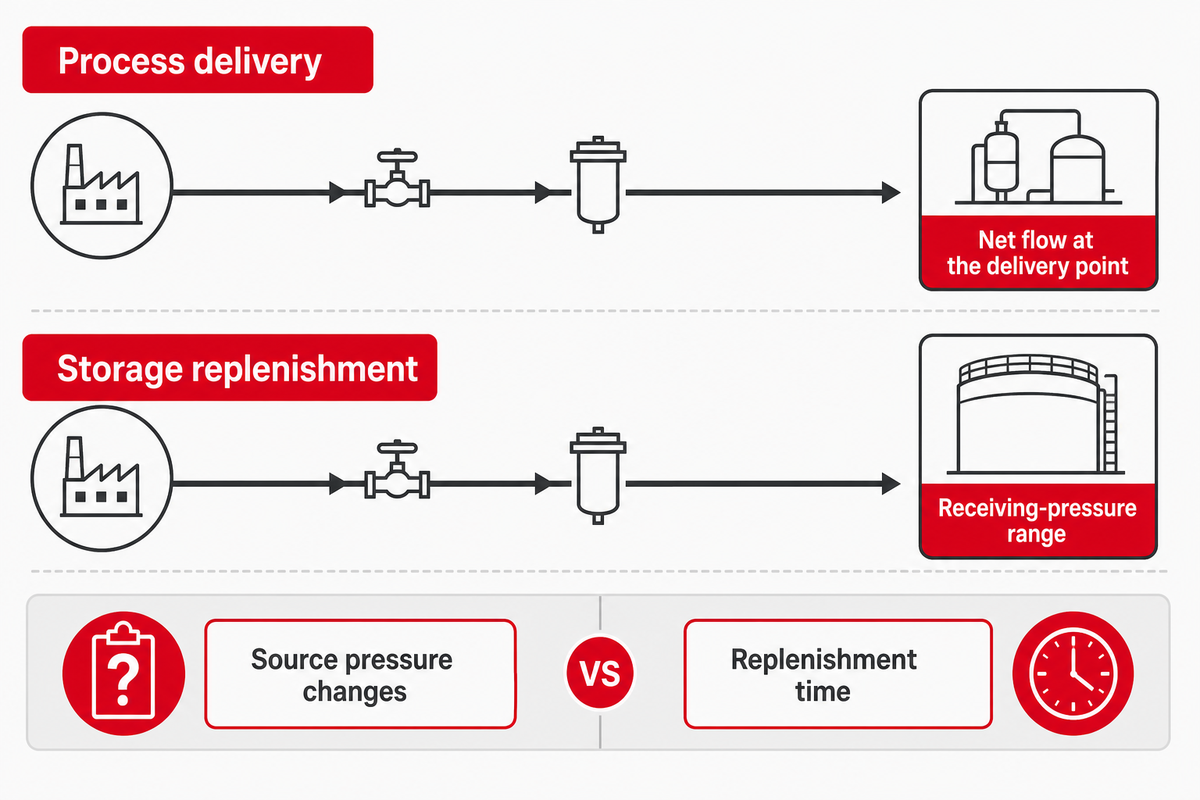
A 200 bar hydrogen compression inquiry should say where 200 bar is required and how much gas must arrive there. Process delivery and cylinder filling may require different pressure and other system constraints even if the overall system pressure is the same. The guarantee needs to define the conditions of the source, the pressure and net flow at the delivery point.
Consider a continuous process consuming 20 kg/h. If the supply falls from 70 to 20 bar(g), the supplier needs to demonstrate that the offered package still meets the agreed flow at the final receiving condition. Quoting only the fuller source can leave the process short of hydrogen late in the supply cycle.
For process delivery, the source profile belongs in the acceptance criteria because a falling inlet pressure can leave the buyer short of the required flow. H2Tools explains that tube-trailer, pipeline and liquid-tank supply pressures are often below use pressure; it also calls for monitoring wear and failure that can cause hydrogen leakage. Request evidence for the offered package and its interfaces, including the qualified test conditions and the operating exclusions.
When ordering hydrogen for storage, the receiving-pressure range and replenishment time should be specified, especially when peak flow rate is the only information provided. For storage conditions, hydrogen compression may need to work under varying inlet and outlet conditions which the engineer will define; procurement must obtain the guarantee and its limitations.
The pressure sheet is useful to define the interface between various parties in a supply chain (e.g. contractors for hydrogen storage and transportation, compression and processing). Agreeing on a handover point before selecting equipment allows interface disputes to be kept to a minimum.
350 bar hydrogen compression: separate H35 fueling from process duty
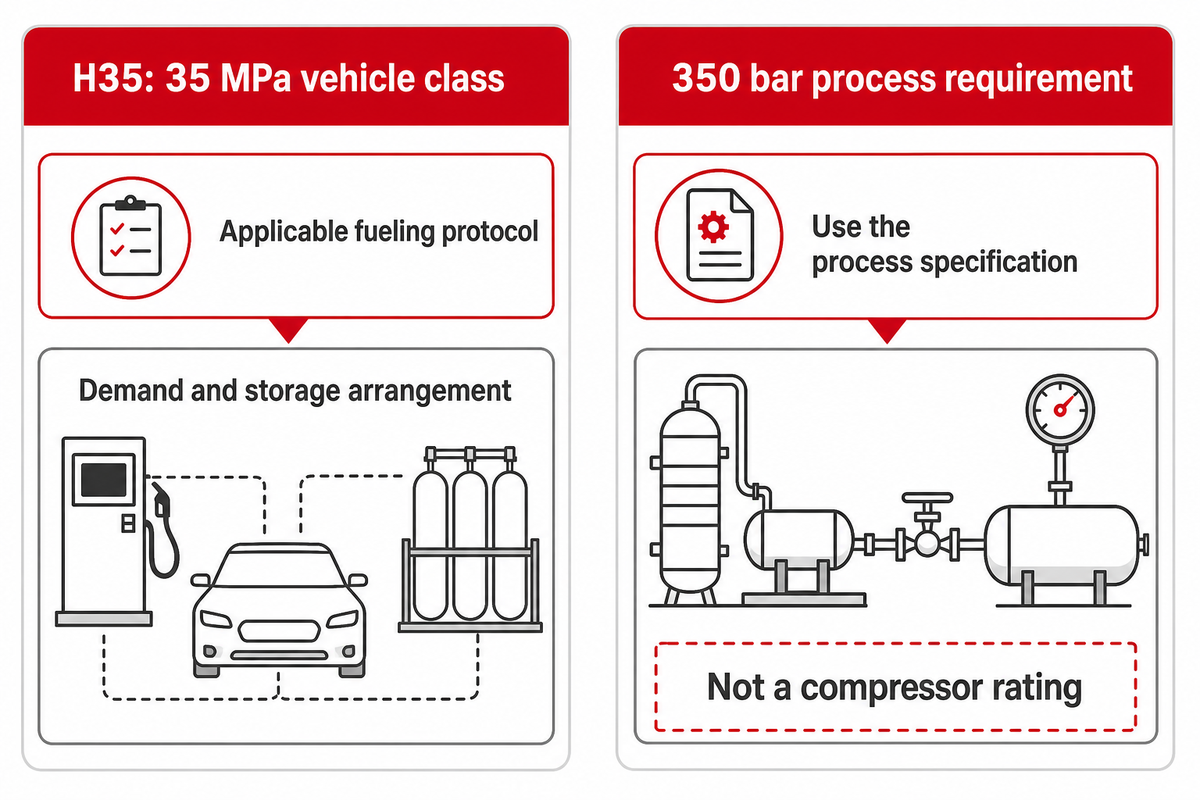
A 350 bar process requirement and an H35 vehicle-fueling project are different specifications. H35 refers to the 35 MPa vehicle-fueling pressure class within the applicable fueling protocol. The compressor and storage arrangement must support that protocol and its demand profile. They cannot be selected from the H35 label alone.
The H2Tools description of SAE J2601 maps 35 MPa to H35 and 70 MPa to H70. It also explains that fueling limits depend on conditions such as fuel-delivery temperature, ambient temperature and initial vehicle-tank pressure. You should determine the edition and protocol version applicable to the vehicle in question.
Your depot’s daily hydrogen demand informs planning but doesn’t determine the peak support requirement. Explain to the integrator the expected fill schedule, and the available system and on-site storage and cooling. Ask the integrator to demonstrate how the compressor replenishes storage between fills at minimum inlet pressure, including the controls that maintain the required system conditions.
Consecutive fills can expose a replenishment delay because the daily total does not describe when vehicles arrive. For the depot inquiry, ask the integrator to document the storage-recovery calculation, the limiting source conditions and acceptance criteria for the proposed schedule. NLR’s integrated testing facility separates storage, compression and dispensing, illustrating why the interfaces need their own evidence. A qualified compressor package still needs a system-level duty review.
For a chemical industry process operating at 350 bar, use the process specification directly. The terminology used in vehicle fueling adds little to no value unless the process includes a fuel dispenser. Hydrogen pressure and hydrogen flow are defined at the receipt boundary. As discussed in the next section, a 700 bar hydrogen compressor inquiry for H70 fueling must describe the station pressure system.
700 bar hydrogen compressor: size the station pressure system
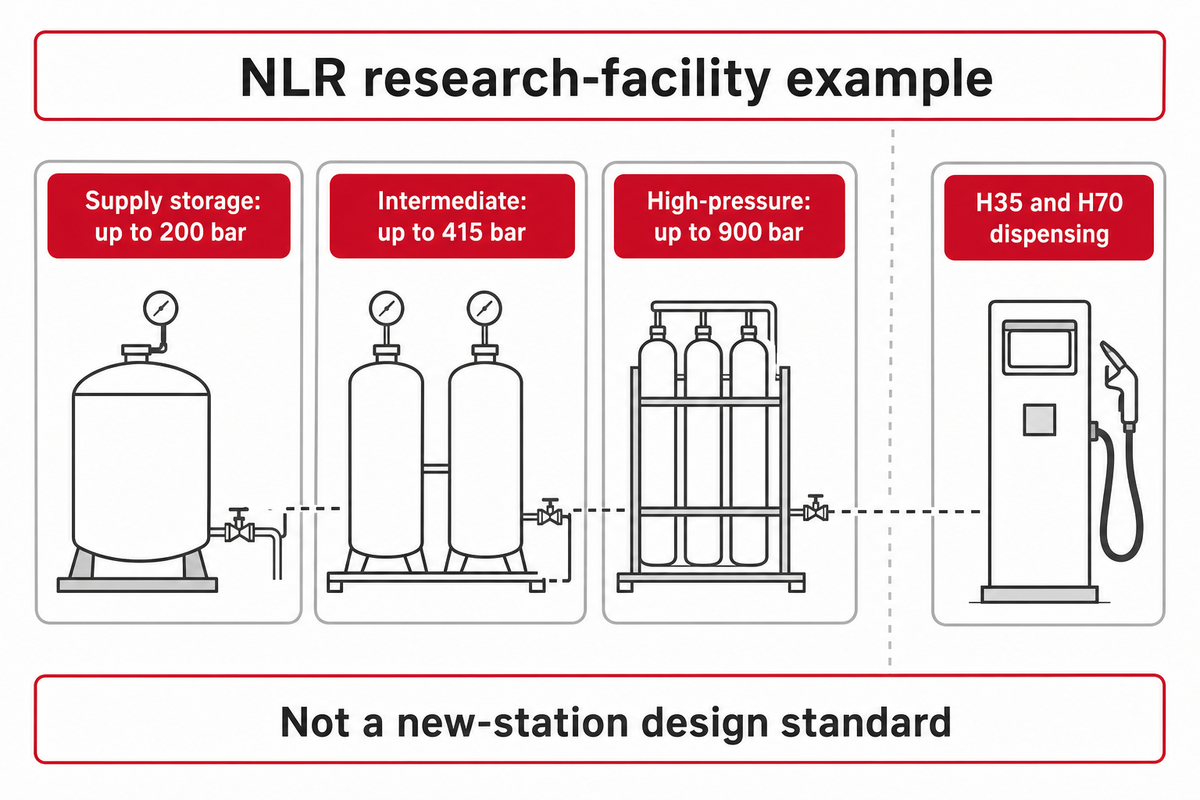
A pressure system for a 700 bar hydrogen compressor (H70 fueling) requires specification of supply conditions and storage bank boundaries, description of duty and dispensing requirements, and provision for cooling. The 700 bar vehicle class doesn’t establish a universal compressor discharge pressure, storage setting or permissible equipment rating for every station.
A good example comes from NLR’s Hydrogen Infrastructure Testing and Research Facility. Its published description separates storage up to 200 bar, intermediate storage up to 415 bar and high-pressure storage up to 900 bar, while describing H35 and H70 dispensing. All this information describes capabilities of this research facility, and isn’t a design standard for a new station.
The case indicates that an integrated specification is required to define limits and interfaces for hydrogen refueling.
Have the station designer explain the discharge requirements for the proposed architecture. Have the package supplier assess pressure, net flow, control response and mechanical limits, given those requirements. Use the provided 700 bar hydrogen compressor reference for station context; this selection form is requesting evidence for the quotation.
It can’t be assumed that a natural gas package, or a high-pressure air compressor, is qualified for hydrogen service. Evaluate the gas path, material selection and pressure testing documents for the offered hydrogen service condition.
Size hydrogen compression at the minimum suction pressure
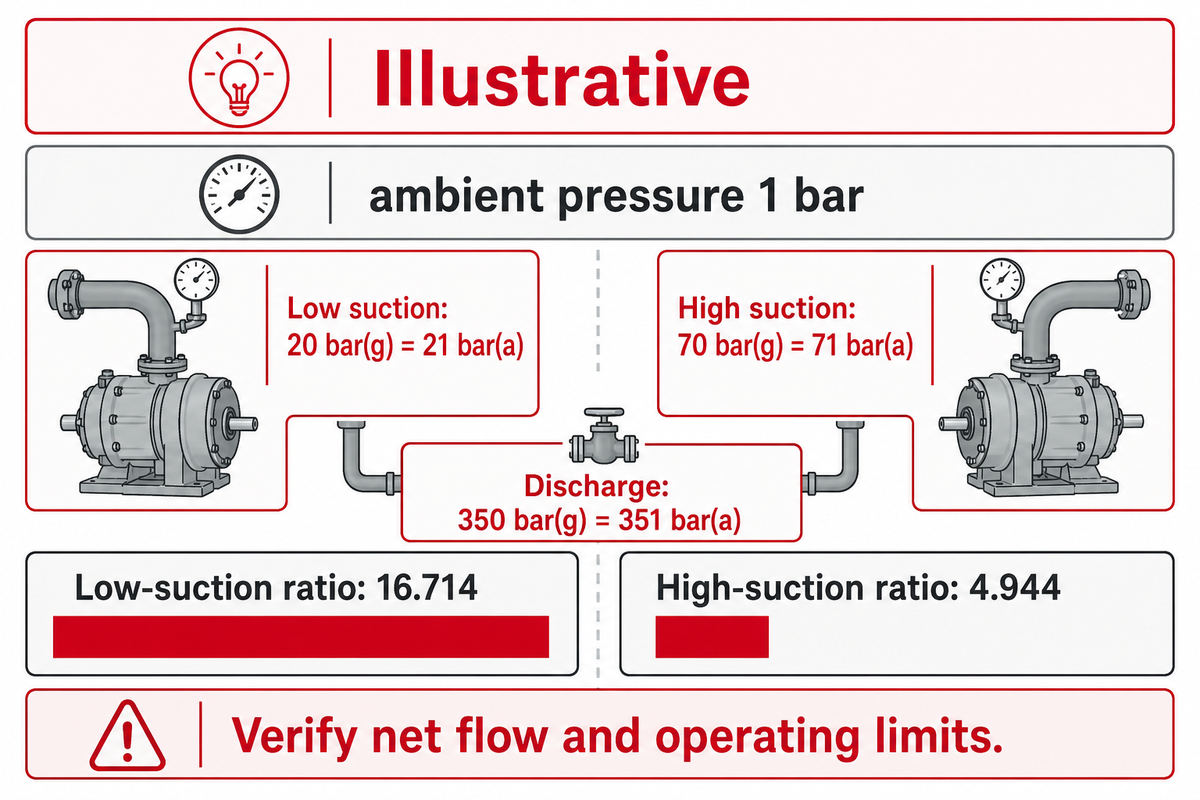
Verify the operating limits and guaranteed net flow across the range of hydrogen supply pressure, and other design constraints at the limiting duty points.
What role does the inlet pressure play in hydrogen compression?
Gas inlet pressure determines the pressure ratio and hydrogen’s inlet density, and therefore the operating condition of the compressor. For design limits and optimal performance, the supplier must disclose net delivery and package limits across source conditions, including the end of the service cycle.
In a 2024 diaphragm-compressor modeling study by Zhao and colleagues, increasing suction pressure was shown to increase throughput and total machine power while reducing unit power consumption. This suggests why procurement should check throughput and limits at more than one operating point. This isn’t a performance curve of a PG model. Also, this isn’t a comparison at constant mass flow rate across suction conditions.
2-Corner Duty Envelope
Our 2-Corner Duty Envelope asks for low-suction delivery proof and high-suction limit checks, plus any other limiting points the supplier identifies.
| Inquiry point | Low-suction corner | High-suction corner |
|---|---|---|
| Suction pressure | 20 bar(g) = 21 bar(a) | 70 bar(g) = 71 bar(a) |
| Discharge pressure | 350 bar(g) = 351 bar(a) | 350 bar(g) = 351 bar(a) |
| Overall compression ratio | 351 ÷ 21 = 16.714 | 351 ÷ 71 = 4.944 |
| Capacity evidence | Guaranteed net kg/h at stated inlet temperature | Delivered flow under the offered capacity control |
| Limit evidence | Temperature, loading and control checks | Power, loading and control checks |
A pressure value used in a compression-ratio calculation is to be interpreted as absolute pressure. The table doesn’t define the allowable stage ratio, size of the driving motor, or the stage count. A lower overall ratio doesn’t guarantee the total machine power is less.
Stable flow, recycle or unloading behavior, starts per cycle, and the flow assurance boundary are requested. For a pipeline supplying a packaged compressor, its pressure and availability envelope is to be provided alongside the drive-system specification. Normal conditions, pressure, and the composition of the working gas are to be provided if flow is provided in Nm3/h. A stated conversion to kg/h is to be provided, with a performance case at increased demand if the project will increase hydrogen delivery.
Choose a diaphragm hydrogen compressor or reciprocating piston package
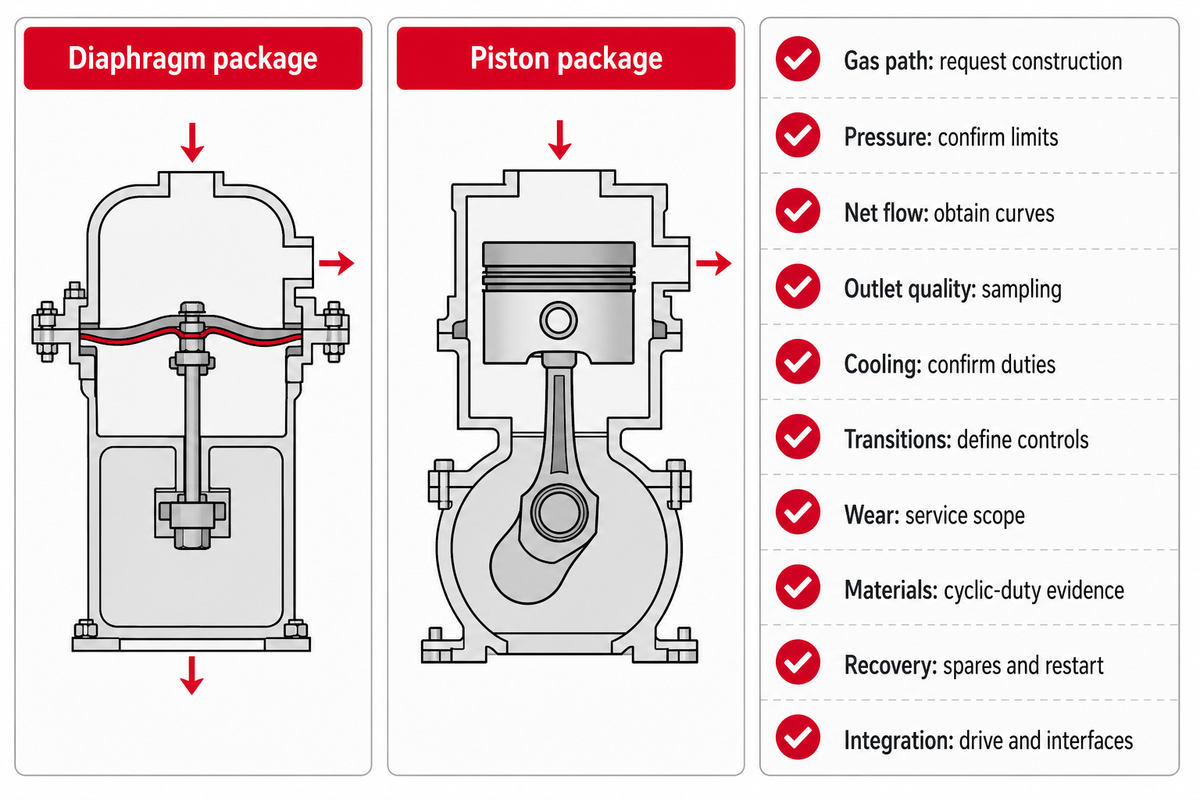
Review a diaphragm hydrogen compressor and a reciprocating piston package under comparable pressure, flow, and operating conditions. Both are reciprocating positive-displacement machines. Differences exist in the construction of the gas path, control, and maintenance needs. Compressors are designed for specific duties, and to evaluate suitability, one must consider the evidence regarding the construction and performance of compressors. The family name may be used to frame questions. However, to answer these questions, the evidence must demonstrate the required capacity of the offered machine, the quality of the process gas, and the suitability of the offered machine for the required duty.
According to the DOE report on reciprocating compression, a piston changes the cylinder volume as it moves. The diaphragm changes the gas chamber volume as its flexible membrane moves. Other than the differences in the means of volume changes, the moving elements reciprocate. With regard to the compressors used for the offered duty, one should inquire about the type of seal employed and its maintenance requirements.
“The discharge pressure produced by the electrolyzer determines the suction pressure for the compression system.”
Ben Williams, Ariel Corporation, technical paper originally presented at the 2023 EFRC Conference
Within the hydrogen economy, Williams also discusses the duty to be performed and the gas path, and describes the use of lubricated and non-lubricated cylinders. His discussion of compressor gas paths prompts questions about maintenance requirements, with the actual gas path evaluated for duty suitability. It doesn’t support the use of another vendor’s compressor, or establish a preventive maintenance schedule.
| Selection criterion | Diaphragm package | Reciprocating piston package | Hold the decision when |
|---|---|---|---|
| Gas-path construction | Request diaphragm, head and leak-detection details | Request cylinder, ring, packing and lubrication details | The offered arrangement is not identified |
| Pressure envelope | Confirm model inlet and discharge limits | Confirm model inlet and discharge limits | Only a headline maximum is supplied |
| Net flow rate | Obtain delivery curves across suction conditions | Obtain delivery curves across suction conditions | The guarantee covers only one favorable point |
| Quality boundary | Verify outlet quality and sampling plan | Verify outlet quality and sampling plan | “Oil-free” substitutes for analysis |
| Cooling interface | Confirm head, gas and hydraulic cooling duties | Confirm gas and package cooling duties | Available utilities are not matched to the package |
| Pressure transitions | Ask how storage switching is controlled | Ask how load changes and pressure transitions are controlled | Only steady operation is demonstrated |
| Wear and maintenance | Request diaphragm and valve service scope | Request ring, packing and valve service scope | Wear-life claims omit the duty and supporting record |
| Material compatibility | Request gas-wetted materials and cyclic-duty evidence | Request gas-wetted materials and cyclic-duty evidence | A generic alloy list is the only evidence |
| Recovery and support | Confirm spares, repair time and restart checks | Confirm spares, repair time and restart checks | Downtime responsibilities are undefined |
| Package integration | Define drive, controls and downstream interfaces | Define drive, controls and downstream interfaces | Component ratings are treated as a complete package guarantee |
To evaluate offered options and request model-specific evidence, see diaphragm hydrogen compressor or reciprocating hydrogen compressor options.
Other hydrogen technologies, such as hydraulic boosters and combinations of stages, or a non-mechanical approach, may also be considered. The 2026 report evaluates mechanical and electrochemical technologies, as well as metal hydride and hybrid hydrogen compression technology. Its technology landscape may be used for screening purposes. Electricity alone can’t evaluate the total energy required by a heat-driven system.
The Department of Energy describes an electrochemical hydrogen compressor as using membranes, electrodes and an external power supply. This working principle differs from moving a piston or diaphragm. For that option, request an offered-system energy boundary and duty evidence; a technology description does not establish the capacity or delivery guarantee of a commercial package.
ISO 14687: confirm gas quality at the agreed boundary
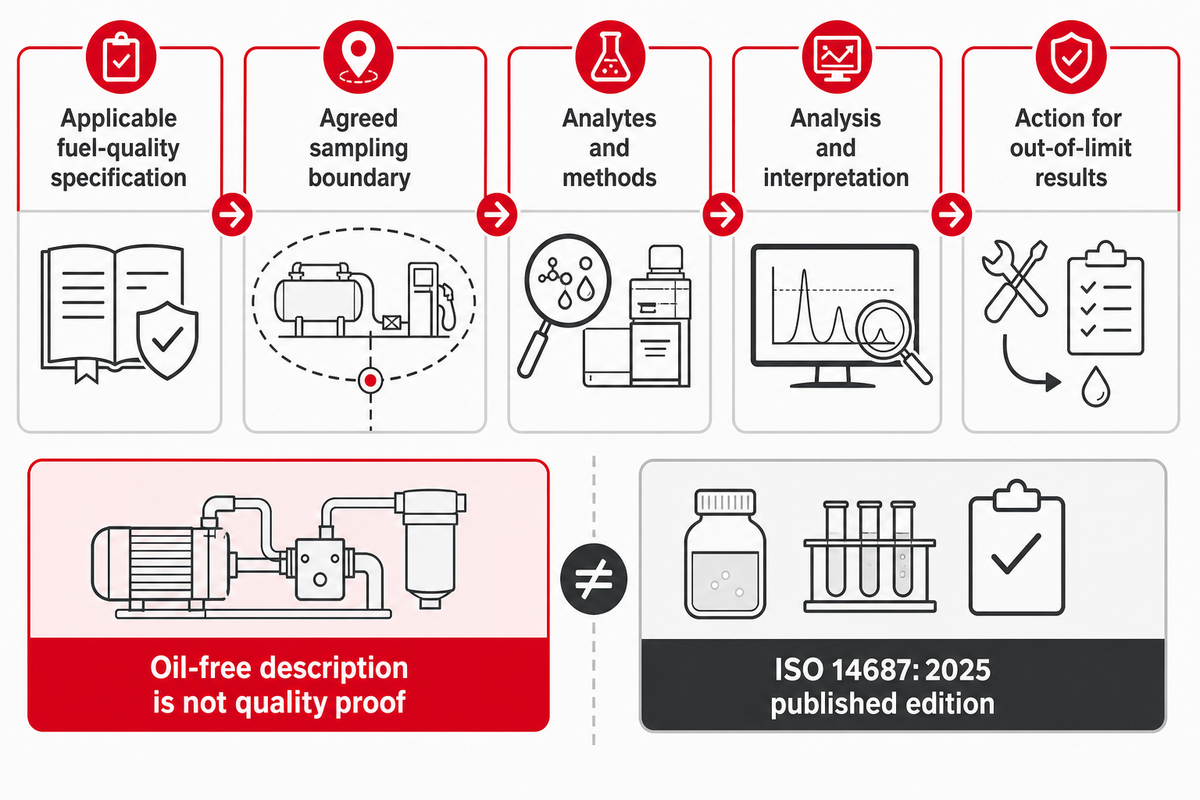
Confirm hydrogen fuel quality at the specified sampling boundary. A description of an oil-free design doesn’t prove fuel quality. Define the fuel quality specification, analytes and methods. Identify the organization and personnel responsible for sampling, analysis and interpretation of results. Take action if results fall outside limits.
The official ISO catalog identifies ISO 14687:2025 as the published second edition of the hydrogen fuel-quality product specification. The catalog lists the 2019 edition as withdrawn and a future revision under development. A developing revision is not a published contract requirement.
2026 procurement outlook: make the fuel-quality edition explicit
For the 2026 inquiry, request the applicable published edition and application grade of the specification. Obtain the supplier’s justification for any deviations. Limits on contaminants in fuel quality should be based on limits specified in the applicable standard rather than a generic fuel purity specification. Evidence to support a general statement regarding purity of hydrogen fuel is to be evaluated based on the documentation provided for the product and service offered.
Locate the complete gas path for fuel cell vehicles. The risk of oil contamination is one concern; a host of other problems including impurities and moisture in the feed, and the materials and services used, require quality assurance. Determine exactly where the sample for the hydrogen gas analysis is taken and assess the scope of the analysis with respect to the sampling location and the guaranteed delivery point.
Require materials documentation showing how the offered equipment addresses the risks associated with hydrogen embrittlement and pressure cycling. The absence of identified components, service conditions and supporting evidence leaves claims such as “alloy steel” or “hydrogen compatible” open to engineering judgment. Where the material in question is to be used in a high pressure system, the responsible engineering team should review the evidence relating to the material and pressure cycling in high-pressure systems, as well as the means adopted to control and protect the equipment, to assess documented safety risks for the offered service conditions.
Hydrogen compressor systems: find the bottleneck
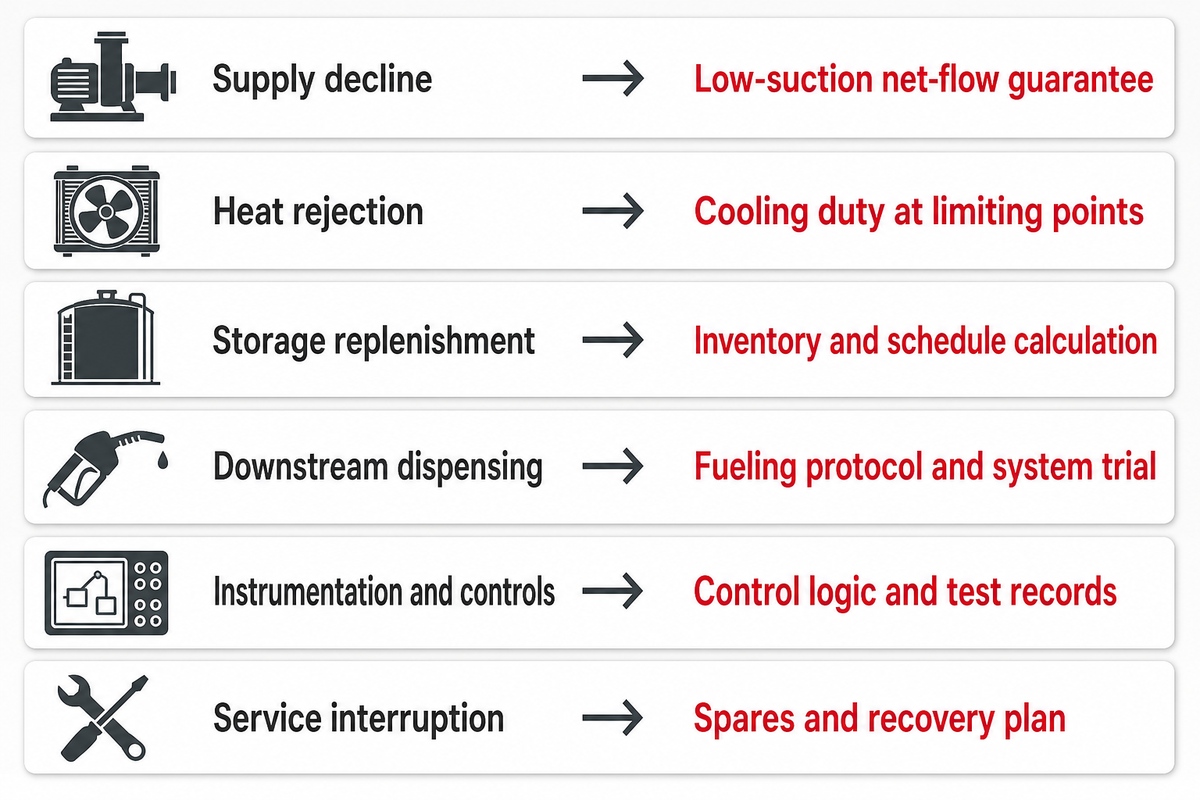
Hydrogen compressor systems rely on integrated supply, compression, cooling, storage and downstream equipment. Ascertain which element causes an inability to meet duty cycle requirements. Nominal compressor flow doesn’t guarantee that the system can satisfy the station’s duty requirements. Interface evidence and a system trial should address whether the system is able to fulfill the required function.
What are the main components of a hydrogen compression system?
The quotation should state who is responsible for connecting the gas supply to the system, driving it, cooling it, and controlling and protecting it. In addition, the quotation should identify who is responsible for storing the gas and supplying it to the customer. The service provider’s quoted scope should identify who will connect all of the aforementioned equipment. Each responsible party should provide evidence for its equipment and identify the utilities and operating data needed to connect the package and demonstrate the offered performance.
| Potential constraint | What the buyer experiences | Evidence to request | Lead owner |
|---|---|---|---|
| Supply-pressure decline | Output drops late in the supply cycle | Source profile and low-suction net-flow guarantee | Process engineering |
| Heat rejection | The intended sustained duty is unavailable | Cooling duty and utility conditions at limiting points | Utilities and package supplier |
| Storage replenishment | A second demand peak arrives before recovery | Inventory and replenishment calculation for the actual schedule | Station integrator |
| Downstream dispensing | Compressor output does not translate into completed fills | Applicable fueling protocol and system trial | Dispenser supplier |
| Instrumentation and controls | Unclear readings or unresolved trips interrupt delivery | Hydrogen-service instruments, control logic and test records | Controls engineering |
| Service interruption | Required annual delivery is missed despite adequate running capacity | Repair-time assumptions, spares and recovery plan | Maintenance and procurement |
NLR’s facility separates compressor maintenance and reliability data, gas quality data and energy data. Thus, measured compressor data can be used to assess actual process performance, as opposed to relying on claims such as “high efficiency” or “superior cooling.” Obtain an understanding from the supplier on the meaning of cooling efficiency and the utility conditions that contribute to process cooling. Assess operational efficiency through delivered process output and actual process conditions weighted by the operating schedule. After component failure, determine replacement-part responsibility and the checks required before returning the component to service, with a recovery plan to minimize interruption.
A 2018 engineering-forum report describes repeated nozzle failures and vibration in hydrogen service. This is a user report, not a validated root-cause study. It illustrates why maintenance should review package and piping responsibilities before purchase, rather than receive only a compressor datasheet.
Fluctuating flow and low hydrogen production pressure in large-scale centrifugal applications are also mentioned in the named Siemens Energy interview. The given example doesn’t justify a smaller model; rather it underscores the importance of selecting hydrogen compression applications based on the requirements of the inlet condition and the operation condition.
Hydrogen compressor cost: compare quotations on delivered flow
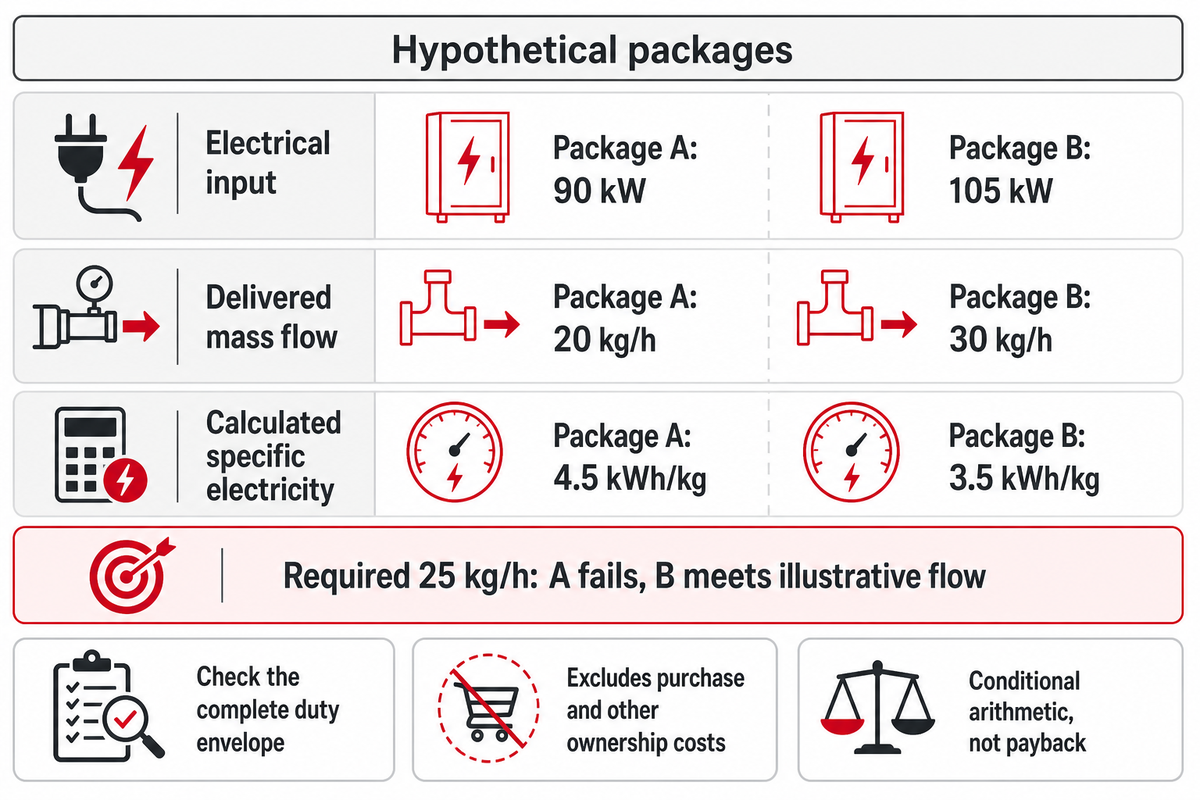
Establish that both quotes meet the same delivery envelope before comparing the total cost. Look at the purchase cost, ownership cost (operation and maintenance), downtime, and service and support. Any difference in the energy figure doesn’t determine the best package.
NLR’s testing facility collects compressor power and energy data separately from gas-quality and maintenance results. The example supports asking for measured operating data; it does not validate the hypothetical bids below.
| Comparison item | Illustrative bid A | Illustrative bid B |
|---|---|---|
| Measured package electrical input | 90 kW | 105 kW |
| Net delivered hydrogen | 20 kg/h | 30 kg/h |
| Conditional specific electricity | 90 ÷ 20 = 4.5 kWh/kg | 105 ÷ 30 = 3.5 kWh/kg |
| If required delivery is 25 kg/h | Fails this flow requirement | Meets the illustrative flow requirement |
| If required delivery is 20 kg/h | Check the full duty envelope | Request performance at the actual 20 kg/h duty |
| Annual arithmetic assumption | 24,000 kg delivered; electricity USD 0.10/kWh; illustrated specific electricity assumed representative of that delivery | |
| Conditional annual electricity | 24,000 × 4.5 = 108,000 kWh | 24,000 × 3.5 = 84,000 kWh |
| Conditional electricity cost | USD 10,800 | USD 8,400 |
| Excluded from the illustration | Purchase price, installation, demand charges, standby energy, thermal input, maintenance, gas losses and downtime costs | |
The conditional electricity difference is USD 2,400 per year. It isn’t a payback result because no purchase-price difference or complete cost of ownership has been supplied. It’s also not a prediction of bid B at reduced flow: its actual control and part-load performance must be demonstrated.
Measured power of packages should replace nameplate power of motors when evaluating energy efficiency. Auxiliaries should be included as agreed and net delivered gas should be stated after any loss or recycle treatment. For variable duty, operation should be analyzed and weighted to determine energy consumption. Claims of energy efficiency should define the system being compared. A claim of efficient compression should indicate the measured conditions of the specific operation being evaluated.
Finance should examine the effects of variations in the electric power tariff and the annual mass of product delivered. Wear and tear of components should be evaluated, along with the number and duration of expected shut-downs. Access for routine maintenance should be evaluated, as well as the ease with which the process may be restarted. To promote the availability of the process, critical spares, response responsibilities and repair assumptions should be defined. The scope of the system, including cooling and auxiliary loads, should be defined when the assessment of the process is made. An efficient compressor still needs to meet the specified duty requirements, while access for routine maintenance belongs in the assessment of operational costs.
Screen hydrogen compressor manufacturers with model-specific evidence
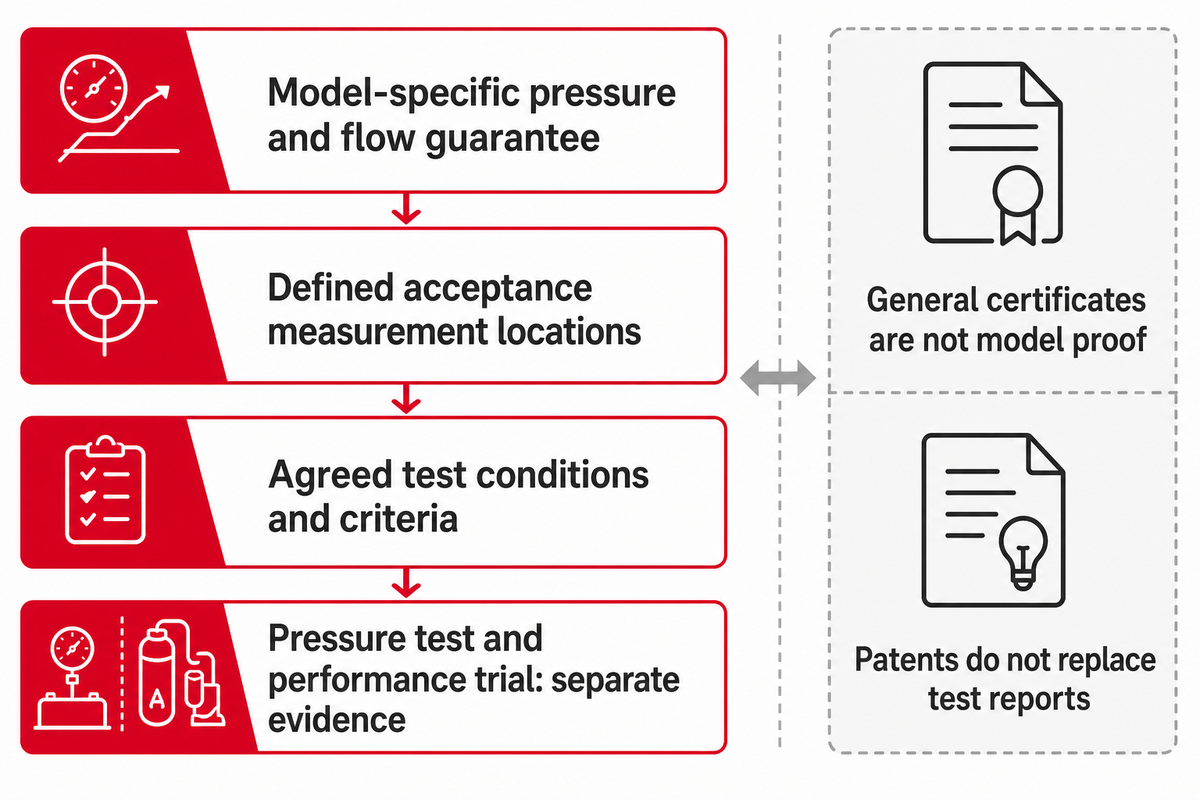
When documents don’t specify the offered pressure-and-flow guarantee, general certificates and patents shouldn’t substitute for model-specific evidence. Equipment should be specified and the conditions under which tests are to be conducted should be defined. The acceptance of the equipment should be defined with measurement locations and criteria agreed by buyer and supplier.
Compressor designs and advertised pressure needs vary across different applications. Ask for the gas-wetted bill of materials, pressure boundaries, performance map, quality-assurance plan and control test scope. Confirm that each document identifies the offered configuration rather than a related product family.
More recent patents illustrate design proposals. For instance, CN223215386U, published in August 2025, mentions protection of diaphragm stress during adjustment of storage pressure levels and lists Censtar as the assignee. PG inventions aren’t established by this patent specification. These design disclosures don’t replace test reports or guarantee a service life. Ask design-related questions to determine the contents of the offered equipment referred to in the technical specifications.
Confirm the performance criteria, the location of the instruments and how variances are handled for the acceptance trial. Pressure testing and hydrogen performance trials should be identified and explained separately, including test medium, purpose, conditions and permitted interpretation. Clarify expectations for system or component reliability, availability, or fault tolerance (e.g., uptime), considering the assumptions made for maintenance and failure recovery.
FAQ: High pressure hydrogen compressor selection
What type of compressor is used for compressing hydrogen gas?
Read the answer
Hydrogen gas can be compressed using several technologies. For many high-pressure duties, selection starts with reciprocating positive-displacement designs, including piston and diaphragm compressors. Centrifugal machines also serve suitable large industrial duties, while other compression solutions require their own application review. Choose from the actual pressure range, flow, gas quality and operating cycle. The family name is a starting point for comparison, not proof that a particular model meets the inquiry.
Which type of compressor is suitable for high pressure applications?
Read the answer
A suitable high-pressure package is one with documented limits and guaranteed delivery for the specified service. Piston compressors and diaphragm compressors are candidates for hydrogen, but their offered configuration must be checked. Verify inlet pressure, discharge conditions, net flow, temperature, material compatibility and controls together. A compressor advertised for higher pressures doesn’t automatically provide the required capacity or demonstrate suitability throughout a changing supply cycle.
How do I choose the right hydrogen compressor?
Read the answer
Start with the delivery boundary and write the source-pressure and temperature envelope. State the net hydrogen flow required at the final receiving condition, then describe continuous operation, storage replenishment or vehicle filling. Obtain supplier performance data at minimum suction and the other limiting points. Compare gas quality, utilities, maintenance and acceptance evidence before comparing price. This sequence makes the quotations comparable and exposes an incomplete guarantee before equipment is ordered.
Does hydrogen become liquid simply by reaching 700 bar?
Read the answer
No. A 700 bar gaseous-hydrogen storage label doesn’t mean liquid hydrogen. The Department of Energy distinguishes compressed gas storage from liquid storage, which requires cryogenic temperatures. Specify the gas and liquid service boundaries separately.
What evidence should accompany a high pressure hydrogen compressor quotation?
Read the answer
Request a model-specific duty sheet, performance map, measured or guaranteed package electrical input, gas-path description, material and pressure-boundary documentation, cooling requirements and quality-assurance plan. The documents should identify the same offered configuration and the same inlet, discharge, temperature and delivery boundaries. Ask for control behavior during source decline, storage switching, unloading and restart, including any operating exclusions. Include wear-part responsibilities, spares, service access and the assumptions behind availability claims. Finally, agree on an acceptance plan that identifies test medium, instruments, measurement locations and the criteria for net delivered flow and gas quality. A general brochure can introduce the equipment, but it can’t resolve differences between the tested model and the package in the quotation.
Send PG Compressor a verified duty envelope
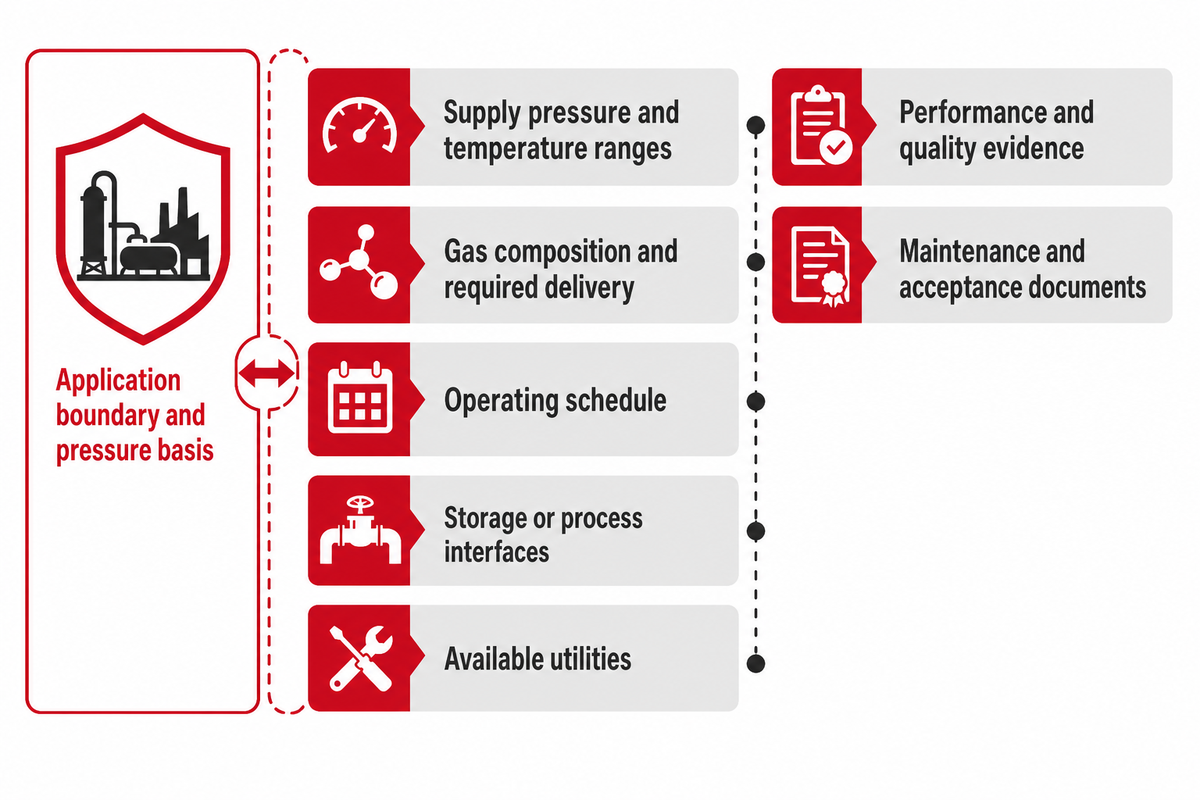
A boundary pressure sheet and information about the operating cycle should be submitted with a request for a hydrogen compressor. PG should propose a solution to meet the requirements, and provide evidence to support the solution.
Include these items in your request
- Named 200, 350 or 700 bar application boundary and pressure basis
- Supply-pressure and temperature ranges, gas composition and required delivery
- Operating schedule, storage or process interfaces and available utilities
- Requested performance, quality, maintenance and acceptance documents
This document provides a procurement reference guide based on public sources. The forms and bid estimates are examples. The responsible engineering team should define the compressor design, site constraints and acceptance limits in the contract documents.
References & Sources
- Compressor best practices H2Tools.
- Reciprocating Compressors and the Hydrogen Economy Ben Williams, Ariel Corporation; manufacturer-authored technical paper.
- Hydrogen compressor snubber-vessel nozzle report Eng-Tips; anecdotal user report, not validated root-cause evidence.
- Hydrogen Storage U.S. Department of Energy.
- Gaseous Hydrogen Compression U.S. Department of Energy.
- SAE J2601 scope description H2Tools.
- Hydrogen Infrastructure Testing and Research Facility NLR; installation-specific case.
- ISO 14687:2025 official catalog International Organization for Standardization.
- Thermodynamics and dynamic investigation of ultra-high-pressure diaphragm compressor Zhao et al., 2024; original modeling research.
- Hydrogen Compression Choices for Tomorrow’s Refueling Stations Letsios et al., 2026; academic review.
- CN223215386U patent publication design disclosure and bibliographic record, not a PG product qualification.
- Hydrogen compression challenges and demonstration interview Turbomachinery International, September 2025; named Siemens Energy interview.


![Low Pressure Hydrogen Compressor Applications [Guide]](https://pgcompress.com/wp-content/uploads/2026/09/low-pressure-hydrogen-compressor-applications-blog-featured-150x150.png)